AI learning for beginners in 2026 does not require a PhD, years of programming, or advanced mathematics. What it does require is a structured roadmap and the discipline to follow it in order, and that is exactly what this guide gives you.
The accessibility is real, but so is the noise. Most people who try to learn AI from scratch jump between random tutorials, collecting tools without seeing how the pieces connect, and burn out before they make progress. This guide replaces that with a six-step path, from understanding what AI actually is to building practical Generative AI skills, in the sequence that builds on itself.
How to learn AI from scratch: the six-step roadmap
Learn AI in order, not in fragments. Each step below earns the next, which is exactly what scattered tutorials fail to do. The demand is worth the effort: the World Economic Forum’s Future of Jobs Report 2025 found that 86% of employers expect AI to transform their business by 2030, with AI and machine learning specialists among the fastest-growing roles.
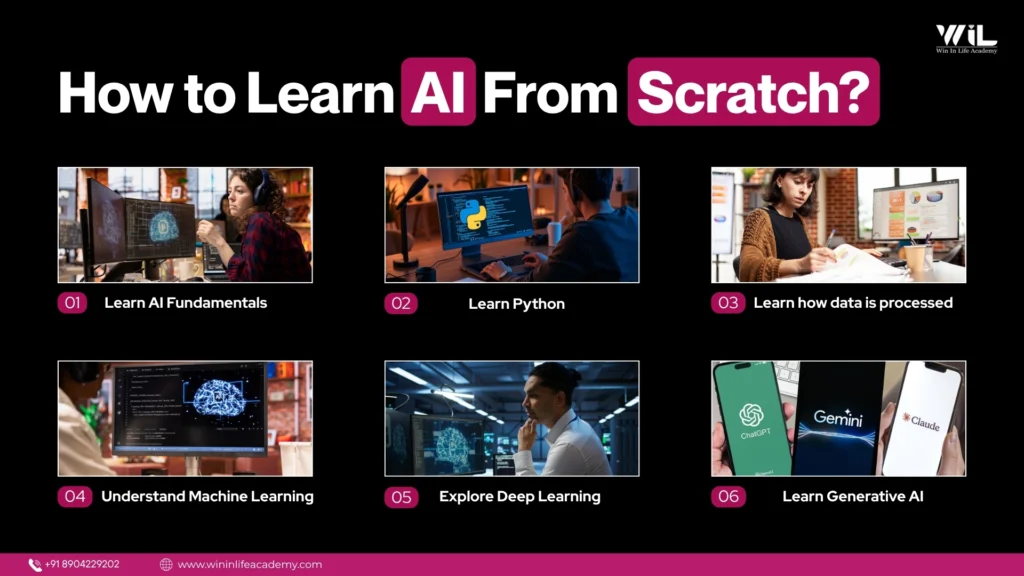
The six steps below form a complete beginner AI roadmap. Follow them as an ordered AI learning path and the field stops feeling overwhelming.
Step 1: Learn the fundamentals
Understand what AI is before you write a single line of code. The first principle of AI learning for beginners is that concepts come before tools, because rushing into tools without grasping the ideas behind them guarantees confusion later.
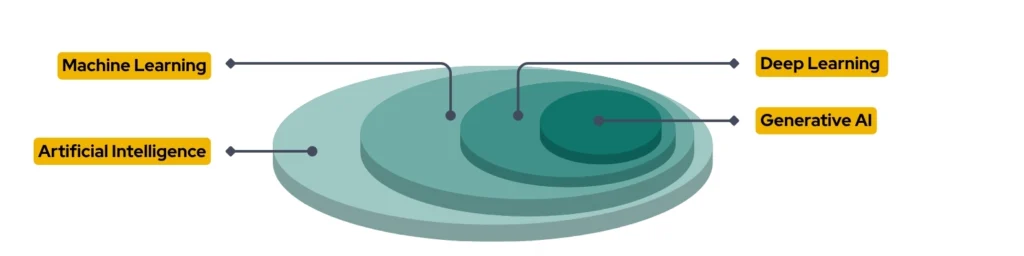
Start with the distinctions between Artificial Intelligence, Machine Learning, Deep Learning, and Generative AI, because people use these terms interchangeably and they are not the same thing. The simplest way to hold the relationship in your head is as nested layers: AI is the broad field, Machine Learning is a subset of AI, Deep Learning is a subset of Machine Learning, and Generative AI sits inside Deep Learning. Our guide to Machine Learning vs Deep Learning breaks that distinction down with examples if you want to go deeper here.
Then look at how AI is applied across healthcare, finance, cybersecurity, e-commerce, and education so the concepts attach to real use cases. This stage is also where you learn what AI cannot do. Cover AI ethics, bias, privacy, and responsible AI practices, because a realistic view of the limits is what stops you chasing hype later.
By the end, you should be able to explain the core concepts clearly to someone non-technical. That fluency is a better signal of understanding than the number of tutorials you have watched. If you want a structured starting point, the AI and Machine Learning beginner’s guide covers the prerequisites in one place.
Learn AI in the Right Order, Not in Fragments
WILA’s Advanced Diploma in Data Science and AI ML walks you through a structured six-stage progression, from core fundamentals to advanced Generative AI concepts and real-world applications.
Step 2: Learn Python
Python is the default language for AI because of its simplicity and its ecosystem of AI libraries. You do not need to become an expert programmer to move forward, but you do need to be comfortable with the basics, and this is the step where AI learning for beginners shifts from theory to something practical.
Focus on variables, data types, loops, conditional statements, functions, lists, dictionaries, and file handling. As you go, write small programs that solve real problems: a calculator, an expense tracker, a file organiser, a basic data-cleaning script. A beginner who builds ten small projects learns more than someone who spends three months memorising syntax.
Treat Python as a tool, not a subject to master in isolation. It is what lets you work with data, build models, and automate tasks, and the libraries do most of the heavy lifting. Our breakdown of the top Python libraries for data science beginners shows which ones to learn first and why. Get comfortable, then move forward. You can always deepen your programming later.
Step 3: Learn how data is processed
AI systems learn from data, so understanding data matters as much as understanding algorithms. Poor-quality data produces poor-quality AI, and no model fixes that for you. Train a crop-disease model on images where healthy plants are mislabelled as diseased, and you do not get a slightly worse model. You get a confidently wrong one. Garbage in, garbage out is not a slogan here, it is the failure mode.
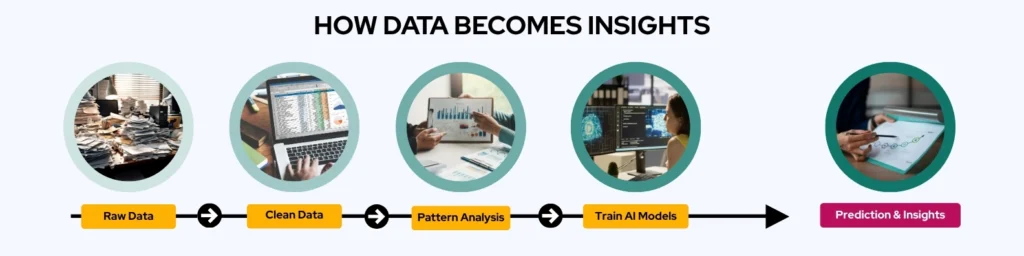
Learn how data is collected, organized, cleaned, analyzed, and visualized before you touch a model. Start with the difference between structured and unstructured data, then see how spreadsheets, databases, and datasets feed AI projects. Get familiar with Excel, SQL, and the Python library Pandas. SQL in particular is worth real time, because querying data is a daily job in most analytics and AI roles; our list of SQL queries every data analyst should know is a practical starting point.
This stage looks less exciting than Machine Learning, so career switchers tend to rush it. That is a mistake. The ability to pull useful insight out of messy data is the skill employers lean on most, across almost every industry, which is why no honest AI learning path can skip it.
Step 4: Understand Machine Learning
Machine Learning is the engine behind most AI applications you use daily. Here you learn how machines find patterns in historical data and use them to make predictions or decisions, rather than being explicitly programmed for every case. When Netflix recommends a film, Spotify builds a playlist, or your bank flags a suspicious transaction, Machine Learning is doing the work.
Focus on the three main categories. Supervised learning trains on labelled examples and powers things like spam detection and price prediction. Unsupervised learning finds hidden patterns without labels, behind customer segmentation and recommendation systems. Reinforcement learning improves through rewards and feedback, behind robotics and game-playing AI.
Skip the deep maths at first and focus on what each method is for. Connecting these categories to real applications is what makes the theory stick. When you are ready to see how the pieces fit together, our overview of the top Machine Learning algorithms maps the common ones to the problems they solve.
From Concepts to Built Projects
This Advanced Diploma in Data Science and AI ML transforms Machine Learning and Deep Learning theory into practical, hands-on models that you build, test, deploy, and showcase in your professional portfolio.
Step 5: Explore Deep Learning
Deep Learning is the branch of machine learning behind AI’s biggest breakthroughs. Facial recognition, voice assistants, language translation, image generation, and self-driving cars all run on it. Where classic Machine Learning recognizes patterns, Deep Learning handles far more complex tasks by passing large volumes of data through neural networks loosely inspired by the brain.
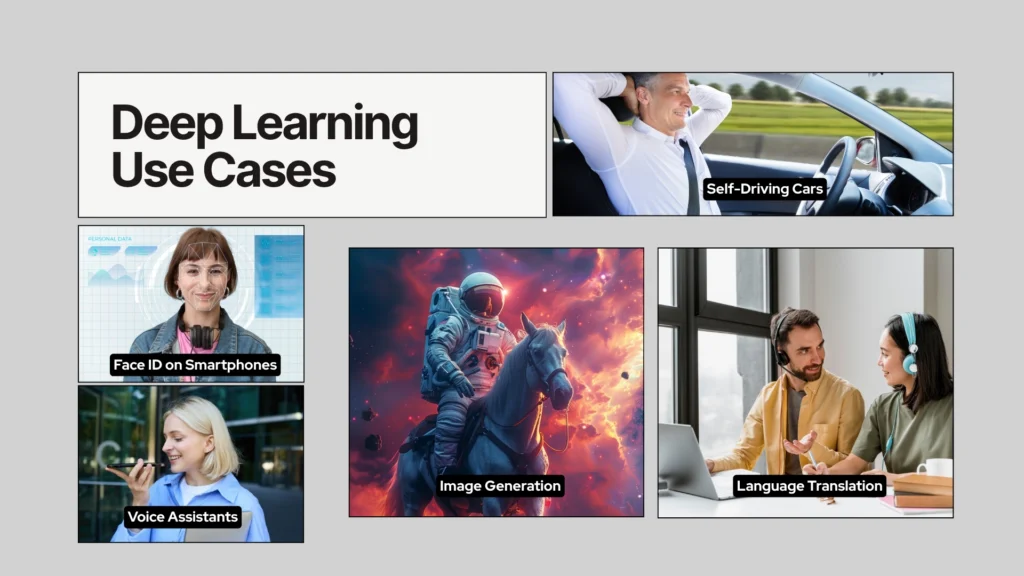
You do not need to master every architecture or the underlying maths. You need to understand the mechanism and the two domains where it matters most. Computer Vision lets machines interpret images and video, behind medical imaging, manufacturing inspection, and autonomous vehicles. Natural Language Processing lets systems understand and generate human language, behind chatbots, translation, and search.
The goal at this stage is context, not construction. Understanding how Deep Learning works gives you the foundation to make sense of almost every AI tool emerging today, including the Generative AI systems in the next step.
Step 6: Learn Generative AI
Generative AI is where many beginners want to start, and it is exactly why they get stuck. For most people doing AI learning for beginners, it should be the last step, because once you understand fundamentals, Python, data, Machine Learning, and Deep Learning, Generative AI stops being magic and starts making sense.
Unlike traditional AI that analyses data or makes predictions, it creates new content: text, images, audio, video, and code. This is what powers tools like ChatGPT, Claude, Gemini, and GitHub Copilot.
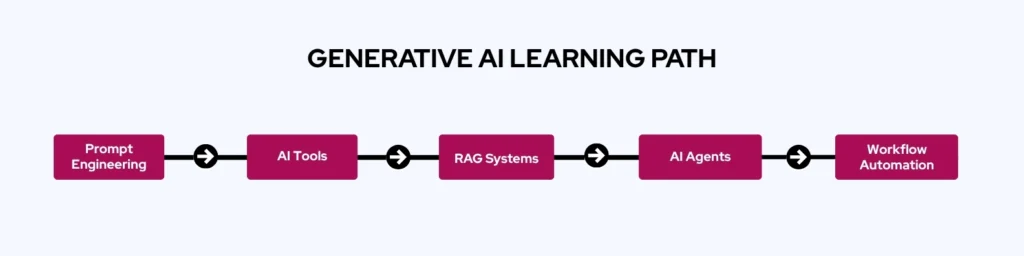
Start with how Large Language Models work and learn Prompt Engineering, the skill of communicating with these systems to get reliable output. From there, move into the concepts businesses are actually deploying: Retrieval-Augmented Generation, which grounds models in external knowledge sources, AI agents that carry out multi-step tasks, and workflow automation. A working knowledge of the current toolset helps; our roundup of the best AI tools for beginners in 2026 is a useful map. It is also worth understanding where these systems fail, which is why prompt injection and LLM security is becoming a core literacy, not a niche topic.
This stage carries the most immediate career value. Companies are not mainly hiring researchers. They are hiring people who can spot AI use cases, build AI-powered workflows, and connect the technology to business outcomes, which makes it especially open to graduates and career switchers from non-technical backgrounds.
What learning AI actually looks like month to month
A realistic first-year roadmap is built on consistency, not intensity. The timeline below turns the AI learning path into something you can actually schedule. It is a guide, not a rule, since some learners move faster and others slower depending on prior experience and weekly hours.
- Month 1: AI fundamentals
- Month 2: Python basics
- Month 3: Data skills (Excel, SQL, Pandas)
- Month 4: Machine Learning concepts
- Month 5: Deep Learning fundamentals
- Months 6 onward: Generative AI, projects, and portfolio
Projects are what turn study into something an employer can evaluate, so start building early rather than waiting until you feel ready. Our list of AI projects for beginners in 2026 gives you concrete starting points. Someone studying five focused hours a week for a year consistently outperforms someone who sprints for two weeks and quits. AI rewards persistence.
Conclusion
AI learning for beginners comes down to sequence, not talent or a degree. The six steps work because each one earns the next: fundamentals make Python purposeful, Python and data make Machine Learning concrete, and that foundation makes Deep Learning and Generative AI understandable rather than intimidating. Most beginners fail on order, not difficulty.
The opportunity is real and the entry barrier is lower than it has ever been. The only thing standing between a beginner and job-ready skills is a roadmap followed long enough to see results.
Not Sure Where You Fit on the Roadmap?
Get a straight answer on whether the Advanced Diploma in Data Science and AI ML matches your current skills, career aspirations, and learning goals.
Frequently Asked Questions
1. Can I start AI learning for beginners without a technical background? Yes. You do not need a computer science degree or prior coding experience. Begin with AI fundamentals, learn basic Python, understand data concepts, then progress to Machine Learning and Generative AI. Consistency matters far more than your starting point.
2. Can I learn AI without coding? Partly. You can explore AI concepts, prompt engineering, and many AI tools without code, and some AI courses for beginners are built without coding. But building models or AI applications eventually needs Python, so most serious paths include it.
3. How long does it take to learn AI from scratch? Most beginners build a solid foundation in six to twelve months of consistent study and hands-on practice. Becoming job-ready takes additional time, depending on the depth of expertise your target role requires.
4. How much mathematics do I need to learn AI? Not much to start. A basic grasp of statistics, probability, and logical reasoning covers the early stages. Advanced mathematics becomes relevant only when you go deeper into Machine Learning and Deep Learning.
5. What is the best programming language for AI? Python. It is beginner-friendly and backed by libraries like Pandas, Scikit-Learn, TensorFlow, and PyTorch. Most AI and Machine Learning projects are built in it, which makes it the most useful first skill.
6. What is the best AI learning path for beginners? Follow a structured beginner AI roadmap rather than random tutorials: fundamentals, Python, data, Machine Learning, Deep Learning, then Generative AI. Build projects along the way to turn the AI learning path into a portfolio that demonstrates real skill.
7. What jobs can I get after learning AI? Common roles include AI Engineer, Machine Learning Engineer, Data Scientist, Data Analyst, and Generative AI Specialist. Many people also use AI skills to strengthen existing roles. See current AI jobs for freshers in India for live examples.
8. Are AI certifications enough to get a job? Rarely on their own. Certifications show commitment, but employers want practical skills, real projects, and a portfolio. The WEF Future of Jobs Report 2025 found employers increasingly prioritize work experience over credentials.