
If you are looking for an AI job in India as a fresher in 2026, two things matter more than your degree: the role you target and the proof you can show for it. Hiring this year is skills-first. Around 73% of Indian employers planned to hire freshers in the first half of 2026, and they are screening for projects, portfolios, and demonstrable ability rather than certificates alone. AI-linked hiring is projected to grow about 32% in 2026 to nearly 3.8 lakh roles, so the demand is real, but it is concentrated in roles where you can build or operate something.
This blog lists only the roles that genuinely hire freshers, with salary numbers from actual market sources rather than invented round figures. Where a role is overhyped or a number is unreliable, it gets said plainly.
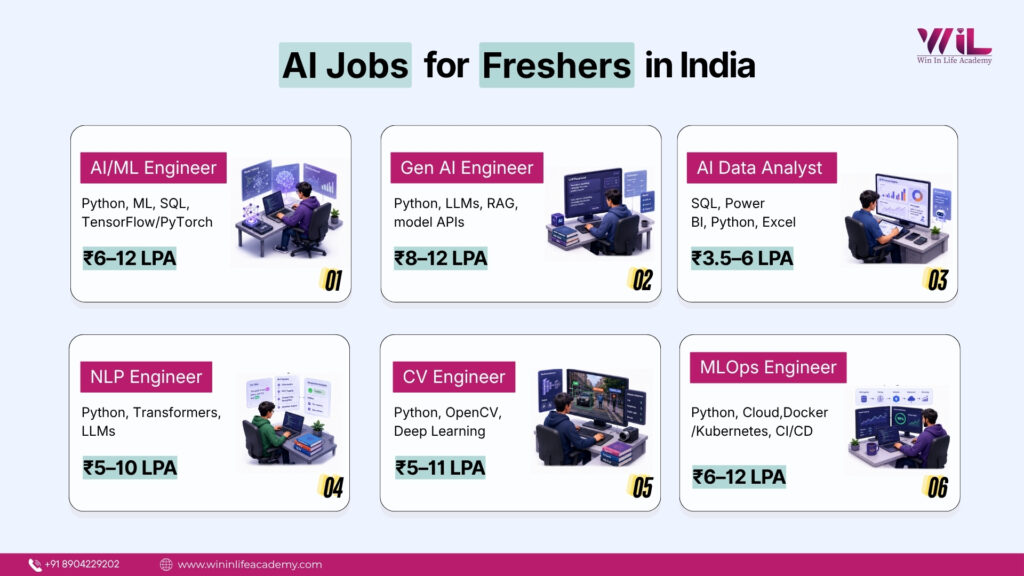
AI Jobs for Freshers in India: Quick Comparison
| Role | What You Build | Core Skills | Fresher Salary (India) |
|---|---|---|---|
| AI / ML Engineer | Recommendation systems, fraud detection, forecasting systems | Python, ML, SQL, TensorFlow/PyTorch | ₹6–12 LPA |
| Generative AI / LLM Engineer | Chatbots, assistants, RAG applications | Python, LLMs, RAG, model APIs | ₹8–12 LPA |
| Data Analyst with AI Skills | Dashboards, reports, AI-assisted analysis | SQL, Power BI, Python, Excel | ₹3.5–6 LPA |
| NLP Engineer | Chatbots, search, sentiment analysis, translation | Python, Transformers, LLMs | ₹5–10 LPA |
| Computer Vision Engineer | Image/video detection, inspection, medical imaging | Python, OpenCV, Deep Learning | ₹5–11 LPA |
| MLOps Engineer | Deploying and maintaining ML models | Python, Cloud, Docker/Kubernetes, CI/CD | ₹6–12 LPA |
Salary bands are fresher starting ranges drawn from Ambition Box, Glassdoor, and recent market salary reports. They are ranges, not promises your number depends on your skills, your portfolio, the city, and whether you join a product company or an IT services firm. The gap between those two can be 60% or more at the same experience level.
Top AI Jobs for Freshers in India
1. AI / ML Engineer
AI/ML Engineers build systems that learn from data and make predictions — recommendation engines, fraud detection, demand forecasting. It is the most established AI role and the one with the clearest fresher pipeline, but it is genuinely technical. You will write code, not just call tools. (For a full breakdown, see the skills required to become an AI engineer.)
Skills to build: Python, core machine learning concepts, SQL, data preprocessing, and at least one of TensorFlow or PyTorch. Deep learning fundamentals help but are not the entry bar.
Fresher salary (India): roughly ₹6–12 LPA, with Indeed placing the fresher average between ₹7.7 LPA and ₹11.9 LPA. Strong project work pushes you to the upper end.
2. Generative AI / LLM Engineer
The highest-paying entry point in 2026, because the field is new and genuinely skilled people are scarce. GenAI engineers build applications on top of large language models — chatbots, internal assistants, document-processing tools, and retrieval-augmented (RAG) systems that let an LLM answer from a company’s own data.
Skills to build: Python, LLM fundamentals, working with model APIs, RAG pipeline basics, and one orchestration framework. Evaluating and constraining model outputs matters more than clever wording.
Fresher salary (India): entry-level GenAI roles with real project exposure start around ₹8–12 LPA, noticeably higher than generalist AI fresher roles.
Build for the Highest-Paying AI Roles
GenAI Production Bootcamp — with IBM
Go from Python to deploying production-grade Generative AI applications. Learn LLMs, RAG, MLOps, Cloud Deployment, and build 16+ real-world projects with dedicated placement support.
Explore the Bootcamp →3. Data Analyst with AI Skills
The most accessible role here, and the best entry point if you do not come from a heavy coding background. AI hasn’t replaced analysts; it has raised the bar for them. Analysts who can work with AI-assisted platforms and build automation into their workflow already command a premium over those who can’t. (If coding worries you, these are among the stronger non-coding IT roles for beginners.)
Skills to build: SQL, Excel, Power BI or Tableau, basic Python, data visualization, and comfort with AI-assisted analytics tools. See the full list of data analyst skills required.
Fresher salary (India): roughly ₹3.5–6 LPA, with the national average for all data analysts near ₹6.5–7 LPA. Python, SQL, and BI proficiency reliably add 20–35% over peers without them.
4. NLP Engineer
NLP Engineers build systems that process human language — chatbots, sentiment analysis, search, translation. There is heavy overlap with GenAI work now, since most modern NLP runs on transformer models and LLMs.
Skills to build: Python, text processing, NLP fundamentals, transformers and LLMs, and TensorFlow or PyTorch.
Fresher salary (India): roughly ₹5–10 LPA, depending on depth and portfolio.
5. Computer Vision Engineer
Computer Vision Engineers build systems that interpret images and video — quality inspection in manufacturing, medical imaging, object detection. Demand is strong but more specialized, so fewer pure-fresher openings exist than for the roles above.
Skills to build: Python, OpenCV, image processing, deep learning, and TensorFlow or PyTorch.
Fresher salary (India): roughly ₹5–11 LPA, with the higher end tied to deep learning depth.
6. MLOps Engineer
MLOps Engineers solve the problem that quietly costs companies the most: AI models that break, drift, or stop working after deployment. This is less a pure-fresher role and more one you grow into after some engineering or DevOps grounding but it is one of the most durable and best-paid paths in AI.
Skills to build: Python, a cloud platform, Docker and Kubernetes basics, CI/CD concepts, and the mechanics of deploying and monitoring ML models.
Fresher salary (India): roughly ₹6–12 LPA at entry, rising steeply with experience.
Specialize in MLOps — IBM-Certified
Data Science & MLOps Professional Certificate
Master Python, Machine Learning, Docker, Kubernetes, and Multi-Cloud Deployment. Build expertise through 22 real-world projects and get dedicated placement support to accelerate your career.
Explore the Course →Start from the Ground Up
PG Diploma in Data Science and AI ML
Build a strong foundation in Python, Machine Learning, Deep Learning, NLP, and Computer Vision. Gain practical experience through hands-on projects and receive dedicated placement support to launch your AI career with confidence.
Explore the PG Diploma →How to Actually Get Hired as a Fresher
The skills-first shift works in your favour if you act on it.
Build genuine fundamentals first
Python, machine learning basics, SQL and data handling, and a working understanding of how generative AI systems are built. Depth in a few things beats a shallow list of buzzwords.
Then build proof
Ship two or three real projects — an AI chatbot, a RAG application, a working dashboard with an automation script, a small computer vision tool. Put them on GitHub. A candidate with two deployed projects consistently beats one with five certificates and nothing to show. Need ideas? Start with these AI projects for beginners in 2026.
Target the right entry point
Strong coder? Aim at AI/ML or GenAI engineering — and get comfortable with the core Python libraries for machine learning. Comfortable with data and business logic but lighter on code? Data Analyst with AI skills is the fastest realistic door, and it opens onto the others later.
Keep moving
The AI stack changes fast. The freshers who compound their advantage keep shipping and learning after the first role — which is also where the fastest salary growth happens, typically by year three.
Conclusion
The AI job market in India is expanding, but it doesn’t hand out roles to anyone listing the right keywords. It rewards people who can build and operate intelligent systems and in 2026 it rewards them whether or not they hold a conventional tech degree, as long as they can prove the skill.
The roles that are in high demand are AI/ML Engineer, Generative AI Engineer, Data Analyst with AI skills, and the engineering paths around them; all are reachable with focused fundamentals and a few real projects. If you want a structured path to those skills, Win In Life Academy‘s GenAI Production Bootcamp is built around the exact production stack these roles hire for.
Frequently Asked Questions (FAQs)
1. Which AI job is best for freshers in India?
For a strong coder, AI/ML Engineer and Generative AI Engineer offer the best demand and pay. For freshers from a non-coding or business background, Data Analyst with AI skills is the most accessible entry point. All three have clear fresher demand in 2026.
2. Do freshers need coding skills for AI jobs?
Most core AI roles require Python. Analyst-oriented roles need less coding than engineering roles, but some programming ability is expected almost everywhere. There is no genuine “AI engineering job with no coding.”
3. What is the average salary for AI freshers in India?
It varies by role. Data analysts with AI skills typically start around ₹3.5–6 LPA, AI/ML engineers around ₹6–12 LPA (AmbitionBox places the fresher average near ₹7.7–11.9 LPA), and Generative AI roles with real projects around ₹8–12 LPA.
4. Is Generative AI a good career option for freshers?
Yes — it is currently the highest-paying AI entry point because skilled people are scarce. Build real LLM and RAG projects rather than collecting prompt-writing certificates.
5. Should I become a Prompt Engineer?
No, not as a target job. The standalone role has faded since 2024, and prompt skills are now absorbed into engineering and analyst roles. Learn prompting as a skill, but plan your career around a real role.
6. Can non-IT students start a career in AI?
Yes. The skills-first hiring shift in 2026 favours candidates who can demonstrate ability through projects, regardless of degree background. Data analytics with AI skills is the most realistic starting point for non-IT graduates, and there are solid AI courses for beginners without coding to start with.
7. Which programming language is most important for AI jobs?
Python, clearly. It is the standard across machine learning, generative AI, and analytics.
8. How can freshers improve their chances of getting AI jobs?
Build two or three real, deployed projects and put them on GitHub. With employers screening for proof of work over degrees, a visible portfolio is the single highest-return thing a fresher can do.
9. Do I need a degree to get an AI job in India in 2026?
A degree helps but is no longer the deciding factor. Hiring has shifted to skills-first screening, with around 73% of employers prioritising demonstrated ability and proof of work over qualifications alone.
10. Which AI role pays the most for freshers?
Generative AI / LLM Engineer roles pay the most at entry level around ₹8–12 LPA with real project exposure because the skill set is new and supply is short.