
Machine learning vs deep learning refers to how systems learn from data within artificial intelligence. Machine learning learns from past data to make predictions, while deep learning goes a step further by learning patterns in images, voice, and text. Deep learning is a subset of machine learning and is used for more complex problems.
If you are exploring careers in AI or data science, you have probably come across the terms machine learning and deep learning almost everywhere. They show up in job descriptions, course titles, YouTube videos, and articles, often used in the same way. At some point, it becomes unclear whether they mean the same thing or two different things you are expected to learn.
This confusion is common, especially for beginners and professionals switching into this field. The problem is not the concepts themselves, but how they are explained. Most explanations skip the basic relationship between the two and jump straight into technical details.
Once that connection is clear, everything else starts to make sense. By the end of this blog, you will have a simple and clear understanding of machine learning vs deep learning for beginners and where each one fits.
Key Takeaways
- Machine learning and deep learning are part of the same field, but used for different types of problems.
- Machine learning works best with structured data like tables, while deep learning handles complex data like images, text, and voice.
- You do not need deep learning to start your career. Most entry-level roles rely on machine learning skills.
- Deep learning becomes useful only when problems are more complex and require higher accuracy.
- Focus on learning in the right order. Start with machine learning, then move to deep learning once your basics are clear.
What Is Machine Learning?
Think of machine learning like teaching someone through experience instead of giving them fixed instructions. For example, if you want someone to recognize spam emails, you do not write rules for every possible case. Instead, you show them many examples of spam and non-spam emails. Over time, they start spotting patterns on their own and get better at identifying what is spam.
Businesses use machine learning in a very similar way. For example, Netflix uses it to recommend shows based on what you have watched before. It looks at your past behavior, compares it with patterns from other users, and predicts what you are likely to watch next.
Machine learning is best suited for problems where you have historical data and want to make predictions or decisions based on patterns in that data.
Machine learning is like learning from examples rather than following step-by-step rules. The more relevant examples you have, the better the system becomes at making accurate decisions.
What Is Deep Learning?
Deep learning is a type of machine learning that is designed to handle more complex data like images, voice, and text. Instead of relying on simple patterns, it tries to understand deeper relationships in data.
Think of it this way. If machine learning is like learning from examples, deep learning is like learning in layers. It does not just look at the final outcome. It breaks the problem into multiple steps and gradually builds understanding.
For example, when a system identifies a face in a photo, it does not recognize the face all at once. It first detects edges, then shapes, then features like eyes and nose, and finally puts everything together to identify the person.
This layered approach is what makes deep learning powerful, but it also makes it more data-heavy and computationally demanding.
Deep learning is used when problems become too complex for basic pattern recognition, especially in areas like image recognition, speech processing, and natural language understanding.
Machine Learning vs Deep Learning — Key Differences
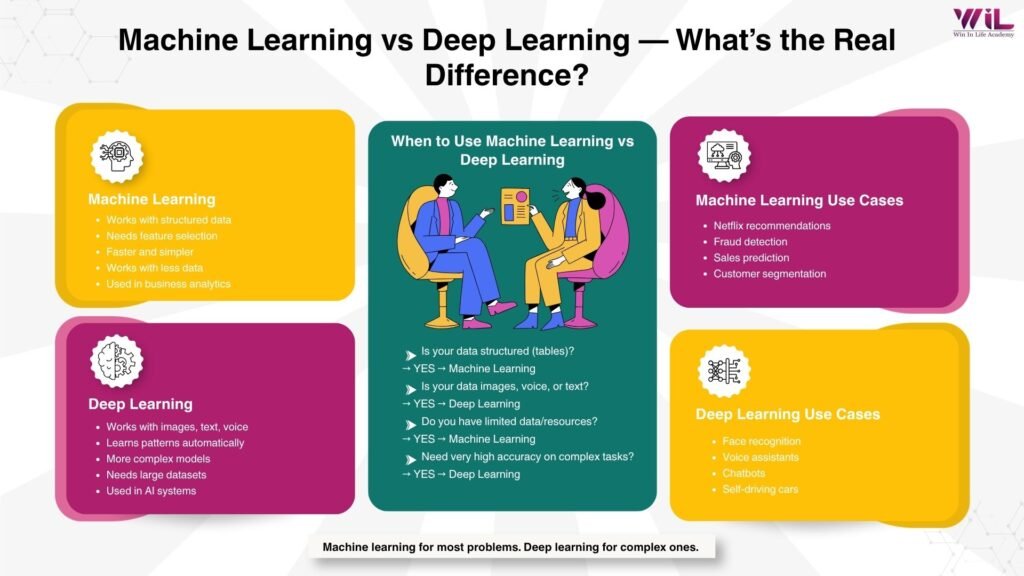
At a high level, both machine learning and deep learning are used to learn from data and make predictions. But the way they approach problems, the type of data they handle, and the effort required to use them are quite different. Understanding the difference between machine learning and deep learning helps you decide where each one fits.
How They Learn from Data
Machine learning learns patterns directly from data, but it depends heavily on how that data is prepared. You often need to decide what information matters before the model can learn anything useful. For example, if you are predicting house prices, you would explicitly provide inputs like location, size, and number of rooms. The model then finds patterns between these inputs and the final price.
Deep learning works differently. It tries to learn these patterns step by step on its own. Instead of relying heavily on manually selected inputs, it breaks the problem into layers and gradually builds understanding. This makes it more flexible, especially when patterns are not obvious from the start.
The key difference is simple.
Machine learning needs guidance on what to learn from.
Deep learning tries to figure that out by itself.
Type of Data They Work With
Machine learning works best with structured data. This means data that is already organized in rows and columns, like spreadsheets or database tables. Examples include customer data, sales records, or financial transactions. In these cases, the relationships between variables are easier to define and work with.
Deep learning is designed for unstructured data, where patterns are not clearly defined. This includes images, audio, videos, and text. For example, identifying objects in an image or understanding spoken language cannot be easily broken into simple columns and rules.
This is why you will often see machine learning used in business analytics and deep learning used in areas like computer vision and natural language processing.
Complexity of Problems
Machine learning is typically used for problems where the relationship between inputs and outputs is relatively straightforward. Examples include predicting customer churn, detecting fraud, forecasting sales, or classifying users into categories.
Deep learning is used when problems become more complex and cannot be solved easily with basic patterns. For example, recognizing faces in images, understanding human speech, translating languages, or generating text. These problems involve multiple layers of interpretation, which is where deep learning performs better.
In simple terms, machine learning handles problems where patterns are visible with the right setup, while deep learning handles problems where patterns are deeply hidden.
Data and Resource Requirements
Machine learning can work effectively even with smaller datasets, as long as the data is clean and well-prepared. It also does not require very high computing power, which makes it more accessible for beginners and smaller projects.
Deep learning, on the other hand, usually requires large amounts of data to perform well. Because it learns in layers and processes more complex patterns, it also needs more computational power, often using GPUs or specialized hardware.
This is an important practical difference. Even if deep learning sounds more advanced, it is not always the right choice if you do not have enough data or resources.
Setup and Effort
In machine learning, a significant part of the work goes into preparing the data and selecting the right features. This means deciding which inputs the model should focus on. If this step is done poorly, the model will not perform well.
In deep learning, much of this feature selection is handled automatically. The model learns what matters as part of the training process. This reduces manual effort in one area but increases complexity in others, such as tuning the model and managing training time.
So the trade-off is clear.
Machine learning requires more upfront thinking about the data.
Deep learning requires more resources and careful training.
A Simple Way to See the Difference
If you are working with structured data and a clearly defined problem, machine learning is usually the better starting point. It is faster to implement, easier to understand, and widely used in business scenarios.
If you are dealing with complex data like images, voice, or text, and the patterns are not obvious, deep learning becomes more suitable. It is built for handling that level of complexity.
Master the pillars of modern intelligence. This intensive program covers supervised and unsupervised learning, model optimization, and neural networks, transforming complex algorithms into practical, industry-ready skills through hands-on labs and real-world data applications.
In Partnership with IBM —– [4.8★ Ratings]
View Course –
https://winifileacademy.com/ai-and-ml-certification/- Python Programming & OOP Fundamentals
- Statistical Modeling & Inferential Statistics
- Supervised & Unsupervised Learning
- Neural Networks & Deep Learning (ANN, CNN, RNN)
- Natural Language Processing (NLP) & Text Mining
- Computer Vision & Image Processing
- Model Training, Evaluation & Optimization
- Data Visualization (Matplotlib, Seaborn)
When to Use Machine Learning vs Deep Learning
Understanding the difference is one thing. Knowing when to use each is what actually matters in real work.
Most beginners assume deep learning is always better because it sounds more advanced. That is not how it works. The choice depends on the type of problem, the data you have, and the resources available.
Use Machine Learning When the Data Is Structured
If your data is already organized in tables with clear columns like customer details, transactions, or sales records, machine learning is usually the right choice.
In these cases, the relationships between variables are easier to define, and models can learn effectively without needing complex architectures.
For example, predicting customer churn, forecasting sales, or identifying fraudulent transactions are all situations where machine learning works well.
Trying to use deep learning here often adds unnecessary complexity without improving results.
Use Deep Learning When the Data Is Unstructured
If you are working with images, audio, video, or text, machine learning alone is often not enough. These types of data do not come in clean rows and columns, and patterns are harder to define manually.
This is where deep learning becomes useful. It can process raw data and learn patterns automatically.
For example, recognizing objects in images, converting speech to text, or understanding language in chat applications are all problems better handled by deep learning.
Use Machine Learning When You Have Limited Data
Machine learning can perform well even with smaller datasets, as long as the data is relevant and properly prepared.
Deep learning, on the other hand, usually needs large amounts of data to learn effectively. Without enough data, its performance drops significantly.
So if you are working on a project with limited data, machine learning is often the more practical option.
Use Deep Learning When Accuracy on Complex Tasks Matters
In tasks where small improvements in accuracy make a big difference, especially in complex problems, deep learning often outperforms traditional machine learning.
For example, in image recognition or voice assistants, even slight improvements in accuracy can significantly impact user experience. Deep learning models are better suited for achieving that level of performance.
Use Machine Learning When You Need Faster and Simpler Solutions
Machine learning models are generally faster to build, easier to understand, and quicker to deploy. This makes them ideal for business environments where speed and simplicity matter.
If a problem can be solved effectively with machine learning, there is usually no reason to move to deep learning.
Use Deep Learning When You Have the Right Resources
Deep learning requires more than just data. It also needs computational power, time, and expertise to train and maintain models.
If you do not have access to these resources, using deep learning can become impractical, even if the problem seems suitable for it.
What Most Beginners Get Wrong
Many beginners jump straight to deep learning because it feels more advanced or more “in demand.” In reality, most real-world business problems are still solved using machine learning.
Starting with machine learning builds a strong foundation and helps you understand how models work before moving into more complex areas like deep learning.
A Simple Way to Decide: Machine Learning or Deep Learning
- If your problem involves structured data, limited resources, and clear patterns, start with machine learning.
- If your problem involves complex data like images, text, or voice, and you have enough data and resources, then deep learning is a better fit.
Career Impact: Machine Learning vs Deep Learning — What Should You Learn First?
One of the most common questions beginners have is: should I learn machine learning or deep learning first?
If your goal is to enter AI or data science, the order in which you learn these matters more than people admit.
Most beginners get this wrong. They jump into deep learning because it sounds more advanced and more exciting. The problem is, without a foundation, it becomes confusing very quickly and does not translate into job-ready skills.
Why Machine Learning Should Come First
Machine learning builds the foundation you need to understand how models actually work. It teaches you how to work with data, how to prepare it, how to evaluate results, and how to think through a problem step by step.
These are the skills that show up in most entry-level roles.
For example, roles like data analyst, business analyst, and junior data scientist often involve working with structured data, building basic models, and generating insights. Machine learning fits directly into this kind of work.
It also connects with other core skills like data cleaning, SQL, and visualization, which are expected in real jobs.
If you skip this and go straight to deep learning, you end up knowing tools without understanding the logic behind them.
Where Deep Learning Fits in Your Career
Deep learning becomes relevant when you move into more specialized roles.
This includes areas like computer vision, natural language processing, recommendation systems, and AI product development. These roles deal with more complex data and require a deeper understanding of models and systems.
However, these are not typically entry-level roles. They expect you to already understand machine learning concepts, data handling, and model evaluation.
That is why deep learning is better seen as a second step, not a starting point.
What Employers Actually Look For
At the fresher level, employers are not expecting you to build complex deep learning models.
They are looking for whether you can:
- Work with real datasets
- Understand business problems
- Build simple models
- Explain your approach clearly
These are all grounded in machine learning, not deep learning.
Even in roles that mention AI or machine learning, the actual work often involves data preparation, basic modeling, and analysis.
Check out our Advanced Diploma in AI and ML to help you develop practical skills that will help you build an AI-enabled career.
A Practical Learning Path That Works
If your goal is to become job-ready, the path is straightforward:
- Start with the basics of data handling and analysis
- Move into machine learning concepts and real use cases
- Practice solving business problems using data
- Then explore deep learning once your foundation is strong
This approach keeps your learning aligned with what the industry actually expects.
Real-World Examples of Machine Learning vs Deep Learning
The easiest way to understand this is through deep learning vs machine learning examples from real companies. These examples show exactly where each approach fits and why both are needed.
Machine Learning in Business Analytics and Recommendations
Companies like Netflix, Amazon, and Spotify use machine learning to personalize user experience and drive engagement.
When Netflix suggests shows or Amazon recommends products, the system is learning from past behavior. It looks at what users have watched, searched, or purchased and predicts what they are likely to do next.
This is a clear example of machine learning. The data is structured, the patterns are based on history, and the goal is to improve measurable outcomes like clicks, watch time, or sales.
Machine Learning in Fraud Detection and Forecasting
Banks and financial platforms rely on machine learning to detect unusual patterns in transactions.
For example, if a transaction suddenly looks very different from your usual behavior, the system can flag it as suspicious. Similarly, companies use machine learning to forecast demand, predict sales, and plan inventory based on past trends.
These problems involve structured data where patterns can be learned and applied to make predictions. Machine learning handles this efficiently without needing complex architectures.
Deep Learning in Image Recognition and Computer Vision
Deep learning is widely used in areas where systems need to understand visual data.
For example, companies like Tesla use deep learning in their self-driving technology to identify objects such as pedestrians, vehicles, and road signs. Face recognition features in smartphones also rely on deep learning to identify and verify users.
In these cases, the system is not working with clean, structured data. It is interpreting images, which requires identifying patterns that are not explicitly defined. That is where deep learning becomes necessary.
Deep Learning in Speech and Language Processing
Voice assistants like Google Assistant and Siri use deep learning to understand and respond to human language.
When you speak to your phone, the system processes audio, converts it into text, understands the intent, and generates a response. Similarly, chatbots and translation tools rely on deep learning to process and generate language.
These are complex tasks where context, tone, and meaning matter. Simple models are not enough, which is why deep learning is used.
What You Should Notice Across These Examples
- Machine learning is used in business-focused tasks like recommendations, predictions, and analytics.
- Deep learning is used in complex data problems like images, voice, and language.
- The choice depends on the type of data and problem, not which one sounds more advanced.
Conclusion
If you observe, the difference between machine learning and deep learning is not as complicated as it first seems. They are part of the same path, but used at different stages depending on the problem.
For most beginners, the real priority is not choosing the more advanced option, but building the right foundation. Machine learning is what helps you understand data, think through problems, and apply solutions in a way that matches real-world work.
Once that foundation is in place, deep learning starts to make sense and becomes far more useful, especially in areas like image recognition, language processing, and AI-driven systems.
If your goal is to move into AI or data science, focus on learning in the right order and applying what you learn to real problems. That is what actually makes you job-ready.
To do this in a structured and practical way, programs like the Win in Life Academy’s Data Analytics Course can help you build these skills through hands-on projects and real-world scenarios.
Frequently Asked Questions
1. Do I need to learn programming before starting machine learning or deep learning?
Yes, at least the basics. Most work in this field is done using Python, so you should be comfortable with basic syntax, data structures, and working with libraries before moving into models.
2. Is deep learning required for entry-level data science jobs?
No. Most entry-level roles focus on data handling, analysis, and basic machine learning. Deep learning is usually expected only in specialized roles.
3. Can machine learning solve problems that deep learning also handles?
In some cases, yes. For simpler versions of problems, machine learning can perform well. Deep learning is mainly used when the problem becomes too complex or involves unstructured data.
4. Which is easier to learn for beginners, machine learning or deep learning?
Machine learning is easier to start with because it involves simpler concepts and requires less data and computing power compared to deep learning.
5. Do I need a strong math background to learn machine learning or deep learning?
You need a basic understanding of statistics and linear algebra, but you do not need advanced math to get started. Most beginners can learn by focusing on practical applications first.
6. How long does it take to learn machine learning before moving to deep learning?
With consistent practice, most beginners can build a solid foundation in machine learning in a few months. The timeline depends more on hands-on practice than just theory.
7. What tools are commonly used for machine learning and deep learning?
Machine learning is often done using libraries like Scikit-learn, while deep learning uses frameworks like TensorFlow and PyTorch.
8. Can I learn deep learning without understanding machine learning first?
You can try, but it usually leads to confusion. Without understanding basic concepts like data handling and model evaluation, deep learning becomes difficult to apply correctly.
9. Are machine learning and deep learning used together in real projects?
Yes. Many real-world systems use a combination of both. Machine learning may handle structured data and predictions, while deep learning handles complex data like images or text.
10. What kind of projects should beginners build to understand these concepts?
Start with simple projects like predicting sales, analyzing customer data, or building recommendation systems. Once you are comfortable, you can move to projects like image classification or text analysis using deep learning.