SEO, AEO and GEO are three layers of one skill, not three separate careers. SEO is search engine optimization: getting pages to rank. AEO is answer engine optimization: getting one answer picked. GEO is generative engine optimization: getting your brand named inside an AI-written reply.
Google says the work behind all three is still SEO. Employers rename jobs faster than the work changes. This guide to GEO vs AEO vs SEO shows what each term means, which jobs use them, and what to learn first.
What is SEO?
SEO, short for search engine optimization, is making a web page easy to find and worth ranking on Google. Technical work helps Google crawl your site. Content answers what people type. Links show your page can be trusted.
Every AI search feature starts here. Google says a page must be indexed and snippet-eligible before AI Overviews or AI Mode can link to it.
What is AEO?
AEO, short for answer engine optimization, is writing a page so one passage can be lifted out as the direct answer. It began with featured snippets, the boxed answers at the top of Google, and now covers voice replies and AI summaries.
Put the question in a heading. Answer it in the first sentence. Then add detail.
Is AEO a part of GEO?
They overlap, and no standard body settles it. A useful split: AEO is how one page is written, and GEO is how a whole brand gets cited.
What is GEO?
GEO, short for generative engine optimization, is making your content likely to be cited when an AI tool writes an answer. The term comes from a 2023 research paper by Pranjal Aggarwal and five co-authors, posted on arXiv on 16 November 2023. On a benchmark of 10,000 queries, content changes raised visibility by up to 40 percent.
Adding quotations helped most, about 41 percent on their main measure. Statistics gave about 31 percent. Keyword stuffing scored below the unedited baseline. The tests used 2023-era engines, so treat the numbers as direction, not a promise.
GEO also leans on entity optimization: making your brand, authors and products easy to identify. Use the same names everywhere, and keep clear author and About pages.
Is AI SEO called GEO?
Not exactly. AI SEO is a loose label for any SEO work aimed at AI search. GEO is the named practice from the 2023 paper.
GEO vs AEO vs SEO: what is the difference?
The short answer: SEO gets your page ranked. AEO gets one passage picked as the direct answer. GEO gets your brand cited when an AI tool writes a reply. All three need pages that Google and Bing can crawl and index. They differ in goal, where you appear, and how you measure.
| SEO | AEO | GEO | |
|---|---|---|---|
| Goal | Rank the page | Be the direct answer | Be cited in AI replies |
| Where you appear | Search result lists | Snippets, voice, AI summaries | ChatGPT, Gemini, AI Overviews |
| What helps | Crawlable site, useful content, links | Question headings, answer-first writing | Sourced facts, named quotes, clear brand identity |
| How you measure | Search Console clicks and rankings | Snippet and answer checks | Search Console AI report, GA4 AI Assistant channel, prompt checks |
Is SEO replaced by AEO and GEO?
No, and the GEO vs AEO vs SEO debate rests on that answer. Google’s guide says SEO best practices still apply, because its AI features run on its core ranking and quality systems. The guide, last updated on 10 July 2026, calls optimizing for AI search “still SEO.”
It also says you do not need llms.txt files, special AI markup, rewritten pages or content cut into tiny pieces.
Two limits matter. That guide covers Google only. For ChatGPT search, OpenAI says to allow its OAI-SearchBot crawler in robots.txt. And ranking is not the gate. Ahrefs found in 2026 that only 38 percent of AI Overview citations came from top 10 pages, down from 76 percent in July 2025.
Is SEO still a good career with AI search?
Yes, but the job is changing, and GEO vs AEO vs SEO is part of why. Pew Research Center studied 68,879 Google searches by 900 US adults in March 2025. Users clicked a regular result link in 8 percent of visits when an AI summary appeared, and 15 percent when it did not. So the job now includes earning visibility, not only traffic.
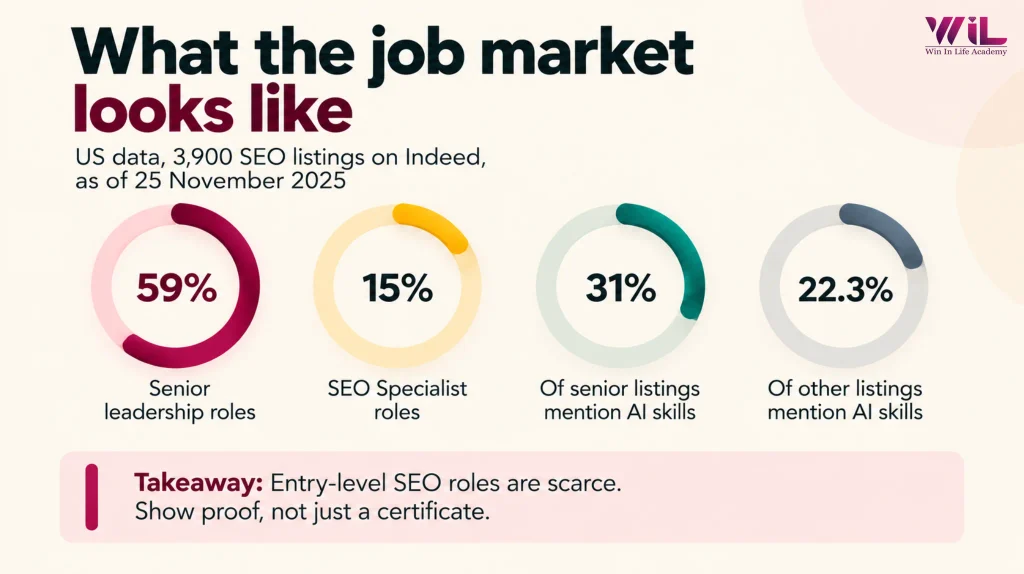
Hiring data shows the shift. Semrush studied 3,900 US SEO listings on Indeed as of 25 November 2025. Senior leadership roles were 59 percent and SEO Specialist roles 15 percent. AI skills appeared in 31 percent of senior listings and 22.3 percent of the rest.
We found no reliable India dataset for GEO and AEO jobs, so treat these as US direction. For Indian pay, see our SEO specialist salary in India guide. Weighing paid ads? Read SEO career vs performance marketing career.
Which job titles are actually GEO and AEO roles?
In the GEO vs AEO vs SEO job market, most roles are SEO jobs with a new label. Lumar’s November 2025 hiring review listed an “AI SEO / Generative Engine Optimization Specialist” role at Caterpillar and an AI search role at Manychat. Read the job description, not the title.
| Title you will see | What the work usually is | Skill to show |
|---|---|---|
| GEO or AI Search Specialist | SEO plus checking whether AI tools cite your brand | Prompt tracking, reporting |
| AEO Manager | Page structure and direct answers across a site | Content editing, Search Console |
| SEO and GEO Manager | Strategy, budget and reporting | Planning, stakeholder talks |
| Technical SEO Specialist | Crawling, indexing, site speed | Site audits |
What should you do at your career stage?
Beginner – Learn SEO first. Only 15 percent of the SEMrush listings were Specialist roles, so you need proof, not just a certificate. Start a small site and track it in Search Console for three months. Our guides on SEO skills for digital marketers and SEO interview questions show what employers test. For entry roles, see digital marketing jobs for freshers.
Mid-level – Add AI visibility to your reports. Pick 20 questions your site should answer. Check them weekly in ChatGPT, Gemini and Google, and log who gets cited. Pair that with the GA4 AI Assistant channel. It becomes your first case study.
Experienced and leads – Own the reporting and test the vendors. Google updated its “Do you need an SEO?” page on 5 June 2026 (Search Engine Land, 7 June 2026). It tells site owners to check AEO or GEO advice against Google’s guidance. Treat any promise of guaranteed AI rankings as a red flag.
How do you learn SEO, AEO and GEO, and in what order?
Learn GEO vs AEO vs SEO as one path, not three. Read Google’s AI optimization guide and the GEO paper first. Both are free.
- SEO basics: how crawling, indexing, keywords and links work. Practice in Search Console.
- AEO writing: question headings, an answer in the first sentence, short paragraphs.
- GEO habits: add dated, sourced facts and named quotes. Keep brand names consistent.
- Proof: run a before and after test on five pages. Write up what changed.
See how marketers use AI daily in our ChatGPT for digital marketing guide.
How can Win in Life Academy help you learn this?
If you are weighing GEO vs AEO vs SEO as a career, start with the base. Win in Life Academy’s Digital Marketing Course with AI teaches the SEO that GEO and AEO sit on. You work on live campaigns and use AI tools such as ChatGPT and Microsoft Copilot. To compare options, read our 10 best digital marketing courses with AI training in India.
Conclusion
GEO vs AEO vs SEO is not a choice between three careers. SEO is the base. AEO and GEO are skills you add on top, and Google says the work is still SEO. The decision that matters is the order: build search fundamentals, then prove you can earn visibility in AI answers.
Your next step is small. Pick ten questions a site you can access should answer, check who ChatGPT, Gemini and Google cite, and write it down. For guided practice, the Digital Marketing Course with AI is built around live campaigns.
Frequently asked questions
1. What do GEO, AEO and SEO stand for?
GEO stands for generative engine optimization, AEO for answer engine optimization, and SEO for search engine optimization. Google’s guide to generative AI features, updated July 2026, defines AEO and GEO and says the work is still SEO.
2. What are the four types of SEO?
People commonly group SEO into technical, on-page, off-page and local SEO. Technical covers crawling and site speed. On-page covers content and headings. Off-page covers links from other sites. Local covers map results and nearby searches.
3. Do I need an llms.txt file to appear in AI search?
Not for Google. Google’s guide, last updated 10 July 2026, says you do not need llms.txt or other AI-specific files for Google Search to show your pages in AI features. Other services may treat them differently, so check each tool’s documentation.
4. How do I get my pages cited in ChatGPT?
OpenAI’s crawler documentation says sites that block OAI-SearchBot will not appear in ChatGPT search answers. Allow it in robots.txt, the text file that tells crawlers what they may read. Blocking GPTBot, which collects training data, is a separate choice.
5. What is entity optimization?
Entity optimization means making a brand, author or product easy for search tools to identify. Use consistent names, a clear About page and named author pages. Google’s guide says no special markup is needed for AI search, so focus on clarity, not code.
6. How do I track AI search visibility?
Google’s guide points to the generative AI performance report in Search Console for Google’s AI features. Google Analytics 4 also has an AI Assistant channel for visits from ChatGPT, Gemini and Copilot. Google says third-party tools cannot see its internal ranking data.
7. Can a fresher get a GEO or AEO job?
Getting hired on a GEO title alone is hard. Semrush’s analysis of 3,900 US SEO listings from 25 November 2025 found only 15 percent were SEO Specialist roles, while 59 percent were senior leadership. Build SEO proof first, then add AI search skills.
8. Is there a course that covers AEO and GEO?
Because Google calls the work SEO, an SEO course with AI tools covers the base. Win in Life Academy’s Digital Marketing Course with AI covers SEO, GA4 and AI tools such as ChatGPT. Confirm the current syllabus for any GEO or AEO modules before enrolling.