You have finished a digital marketing course, or you are about to. Two job titles keep coming up, and nobody explains the difference in plain words.
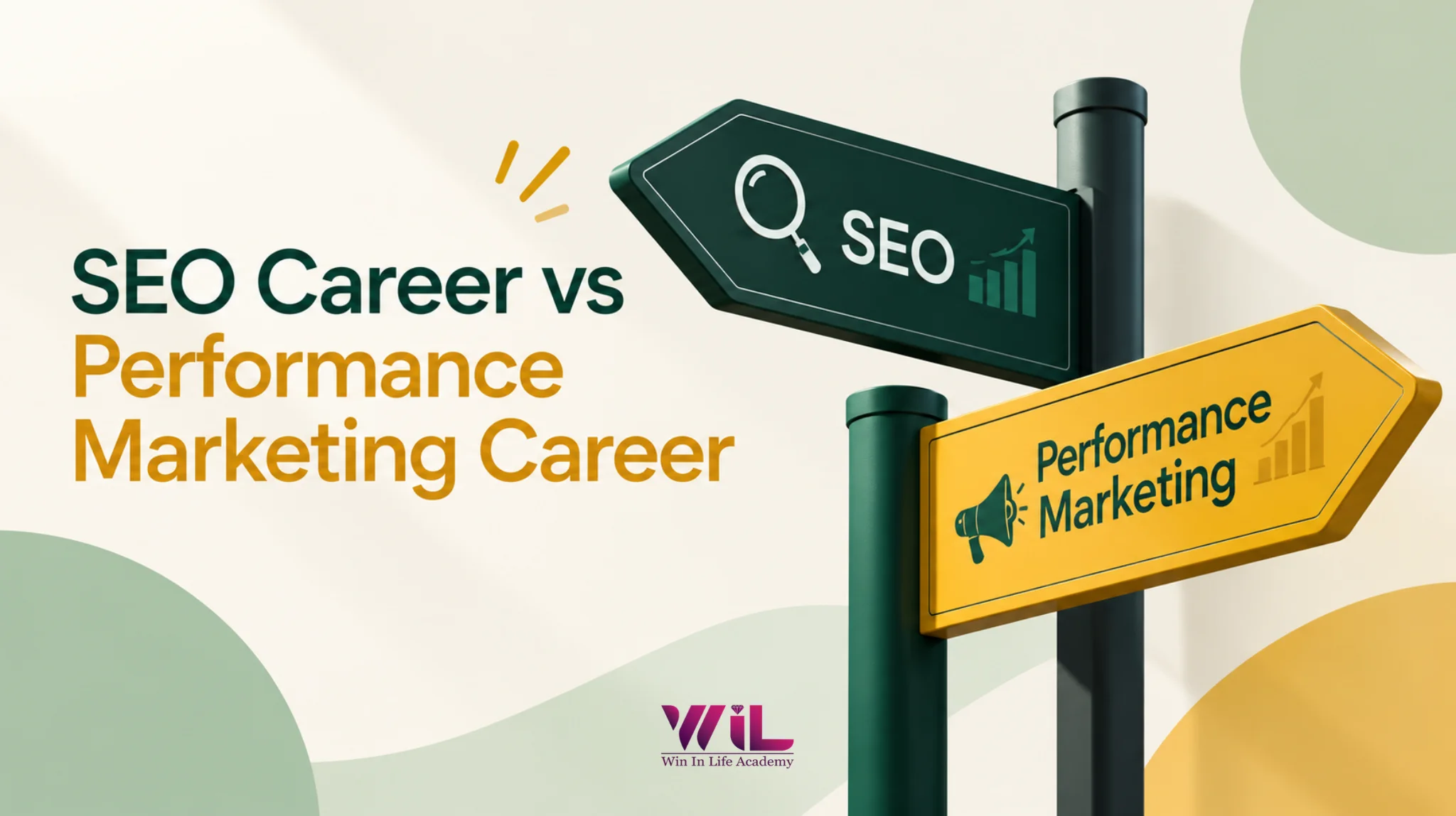
SEO and performance marketing are both about getting people to a website. One does it without paying for ads. The other does it by paying for ads.
That one line is the whole difference. Everything else, the daily work, the pressure, the pay and the career ladder, follows from it.
The short answer: An SEO career means bringing visitors to a website for free, by making pages that rank on Google. A performance marketing career means bringing visitors by paying for ads, then proving the ads made money. SEO is slower and steadier. Performance marketing is faster and more pressured.
What is an SEO career?
An SEO career is about getting a website to show up on Google without paying for ads. SEO stands for search engine optimization.
Say someone searches “best laptop under 50000”. Dozens of pages appear. Your job is to make your company’s page one of them, and ideally near the top.
What you do most days:
- Find out what people are typing into Google
- Write or fix pages that answer those searches
- Check the website for problems, like slow pages or broken links
- Get other websites to mention and link to yours
- Track which pages are moving up or down
Who it suits: People who like writing, patience and detective work. You will often wait two or three months to find out if something worked.
Common job titles are SEO executive, SEO specialist and SEO manager. Entry level SEO jobs for freshers usually ask for practice, not a marketing degree.
Is SEO a technical job?
Mostly no. Basic knowledge of how web pages work helps, but you do not need coding. Most SEO specialist jobs ask you to spot a problem and explain it to a developer, not fix it yourself.
What is a performance marketing career?
A performance marketing career is about running paid ads and proving they made money. You are given a budget, and you have to return more than you spent.
Those are the sponsored results you see at the top of Google, and the ads in your Instagram feed. Somebody chose who sees them, wrote them, and checks every morning whether they are working.
What you do most days:
- Set up ad campaigns on Google and Meta
- Decide who should see each ad
- Open a report each morning and stop what is losing money
- Write short ad copy and test two versions against each other
- Explain where the money went, and what it brought back
Who it suits: People who like numbers, quick decisions and visible results. You will know within two days whether a choice worked.
Common job titles are performance marketing specialist, ads executive and performance marketing manager. Deciding where to run ads? Our guide on Google Ads vs Meta Ads covers where each one fits.
What is the real difference between the two?
The real difference is how long you wait to find out whether you were right. Everything else follows from that.
Performance marketing runs on a short loop. Launch an ad today, and by the weekend you know if people clicked and bought. Change it on Monday, and you have an answer by Wednesday.
SEO runs on a long loop. Publish a page today, and Google may take months to react. Meanwhile ten other things change too, so proving it was your work is harder.
| SEO career | Performance marketing career | |
|---|---|---|
| Time to see results | Weeks to months | Hours to days |
| What brings the visitors | Pages, content, other sites linking to you | Ad budget |
| If you stop working | Traffic fades slowly | Traffic stops the same day |
| Cost per visitor | Falls over time | Stays, or rises |
| You are judged on | A trend each quarter | A number each week |
Neither one is better. They suit different people. If waiting three months to be proved right would frustrate you, that is useful to know now.
Which career is better for freshers in India?
Performance marketing has more openings right now, but SEO has lower entry barriers. Both are worth starting in, for different reasons.
Why performance marketing has more jobs. Almost every company selling something online runs ads. Dedicated SEO teams sit mostly in agencies, larger brands and publishers, so there are fewer of those roles.
Why SEO is easier to start. You can practise SEO alone for free on your own blog. Practising ads needs real money, so most people learn it inside an internship or a first job.
One honest risk for SEO. AI answers are reducing clicks on normal search results. Pew Research Center studied 68,879 Google searches by 900 US adults in March 2025. When an AI summary appeared, people clicked a normal result in 8 percent of visits. Without one, they clicked in 15 percent, “nearly twice as often” (Pew Research Center, July 2025).
That is US data, so treat it as a direction, not an exact Indian number. It does not end the SEO career. It adds a new part to the job: getting your brand mentioned inside AI answers. Google now tracks this. In May 2026 it added an “AI Assistant” channel to Google Analytics. It counts visitors arriving “from sources like ChatGPT, Gemini, Deepseek, Copilot, or Grok” (Google Analytics Help).
One honest risk for performance marketing. When business slows, ad budgets get cut first. The team spending that budget feels it immediately.
On pay, both start in a similar range in India and both climb with proven results. We keep the actual numbers in separate guides: SEO specialist salary in India and performance marketing salary in India.
People also ask: Can I do both SEO and performance marketing? Most Indian digital marketers end up doing both, usually after three or four years. Start with one and go deep. Companies hire specialists at entry level and all-rounders at manager level.
How do you start in either one?
Try both for one week before you choose. You will know quickly which one you enjoy.
To try SEO:
- Start a free blog on any topic you know well
- Write three pages aimed at things people search for
- Install Google Analytics and Google Search Console, both free
- Watch what happens over the next two months
To try performance marketing:
- Run one small ad with a budget you can afford to lose
- Pick one clear goal, like clicks to a page
- Check the report daily and change one thing at a time
- Note what made the cost go up or down
Whichever you keep thinking about on the bus home is your answer. After that, the fastest route in is an internship or a structured course. Our guides to SEO interview questions and Google Ads interview questions show what each side gets asked.
Still deciding whether marketing suits you at all? Start with how to become a digital marketer, then scan the wider list of digital marketing jobs for freshers.
Learn this with support
Advanced Diploma in Digital Marketing + AI Essentials, Win in Life Academy Covers SEO, Google Ads, Meta Ads, analytics and AI tools, with live campaign projects, IBM-integrated modules and 1:1 placement mentorship. Built for freshers and working professionals in India. View the programme
Conclusion: pick the speed you can live with
Pay should not decide this. An SEO career and a performance marketing career both reward people who can show they moved a number, and both pay well once you can.
What differs is the wait. One answers you in two days and holds you to a weekly figure. The other answers you in months and asks you to defend a trend. You already know which of those sounds like relief and which sounds like pressure.
So do the one-week test this week. Write one page, run one tiny ad, and see which one you want to open again tomorrow. A good digital marketing course can take it from there.
Frequently asked questions
1. Which is better, an SEO career or a performance marketing career?
Neither is better overall. Performance marketing gives faster feedback and has more openings in India. SEO has lower entry barriers and builds traffic that keeps working. Pick by how long you can wait for results.
2. Is an SEO career still worth it in 2026?
Yes, though the job is changing. Pew Research Center found in July 2025 that clicks on normal search results roughly halved when an AI summary appeared. SEO work now includes earning mentions inside AI answers, not only rankings.
3. How to start a career in SEO with no experience?
Start a free blog, write pages aimed at real searches, and track what ranks over a few months. That gives you something to show. Most SEO jobs for freshers want proof of practice, not a marketing degree.
4. What does a performance marketing specialist do every day?
They set up and adjust paid ads, usually on Google and Meta. Daily work means reading a report, pausing ads that lose money, and testing new wording. They are measured on sales produced against budget spent.
5. Which pays more, SEO or performance marketing?
Entry level pay is broadly similar in India, and both rise with proven results. Rather than quote one figure, see our separate guides on SEO specialist salary in India and performance marketing salary in India for level-by-level numbers.
6. Is an SEO internship useful for getting a job?
Very useful. An SEO internship gives you a real website with real visitors, which you cannot get on your own. Most entry level search engine optimization jobs in India favour candidates who have handled a live site.
7. Do I need coding for an SEO career?
No, though basic knowledge of how web pages work helps. Most SEO specialist jobs ask you to spot a technical problem and explain it clearly to a developer. Writing and analysis matter far more day to day.
8. Can I switch from SEO to performance marketing later?
Yes, and people move in both directions regularly. Analytics skills carry over completely. What you learn fresh is handling an ad budget on one side, or content and website structure on the other. Expect a few months of catching up.
9. Which has more job openings in India?
Performance marketing jobs are more common, because almost any company running ads needs someone to run them. Dedicated SEO teams sit mainly in agencies, larger brands and publishers, so those roles are fewer but more specialised.
10. What is the usual SEO career path?
Executive, then specialist, then manager, then head of SEO or head of growth. Moving up depends on showing you grew free traffic and enquiries. That evidence usually takes two to three years of steady results.