SEO in 2026 is no longer just keywords and backlinks. A digital marketer now has to fix slow mobile pages, get content quoted by AI tools, and prove that organic traffic brought real enquiries. The SEO skills that get you hired have changed with it.
This guide explains the eight SEO skills that matter now, in plain language, with Indian examples. Each section opens with the short answer, so you can read it fully or skim the bold lines. Every figure links to its source.
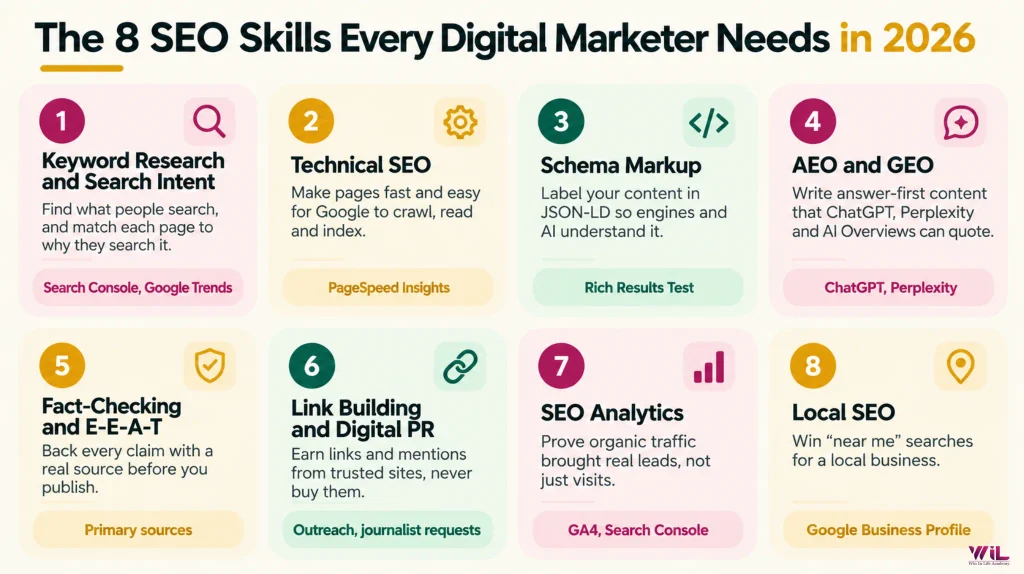
| SEO Skills | What you actually do | Tool to start with |
|---|---|---|
| Keyword Research and Search Intent | Find what people search and match pages to it | Search Console, Google Trends |
| Technical SEO | Fix crawling, indexing, speed and mobile issues | PageSpeed Insights, Screaming Frog |
| Schema Markup | Label your content so engines understand it | Rich Results Test |
| AEO and GEO | Write answer-first content AI tools can quote | ChatGPT, Perplexity |
| Fact-Checking and E-E-A-T | Back every claim with a real source | Primary sources |
| Link Building and Digital PR | Earn links and mentions from trusted sites | Journalist requests, outreach |
| SEO Analytics | Link organic traffic to leads and revenue | GA4, Search Console |
| Local SEO | Win “near me” searches | Google Business Profile |
1.Keyword Research and Search Intent
Find the terms people actually search, then match each page to the reason behind the search, not just the words. Two people typing “digital marketing” want different things, and Google serves each one differently. This is the first of the SEO skills to learn, because every other skill builds on it.
- Informational: “what is GST registration” wants an explanation.
- Commercial: “best digital marketing course in Bangalore” wants a comparison.
- Transactional: “digital marketing course fees Bangalore” wants a page to enroll on.
A student searching for fees who lands on a history of marketing just leaves. So before writing, search your keyword and study what already ranks. Then shape the title and first paragraph to answer that.
Then build topic clusters: one main page, linked to smaller pages on its sub-questions. A “digital marketing” page can link to pages on SEO, Google Ads and social media, the way our guide to the types of digital marketing does. Indian users also mix languages, typing “SEO kaise seekhe” next to “learn SEO”, so check Google’s suggestions for both.
2.Technical SEO
Technical SEO is about helping Google find, read and load your pages. You do not need to be a developer. You need to spot a problem, judge how badly it hurts, and brief the developer.
Speed matters most in India, where many people browse on budget Android phones and patchy 4G. Google measures this through Core Web Vitals, checked at the 75th percentile of visits per web.dev.
| Metric | In simple words | Good target |
|---|---|---|
| Largest Contentful Paint (LCP) | How fast the main content appears | 2.5 seconds or less |
| Interaction to Next Paint (INP) | How fast the page reacts to a tap | 200 milliseconds or less |
| Cumulative Layout Shift (CLS) | Whether things jump while loading | 0.1 or less |
INP replaced First Input Delay in 2024, so older tutorials are out of date. Also learn to check indexing in Search Console, fix broken links and duplicate URLs, and test forms on a real phone. Ignore “crawl budget” talk for now: Google says it only matters for very large sites, 1 million pages and up, not a normal business site.
3. Schema Markup
Schema markup, also called structured data, is a block of code that tells search engines what your page contains. Think of it like the label on a packet of masala: it tells you what is inside without opening it.
Google recommends JSON-LD and requires the code to match what visitors actually see on the page. Learn to pick the right type (Article, Organization, FAQ), connect official profiles with sameAs, and test with Google’s Rich Results Test before publishing.
Be honest about the payoff. Valid markup makes a page eligible for rich results. It does not guarantee them or a higher rank.
4.AEO and GEO
AEO and GEO are about getting your content used by AI tools, not just ranked on Google. Many people now get answers from ChatGPT, Perplexity and AI Overviews without clicking any site. McKinsey found that half of consumers intentionally use AI-powered search, yet only 16 percent of brands track how they appear there. These are the newest SEO skills, and the ones interviewers ask about most in 2026.
- AEO (Answer Engine Optimization): be the clear, direct answer to one question.
- GEO (Generative Engine Optimization): get AI tools to cite your brand when they write.
One tactic has research behind it. A study by Princeton, Georgia Tech and IIT Delhi found that adding citations, quotations and statistics raised a source’s visibility in AI answers by up to 40 percent. That was an experiment, not a promise.
Google says no special optimisation is needed for its AI features, and normal SEO still applies. So put the answer in the first sentence of each section, add sourced numbers, and test your key questions in AI tools every month. Our guides on ChatGPT for digital marketing and prompt engineering for digital marketers help here.
5. Fact-Checking and E-E-A-T
Fact-checking means verifying every claim before you publish, which is how you prove E-E-A-T: experience, expertise, authoritativeness and trust. E-E-A-T is how Google’s helpful content guidance describes quality, and Google says it rewards quality regardless of how the content was made.
This matters more now because AI tools write fast and sometimes wrongly. An AI draft may quote a salary or exam rule nobody ever published. Publish that, and readers stop trusting you. Fact-checking is the least glamorous of the SEO skills, and the one that protects all the others.
Build the habit in four steps:
- Source every statistic to a government body, university or official report.
- Add something only you have: your own test, screenshot or result.
- Name the author and state real credentials.
- Revisit old posts and fix outdated fees, rules and links.
6.Link Building and Digital PR
Link building earns other websites to point to yours, which tells Google your site is trusted. A link from a respected site works like a recommendation. One from a news portal or a university counts far more than fifty from random blogs.
Chasing shortcuts backfires. Google’s link spam policy treats buying or exchanging links for ranking as a violation, so quality beats quantity every time. The safer, slower skills are:
- Publishing original data or guides that others naturally want to cite.
- Digital PR: offering quotes or research to journalists and industry sites.
- Getting your brand mentioned on Reddit, LinkedIn and YouTube, which also feeds AI citations.
This is the hardest of the SEO skills to fake, and the one that separates a junior from a senior.
7.SEO Analytics
Analytics is how you prove SEO actually worked. Traffic alone means nothing: a page with 10,000 visitors and zero enquiries is a failure. Search Console shows how you appear on Google; GA4 shows what visitors do next.
| Impressions and clicks | Search Console | Is organic search reaching people? |
| Click-through rate | Search Console | Do my titles earn the click? |
| Key events (conversions) | GA4 | Are visitors filling the form or calling? |
| Qualified leads | GA4 plus CRM | Are these real buyers? |
Google advises watching impressions and clicks more than average position. Looker Studio can turn these into a simple dashboard for clients. Remember that attribution shows how organic search helps alongside ads and social; it does not prove SEO alone made the sale. Of all the SEO skills, this is the one that gets you promoted, because it speaks the language of revenue.
8.Local SEO
Local SEO helps a business show up when someone nearby searches. Think “dentist near me” or “PG in Koramangala”. It decides survival for clinics, coaching centres, restaurants and training institutes, and it is one of the quickest SEO skills to show results with.
Google says local results rest mainly on relevance, distance and prominence, and that you cannot pay for a better local rank. What you control:
- A complete, accurate Google Business Profile with the right categories.
- Genuine reviews, answered politely.
- Separate location pages with real detail, not copied text.
- Calls and direction requests tracked as outcomes.
Conclusion
Ranking is only the starting line. The marketer employers want in 2026 can show that a page brought qualified enquiries, appeared in AI answers, and carries a source for every claim. You do not need all eight SEO skills at once: pick one, finish a small project this week, and track it in Search Console. For the full picture, see our digital marketing course syllabus.
If you prefer structured learning with live projects, explore WILA’s digital marketing course or compare options in our best digital marketing courses in India guide.
Frequently asked questions
1. What is the difference between SEO, AEO and GEO?
SEO improves visibility in search results, AEO makes content easy to use as a direct answer, and GEO raises the chance of being cited in AI-generated responses.
2. Is SEO still worth learning because of AI search?
Yes. Google says normal SEO fundamentals still apply to AI Overviews and AI Mode, and traffic from them is reported in Search Console.
3. Do I need coding to learn SEO skills?
No. Basic HTML helps, but the job is finding problems and briefing developers.
4. Which SEO tools should a beginner learn first?
Google Search Console, GA4, PageSpeed Insights, Google Trends and Screaming Frog cover most beginner work.
5. What are good Core Web Vitals scores?
LCP of 2.5 seconds or less, INP of 200 milliseconds or less, and CLS of 0.1 or less.
6. Does schema markup improve rankings?
It makes pages eligible for rich results. Google does not guarantee higher rankings or enhanced listings from it.
7. Can I buy backlinks to rank faster?
No. Google’s link spam policy treats paid links for ranking as a violation. Earn links through useful content and digital PR instead.
8. Can AI write my SEO content?
It can draft, but you must fact-check every claim yourself before publishing.