ChatGPT is reshaping digital marketing across four levels; from writing content to running fully automated campaigns via AI agents. While 77% of marketers use it, only 7% truly leverage it. Beginners who understand all four levels today enter the field with a measurable head start.
Digital marketing is one of the most in-demand skills in the world right now, and ChatGPT has completely changed how it’s done.
If you’re thinking about getting into this field, here’s something worth knowing before you start. Around 77% of marketing professionals are already using ChatGPT as one of their primary ai tools for digital marketing. But almost all of them are doing the same thing with it, writing captions, drafting emails, and generating blog posts. That’s where it stops for most people.
Only 7% of organisations are actually using it at the level where it analyses performance, builds campaign systems, and makes marketing decisions on its own.
That gap, between the 77% who use it and the 7% who truly leverage it, is where the real opportunity in digital marketing sits today.
And if you’re just getting started, that’s actually good news. You don’t have old habits to unlearn. You can understand all four levels of how ChatGPT for marketers works in practice and build toward the ones that actually move the needle, right from the beginning.
That’s what this blog walks you through.
Key Takeaways
- Most marketers use ChatGPT only for writing. The real opportunity is to analyze audiences, build campaigns, and automate workflows through AI agents — and only 7% of organizations have reached that level.
- You don’t need a degree to enter digital marketing. Three to four months of consistent, hands-on practice is enough to build a portfolio that employers and clients take seriously.
- GEO is the next big shift after SEO. Getting your brand cited in AI-generated answers on tools like ChatGPT and Perplexity is becoming one of the most valuable and least understood skills in the field.
- The digital marketing job market is growing faster than it can find skilled people. With 45% of hiring managers struggling to fill roles, beginners who build the right skills enter a market that is actively looking for them.
4 Levels of How Digital Marketers Use ChatGPT
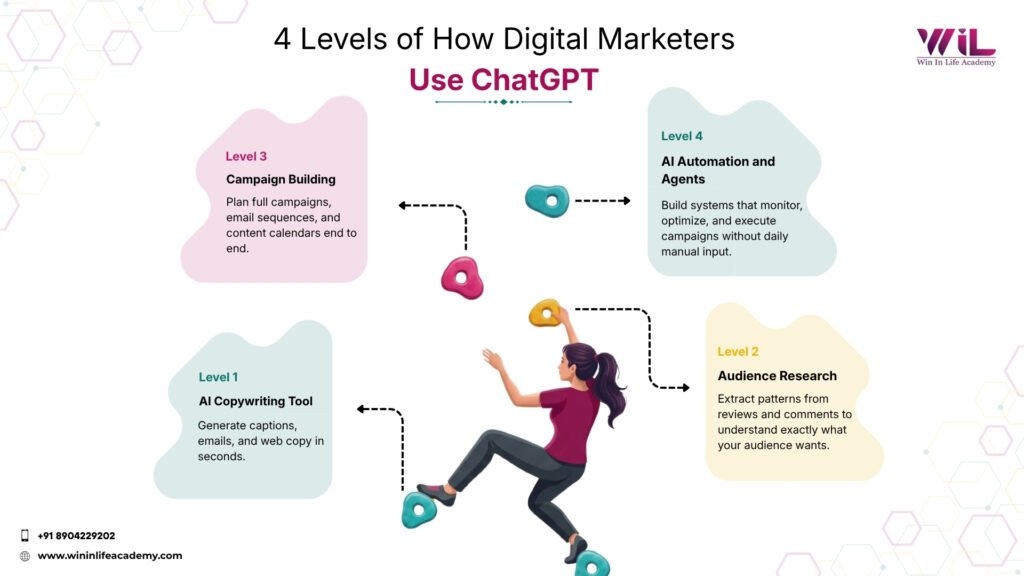
Level 1: ChatGPT as an AI Copywriting Tool
This is where almost everyone begins, and there’s nothing wrong with that.
Imagine you’re helping a small brand promote a new product. You need something written, a caption for Instagram, an email to send to their customers, maybe a short description for their website. Before ChatGPT, you’d sit down and write it yourself, which takes time, especially when you’re new and second-guessing every sentence.
With ChatGPT, you describe what you need, and it gives you a decent draft in seconds. You tweak it, clean it up a little, and it’s ready to go. As an ai copywriting tool, it’s genuinely useful when you’re just starting out, removing the blank page problem entirely.
The problem is that every other marketer is doing exactly the same thing. The captions start sounding similar. The emails start feeling familiar. When everyone uses the same tool the same way, the advantage disappears pretty quickly.
Level 1 is where you get comfortable, where the tool stops feeling unfamiliar and starts feeling natural. That’s an important first step. But it’s just that, a first step. Because writing faster isn’t the same as marketing better, and that’s where the next level comes in.
Level 2: ChatGPT for Content Marketing and Audience Research
Here’s where things start to shift from just producing content to actually thinking about who you’re talking to and what they care about.
Let’s say a brand has been posting on Instagram for months, but nothing seems to be working. Engagement is low, nobody’s clicking, and they don’t really know why. A beginner marketer at Level 1 would just write more posts and hope something sticks. A marketer at Level 2 would stop and ask a different question: what does the audience actually want?
This is where ChatGPT for content marketing becomes something more than a writing tool. You can take real information, customer reviews, comments on their posts, questions people ask in emails, paste it all in, and ask ChatGPT to find the patterns. What are people saying again and again? What are they frustrated about? What language do they actually use when they talk about this product?
That last part matters more than most beginners realize. When you know the exact words your audience uses to describe their own problems, you can use those same words in your captions and emails. Suddenly the content feels like it was written for them, because in a way, it was.
This is the difference between guessing what to say and actually knowing. And for someone just entering digital marketing, being able to do this kind of thinking early puts you well ahead of people who’ve been in the field for years but never developed the habit.
Level 3: ChatGPT for Email Marketing and Campaign Building
Once you understand your audience, the natural next step is building something for them. And this is where a lot of beginners don’t realize how much they can actually do on their own.
Think about what it used to take to launch even a basic marketing campaign. You’d need someone to write the emails, someone to plan the sequence, someone to figure out the messaging for each stage, and probably a few rounds of back and forth before anything was ready to go. For a small brand or a freelancer just starting out, that kind of workload either slowed everything down or got skipped entirely.
At Level 3, ChatGPT for email marketing and campaign planning starts helping you put whole things together, not just individual pieces of writing, but actual systems. Things like:
- A welcome email sequence for a brand’s new subscribers
- A month-long content plan across Instagram and email
- A campaign brief that maps out what to say, to whom, and when, channel by channel
None of these requires technical skills or years of experience. What it requires is knowing how to ask the right questions and use the right ChatGPT prompts for marketers to get useful output. That’s a learnable skill, and it’s one that makes you genuinely useful to any brand or business from very early on.
For someone building a freelance career or trying to land their first marketing role, this is the level where you start having real work to show. Not just “I know how to use ChatGPT” but here’s a campaign I planned, here’s an email sequence I built, here’s what I would do for your brand. That’s a very different conversation to walk into.
Level 4: AI Marketing Automation and Agentic AI
This is the level that only 7% of marketers have reached, and it’s worth understanding even if you’re just starting out, because it’s where the industry is clearly heading.
At Levels 1, 2, and 3, you’re still the one driving. You open ChatGPT, ask it something, use the output, and move on. Level 4 is different. This is where AI marketing automation and AI agents come in.
An AI agent isn’t just a tool you prompt. It’s a system that can be given a goal and then figure out on its own how to achieve it. In marketing, that looks like:
- Monitoring how your ads are performing across platforms, around the clock
- Spotting which content is getting traction and generating more like it
- Shifting budget away from underperforming campaigns automatically
- Testing different versions of copy and flagging what works
All of this happens continuously, without you having to log in and manage it every day.
Picture a small brand running ads on Instagram and Google at the same time. At Level 4, when one ad starts underperforming, the agent catches it and reallocates the budget. When a certain type of content starts getting more engagement, it notices the pattern and generates more like it. The marketer isn’t managing the campaign hour to hour anymore. They’re setting the direction and letting the system handle the execution.
According to McKinsey, agentic AI can accelerate the creation and execution of marketing campaigns by ten to fifteen times. It’s not doing the same work faster. It’s doing work that simply wasn’t possible to do manually at that scale. We’re already seeing small teams of three or four people producing the output that used to require fifteen, purely because of how well they’ve set these systems up.
But it goes even further than campaign management. Something called GEO, Generative Engine Optimization, is quietly becoming one of the most important skills in digital marketing, and most people haven’t heard of it yet.
You already know what SEO is, getting a website to show up on Google when someone searches for something. ChatGPT for SEO used to mean using AI to help write optimised content. But GEO takes it further. When someone asks ChatGPT “what’s the best project management tool for a small team?”, ChatGPT doesn’t show them ten links. It gives them an answer and mentions specific brands by name. GEO is the practice of making sure your brand, or your client’s brand, is one of the ones that gets mentioned.
At Level 4, marketers aren’t just running campaigns. They’re building the kind of presence that gets their brand cited by AI tools, recommended in AI-generated answers, and visible in places that didn’t even exist as marketing channels two years ago.
The marketer’s role at this level stops being about execution entirely. It becomes about setting goals, making judgment calls, and designing the systems that do the work. That’s a fundamentally different job, and a much more valuable one.
You don’t need to be here on day one. But knowing it exists, and knowing what direction you’re building toward, changes how you approach everything else along the way.
What the Research Says About Level 4
- Only 7% of organizations are fully scaled or actively scaling agentic AI in marketing (PwC / Talkwalker, 2025).
- Agentic AI can run marketing workflows 10 to 15 times faster than manual teams (McKinsey, 2026).
- By 2028, 60% of brands are projected to use agentic AI for customer interactions (Gartner, 2026).
- Nearly 90% of CMOs are experimenting with AI, but fewer than 10% have captured value across end-to-end workflows (McKinsey, 2026).
Where Do You Start as a Beginner?
This is the question most blogs skip, and it’s the most important one for someone just getting in.
The honest answer is simpler than you’d expect. You don’t need to master all four levels before you’re useful. You don’t need a degree, a portfolio of ten projects, or months of preparation before you begin. What you need is to start at Level 1, get genuinely comfortable with AI tools for digital marketing, and then deliberately push yourself toward Level 2 before you think you’re ready.
Here’s what that looks like in practice:
- Start with one real task, not a made-up exercise. Help a local business write their Instagram captions for a week. Draft an email for a friend’s small brand. Work with something real, where the output actually gets used somewhere. That’s what builds intuition faster than any tutorial.
- Once that feels natural, shift how you ask questions. Instead of “write me a caption,” try “here are the last 20 comments on this brand’s posts. What are people responding to most, and what does that tell us about what to post next?” That one change in thinking is the move from Level 1 to Level 2.
- Don’t jump to Level 3 or Level 4 too early. Those levels are built on the judgment you develop at the earlier ones. Someone who skips straight to building campaign systems without understanding their audience first just builds faster versions of things that don’t work.
Give yourself a realistic timeline. Three to four months of consistent, practical work is enough to go from complete beginner to someone with real, demonstrable skills. Not theoretical knowledge. Actual work you can show. That’s what gets you hired, gets you clients, and gets you taken seriously in this field.
What Does a Digital Marketing Career Actually Look Like?
Digital marketing isn’t one job. It’s a field with a lot of directions you can go, and the path you take depends on what you enjoy and where you want to end up.
Some people go deep on paid advertising, managing budgets on Google and Meta, running experiments, optimizing for return on spend. Others go into content strategy, ChatGPT for SEO, or email marketing. Some build toward becoming generalist digital marketers who can manage an entire brand’s online presence end to end. And increasingly, a growing number are carving out a lane specifically around ai marketing automation and AI-driven campaigns, the kind of work we’ve been talking about throughout this blog.
The job market for all of these is real. The U.S. Bureau of Labor Statistics projects 6% annual growth in marketing roles through 2032, above the national average. In India, the sector is growing at 25 to 30% annually. And 45% of hiring managers say they still can’t find people with the right skills, which means the gap between supply and demand is very much in your favour if you come in prepared.
What employers are actually looking for right now isn’t a long CV. It’s proof that you can do the work. A campaign you planned. An email sequence you built. An analysis you ran. Something that shows you understand not just the theory but how to apply it.
That’s exactly what we help you build at Win in Life Academy.
Our digital marketing course with AI is built for people starting from scratch, whether you’re a student figuring out your career, a professional looking to switch lanes, or a business owner who wants to understand how to market their own brand properly. You’ll go through every level we’ve covered in this blog, with real briefs, real tools, and real feedback, not just video lectures you watch and forget.
By the time you’re done, you won’t just know what digital marketing is. You’ll have the work to prove you can do it.
Frequently Asked Questions
1. What is ChatGPT for digital marketing?
ChatGPT for digital marketing is the use of AI to plan, create, and optimize marketing work, from writing content and analyzing audiences to automating campaign tasks. It is currently one of the most widely used AI tools for digital marketing across teams of every size.
2. How do beginners use ChatGPT for marketing?
Beginners typically start by using ChatGPT to write captions, emails, and blog drafts. From there, they progress to using it for audience research, content planning, and campaign building as their confidence grows.
3. What are the best ChatGPT prompts for marketers?
The best ChatGPT prompts for marketers are specific, context-rich, and goal-driven. Examples include “Here are 20 customer reviews. What frustrations keep coming up?” or “Write a 5-email welcome sequence for a sustainable clothing brand targeting women aged 25 to 35.”
4. Is ChatGPT useful for SEO?
Yes. ChatGPT helps with keyword research, content structuring, and writing optimized copy. In 2026, the bigger emerging opportunity is GEO; getting your brand mentioned in AI-generated answers, not just ranked on Google.
5. What is AI marketing automation?
AI marketing automation is the use of AI agents to handle marketing tasks automatically, monitoring campaign performance, reallocating budgets, and generating content variations, without manual intervention at every step.
6. Do I need a degree to get into digital marketing?
No. Employers prioritize practical skills and a demonstrable portfolio over formal qualifications. Free certifications from Google, Meta, and HubSpot are widely recognized entry points into the field.
7. How long does it take to learn digital marketing from scratch?
Most beginners develop job-ready skills in three to four months with consistent, hands-on practice. Working on real projects rather than just watching tutorials significantly accelerates the learning curve.
8. What is the difference between SEO and GEO?
SEO focuses on ranking your website higher on Google. GEO focuses on getting your brand cited in AI-generated answers on tools like ChatGPT and Perplexity. Both matter in 2026, but GEO is the faster-growing opportunity.
9. Can ChatGPT replace digital marketers?
No. ChatGPT cannot replace digital marketers. It handles execution faster but still requires human direction, strategic thinking, and audience understanding. Marketers who work alongside AI become more valuable, not less relevant.
10. What digital marketing skills are employers looking for in 2026?
According to Robert Half’s 2026 Marketing Job Market report, the most in-demand skills are AI literacy, data analysis, content strategy, and multi-channel campaign management. The ability to use AI tools effectively is now a top hiring criterion across industries.