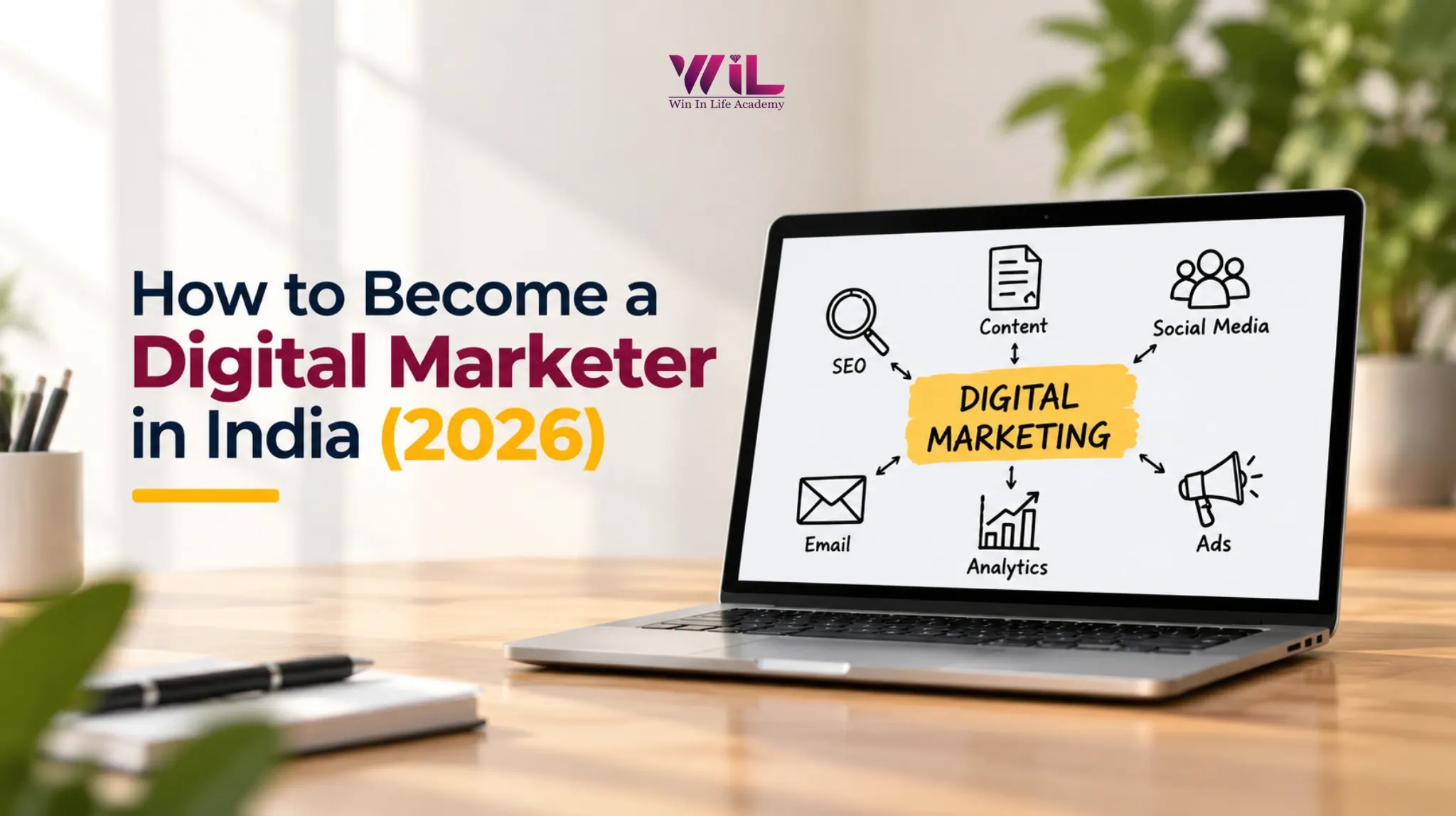
Digital marketing is not a single job or skill. It is a broad career domain covering specialized areas such as SEO, paid advertising, social media, content, email, analytics, CRM, automation, and AI-powered marketing.
That means how to become a digital marketer is not about mastering every channel. The better approach is to understand the major areas, identify the role that matches your strengths and interests, and then build deeper expertise in that direction.
If you are figuring out how to become a digital marketer in India in 2026, this guide will help you understand the career paths available and the skills, tools, certifications, and practical experience you need to become job-ready.
What Does a Digital Marketer Actually Do?
A digital marketer helps a business reach its target audience, generate demand, and convert online users into customers.
Depending on the specialization, the work can include:
- Optimizing websites and content for search engines
- Managing Google and Meta advertising campaigns
- Creating content and social media strategies
- Managing email campaigns and customer journeys
- Analysing marketing data and campaign performance
- Managing CRM systems and marketing automation
- Using AI tools for research, content, analysis, and automation
So the question is not just “How to become a digital marketer?” It is also “Which digital marketing role do I want to build toward?”
Digital Marketing Roles: Which Career Path Can You Choose?
Digital marketing has several specialized roles. While responsibilities can overlap at junior levels, each role has a different primary focus.
| Role | Primary Focus | Useful Skills |
|---|---|---|
| SEO Specialist | Organic search visibility and website growth | SEO, keyword research, content, analytics |
| Performance/PPC Marketer | Paid campaigns and conversions | Google Ads, Meta Ads, targeting, analytics |
| Social Media Marketer | Organic and paid social growth | Content, community management, social ads |
| Content Marketer | Content that attracts and converts audiences | Writing, research, SEO, strategy |
| Email/Lifecycle Marketer | Lead nurturing and customer retention | Email, segmentation, automation, CRM |
| Digital Marketing Analyst | Measuring marketing performance | GA4, reporting, data analysis |
| CRM/Marketing Automation Specialist | Automating customer journeys | CRM, workflows, lead nurturing |
| Growth Marketer | Improving acquisition, activation, and retention | Analytics, experimentation, multiple channels |
A 2026 analysis of employer requirements also highlights analytics, SEO, paid advertising, AI tools, content, social media, email, CRM, automation, design, video, and AEO/GEO among the skills marketers should develop.
The Digital Marketing Roadmap at a Glance
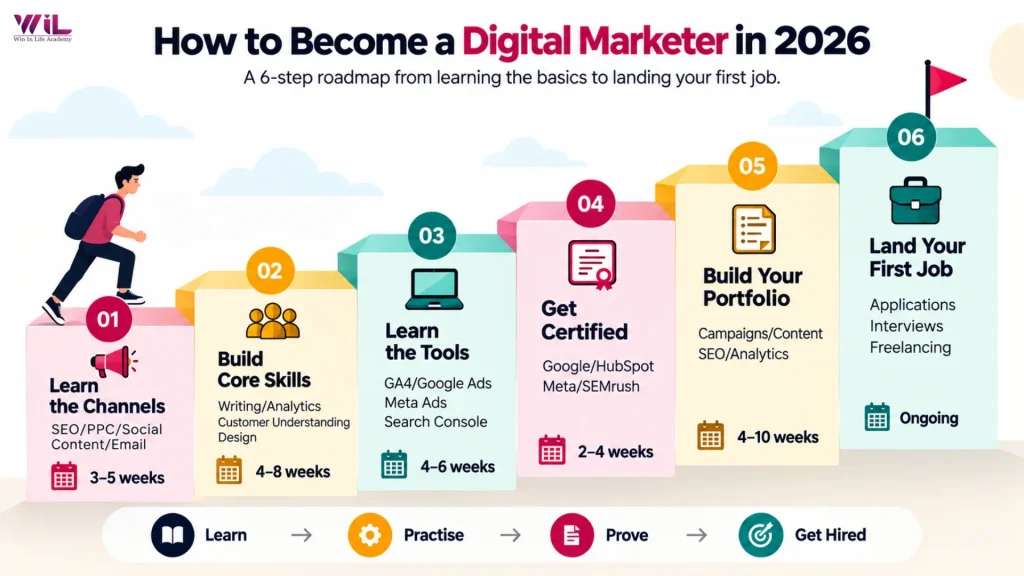
| 1. Learn the channels | SEO, PPC, social, content, email, analytics | 3–5 weeks | Specialization |
| 2. Build core skills | Writing, analytics, design, customer understanding | 4–8 weeks | Samples + report |
| 3. Learn the tools | GA4, Google Ads, Meta Ads, Search Console | 4–6 weeks | Practice projects |
| 4. Get certified | Google, HubSpot, Meta, SEMrush | 2–4 weeks | Certificates |
| 5. Build a portfolio | Campaigns, content, SEO, analytics | 4–10 weeks | 2–3 case studies |
| 6. Land your first job | Applications, interviews, freelancing | Ongoing | Offers, gigs, references |
6 Steps on How to Become a Digital Marketer in 2026
1. Learn the Major Digital Marketing Channels and Pick a Lane
Start by understanding what each channel does before choosing an area to specialize in.
- SEO: Improves visibility in organic search results.
- PPC/SEM: Uses paid search advertising to reach high-intent users.
- Social media marketing: Builds visibility, engagement, and paid social campaigns.
- Content marketing: Uses blogs, videos, guides, and other content to attract and educate audiences.
- Email marketing: Nurtures leads and customers through targeted communication.
- Analytics: Measures marketing performance and informs decisions.
You do not need to master all six. Build a broad foundation, then develop depth in one or two areas. Someone who enjoys writing and research may prefer SEO or content, while someone comfortable with numbers and experimentation may prefer performance marketing or analytics.
For a beginner-friendly breakdown, explore WILA’s guide to 8 types of digital marketing.
2. Build the Core Skills Employers Look For
Tools change, but foundational skills remain valuable.
Focus on:
- Clear writing: For ads, emails, landing pages, and content.
- Analytics thinking: Turning campaign data into useful decisions.
- Customer understanding: Knowing what audiences need and why they act.
- Basic design: Creating effective visuals with tools such as Canva.
- Problem-solving: Testing ideas and improving weak campaigns.
In 2026, add AI literacy to this foundation. Marketers increasingly use AI for research, content workflows, analysis, and productivity.
3. Get Hands-On With Marketing Tools
Knowing what a tool does is different from knowing how to use it.
Start with:
- Google Analytics 4: Traffic, user behaviour, conversions, and reporting.
- Google Ads: Campaigns, keywords, targeting, budgets, and performance.
- Meta Ads Manager: Audiences, ad sets, creatives, and campaign results.
- Google Search Console: Search visibility and organic performance.
You can explore broader options through ZoomInfo’s digital marketing tools guide.
Do not buy every premium platform when starting. Learn the fundamentals first, then add specialized tools when you have a clear reason to use them.
4. Earn Relevant Certifications
Certifications can strengthen a beginner’s resume, but they should support practical experience rather than replace it.
Useful options include:
- Google Digital Garage: Fundamentals of Digital Marketing
- HubSpot Academy: Inbound, content, email, and related certifications
- Meta Blueprint: Social media marketing courses and certifications
- SEMrush Academy: SEO, PPC, and digital marketing training
Explore Google’s Fundamentals of Digital Marketing, HubSpot Academy, Meta Blueprint, and SEMrush Academy.
One or two relevant certifications plus real projects are more valuable than collecting certificates without applying the knowledge.
5. Build a Portfolio Before You Apply
You do not need years of experience to create a portfolio. You need projects that demonstrate how you think and what you can do.
You could:
- Help a small business or NGO with SEO or social media.
- Build and grow your own niche website or social media page.
- Create a mock Google or Meta campaign.
- Audit a website and recommend SEO improvements.
- Create a content plan and measure its performance.
Structure each project as:
Challenge → Strategy → Execution → Results
Include numbers, screenshots, charts, or before-and-after comparisons wherever possible. Marketing portfolios are stronger when they demonstrate measurable outcomes such as improved traffic, leads, acquisition costs, or conversions.
For additional inspiration, see MySeera’s marketing portfolio examples.
6. Apply for Your First Digital Marketing Job
Once you have the fundamentals, relevant certifications, and two or three portfolio projects, start applying.
Common entry-level titles include:
- Digital Marketing Executive
- SEO Executive
- Performance Marketing Associate
- Social Media Executive
- Content Marketing Executive
- Email Marketing Associate
Agencies can provide broad exposure to clients and campaigns, while in-house roles offer deeper ownership of a brand or product. Freelancing alongside your job search can also help you gain client experience, references, and portfolio material.
How Much Can a Digital Marketer Earn in India?
Digital marketing salaries vary by experience, location, specialization, and measurable results.
| Experience | Broad Salary Range |
|---|---|
| Entry level (0–2 years) | ₹2.5–5.5 LPA |
| Mid level (2–5 years) | ₹6–15 LPA |
| Senior (5+ years) | ₹12–40+ LPA |
Performance marketing, growth, analytics, and management roles can offer higher earning potential as experience increases.
For additional benchmarks, see LinkedIn’s 2026 digital marketing salary data and ResumeVera’s digital marketing salary guide.
Is Digital Marketing a Good Career in 2026?
The demand outlook remains relevant for beginners. A 2026 TeamLease EdTech report covered by Economic Times BrandEquity reported a sharp rise in fresher hiring in marketing, driven partly by AI, analytics, and digital operations.
The role is also evolving. Digital marketers increasingly need to connect channels to business goals, understand performance data, work with automation, interpret customer behaviour, and use AI effectively. This makes digital marketing a career with multiple specialization paths rather than a single fixed skill set.
Common Mistakes Beginners Should Avoid
| Mistake | What to Do Instead |
|---|---|
| Collecting certificates | Build projects and case studies alongside certifications. |
| Trying every channel at once | Understand the basics, then specialize in one or two areas. |
| Ignoring analytics | Learn to connect marketing activity with measurable outcomes. |
| Waiting until you’re ready | Start small, practice, measure, and improve. |
Conclusion
If you want to know how to become a digital marketer, start by understanding the different roles within the field and choosing a specialization that fits your strengths. Then build your core digital marketing skills, practice with real tools, earn relevant certifications, and create a portfolio that demonstrates what you can do.
You do not need to know everything before applying for your first job. You need enough knowledge and practical proof to show an employer that you can learn, execute, measure, and improve.
If you want a structured route instead of putting these pieces together yourself, the Advanced Diploma in Digital Marketing + AI Essentials from Win In Life Academy combines digital marketing fundamentals, AI applications, tools, and practical projects for beginners.
Frequently Asked Questions
1. How do I become a digital marketer with no experience?
Understanding how to become a digital marketer starts with learning one area such as SEO, content, or paid advertising. Practise with free tools, complete a relevant certification, and create two or three projects that demonstrate what you can do.
2. How long does it take to become a digital marketer?
The time required to learn how to become a digital marketer depends on your learning pace, practice, and the skills you develop. Most beginners can become job-ready in around six to twelve months with consistent practice.
3. Do I need a degree to become a digital marketer?
No specific degree is required to learn how to become a digital marketer. Practical skills, tool knowledge, communication, certifications, and a strong portfolio can help you qualify for entry-level opportunities.
4. What skills do I need to become a digital marketer?
Important digital marketing skills include SEO, PPC, content marketing, social media, analytics, email marketing, communication, customer understanding, and problem-solving. AI literacy is increasingly useful as well.
5. Which digital marketing role should I choose?
When exploring how to become a digital marketer, consider your strengths and interests. SEO and content can suit people who enjoy writing and research; performance marketing and analytics suit those comfortable with numbers and experimentation; CRM and automation can suit people interested in systems and customer journeys.
6. Which tools should beginners learn?
Learning the right tools is an important part of understanding how to become a digital marketer. Start with Google Analytics 4, Google Ads, Meta Ads Manager, and Google Search Console. Add specialized tools such as Semrush, Ahrefs, or HubSpot as your career direction becomes clearer.
7. Can I become a digital marketer without spending money on ads?
Yes. You can practice SEO, content, analytics, social media, and campaign structures without spending on advertising. A small paid campaign can provide additional experience once you understand the fundamentals.
8. Is a digital marketing course necessary to get a job?
A course is not mandatory, but structured training can make learning how to become a digital marketer easier. Look for a program that combines concepts, tools, certifications, practical projects, and career guidance.
9. What does the WILA digital marketing course cover?
The Advanced Diploma in Digital Marketing + AI Essentials covers areas such as SEO, PPC, content marketing, social media, email marketing, analytics, AI applications, marketing tools, and practical projects.
10. How can I build a digital marketing portfolio without experience?
Creating a portfolio is an important step when learning how to become a digital marketer. Create two or three projects using your own website, social media page, or a small business. Explain the objective, strategy, execution, tools, results, and lessons learned for each project.