The best career options for freshers in India in 2026 are not the highest-paying titles or the ones trending online. The right one is the career your degree opens a real door to, and your skills carry forward. Hiring this year rewards proof of skill over the degree alone, and the demand is spread well beyond software: AI, data, cloud, and cybersecurity lead, but finance, manufacturing, and creative roles are all hiring freshers too.
This blog maps 11 of those roles, grouped by the degree you are graduating with, so you can skip the ones that don’t fit and go straight to your lane. For each role you get what the work actually involves, the skills to build, who’s hiring, and a salary figure drawn from real job-portal data. Where a role is hard to enter or easy to overhype, it is said plainly.
How we evaluated these career options
Every role was tested on the same practical filters: whether Indian employers are hiring for it now, whether a fresher can realistically enter without prior experience, how salary and responsibility grow over time, how it holds up as AI reshapes work, and how transferable its skills are. Roles with genuine demand and a clear entry path ranked above those running on hype.
A note on the salary figures: each number below is the average across all experience levels reported on the named job portal, not a fresher-specific figure. Freshers should expect to start below these averages, which include mid- and senior-level professionals. The numbers are included to show the earning trajectory of each role, with the source linked so you can check the latest data yourself.
Best career options for freshers in India 2026, at a glance
The best career options for freshers in India in 2026 fall across four degree backgrounds: CS/IT graduates can target AI/ML Engineer, Data Analyst, Cloud Engineer, and Cybersecurity Analyst roles; non-CS engineers suit EV/Battery, Semiconductor/VLSI, and Supply Chain roles; commerce and BBA graduates fit Business Analyst and Financial Analyst paths; and arts graduates can move into Content Strategy and UX Research. The right one depends on your degree, your skills, and demonstrable proof of work.
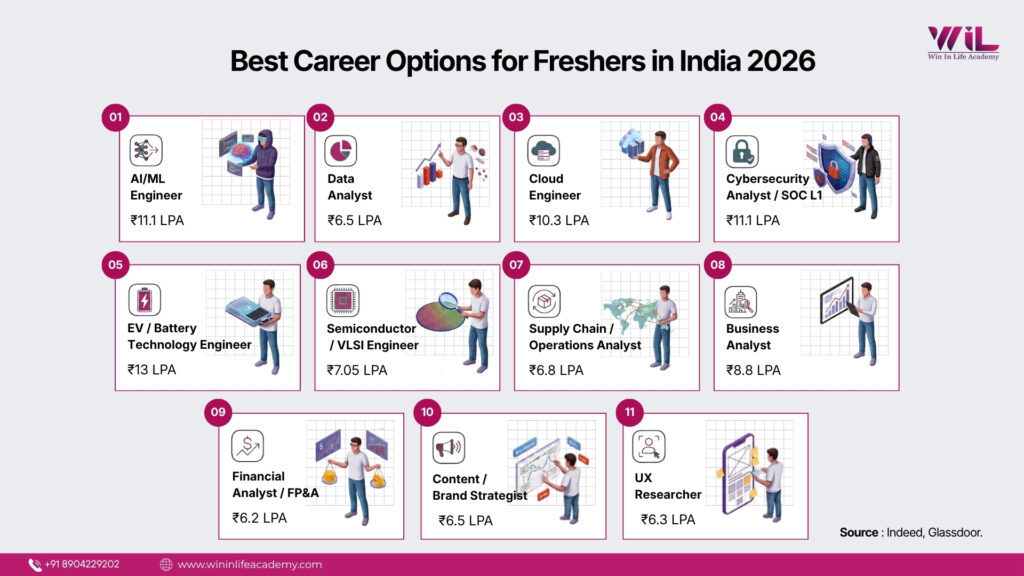
Quick comparison of the 11 roles
| Role | Best-fit background | Avg salary (all experience) | Source |
| AI/ML Engineer | CS / IT / Data Science | ₹11.1 LPA | Indeed |
| Data Analyst | Any quantitative stream | ₹6.5 LPA | Indeed |
| Cloud Engineer | CS / IT / Electronics | ₹10.3 LPA | Indeed |
| Cybersecurity Analyst / SOC L1 | CS / IT / Electronics | ₹5.2 LPA | Indeed |
| EV / Battery Technology Engineer | Mech / Elec / Auto / Chem | ~₹13 LPA* | SalaryExpert |
| Semiconductor / VLSI Engineer | ECE / EEE / CE | ₹7.05 LPA | Glassdoor |
| Supply Chain / Operations Analyst | Mech / Industrial / Ops | ₹6.8 LPA** | Indeed |
| Business Analyst | BBA / Commerce / IT | ₹8.8 LPA | Indeed |
| Financial Analyst / FP&A | Commerce / Finance / Econ | ₹6.2 LPA | Indeed |
| Content / Brand Strategist | Mass Comm / English / Marketing | ₹6.5 LPA | Glassdoor |
| UX Researcher | Psychology / Design / Humanities | ₹6.3 LPA** | Indeed |
[*Survey-based, not job-portal data; skewed high by senior roles. **Based on limited reporting. All figures are averages across experience levels; freshers start below these.]
Future-Ready Careers for CS and IT Graduates
Technology holds the deepest pool of fresher roles in India, across AI, data, cloud, and security, and it now rewards what you can build over the degree on paper. For a deeper, AI-specific breakdown, see our guide to AI jobs for freshers in India.
1. AI/ML Engineer
AI/ML Engineers build systems that learn from data and make predictions, powering recommendation engines, fraud detection, and the AI assistants now embedded across products. It is the most established AI role and has the clearest fresher pipeline, but it is genuinely technical: you will write code, not just call tools. It suits graduates from Computer Science, IT, Data Science, Mathematics, and Statistics backgrounds. To see exactly what the role demands, review the skills required to become an AI engineer.
Skills to build: Python, machine learning fundamentals, SQL, data preprocessing, and one deep learning framework such as TensorFlow or PyTorch.
Industries hiring: Fintech, e-commerce, healthcare, SaaS, banking, IT services, and consulting.
Salary in India: Average ₹11.1 LPA across all experience levels (freshers earn well below this). Source: Indeed.
PG Diploma in Data Science and AI ML
Master Python, ML, deep learning, NLP, and model deployment from fundamentals to production.
Real projects, IBM-backed curriculum, and placement support.
2. Data Analyst
Data Analysts collect, clean, and interpret data to answer business questions, building the dashboards and reports decisions get made on. It is the broadest entry point in tech and the most accessible to non-CS graduates, because the bar is analytical thinking more than heavy engineering. AI has not replaced analysts; it has raised the bar, and those who fold AI-assisted tools into their workflow command a premium. See the full list of data analyst skills required.
Skills to build: SQL, Excel, Power BI or Tableau, basic Python, and data visualization, plus comfort with AI-assisted analytics tools. If coding worries you, several of these sit among the stronger non-coding IT roles for beginners.
Industries hiring: Fintech, banking, e-commerce, healthcare, FMCG, consulting, retail, and insurance.
Salary in India: Average ₹6.5 LPA across all experience levels (freshers earn below this). Source: Indeed.
Certificate in Data Analytics
Get job-ready in analytics with SQL, Excel, Power BI, and Python through hands-on projects and placement support.
Explore the Course →3. Cloud Engineer (AWS / Azure / GCP)
Cloud Engineers design, deploy, and manage the infrastructure that keeps applications running at scale: servers, storage, networking, security, and automation across AWS, Azure, or GCP. Demand is durable because almost everything now runs on the cloud. It suits graduates from Computer Science, IT, Electronics, and related engineering backgrounds who like systems thinking.
Skills to build: Core services of one cloud platform, Linux, networking fundamentals, infrastructure-as-code such as Terraform, Docker, Kubernetes, and scripting in Python or Bash.
Industries hiring: IT services, SaaS, banking, e-commerce, healthcare, media, and telecom.
Salary in India: Average ₹10.3 LPA across all experience levels (freshers earn below this). Source: Indeed.
4. Cybersecurity Analyst / SOC L1
Cybersecurity Analysts and SOC Level 1 analysts monitor, detect, and respond to threats targeting an organization’s systems, networks, and data. They are the first line of defense against breaches, and demand stays high because threat volume only grows. It suits detail-oriented graduates from Computer Science, IT, Electronics, and related backgrounds. Not sure where to begin? This cybersecurity certification career-path guide helps build a foundation.
Skills to build: Networking fundamentals such as TCP/IP and firewalls, SIEM tools such as Splunk or IBM QRadar, threat analysis, incident response, and a certification like CompTIA Security+ or CEH as a strong advantage.
Industries hiring: IT services, banking, fintech, government, defense, healthcare, and telecom.
Salary in India: Average ₹5.2 LPA across all experience levels (freshers earn below this). Source: Indeed.
Cyber Security Course
Build job-ready security skills from networking and threat analysis to SIEM tools and incident response, with hands-on labs and placement support.
Explore the Course →Emerging Career Paths for Non-CS Engineers
Engineering graduates outside CS have real options beyond conventional roles. Electric vehicles, semiconductors, and operations are hiring people who can apply technical knowledge to physical and industrial problems.
5. EV / Battery Technology Engineer
EV and Battery Technology Engineers design, test, and optimize electric vehicles and energy storage systems, working on battery chemistry, thermal management, powertrains, and embedded controls. It suits freshers drawn to sustainable mobility, particularly from Mechanical, Electrical, Electronics, Automobile, and Chemical Engineering backgrounds.
Skills to build: Battery management systems, thermal management, powertrain fundamentals, CAD tools such as CATIA or SolidWorks, MATLAB/Simulink, and EV standards.
Industries hiring: Automotive OEMs, EV startups, battery manufacturers, energy storage firms, and government R&D.
Salary in India: Around ₹13 LPA average across all experience levels, based on survey data rather than job-portal postings and skewed high by senior roles; fresher pay is materially lower. Source: SalaryExpert.
6. Semiconductor / VLSI Engineer
Semiconductor and VLSI Engineers design, verify, and test the chips that power every electronic device, spanning circuit design, logic verification, and physical layout. India’s national semiconductor build-out is widening fresher demand here. It suits meticulous graduates from Electronics, Electrical, and Computer Engineering backgrounds.
Skills to build: VLSI fundamentals, HDL languages such as Verilog or VHDL, logic synthesis, static timing analysis, EDA tools such as Cadence or Synopsys, and RTL design.
Industries hiring: Semiconductor and chip-design firms, consumer and automotive electronics, defence, and telecom hardware.
Salary in India: Average ₹7.05 LPA across all experience levels for a VLSI Design Engineer (freshers earn below this). Source: Glassdoor.
7. Supply Chain / Operations Analyst
Supply Chain and Operations Analysts optimise the flow of goods and information across production and distribution, working on demand forecasting, inventory, vendor coordination, and logistics. It suits graduates who like structured problem-solving, particularly from Mechanical, Industrial, and Manufacturing Engineering or Operations Management backgrounds.
Skills to build: Excel and data analysis, ERP systems such as SAP or Oracle, supply chain fundamentals, basic SQL, and process mapping.
Industries hiring: Manufacturing, FMCG, automotive, retail, logistics, pharmaceuticals, and e-commerce.
Salary in India: Average ₹6.8 LPA across all experience levels, based on limited reporting. Source: Indeed.
Business and Finance Career Paths
Every organization needs people who can analyse performance, manage money, and connect business problems to solutions. These roles build skills that stay valuable across industries and economic cycles.
8. Business Analyst
Business Analysts bridge business problems and technology solutions, gathering requirements, mapping processes, and working with product and development teams to deliver workflows that solve real organizational needs. It suits strong communicators who enjoy structured problem-solving, from BBA, Commerce, Computer Science, IT, and Management backgrounds. Explore real-world Business Analyst projects that strengthen a fresher profile.
Skills to build: Requirements gathering, process mapping, user-story writing, basic SQL, Excel, wireframing tools such as Figma, and stakeholder communication.
Industries hiring: IT services, consulting, banking, fintech, e-commerce, insurance, and SaaS.
Salary in India: Average ₹8.8 LPA across all experience levels (freshers earn below this). Source: Indeed.
PG Diploma in Business Analytics (Next-Gen AI, with IBM)
Master analytics, data-driven decision-making, and AI tools through real projects, IBM-backed curriculum, and placement support.
Explore the Course →9. Financial Analyst / FP&A
Financial Analysts and FP&A professionals build financial models, analyse performance, forecast revenue and costs, and prepare reports that guide leadership decisions. The work connects numbers to strategy. It suits graduates with strong quantitative instincts from Commerce, BBA, Economics, and Finance backgrounds. Compare Business Analyst and Financial Analyst careers to see which fits you.
Skills to build: Advanced Excel, financial modelling, PowerPoint, accounting fundamentals, budgeting and forecasting, and increasingly SQL.
Industries hiring: Banking, FMCG, consulting, fintech, manufacturing, real estate, and corporate finance teams.
Salary in India: Average ₹6.2 LPA across all experience levels (freshers earn below this). Source: Indeed.
High-Growth Career Paths for Arts and Humanities Graduates
Communication, research, and creative judgment are workplace skills in their own right. Graduates from arts, humanities, journalism, and mass communication backgrounds can build careers that shape products, brands, and customer experiences.
10. Content / Brand Strategist
Content and Brand Strategists shape how an organisation communicates its identity and offerings, developing content strategies, managing brand voice, and building campaigns that hold a consistent narrative across formats. It suits strong writers who are culturally aware and can connect a brand’s purpose to its audience, particularly graduates from Mass Communication, Journalism, English, Marketing, and Humanities backgrounds. If marketing interests you, start with the core types of digital marketing.
Skills to build: Writing and editing across formats, brand positioning, content planning, SEO fundamentals, basic analytics such as Google Analytics, and a consistent tone of voice.
Industries hiring: Agencies, edtech, SaaS, e-commerce, FMCG, media, fintech, and in-house marketing teams.
Salary in India: Average ₹6.5 LPA across all experience levels (freshers earn below this). Source: Glassdoor.
Advanced Diploma in Digital Marketing + AI Essentials
Build practical, AI-integrated marketing skills with IBM lab sessions, hands-on projects, and placement support.
📅 6 Months | 🧪 IBM Labs | 🎯 Placement Support
Explore the Course →11. UX Researcher
UX Researchers study how people interact with products and interfaces to guide better design decisions, running user interviews, usability tests, and surveys, then turning findings into recommendations for product teams. It suits naturally curious, empathetic freshers who ask sharp questions, particularly from Psychology, Sociology, Mass Communication, Design, and Humanities backgrounds.
Skills to build: User interview and usability-testing methods, survey design, affinity mapping, basic quantitative analysis, research synthesis, and tools such as Figma or Maze.
Industries hiring: Product companies, design consultancies, fintech, healthtech, e-commerce, SaaS, and edtech.
Salary in India: Average ₹6.3 LPA across all experience levels, based on limited reporting. Source: Indeed.
Choosing Your Lane
The right career for a fresher in 2026 is the one that fits your background, your interests, and where you want to be in five years, not the one with the loudest hype. The opportunities are real and they span technology, engineering, business, finance, and the creative fields. What separates the freshers who get hired is not the degree on the certificate but the skill behind it.
Go deep on a few core skills rather than collecting shallow buzzwords, ship two or three real projects you can show, and earn a relevant certification where it genuinely signals capability. A visible portfolio beats a stack of certificates with nothing behind them. Pick the lane that fits you, build genuine ability, and prove it through real work.
Build Job-Ready Skills with Win In Life Academy
At Win In Life Academy, we help learners turn career goals into job-ready skills through industry-focused training, hands-on projects, expert mentorship, and placement support. Our programs span high-growth fields, each built around the skills employers actually hire for:
Frequently Asked Questions
1.Which is the best career option for freshers in India in 2026?
There is no single best career for everyone. The right one depends on your degree, your strengths, and your goals. Strong options in 2026 span technology (AI/ML Engineer, Data Analyst, Cloud Engineer, Cybersecurity Analyst), engineering (EV, Semiconductor, Supply Chain), business and finance (Business Analyst, Financial Analyst), and creative fields (Content Strategist, UX Researcher). Match the role to your background first, then build the skills it needs.
2. What are the highest-paying career options for freshers in India?
By average reported salary across experience levels, AI/ML Engineer (around ₹11 LPA), Cloud Engineer (around ₹10 LPA), and Business Analyst (around ₹9 LPA) sit at the top among the roles covered here. Freshers start below these averages, but these paths show the strongest earning trajectory.
3. Can freshers from non-CS backgrounds get good tech jobs?
Yes. Data Analyst, Business Analyst, and Cybersecurity roles are accessible to graduates from many streams through focused upskilling and project work. Hiring in 2026 leans skills-first, so demonstrable ability and a portfolio matter more than the exact degree.
4. Which career options suit commerce and BBA graduates?
Commerce and BBA graduates fit Business Analyst and Financial Analyst / FP&A roles well. Both build on analytical thinking and business understanding, and both offer clear progression into specialised and leadership positions over time.
5. What can arts and humanities graduates do in 2026?
Arts, humanities, and mass communication graduates can move into Content and Brand Strategy, UX Research, digital marketing, and communication-focused roles. These value writing, research, and human insight, which remain hard to automate.
6. Do I need a degree to get hired as a fresher in 2026?
A relevant degree helps, but employers increasingly screen for demonstrated skills, real projects, and portfolios over qualifications alone. A graduate who can show working projects often beats one with stronger paper credentials and nothing to demonstrate.
7. Are certifications enough to land a fresher job?
Certifications strengthen a profile but rarely close a hire on their own. Employers look for a combination of skills, hands-on projects, practical experience, and interview readiness. Treat certifications as proof of foundation, not a finished case for hiring you.
8. How do I choose the right career path as a fresher?
Start with your degree and strengths, then look for roles with genuine hiring demand and a realistic fresher entry path. Weigh salary trajectory, how the role holds up against AI, and how transferable its skills are, rather than chasing whatever is trending.
9. Which skills do employers value most in freshers today?
Beyond degree knowledge, employers value practical problem-solving, communication, project experience, and fluency with the core tools of the role. Across most of the roles here, comfort with data and AI-assisted tools is now a baseline advantage rather than a bonus.
10. How can freshers become job-ready faster?
Go deep on a few core skills, ship two or three real projects you can show, earn a relevant certification, and build interview readiness. A structured learning path with mentorship and placement support shortens the gap between graduating and getting hired.
Schema