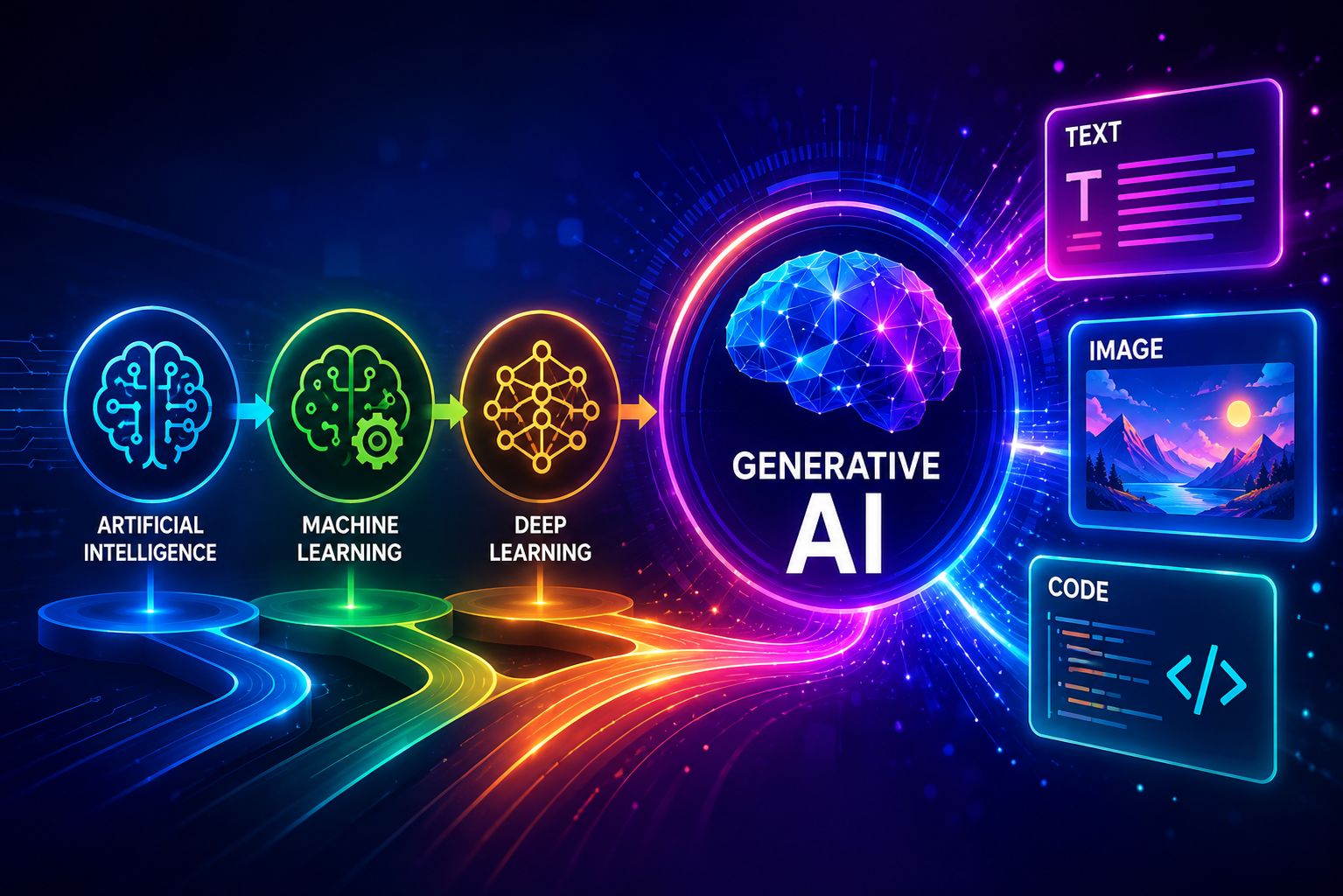
Generative AI is a type of artificial intelligence that creates new content — text, images, audio, video, or code — instead of just analyzing existing data. It learns patterns from massive datasets using deep learning models, then generates original outputs based on user prompts.
Generative AI refers to AI systems that produce new, original content rather than simply classifying or predicting from data. Built on deep learning and transformer architectures, models like ChatGPT, Gemini, and Claude generate human-like text, images, and code. It powers tools across education, healthcare, marketing, and software development, making it one of the fastest-growing skill areas today.
Introduction
Generative AI is no longer a buzzword — it’s the technology behind ChatGPT, Gemini, Midjourney, and dozens of tools you may already use daily. But what is generative AI, actually? In simple terms, it’s AI that creates new content instead of just analyzing old data. This guide breaks down its meaning, how it works, real examples, and how you can start a career in it.
What Is Generative AI?
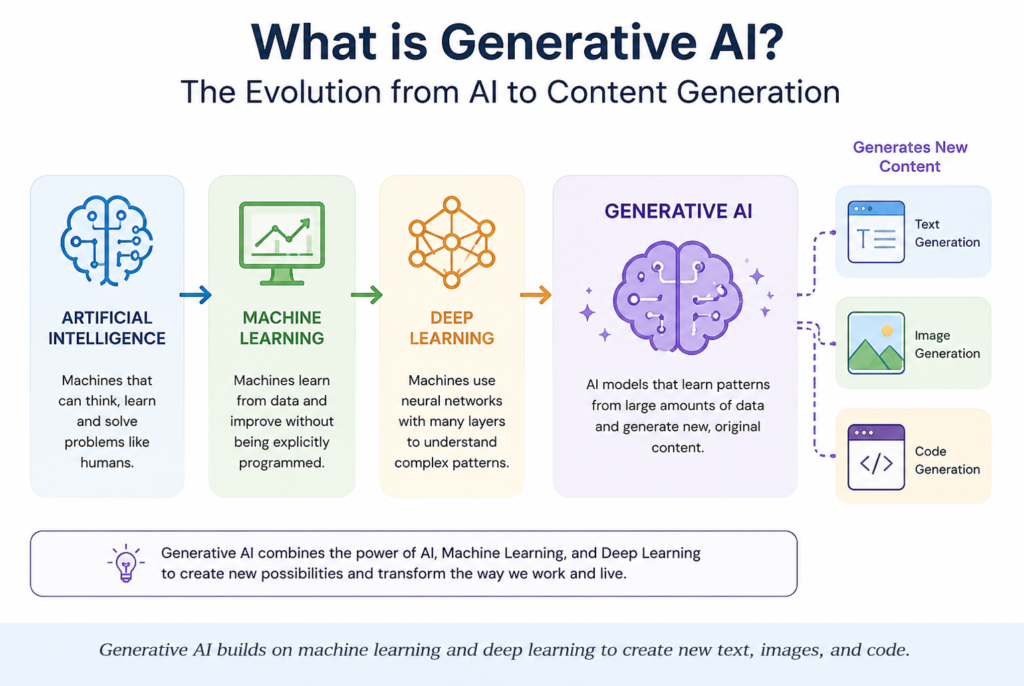
Quick answer: Generative AI is artificial intelligence that generates new text, images, audio, video, or code by learning patterns from large datasets.
Unlike traditional AI, which classifies or predicts (like spam filters), generative AI produces original output. Ask ChatGPT to write an email, and it generates fresh text — it doesn’t fetch a pre-written answer.
AI vs ML vs Deep Learning vs Generative AI
| Concept | What It Does | Example |
|---|---|---|
| Artificial Intelligence | Broad field of machines mimicking human intelligence | Chess-playing AI |
| Machine Learning | Systems that learn patterns from data | Spam detection |
| Deep Learning | ML using neural networks with many layers | Image recognition |
| Generative AI | Deep learning that creates new content | ChatGPT writing text |
Key takeaway: Generative AI is a specialized outcome of deep learning, built on neural networks and foundation models like large language models (LLMs).
How Does Generative AI Work?
- Training – Models learn from massive training data using neural networks.
- Tokenization – Text is broken into tokens the model can process.
- Prompt – You give an instruction (the prompt).
- Inference – The model predicts the most likely next output within its context window.
- Generation – It produces text, image, or code as output.
Transformer architecture, introduced in 2017, made this possible by helping models understand context and relationships between words — the foundation of modern LLMs.
Types of Generative AI Models
- LLMs (Large Language Models): Power chatbots like ChatGPT and Claude
- Diffusion Models: Generate images from noise (used in Midjourney, DALL·E)
- GANs: Two networks compete to create realistic outputs
- VAEs: Compress and reconstruct data creatively
- Transformer Models: The backbone architecture behind most LLMs
Popular Generative AI Tools
ChatGPT (OpenAI), Gemini (Google), Claude (Anthropic), Microsoft Copilot, Perplexity AI, Midjourney, and DALL·E are leading examples, each specializing in text, search, or image generation.
Real-World Applications
Generative AI is used in education (personalized tutoring), healthcare (drug discovery), finance (fraud detection), marketing (content creation), software development (code generation), cybersecurity (threat simulation), customer support (AI chatbots), and manufacturing (design optimization).
Benefits of Generative AI
- Speeds up content and code creation
- Reduces repetitive work
- Personalizes learning and marketing
- Assists research and decision-making
Challenges of Generative AI
- Bias in training data
- AI hallucinations (confident but incorrect outputs)
- Privacy and data security risks
- Copyright ambiguity
- Security misuse potential
Responsible AI practices help address these limitations — no model is perfectly accurate today.
Career Opportunities
Generative AI Engineer, Prompt Engineer, AI Developer, ML Engineer, Data Scientist, and AI Product Manager are among the fastest-growing roles in 2026, spanning tech, finance, healthcare, and media industries.
How to Start Learning Generative AI
- Learn Python and statistics basics
- Understand machine learning and neural networks
- Study transformer architecture and LLMs
- Practice prompt engineering
- Build projects using APIs (OpenAI, Gemini, Claude)
- Learn responsible AI and ethics
- Apply skills through a structured program
Conclusion
Generative AI is reshaping how we create, work, and learn. Understanding its fundamentals today prepares you for tomorrow’s job market. If you’re ready to go beyond theory, WILA‘s GenAI Production Bootcamp can help you build real, deployable skills.
FAQs
1. What is generative AI in simple words? Generative AI is AI that creates new content — like text, images, or code — instead of just analyzing existing data.
2. Is ChatGPT generative AI? Yes. ChatGPT is a generative AI tool built on a large language model that generates human-like text responses.
3. What is the difference between AI and generative AI? AI is the broad field of intelligent machines; generative AI is a subset that specifically creates new content.
4. What skills are needed to learn generative AI? Python, statistics, machine learning basics, neural networks, and prompt engineering are essential starting skills.
5. Is generative AI a good career option? Yes. Roles like Prompt Engineer, AI Developer, and Generative AI Engineer are among the fastest-growing tech careers in 2026.