
If you are looking for the best AI career options after graduation, the honest answer is that there is no single best. There is only the best fit for your strengths. AI has created distinct career paths across coding, analytics, and business functions, and the role that makes sense for a BTech graduate looks nothing like the one that makes sense for a BBA or B.Com graduate.
This blog breaks down 11 real, in-demand AI jobs after graduation into three tracks (technical, applied, and entry-level) so you can find where you actually belong and what you need to get there. The opportunity is genuine: according to the World Economic Forum’s Future of Jobs Report 2025, AI and machine learning specialists rank among the three fastest-growing roles in the world. In India specifically, NASSCOM projects AI-related demand to cross one million roles, against a talent pool that is still catching up.
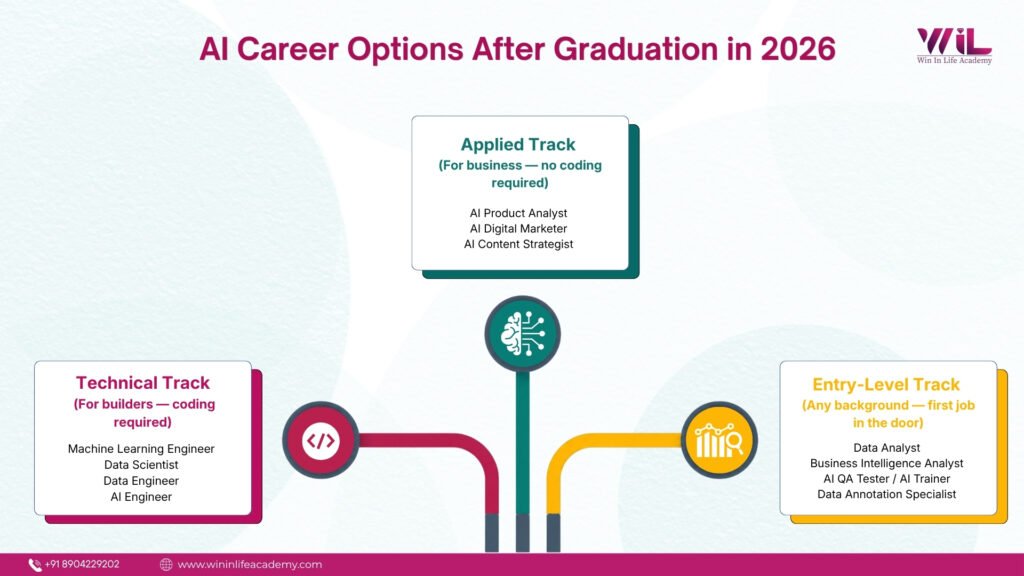
AI Career Options After Graduation at a Glance
| AI Career Role | Track | Coding Required | Entry-Level Salary (India) |
| Machine Learning Engineer | Technical | Yes | ₹5–₹12 LPA |
| Data Scientist | Technical | Yes | ₹6–₹13 LPA |
| Data Engineer | Technical | Yes | ₹5–₹10 LPA |
| AI Engineer | Technical | Yes | ₹6–₹14 LPA |
| AI Product Manager / Analyst | Applied | Light | ₹4–₹8 LPA* |
| AI Digital Marketer | Applied | No | ₹3–₹6 LPA |
| AI Content Strategist | Applied | No | ₹3–₹5 LPA |
| Data Analyst | Entry-Level | Light | ₹3.5–₹7 LPA |
| Business Intelligence Analyst | Entry-Level | Light | ₹4–₹8 LPA |
| AI QA Tester / AI Trainer | Entry-Level | No | ₹2.5–₹5 LPA |
| Data Annotation Specialist | Entry-Level | No | ₹2–₹3.5 LPA |
Technical AI Careers: For Those Who Want to Build
These are the roles that sit closest to the core of AI: building models, managing data infrastructure, and deploying intelligent systems. They require programming skills, mathematical foundations, and comfort working with large datasets. If you have a BTech, BCA, or BSc background in computer science, mathematics, or a related field, this is your track.
Machine Learning Engineer
Machine Learning Engineers design, build, and deploy ML models that allow systems to learn from data and make predictions. In practice, this means building recommendation engines, fraud detection systems, demand forecasting models, and similar applications that companies across fintech, e-commerce, and healthcare depend on daily.
Skills required: Python, TensorFlow, PyTorch, Scikit-learn, model deployment frameworks, cloud platforms (AWS, Azure, GCP), statistics, linear algebra. Analytical thinking, ability to communicate model performance to non-technical stakeholders, problem-solving under ambiguous data conditions.
Graduates who want to understand which Python libraries for machine learning matter most can use this as a starting checklist.
Industries hiring: Fintech, e-commerce, healthcare, SaaS, IT services.
Salary in India: ₹5 to ₹12 LPA for entry-level roles, as reported on AmbitionBox. Figures are self-reported and vary significantly by city, with Bengaluru, Hyderabad, and Pune consistently showing higher ranges than tier-2 cities.
Data Scientist
Data Scientists work with complex datasets to find patterns, build predictive models, and generate insights that drive business decisions. The role sits at the intersection of statistics, programming, and business thinking, which is why it remains one of the most sought-after AI careers across industries.
For a detailed breakdown of the path, see how to become a Data Scientist in 2026.
Skills required: Python, R, SQL, machine learning libraries, statistical modeling, data visualization tools, hypothesis testing, probability. Business thinking, storytelling with data, ability to translate complex findings into decisions non-technical teams can act on.
Industries hiring: Finance, healthcare, retail, technology, consulting.
Salary in India: ₹6 to ₹13 LPA for entry-level roles, as reported on AmbitionBox. Candidates with strong project portfolios and internship experience tend to land at the higher end.
Data Engineer
Data Engineers build and maintain the pipelines that move, store, and organize data so that analysts, data scientists, and AI systems can actually use it. Without solid data infrastructure, no AI model works reliably, which is why this role has quietly become one of the most stable and in-demand in the ecosystem.
Skills required: SQL, Python, Apache Spark, ETL tools, cloud platforms (AWS, Azure, GCP), data warehousing, pipeline architecture, top Python libraries for machine learning. Attention to data quality and system reliability, ability to collaborate with analysts and scientists who depend on your pipelines.
Industries hiring: SaaS, fintech, healthcare analytics, IT services, logistics.
Salary in India: ₹5 to ₹10 LPA for entry-level roles, as reported on AmbitionBox. Cloud platform certifications such as AWS and Azure measurably improve starting offers.
AI Engineer
AI Engineers integrate AI capabilities such as large language models, automation workflows, APIs, and generative AI tools into real business applications. Where a Machine Learning Engineer focuses on building models, an AI Engineer focuses on making those models work inside products and business systems. It is one of the fastest-growing titles in job postings as companies move from AI experimentation to AI deployment.
If you want to understand what skills this role specifically demands, read AI Engineer Skills Required.
Skills required: Python, REST APIs, LangChain, OpenAI API, cloud integrations, automation tools, generative AI frameworks, AI Engineer skills required. Systems thinking, ability to translate business requirements into AI-integrated workflows, comfort working across technical and product teams.
Industries hiring: Technology, SaaS, digital agencies, IT services, startups.
Salary in India: ₹6 to ₹14 LPA for entry-level roles, as reported on AmbitionBox. Roles at product companies and AI-native startups tend to pay significantly more than service firms.
Build the technical skills that Machine Learning Engineer, Data Scientist, and AI Engineer roles actually hire for.
Python | Machine Learning | Model Deployment | MLOps
6 Months | BTech / BCA / BSc
View ProgramApplied AI Careers: Best AI Careers Without Coding
These roles are AI jobs without coding requirements, and so do not require you to build AI models from scratch. They require you to understand how AI works well enough to apply it strategically in marketing, product decisions, and content operations. If your background is in business, marketing, communications, or a non-technical degree, this is your track. The skill bar here is not lower. It is different.
AI Product Manager / AI Product Analyst
AI Product Managers and AI Product Analysts sit between the technical team building an AI product and the business stakeholders who need it to perform. They define what the product should do, analyze how users are actually interacting with it, identify where it is failing, and translate those findings into decisions the engineering team can act on.
This is not a role you walk into straight out of graduation at most companies. But AI Product Analyst, the more realistic entry point, is increasingly available at SaaS companies and AI-native startups that need someone to track product performance, run user behavior analysis, and support roadmap decisions with data.
Skills required: SQL, product analytics platforms, user behavior tools, dashboard tools, wireframing basics, data interpretation. Structured communication, ability to bridge technical and business teams, comfort with ambiguity, stakeholder management.
Industries hiring: SaaS, fintech, healthtech, e-commerce, technology startups.
Salary in India: Reliable entry-level data for this specific title is limited on AmbitionBox given how recently it emerged as a standalone role. Business Analyst ranges, the closest comparable, sit at ₹4 to ₹8 LPA as reported on AmbitionBox.
AI Digital Marketer
AI Digital Marketers use artificial intelligence tools to improve campaign performance, audience targeting, content personalization, and marketing analytics. The difference between a regular digital marketer and an AI Digital Marketer in 2026 is not the channel. It is the workflow.
AI tools (like ChatGPT, Claude, Gemini, Midjourney, Surfer SEO, etc.) have fundamentally changed how fast campaigns are built, tested, and optimized, and companies are actively looking for marketers who know how to work inside those workflows rather than around them.
For graduates from marketing, mass communication, BBA, or B.Com backgrounds, this is one of the most accessible and genuinely growing AI career paths available after graduation.
Understanding how digital marketers use ChatGPT is a practical starting point for this role.
Skills required: Google Ads, Meta Ads, SEO tools, AI marketing platforms, marketing analytics dashboards, content automation tools, campaign tracking. Strategic thinking, copywriting fundamentals, ability to read performance data and adjust campaigns, understanding of how digital marketers use ChatGPT.
Industries hiring: Digital agencies, e-commerce, SaaS, retail, media, D2C brands.
Salary in India: ₹3 to ₹6 LPA for entry-level roles, as reported on AmbitionBox. Candidates with hands-on campaign experience and tool proficiency tend to move up faster than those with only theoretical knowledge.
AI Content Strategist
AI Content Strategists plan, manage, and oversee content operations that run on AI-assisted workflows. It is about understanding SEO deeply enough to brief AI tools correctly, editing output to meet brand and quality standards, building content systems that scale, and measuring what actually performs.
Companies that scaled content teams aggressively are now rebuilding them leaner, with fewer people, higher output, and stronger strategic oversight. The AI Content Strategist is the role that sits at the top of that leaner operation and is a valuable role for navigating real challenges like AI hallucinations, AI content quality control, EEAT compliance and AI detection concerns.
Skills required: SEO platforms, AI writing tools, content management systems, analytics tools, keyword research, editorial workflow management. Strong editorial judgment, ability to brief and quality-check AI-generated output, understanding of content performance metrics.
Industries hiring: Digital agencies, SaaS, media companies, e-commerce, EdTech.
Salary in India: ₹3 to ₹5 LPA for entry-level roles, as reported on AmbitionBox. Salary progression in this role is heavily tied to demonstrable SEO results and portfolio quality, not years of experience.
The fastest route into AI for graduates from BBA, B.Com, or arts backgrounds aiming at analytics and applied AI roles.
Excel | SQL | Power BI | AI Analytics Workflows
3 Months | Any Background
Entry Level AI Jobs: For Those Who Need AI Jobs Without Experience
These are the most realistic first jobs after graduation in 2026. They are not the most glamorous titles on this list, and some are deliberately stepping stones rather than destinations. But they are genuinely available, they build skills that compound, and they put you inside the AI ecosystem from day one, which matters more than the title on your first offer letter.
Data Analyst
Data Analysts collect, clean, and interpret data to help businesses make faster, better decisions. It is one of the most widely available entry-level roles in the AI ecosystem, hired across virtually every industry, and it is a credible launchpad into Data Science, BI, or Product Analytics with two to three years of solid experience.
The role is not passive. Companies expect new hires to own dashboards, flag anomalies, and present findings to non-technical stakeholders, which means communication matters as much as technical skill. Data Analysts progress into Data Scientist roles with experience.
Start with top SQL queries for Data Analysts to build that foundation fast.
Skills required: Excel, SQL, Power BI, Tableau — see Tableau vs Power BI if you are deciding where to start — basic Python or R, data visualization, top SQL queries for Data Analysts. Clear communication of findings to non-technical teams, attention to detail, ability to own dashboards and flag anomalies independently.
Industries hiring: Finance, healthcare, e-commerce, SaaS, retail, IT services.
To understand where Data Analysts fit in the hiring landscape, top Data Analytics companies in India hiring in 2026 gives you a real employer picture.
Salary in India: ₹3.5 to ₹7 LPA for entry-level roles, as reported on AmbitionBox. SQL proficiency and a working knowledge of at least one BI tool significantly improve starting offers.
Business Intelligence (BI) Analyst
BI Analysts turn business data into dashboards, reports, and visual insights that help leadership teams make operational and strategic decisions. The role overlaps with Data Analyst but sits closer to the business side, with less statistical modeling and more structured reporting, stakeholder communication, and performance tracking.
For graduates who are strong with tools but not yet comfortable with Python or machine learning, BI is a practical and well-paying entry point with clear growth toward senior analyst or data engineering roles.
Skills required: Power BI, Tableau, SQL, Excel, reporting frameworks, data warehousing basics, dashboard design. Business acumen, structured presentation of insights to leadership, ability to translate operational data into decisions stakeholders can use.
A comparison of Tableau vs Power BI is worth reading before you decide which tool to prioritize first.
Industries hiring: Finance, healthcare, retail, SaaS, IT services, logistics.
Salary in India: ₹4 to ₹8 LPA for entry-level roles, as reported on AmbitionBox. Power BI and Tableau certifications are among the most effective credentials for improving starting offers in this role.
AI QA Tester / AI Trainer
AI QA Testers evaluate AI systems for accuracy, reliability, and consistency before they go live. AI Trainers, sometimes called RLHF Specialists, review model outputs, rate responses, and provide structured human feedback that improves how AI models behave over time. Both roles (AI testing jobs & AI trainer jobs) are growing directly alongside the expansion of generative AI products.
These are genuine entry points that do not require coding knowledge. They do require sharp analytical thinking, strong written communication, and the ability to spot subtle errors in AI-generated output, which are skills less common than they sound.
Skills required: AI testing frameworks, prompt validation tools, evaluation platforms, generative AI systems, basic understanding of model behavior. Sharp analytical thinking, strong written communication, meticulous attention to detail, ability to spot subtle errors in AI-generated output consistently.
Industries hiring: AI product companies, SaaS, IT services, BPO firms expanding into AI operations.
Salary in India: Reliable aggregate data for these titles is not yet available on AmbitionBox or Glassdoor at sufficient sample size, as they are emerging roles with significant variance. Anecdotal ranges from job postings on Naukri and LinkedIn suggest ₹2.5 to ₹5 LPA, but treat that as directional rather than sourced.
Data Annotation Specialist
Data Annotation Specialists label and tag images, text, audio, and video datasets that AI models use for training. Every AI system, from a chatbot to a medical imaging tool, depends on accurately annotated data to function. Without this role, the models that power everything else on this list do not get built.
Be honest with yourself about what this role is. It is the lowest-paid entry on this list, and it is a foot-in-the-door position, not a career destination for most people. The value is in getting inside the AI pipeline, understanding how training data works, and using that exposure to move toward QA, AI training, or analytics roles within 12 to 18 months contract based. The best perk of this role is that it’s often remote-friendly.
Skills required: Annotation platforms, labeling tools, quality validation workflows, basic AI dataset guidelines, familiarity with the type of data being labeled (text, image, audio, or video). Patience, consistency, high attention to detail, ability to follow annotation guidelines precisely without drifting in quality over repetitive tasks.
Industries hiring: AI product companies, autonomous vehicle companies, healthcare AI, e-commerce, IT services.
Salary in India: ₹2 to ₹3.5 LPA for entry-level roles, as reported on AmbitionBox. This is the realistic range, regardless of what any blog tells you otherwise.
How to Choose the Right AI Career After Graduation
Most graduates make this decision backwards. They look at the highest salary, pick that title, and then figure out whether they can actually do the job. That approach wastes months and leads to applications going nowhere, because the skill gap is obvious to every recruiter reading the resume.
Here is a more honest framework.
Start with your current background, not your aspirations.
If you have a BTech, BCA, or BSc in computer science or mathematics, the technical track is your natural starting point. You already have the foundation that the applied and entry-level tracks take years to compensate for. Do not talk yourself into an AI Marketing role because it seems easier, because you are leaving significant salary and growth potential on the table.
If you have a BBA, B.Com, MBA, or a background in communications or humanities, the applied track is where you will compete most effectively. AI Digital Marketing and AI Content Strategy are not consolation prizes. They are genuinely in-demand roles at companies that are rebuilding their marketing and content operations around AI workflows right now.
If you are from any background and need a job within the next three to six months, the entry-level track is the honest answer. A Data Analyst or BI Analyst role is not a step down. It is a step in. Two years of real work experience in either role puts you in a stronger position than someone with three extra certificates and no job.
Then look at what you are actually willing to learn.
Every role on this list requires deliberate skill-building beyond your degree. The question is not whether you need to learn. It is whether you are willing to learn the specific things that role demands. If the idea of writing SQL queries for eight hours a day sounds miserable, Data Analytics is the wrong path regardless of the salary. If building and deploying Python models sounds genuinely interesting, the technical track is worth the investment even if it takes longer to break in.
One role, one track, focused for six months.
The graduates who land AI jobs in 2026 are not the ones who dabbled in five tools across three tracks. They are the ones who picked one role, identified the two or three skills that role actually requires, built a small portfolio of real projects around those skills, and applied before they felt fully ready.
If you are on the technical track, top AI projects for beginners in 2026 gives you a concrete starting list.
The NASSCOM and Indeed AI Talent report confirms what recruiters already act on: Indian employers now prioritize demonstrable, AI-ready skills over degrees. Breadth is the enemy of your first job. Depth gets you hired.
Start Building the Right AI Skills Today
The best AI career options after graduation in 2026 include Machine Learning Engineer, Data Scientist, AI Engineer, Data Analyst, AI Product Analyst, and AI Digital Marketer. The right path depends on whether your background is technical, analytical, or business-focused.
AI career opportunities after graduation are not waiting for graduates who are still deciding. The demand is real, the talent gap in India is real, and the window to get in early, before the supply catches up, is narrowing. But none of that matters if you spend the next six months consuming content about AI instead of building skills in it.
The difference between graduates who land AI jobs and those who do not comes down to one thing: demonstrable, practical skills backed by real projects. Not certificates alone. Not course completions. Actual work that a recruiter can look at and evaluate.
If you are looking to build those skills with structure and industry relevance, Win In Life Academy‘s Data Analytics with AI Foundation and Data Science & MLOps programs are designed specifically for that outcome: practical, project-driven, and aligned with what Indian companies are actually hiring for in 2026.
Frequently Asked Questions
1. Which AI career is best after graduation in 2026?
There is no single best AI career after graduation. The right choice depends on your background and strengths. Graduates from technical fields like BTech or BCA should target Machine Learning Engineer, Data Scientist, or AI Engineer roles. Graduates from business or humanities backgrounds are better suited to AI Digital Marketing, AI Content Strategy, or AI Product Analysis. For those who need a first job quickly, Data Analyst and BI Analyst are the most widely available entry points across industries.
2. What are the best AI jobs after graduation for non-technical graduates?
Non-technical graduates from B.Com, BBA, or arts backgrounds can realistically enter AI careers through roles like AI Digital Marketer, AI Content Strategist, AI QA Tester, or Data Analyst with the right training. These roles do not require coding, but they do require genuine skill in tools, analytics, SEO, or business communication. Calling a role non-technical does not mean it is easy. It means the skill set is different.
3. What AI skills are most in demand after graduation in India in 2026?
For technical AI roles, the most in-demand skills are Python, SQL, machine learning frameworks like TensorFlow and PyTorch, and cloud platform familiarity. For applied and business AI roles, the most valued AI skills are data analytics, AI tool proficiency, SEO, campaign management, and the ability to work within AI-assisted workflows.
According to the NASSCOM and Indeed report published in May 2026, 86% of Indian employers have seen AI impact job roles, with practical, demonstrable AI-ready skills ranked as the top hiring priority.
4. What is a realistic salary for AI jobs after graduation in India?
Salaries in AI-related roles in India vary significantly by role, city, and skill level. As reported on AmbitionBox, entry-level Data Analysts typically earn ₹3.5 to ₹7 LPA, Data Scientists ₹6 to ₹13 LPA, and ML Engineers ₹5 to ₹12 LPA. Bengaluru, Hyderabad, and Pune consistently offer higher ranges than tier-2 cities. Roles like Data Annotation typically start at ₹2 to ₹3.5 LPA. Candidates with strong project portfolios generally land at the higher end regardless of college brand.
5. Are AI careers a good option after graduation right now?
Yes, with an important qualification. AI roles are among the fastest-growing job categories globally, and NASSCOM projects AI-related demand in India to cross one million roles, against a talent pool that is still catching up. However, generic entry-level white-collar hiring has contracted in the same period.
The people finding jobs are those with specific, demonstrable AI skills, not those with a vague awareness of the field. The opportunity is real, but it rewards focused preparation.
6. What is the AI career roadmap after graduation for someone starting from scratch?
A practical AI career roadmap starts by identifying your track: technical, applied, or entry-level. For technical roles, begin with Python fundamentals, then move to SQL, statistics, and machine learning basics, and build two to three real projects on GitHub. For applied roles, start with the core business skill first, whether marketing, content, or analytics, then layer AI tool proficiency on top. For entry-level roles, SQL and one BI tool are the minimum to be competitive. In all cases, apply before you feel fully ready.
7. Which AI jobs have the highest demand in India in 2026?
The highest-demand AI roles in India in 2026 are Machine Learning Engineer, Data Scientist, Data Engineer, AI Engineer, and Data Analyst, based on active job postings across Naukri and LinkedIn. On the applied side, AI Digital Marketer and AI Product Analyst roles are growing rapidly as companies rebuild marketing and product operations around AI workflows.
The World Economic Forum’s Future of Jobs Report 2025 identifies AI and machine learning specialists as among the three fastest-growing roles globally in percentage terms.
8. Do AI jobs require a computer science degree?
Not all AI jobs require a computer science degree. Technical roles like ML Engineer and Data Scientist strongly benefit from a CS or mathematics background, but applied and entry-level AI roles are accessible to graduates from any discipline with the right practical skills. The NASSCOM and Indeed 2026 report identifies a clear shift toward skills-based hiring over degree-based hiring across Indian AI employers, meaning demonstrable skills and project work outweigh the name of your degree for most non-research roles.
9. Are AI jobs the future after graduation?
AI jobs are firmly positioned as future jobs. The World Economic Forum’s Future of Jobs Report 2025 places AI and machine learning specialists among the fastest-growing roles worldwide through 2030, and India’s AI talent demand continues to outpace supply. The roles most resistant to automation are those that build, deploy, apply, and supervise AI, which is precisely where graduates should aim rather than at routine tasks that AI now handles.
10. How long does it take to become job-ready for an AI career after graduation?
The timeline depends on the track. For entry-level roles like Data Analyst or BI Analyst, three to six months of focused skill-building is a realistic preparation window for graduates of any background. For applied roles like AI Digital Marketing or Content Strategy, four to six months covering tools, platforms, and a portfolio project is sufficient.
For technical roles like ML Engineer or Data Scientist, six to twelve months is a more honest estimate, and that assumes consistent daily practice, real projects, and not just passive course consumption.