Working with AI isn’t writing. It’s directing.
Think about what a film director actually does. They don’t show up on set and say “make a movie.” They pick the location. They position the actors. They hand the actor a specific line, with a specific emotion, delivered in a specific pause. They light the scene. They frame the shot. And only then do they call action, because every variable they didn’t define is a variable that will go wrong.
Prompt Engineering for Digital Marketers follows the same principle. When you type “write me a LinkedIn post” and hit enter, you’re skipping every one of those decisions. You know your audience, your brand tone, your deadline, and your taste. The AI knows none of it. So it fills in the blanks with its own defaults, and the default is always generic.
The digital marketers getting above-expectation output from GenAI tools aren’t typing better requests. They’re directing the scene. That skill has a name: prompt engineering. And in 2026, it’s quietly becoming the dividing line between marketers who use AI and marketers who get average output and blame the tool.
What is Prompt Engineering?
Prompt engineering is the practice of writing clear, structured instructions that guide an AI model to produce the output you actually want. Instead of typing a request and hoping the AI gets it right, you give it the same level of detail you’d give a junior team member on their first day: context, role, audience, format, and tone.
In practice, prompt engineering is what turns generative AI from a novelty into a reliable marketing asset. It’s the difference between using GenAI as a slot machine; pulling the lever and hoping; and using it like a system.
This guide doubles as a prompt engineering for AI guide built specifically for marketers, with practical prompt engineering examples you can apply to your next campaign. For anyone learning Prompt Engineering for Digital Marketers, the core idea is simple: stop asking AI to write and start telling it how to perform.
Going back to the director metaphor, prompt engineering is the difference between yelling “act sad” at an actor and saying “you’ve just read a letter from someone you haven’t spoken to in ten years. Don’t cry. Hold the letter for three seconds, then set it down.” Both are instructions. Only one produces the scene you wanted.
The skill isn’t technical. It’s communicative. And in 2026, it’s what separates marketers who get usable output from marketers who keep rewriting AI drafts at midnight.
Want to Build This Skill From the Ground Up?
Win In Life Academy’s Advanced Diploma in Digital Marketing + AI Essentials is a 6-month program built in collaboration with IBM.
It covers prompt engineering, generative AI in marketing, SEO, performance ads, marketing automation, and AI-powered analytics. Hands-on with ChatGPT, Jasper AI, IBM Watson, HubSpot, and GA4.
Explore Course →Why is Prompt Engineering important for Digital Marketers?
Because access to AI is no longer the advantage. Everyone has it. In 2024, having ChatGPT was a competitive edge. In 2026, it’s now part of a foundational skillset.
According to McKinsey’s State of AI 2025 report, 88% of organizations now use AI in at least one business function. HubSpot’s State of Marketing Report 2026 puts the marketer-specific number even higher: over 80% of marketers report using AI for content creation alone.
Your competitor has the same AI tools you do. Your intern has them. The freelancer pitching against you has them. The free version of every major LLM is now powerful enough to handle most of marketing tasks.
Whether you’re working with ChatGPT, Claude, Gemini, or any other Large Language Model, the underlying skill of prompting them well is identical. Prompt engineering for GenAI is what makes the output reliable across tools. So, the question isn’t who has AI. It’s who can get better output from it.
This is where prompt engineering becomes the real differentiator. McKinsey’s data tells a striking story: while 79% of organizations say they’re using generative AI, only 5.5% report meaningful financial returns from it. The usage gap closed. The value gap opened.
Prompt engineering for digital marketers is the bridge between those two numbers and the difference between marketers in the first group and marketers in the second often comes down to how well they instruct the tool.
Two marketers using the same AI will produce wildly different work depending on how they direct it. One gets generic content that needs three rounds of editing. The other gets near-publishable output on the first try. The gap isn’t talent. It’s instruction quality. This is exactly what prompt engineering for generative AI is built to close.
For digital marketers specifically, this matters more than for most roles. You’re working across blogs, ads, emails, captions, scripts, and reports. High volume, high variation, tight deadlines. The marketer who can direct AI to handle the first 70% of that work cleanly will out-ship the marketer who’s still treating AI like a glorified Google search.
What makes a good prompt? (The 5 elements)
Most marketers’ AI skills plateau at the same point: they can use AI tools, but they can’t reliably direct them. The five elements below; Context, Role, Audience, Format, and Tone; are the foundation that separates random use of generative AI tools from systematic application.
A good prompt does what a good director does: it leaves nothing important to chance. Five elements cover almost every prompt you’ll ever need to write. Master these and you’ve covered most prompt engineering techniques worth knowing.
Context
Tell the AI what’s happening. What’s the situation, where will the output be used, what’s the goal? Without context, the AI defaults to its most average interpretation of your request.
Weak: “Write a social media post about our new course.”
Better: “We’re launching a 6-week digital marketing course aimed at early-career professionals in India. The post will run on Instagram a week before enrollment closes.”
The second version tells the AI what universe the post lives in. The first leaves it to guess.
Role
Assign the AI a specific identity. A copywriter thinks differently from an SEO strategist. A performance marketer writes differently from a brand storyteller. By naming the role, you shift the AI’s entire writing posture.
Example: “Act as a performance marketing copywriter who specializes in conversion-focused ad copy.”
Roles work because LLMs were trained on writing from millions of different professional voices. Naming the role activates that pattern. Skip it, and you get the AI’s default voice, which is bland by design. This is one of the simplest and most underused techniques in prompt engineering for marketing.
Audience
Define exactly who the output is for. Not “young professionals.” That’s too broad. Get specific.
Weak: “Write for young professionals.”
Better: “Write for 24-28 year olds in tier-2 Indian cities who are 2-3 years into their first job, feel stuck in their current role, and are exploring online courses to switch into a higher-paying field.”
The second version gives the AI a real person to write to. The first gives it a demographic.
Format
Specify the output structure. Length, layout, format, what to include, what to exclude. AI cannot read your mind on this. It will pick whatever format it thinks is most common, which is often wrong.
Example: “Format: 4 Instagram caption options, each under 150 characters, with a hook in the first line and a single CTA. No hashtags.”
The more specific the format, the less editing you do afterwards. The same principle applies whether you’re writing ChatGPT prompts for digital marketing or briefing Claude on a long-form blog: structure the output before you ask for it.
Tone
Tell the AI how it should sound. Confident? Conversational? Slightly urgent? Professional but warm? “Professional” alone is too vague. Every AI defaults to a kind of neutral corporate voice when you don’t specify.
Example: “Tone: Conversational and direct. Slightly urgent but not pushy. Avoid clichés like ‘unlock your potential’ or ‘in today’s fast-paced world.'”
Negative instructions, telling the AI what to avoid, often work better than positive ones. AI knows the clichés. Tell it which ones to skip.
Three Prompting Techniques Every Marketer Should Know
Beyond the 5 elements, three specific prompting techniques separate marketers who get average AI output from those who consistently get high-quality, on-brand AI-generated content. These techniques work across LLMs — ChatGPT, Claude, Gemini, and any other GenAI tool you’re using.
Zero-shot prompting
Ask the AI to perform a task without giving any examples. This is the default for most marketers. It works for simple tasks (summarize this article, list 5 keywords, translate this sentence) but produces generic output for anything requiring brand voice or nuance.
Example: “Write 5 Instagram captions for a fitness app.”
Few-shot prompting
Give the AI 2-3 examples of the output style you want before asking it to produce more. This is one of the most underused techniques in AI prompts for digital marketing, and one of the most powerful for maintaining brand voice.
Example: “Here are three captions from our brand: [paste 3 examples]. Now write 5 more in the same voice, for our new product launch.”
Chain-of-thought prompting
Ask the AI to reason step-by-step before producing the final output. This dramatically improves quality on complex tasks like campaign strategy, audience segmentation, or competitive analysis.
Example: “Before writing the ad copy, first list the audience’s top 3 pain points, then the emotional trigger most likely to convert each, then draft the copy.”
Most marketers stop at zero-shot prompting and wonder why output feels generic. Few-shot and chain-of-thought are where Prompt Engineering for Digital Marketers separates itself from casual AI use.
Build the Full AI-Driven Marketing Skillset
Advanced Diploma in Digital Marketing + AI Essentials
- 6-month IBM-partnered program
- 15+ tools: ChatGPT, Jasper AI, IBM Watson, HubSpot, GA4
- Hands-on labs and capstone project
- 1:1 mentorship and placement support
- Globally recognized certification
Bad Prompt vs. Good Prompt: Real Examples
Theory is easy. Let’s look at what this actually changes in real AI-driven marketing work. The three prompt engineering examples below are pulled from situations every marketer faces weekly.
Example 1: Instagram caption for a course launch
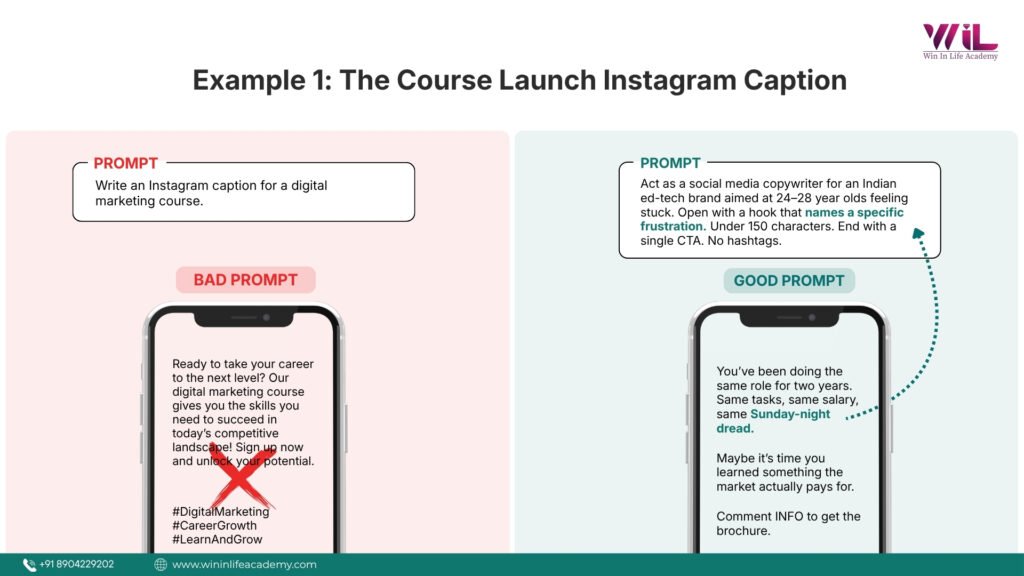
What changed: Audience specificity, a named role for the AI, a clear hook instruction, format constraints, and negative instructions on what to avoid.
Example 2: Cold email to a corporate L&D head
What changed: The role shifted the writing style. The audience context made the email land on a real pain point. The negative instructions stripped out clichés. The format constraint kept it tight.
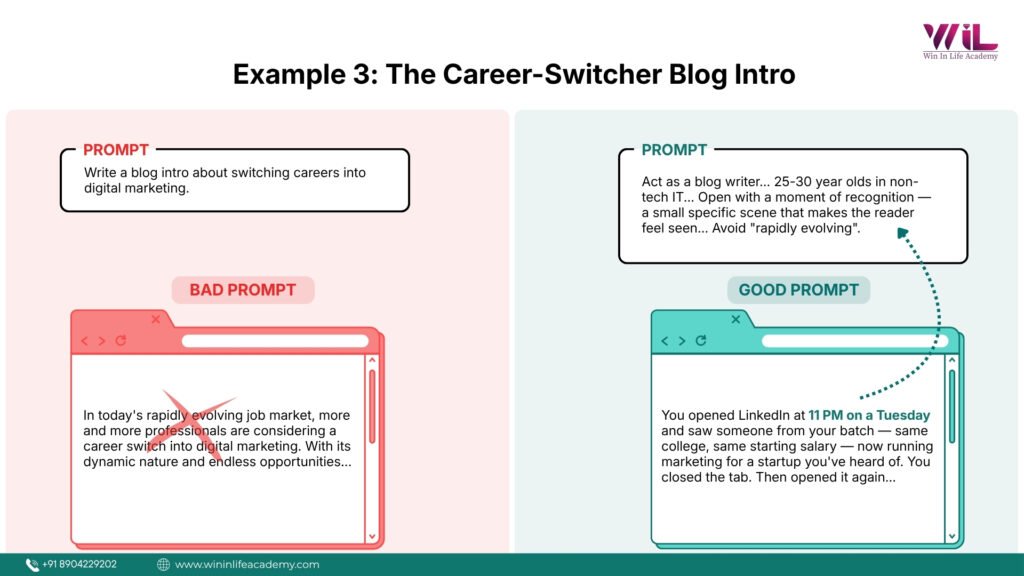
Example 3: Blog intro for a career-switcher audience
What changed: Specific audience profile, instruction to open with a scene (not a stat), negative constraints on clichéd language, and a clear directive on how to close.
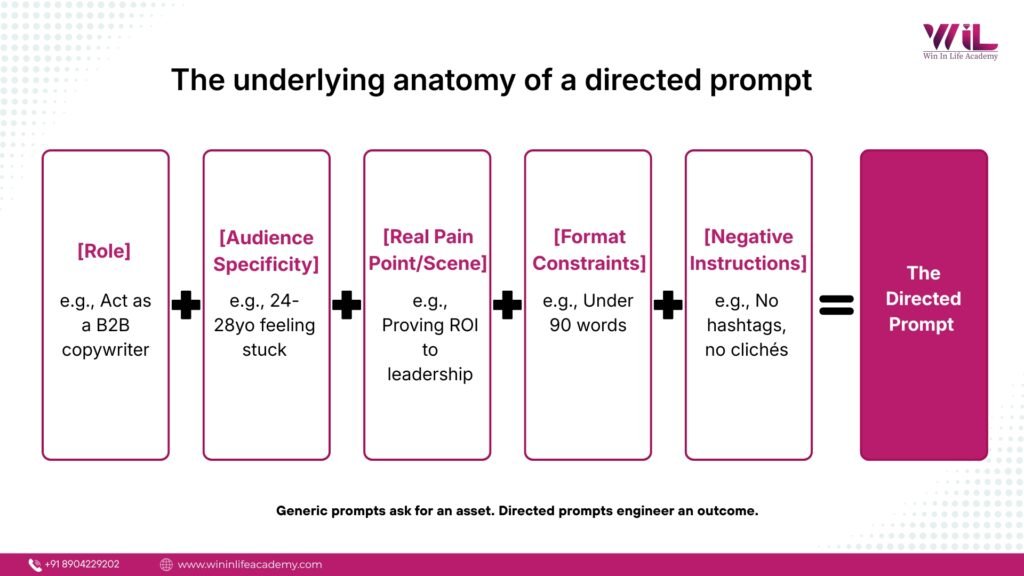
The pattern across all three examples is the same. Lazy prompts produce average output because they leave too many variables undefined. Directed prompts produce specific output because they remove the AI’s need to guess. You’re not writing better requests. You’re directing the scene.
How can marketers use prompt engineering in daily work?
Prompt engineering isn’t a separate task you do on the side. It plugs directly into work you’re already doing. Three areas where it changes output quality the most.
Content creation
Blog drafts, captions, scripts, email sequences, landing page copy. Most marketers use GenAI tools for these already. The question is whether you’re getting drafts you can ship or drafts you have to rewrite. This is where prompt engineering in content marketing earns its weight.
A directed content prompt names the audience stage (top-of-funnel vs. consideration vs. decision), the publication context (where it lives, what surrounds it), and the structural constraints (length, format, must-include and must-exclude points). With those defined, you go from generating 5 versions and picking one to generating 1 version that’s 80% there.
Quick example: instead of “write a blog on email marketing,” try “write a 1500-word blog on email marketing for SaaS founders running their first cold outbound campaign. Open with a common mistake, follow with a 5-step framework, include one real-world example per step. Avoid generic stats.”
The second prompt won’t give you perfect copy. It’ll give you copy you can edit in 20 minutes instead of rewriting from scratch in two hours. The same logic applies when you’re crafting the best prompts for SEO content: tell the AI the keyword, the search intent, the competitor angle to beat, and the format you want.
Ad copy and campaign variations
Performance marketers test variations. That’s the job. AI is built for this, generating 10 hooks, 5 angles, 3 CTAs in seconds. But only if you direct it properly.
A weak prompt asks for “10 ad hooks for a fitness app.” You’ll get 10 versions of the same generic hook. A directed prompt names the audience (e.g., “men aged 30-40 who’ve tried gyms but quit within a month”), the emotional angle (“frustration with starting over”), the platform (“Meta feed ads, first 3 seconds matter”), and the format (“each hook under 8 words, no questions, no exclamation marks”).
That’s how you get variation that’s actually testable instead of 10 hooks that look like rewrites of each other. If you want to understand how prompt engineering fits across different marketing channels, our breakdown of the 8 types of digital marketing shows where each channel demands a different prompting approach.
Audience research and personalization
This is the area most marketers underuse. AI can simulate audience perspectives, draft buyer persona pain-point maps, and rewrite the same message for different segments in seconds. But the output is only as good as the input.
A directed prompt for audience research looks like: “You’re a 32-year-old mid-level product manager at a Series B startup in Bangalore. You’re considering switching to a senior PM role at a bigger company but worried about leaving a team you built. List the top 5 anxieties you’d have, in your own words, in priority order.”
You’re not asking the AI to write copy. You’re asking it to be the audience for a moment. The output gives you real angles to write from, angles you might not have arrived at through traditional research. Pair this with the right GenAI tools for digital marketers (ChatGPT for ideation, Claude for long-form drafts, Gemini for research synthesis) and you’ve replaced a week of persona workshops with an afternoon of focused prompting.
Ready to Apply This to Real Campaigns?
The Advanced Diploma in Digital Marketing + AI Essentials includes IBM-guided labs, live marketing simulations, and a full capstone project.
You’ll build AI-driven campaigns end to end, from prompt-engineered content to automated workflows and performance analytics.
View Course →Common mistakes marketers make with AI prompts
Most marketers don’t fail at prompt engineering because they don’t know the techniques. They fail because they fall into the same patterns repeatedly. Five mistakes that cover most of them.
Treating AI like a search bar
Typing one-line requests and expecting publish-ready output. AI isn’t Google. Google finds existing content. AI generates new content based on your instructions. One-line instructions produce one-line-quality output.
Not defining the audience
“Write a post for working professionals” tells the AI almost nothing. Working professionals in tech and working professionals in manufacturing read completely different content. Specificity isn’t optional.
Ignoring AI hallucinations
Generative AI tools sometimes invent facts, stats, sources, or quotes that sound plausible but aren’t real. This happens because LLMs are pattern-prediction engines, not fact-retrieval systems.
Skipping the role assignment
Without a named role, the AI defaults to a generic, slightly corporate voice. Naming the role (copywriter, SEO strategist, performance marketer, brand storyteller) reshapes the entire output.
Not specifying format
If you don’t tell the AI what format you want, length, structure, layout, what to include, it picks whatever it considers most common. Which is usually wrong for your specific use case.
Accepting the first response
This is the biggest one. The first output is rarely the best. Iteration, refining the prompt, pushing back on what didn’t work, asking for variations, is where good output becomes great output. Marketers who treat the first response as the final response leave most of the value on the table.
Is prompt engineering a technical skill?
No. Prompt engineering is a communication skill, not a coding skill. You don’t need to know Python, machine learning, or how transformer models work. What you need is the ability to explain a task clearly. The same skill you use when briefing a designer, onboarding a new hire, or writing instructions for a freelancer.
The marketers who get good at this fast aren’t the ones with technical backgrounds. They’re the ones who already think carefully about audience, tone, brand, and message. Because those are exactly the variables that go into a strong prompt. If you’ve ever written a creative brief, you already have 70% of the skill. The remaining 30% is learning to apply that same thinking when the recipient of the brief is a machine, not a person.
The “engineering” in prompt engineering is misleading. It’s not engineering in the technical sense. It’s engineering in the architectural sense, designing instructions with structure and intent.
Building this skill is less about understanding how Large Language Models work under the hood and more about developing the AI skills that turn machine output into usable marketing assets.
Turn This Skill Into a Marketing Career
Graduates of the Advanced Diploma in Digital Marketing + AI Essentials step into roles like:
- AI Marketing Analyst
- Performance Marketing Executive
- Growth Marketing Manager
- Digital Marketing Specialist
Placement support, hiring partner network, and interview prep included.
View Course →How to get better at prompt engineering
Four habits separate marketers who plateau from marketers who keep improving.
Build a personal prompt library
Every time a prompt produces output you’d actually ship, save it. Organize by use case: ad hooks, blog intros, email subject lines, audience research. Within six months, you’ll have a personal library that turns most tasks into fill-in-the-blank exercises.
Iterate, don’t accept
When the first output isn’t right, don’t start over. Tell the AI what was off and ask it to revise. “Make it shorter.” “Tone is too formal.” “The hook isn’t specific enough, try again with a real frustration.” Iteration is where prompts get sharpened.
Reverse-engineer good prompts
When you see AI output online that’s surprisingly good, ask yourself: what was the prompt likely to have been? Try to recreate it. This trains your instinct for what works.
Test the same prompt across different LLMs
ChatGPT, Claude, Gemini, and others have different strengths. The same prompt produces different output across them. Knowing which tool to reach for in which situation is part of the skill.
Each GenAI tool has been trained differently, so the same prompt produces different results across them. Knowing which AI tool to reach for in which situation is part of the skill.
The marketers who get great at this don’t study prompt engineering in isolation. They practice it inside real work, every day, on tasks they were going to do anyway. If you want a structured path instead of self-teaching, an AI prompt engineering course built specifically for marketers can compress months of trial-and-error into weeks.
Conclusion
The marketers who’ll win the next few years aren’t the ones who adopted generative AI first. They’re the ones who learned to direct it.
Going back to where we started: working with AI isn’t writing. It’s directing. You’re not asking a machine to produce content. You’re setting the scene, casting the actor, writing the line, and shaping the delivery. Everything you leave undefined, the AI fills in with its own defaults. And the defaults are why most AI output feels generic.
Prompt Engineering for Digital Marketers isn’t a side skill. It’s the central skill of marketing in the era of accessible AI. The marketers who treat it that way will out-ship, out-test, and out-position the ones who don’t. The ones who don’t will keep blaming the tool.
The tool isn’t the problem. The instruction is.
If you’re serious about building this skill alongside the rest of the modern marketing stack (SEO, performance marketing, content strategy, analytics), Win In Life Academy’s Digital Marketing Course is built for exactly this moment. It includes a full prompt engineering course module with a certificate on completion, covering AI-integrated workflows from day one, not as an add-on but as the way marketing actually gets done in 2026.
For senior analytics and data professionals reading this who want to go beyond marketing prompts into enterprise-level AI strategy, the Professional Certificate in Analytics Leadership & Generative AI is a 5-month program covering generative AI, agentic AI, MLOps, and cloud-native analytics leadership.
FAQs
1.Do I need to learn coding for prompt engineering?
No. Prompt engineering is a communication and structuring skill. If you can write a clear creative brief, you can write a strong prompt. Coding is unrelated.
2. What’s the difference between a prompt and prompt engineering?
A prompt is any input you give to an AI. Prompt engineering is the practice of designing that input strategically, with context, role, audience, format, and tone, to get reliably better output.
3. Which AI tool is best for marketers?
There isn’t one. ChatGPT is strong for general content, Claude for long-form and nuanced writing, Gemini for research-heavy tasks. Most marketers use 2-3 tools and switch based on the task.
4. Can prompt engineering replace a copywriter?
No, but it changes what copywriters do. Copywriters who use prompt engineering well produce significantly more output. Copywriters who don’t are competing with marketers who do.
5. How long does it take to learn prompt engineering?
The basics (context, role, audience, format, tone) take about a week of active practice. Getting genuinely good takes 2-3 months of using it inside real work. There’s no certification that matters; the skill is judged by output quality.
6. Is there a structured prompt engineering course for marketers?
Yes. Win In Life Academy’s Digital Marketing program includes a dedicated prompt engineering for marketing module with hands-on training and a certificate on completion. It’s designed for marketers, not engineers.
7. How do I write a prompt that gets better marketing copy from ChatGPT?
Start by giving ChatGPT four things: a role (e.g., “act as a B2B copywriter”), an audience (specific demographic, stage, and pain point), a format (length, structure, what to include and exclude), and a tone (with examples of clichés to avoid). A complete prompt is usually 4-7 lines, not one sentence. The more specific your instructions, the less editing you do afterward.
8. What are some examples of good prompts for digital marketing?
A strong digital marketing prompt names the role, audience, context, format, and tone in 4-7 lines. For example: “Act as a B2B SaaS copywriter. Write a 100-word LinkedIn post for founders of early-stage startups struggling with cold outbound. Open with a specific frustration, not a stat. Avoid clichés like ‘in today’s market.’ End with a question that invites replies.”
Compare that to “write a LinkedIn post about cold outbound,” which produces generic output. The blog above includes three full bad-prompt vs. directed-prompt examples across Instagram captions, cold emails, and blog intros.
9. Can I use the same prompt across ChatGPT, Claude, and Gemini?
Yes, but the output will differ. The same prompt produces different results across LLMs because each model has different training data, response styles, and default tones. ChatGPT tends toward general-purpose conversational output. Claude is stronger at long-form nuance and instruction-following. Gemini integrates real-time search and is better at research-heavy tasks. Most experienced marketers maintain a prompt library and adapt the same base prompt slightly per tool.
10. How long should a marketing prompt be?
A useful marketing prompt is typically 4-7 lines or 60-150 words. Shorter than that and you’re leaving too many variables undefined. Longer than 200 words and you start confusing the AI with conflicting or redundant instructions. The goal isn’t length, it’s completeness: cover role, audience, context, format, and tone in as few words as needed. A well-structured 80-word prompt outperforms a rambling 300-word one almost every time.