
The core ethical hacking skills required are networking fundamentals, understanding how systems fail, hands-on practice, basic scripting, correct use of security tools, analytical problem-solving, and clear communication. These skills must be built in sequence because each one directly enables the next.
if you search for how to become an ethical hacker, almost every guide points you toward tools. Install Kali Linux. Run Nmap. Use Metasploit. And for someone starting out, this feels like the right direction because tools make everything look practical and immediate.
But this is exactly where most beginners go wrong, and most of them do not realize it until much later.
Knowing how to operate a tool is not the same as knowing how to think like someone who breaks systems for a living. Two people can follow the same tutorials, use the same software, and end up at completely different levels of competence. One learns to repeat steps. The other learns to understand systems, question their behavior, and find where they fail even without instructions. That gap does not come from the tools they used. It comes from how their ethical hacking skills were built.
With approximately 4.8 million cybersecurity roles currently unfilled globally, the demand for people with strong information security skills who can genuinely think through security problems rather than just run scans has never been higher. The real question is not which tools to install. It is what skills required for ethical hacking actually look like in practice, and in what order they need to be built.
This blog answers exactly that.
Key Takeaways
Ethical hacking is a structured progression of skills, not a collection of tools. Jumping straight to tools without foundational knowledge creates gaps that compound and limit you over time.
Networking fundamentals and understanding system behavior are the non-negotiable starting points. Without them, tool outputs are noise and vulnerabilities get missed entirely.
Hands-on practice in real lab environments, not passive learning, is what converts knowledge into actual skill. Pattern recognition only develops through repeated exposure to real scenarios.
Finding a vulnerability means nothing if you cannot explain it clearly. Communication and reporting are professional skills that determine whether your work creates real-world impact or sits ignored in a document.
7 Ethical Hacking Skills You Need to Build (In the Right Order)
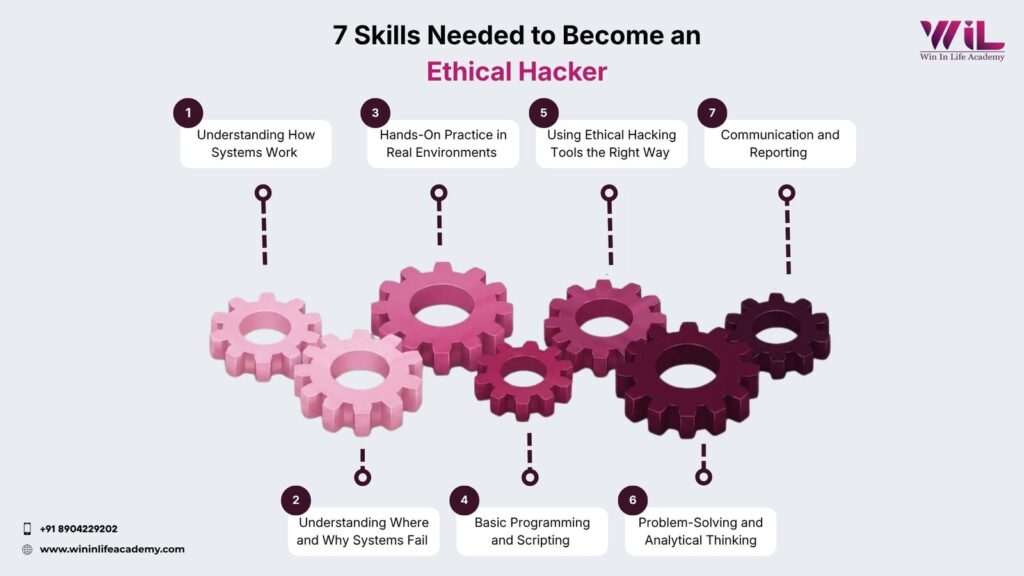
Ethical hacking is not a random collection of techniques you can pick up in any order. The skills are connected, and each one builds directly on the previous. When you understand them in the right sequence, the learning process becomes far less overwhelming and far more effective.
- Understanding How Systems Work
- Understanding Where and Why Systems Fail
- Hands-On Practice in Real Environments
- Basic Programming and Scripting
- Using Ethical Hacking Tools the Right Way
- Problem-Solving and Analytical Thinking
- Communication and Reporting
Here is that progression, explained plainly.
- Understanding How Systems Work
The starting point for ethical hacking is not learning to attack anything. It is learning how systems function under normal conditions, how computers talk to each other, how operating systems manage processes and memory, and how web applications handle requests and responses.
This means getting comfortable with networking fundamentals like IP addresses, ports, DNS, and how protocols like HTTP and TCP/IP actually work. It means understanding Linux well enough to navigate and manage a system from the command line. It means knowing what happens behind the scenes when a user logs into a website and how data moves between a browser and a server.
Beginners frequently want to skip this stage because it feels theoretical. They want to get to the actual hacking. The problem is that without this foundation, tool outputs become meaningless noise. When Nmap shows you that port 22 and port 80 are open on a system, a beginner sees two numbers. Someone with networking knowledge sees an SSH service and a web server, and immediately knows where to focus their testing and what questions to ask next.
You cannot identify what is wrong with a system if you do not know what right looks like. This is the non-negotiable starting point, and it is one of the core cybersecurity analyst skills that separates entry-level professionals from people who are genuinely effective in the field.
- Understanding Where and Why Systems Fail
Once you understand how systems are supposed to work, the natural next step is learning how they break down. Most vulnerabilities in real systems exist not because developers are careless but because systems are built on assumptions, and assumptions under the right conditions can be broken.
At this stage, you should get familiar with the OWASP Top 10, which documents the most common and critical vulnerabilities in web applications. You should understand how authentication and session management work, how access control is supposed to be enforced, and what happens when user input is not properly validated.
Consider a simple example. You log into a web application and notice the URL reads /dashboard?user_id=102. You change it to user_id=103 and suddenly you are looking at someone else’s account. No tool found this. You found it because you understood how the application was supposed to restrict access and tested whether it actually did. That is a broken access control vulnerability, and it is one of the most common issues in real-world applications.
This is where your thinking begins to shift from asking which tool to run to asking where this system might be making a bad assumption.
- Hands-On Practice in Real Environments
Reading about vulnerabilities and understanding them conceptually is necessary, but it is nowhere near sufficient. Ethical hacking is a practical discipline, and the only way to genuinely develop these skills is by applying them in real environments.
This means working through Capture The Flag challenges, using deliberately vulnerable practice applications, and spending time in lab environments designed for testing. Platforms like Hack The Box, TryHackMe, and OWASP’s WebGoat exist specifically for this purpose, and they are where a lot of the real learning happens for anyone pursuing ethical hacking for beginners level content all the way up to advanced practice.
What matters during practice is not just finding the answer. It is understanding why the vulnerability exists, what conditions made it exploitable, and how it might appear differently in another context. When you work through a login page that allows unlimited attempts without lockout, you are not just finding a brute-force weakness. You are developing the pattern recognition that will help you spot similar misconfigurations in environments you have never seen before.
This stage also builds patience and the ability to work through problems without a clear path forward, which turns out to be one of the most important qualities a real ethical hacker needs.
- Basic Programming and Scripting
You do not need to be a software developer to work in ethical hacking, particularly at an entry level. But having a working knowledge of scripting, specifically Python or Bash, changes what you are capable of doing and how efficiently you can do it.
The practical value is straightforward. If you need to test a login form with hundreds of username variations, doing it manually is not realistic. A simple Python script that sends requests, captures responses, and flags successful attempts turns a multi-hour task into a few minutes of automated work. That is not an advanced capability. It is a basic one that separates someone who tests systematically from someone who just tries things manually.
The deeper value is less obvious but more important. When you understand how code works, you understand how applications are built. You can look at a web form and think about what the developer probably wrote to handle that input and where that code might have gaps. Programming gives you a mental model of the system from the inside, which makes you significantly better at finding where the outside does not behave as expected.
- Using Ethical Hacking Tools the Right Way
Ethical hacking tools are essential to this work. Wireshark for analyzing network traffic, Nmap for discovering services, Burp Suite for intercepting and modifying web requests, Metasploit for testing known exploits. These are standard parts of the job. But the way most beginners approach tools is backwards.
Tools are not solutions. They are instruments. And an instrument is only as useful as the person interpreting what it produces.
Here is a concrete illustration of why this matters. You run a Metasploit module against a target and it reports that an exploit might succeed. A beginner assumes the system is vulnerable and moves on. But when you verify manually, checking the exact service version and confirming the conditions the exploit requires, you realize it is a false positive. The system is not actually vulnerable. If you had trusted the tool completely, you would have written an inaccurate report.
Real-world testing produces incomplete outputs, false positives, and results that require human interpretation. The skill is not in running the tool. It is in knowing what the tool is actually telling you, what it might be missing, and what to do next based on that information.
- Problem-Solving and Analytical Thinking
Every guide tells you to develop a problem-solving mindset, and it is almost always left at that, a vague instruction with no practical meaning. Here is what it actually looks like in practice.
You are testing a web form. Nothing about it triggers any obvious vulnerability. Standard inputs return standard responses. A beginner stops here and concludes there is nothing to find. An ethical hacker does not stop. They change the approach. They try unexpected character types. They modify request headers. They send data in formats the application might not be designed to handle. They look at how the system responds to inputs it was not built to expect.
After several attempts, the application starts behaving strangely when it receives certain special characters. That strange behavior becomes a thread to pull. No tool surfaced this. It came from persistence, from testing beyond the obvious, and from recognizing that nothing found yet is not the same as nothing to find.
This is the skill that determines whether you can work in environments where there are no instructions, no hints, and no predefined path to the answer. It develops through practice and through repeatedly choosing to push further rather than accept the first result.
- Communication and Reporting
Finding a vulnerability is half the job. The other half is making sure that finding actually changes something.
In a real professional context, you will rarely be reporting to someone with a technical background identical to yours. Developers, managers, and executives need to understand what the vulnerability is, what it allows an attacker to do, what data or systems are exposed, and what needs to happen to fix it. If you cannot explain those things clearly, your finding sits in a report and nothing gets fixed.
The difference between a useful report and a useless one is not technical depth. It is clarity. Instead of writing “there is an access control vulnerability in the user dashboard,” a useful report explains that an authenticated user can access any other user’s account data by modifying a single parameter in the URL, that this exposes personal information for every account in the system, and that fixing it requires server-side validation of the user’s identity before returning account data.
At entry level, this means practicing writing clear, structured notes about what you tested, what you found, and what it means. This skill develops alongside your technical abilities, not after them, and it is what ultimately determines whether your work creates real impact or just sits in a document.
How These Skills Work Together
The reason this ethical hacking skills progression works is that each skill directly enables the next.
Networking fundamentals give you the ability to read tool outputs intelligently. Understanding vulnerabilities gives you something specific to look for during hands-on practice.
Practice builds the pattern recognition that makes scripting and tool use purposeful rather than mechanical. Problem-solving carries you through the situations where none of the above gives you a clear answer. And communication turns all of it into something that actually matters outside of a lab environment.
Skipping any stage in this sequence does not just slow you down. It creates gaps that compound over time. Someone who jumps straight to ethical hacking tools without foundational knowledge will keep hitting the ceiling of what those tools can tell them.
Someone who practices without understanding vulnerabilities will find things accidentally rather than systematically. The progression is not arbitrary. It reflects the actual structure of the work.
How Long Does It Take to Become Job-Ready in Ethical Hacking?
If you are asking how do I become an ethical hacker and how long it realistically takes, the honest answer is 6 to 12 months with consistent, structured practice. The range depends heavily on how much hands-on work you are doing, not just how much you are reading or watching. Passive learning compresses poorly into real skill. Active practice in lab environments, CTF challenges, and real application testing is what actually moves you forward.
If you want a structured path that covers all of these skills in the right sequence, this Cybersecurity Course is built specifically for this. The program is built around the ethical hacking skills that employers actually test for rather than throwing tools and concepts at you randomly. This program walks you through the full progression from networking fundamentals to hands-on testing to professional reporting, with the right ethical hacking certification guidance built in so that every skill you build has a clear purpose and connects to the next.
If you are serious about entering this field without wasting months figuring out what to learn and in what order, exploring ethical hacker courses at Win In Life Academy is a practical next step.
Frequently Asked Questions
- What is the difference between ethical hacking and penetration testing?
Ethical hacking is a broad term for authorized testing of systems to find security weaknesses. Penetration testing is a specific, structured form of ethical hacking where a defined scope, methodology, and reporting process are agreed upon in advance. All penetration testers do ethical hacking, but not all ethical hacking is a formal penetration test.
- Do I need a computer science degree to become an ethical hacker?
No, a degree is not a requirement. Many working ethical hackers and penetration testers come from non-traditional backgrounds. What employers actually evaluate is demonstrated skill, which includes hands-on experience, recognized certifications like CEH or OSCP, and the ability to explain and solve real security problems.
- Is Python necessary for ethical hacking?
Python is not mandatory at entry level, but it becomes increasingly useful as you progress. Basic scripting in Python or Bash allows you to automate repetitive tasks, process tool outputs, and write simple testing scripts. The sooner you develop basic comfort with it, the more effective your testing becomes.
- How important is Linux for ethical hacking?
Linux is essential. The majority of security tools, testing environments, and professional infrastructure in cybersecurity run on Linux. You do not need to be a system administrator, but you need to be comfortable navigating the file system, managing processes, and working from the command line without relying on a graphical interface.
- What does an ethical hacker actually do day to day?
Day-to-day work typically involves scoping engagements with clients, performing reconnaissance on systems, testing applications and networks for vulnerabilities, documenting findings clearly, and writing reports that explain risks and recommended fixes. A significant portion of the work is analysis and documentation, not just active testing.
- Can I learn ethical hacking without prior IT experience?
Yes, but expect the early stages to take longer. Networking fundamentals and operating system basics are genuinely foundational, and if you have no prior exposure, you will need to build those before moving into security-specific content. Starting with CompTIA Network+ or Linux basics is a practical first step.
- What is the OWASP Top 10 and why does it matter?
The OWASP Top 10 is a regularly updated list of the most critical security risks in web applications, maintained by the Open Web Application Security Project. It matters because it reflects what vulnerabilities are actually appearing in real systems at scale. For anyone learning web application security, it is the most practical starting framework available.
- Do I need certifications to get a job in ethical hacking? Certifications help, particularly OSCP, which is widely respected because it requires passing a practical hands-on exam rather than a multiple-choice test. CEH is more widely recognized in corporate environments. That said, certifications alone are not enough, and employers consistently value demonstrated practical skill over credentials on paper.
- What is the difference between learning about a vulnerability and actually testing for it? Learning about a vulnerability gives you a conceptual understanding of what can go wrong. Testing for it in a real or practice environment shows you how that weakness actually behaves, what conditions trigger it, and how it might appear differently across systems. Both are necessary, but practice is what converts knowledge into usable skill.
- How do I know if I am actually improving in ethical hacking? A reliable signal is when you can interpret tool outputs without needing to look up what they mean, identify potential vulnerabilities without being told where to look, and work through unfamiliar environments without needing step-by-step guidance. Completing tutorials is not the same as improving. Independent problem-solving in environments you have not seen before is the real measure.