
Choosing between a Business Analyst and a Product Owner is confusing for most beginners. On the surface, both roles seem similar. Both work with stakeholders, collaborate with development teams, and contribute to building products.
But this similarity is misleading. The actual difference lies in what each role is responsible for and the level of decisions they make.
This blog breaks down the difference between a Business Analyst and a Product Owner in simple terms. By the end of it, you’ll understand exactly what each role does, how they differ in responsibility and decision-making, and which career path makes more sense for you.
Key Takeaways
- Business Analyst focuses on defining requirements, while a Product Owner focuses on prioritizing product features
- Business Analyst is a more accessible starting role, whereas Product Owner usually requires prior experience
- Product Owners have final say in what gets built, while Business Analysts support with clarity and analysis
- Product Owner salaries are generally higher due to ownership of business outcomes
- Business Analysts are in demand across industries, while Product Owners are highly sought after in Agile and product-based companies
Business Analyst vs Product Owner: What’s the Difference
What is a Business Analyst
A Business Analyst is responsible for understanding business problems and translating them into clear, detailed requirements that development teams can build. Their focus is on clarity, accuracy, and ensuring that the solution matches the business need.
According to the International Institute of Business Analysis, Business Analysts focus on enabling change by defining needs and recommending solutions.
What is a Product Owner
A Product Owner is responsible for deciding what the product team should build and in what order. Their focus is on prioritizing features based on business value, customer needs, and overall impact.
As defined in the Scrum Guide, the Product Owner is accountable for maximizing the value of the product.
Business Analyst vs Product Owner: Which Career Should You Choose
Choose Business Analyst if….
You enjoy breaking down problems, asking questions, and getting clarity before anything is built. You like structured thinking, detailed work, and making sure nothing is missed. If you prefer working with logic, processes, and clear requirements rather than making high-level decisions, this role fits you better.
Choose Product Owner if….
You are comfortable making decisions with limited information and handling trade-offs. You care more about outcomes than details and prefer deciding what matters most at a given time. If you like ownership, prioritization, and working closely with business goals and customer impact, this role is a better fit.
Simple way to decide between Business Analyst and Product Owner
Think about the type of work you would rather do every day.
If you prefer understanding a problem in detail, asking questions, and clearly defining how a feature should work before it is built, Business Analyst is the better fit.
If you prefer deciding which features should be built first, what can wait, and what will create the most impact for users or the business, Product Owner is the better fit.
In short, one role focuses on clarity before building, the other focuses on deciding what is worth building.
What Does a Business Analyst Do (Roles and Responsibilities Explained)
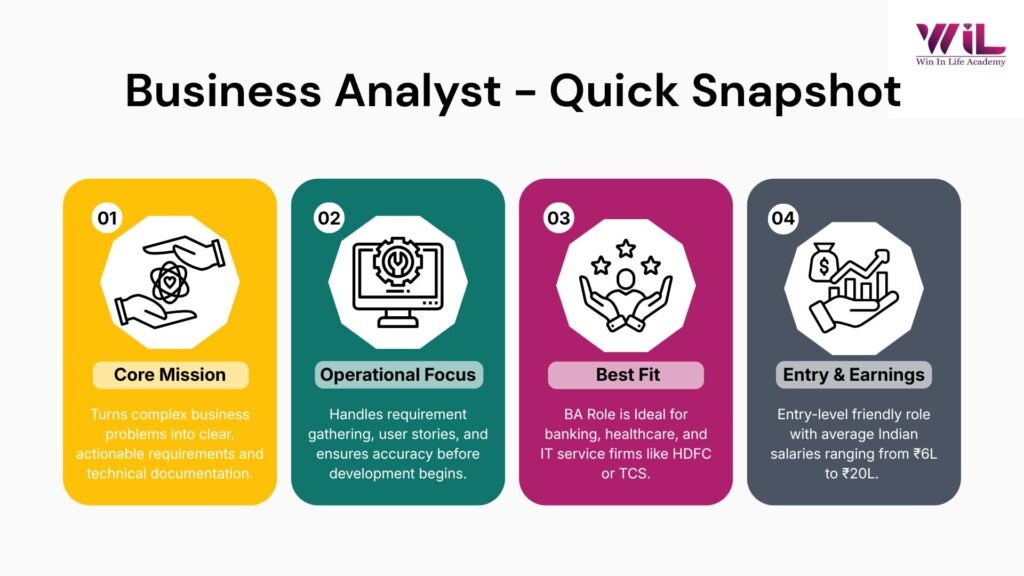
Core responsibility of a Business Analyst
A Business Analyst is responsible for understanding business problems and turning them into clear, structured requirements that a development team can execute. The goal is to remove ambiguity so that what gets built actually solves the right problem.
Day-to-day tasks of a Business Analyst
A typical day involves working closely with stakeholders to understand what they need and why they need it. This includes asking detailed questions, identifying gaps, and clarifying assumptions that are often missed at the initial stage.
Once the problem is clearly understood, the Business Analyst translates it into structured requirements by writing user stories, defining acceptance criteria, and mapping workflows. During development, they stay involved to resolve doubts, handle requirement changes, and support testing to ensure the final output matches the expected behavior.
Where do Business Analysts work
- Banking and financial services (for example: Goldman Sachs, JPMorgan, HDFC Bank)
Business Analysts work on systems related to payments, loans, compliance, and financial operations, where accuracy and regulatory alignment are critical
- Healthcare (for example: UnitedHealth Group, Philips Healthcare, Practo)
They help define workflows for patient management systems, hospital operations, and healthcare data platforms
- E-commerce (for example: Amazon, Flipkart, Meesho)
They focus on improving user journeys, checkout processes, and backend systems that support large-scale transactions
- Consulting and IT services (for example: Accenture, TCS, Infosys)
They work on multiple client projects, gathering and documenting requirements across different industries and systems
- Large enterprises and SaaS companies (for example: SAP, Oracle, Zoho)
They support internal tools, enterprise systems, and product features by ensuring clear and structured requirements
What Does a Product Owner Do (Roles and Responsibilities Explained)
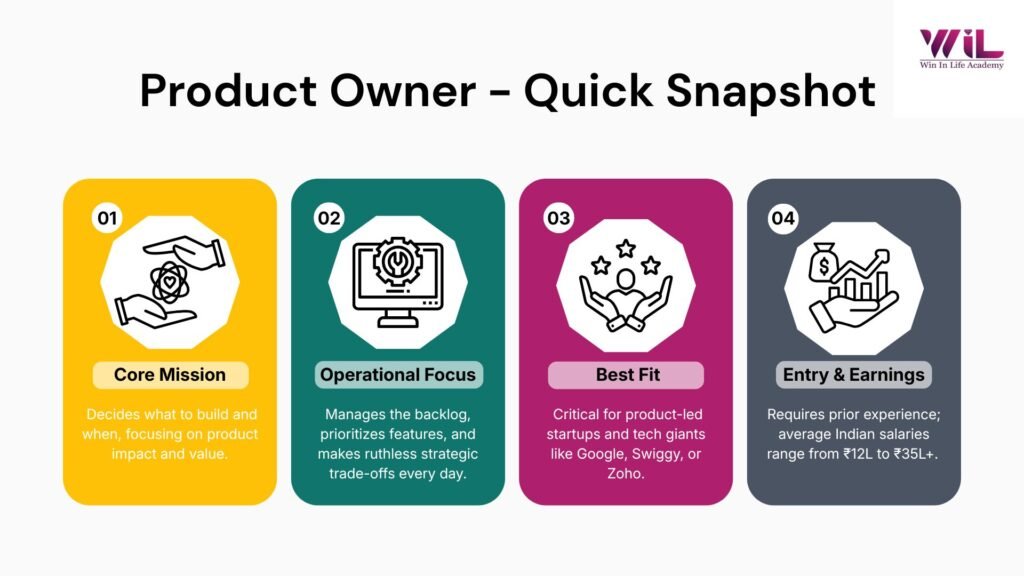
Core responsibility of a Product Owner
A Product Owner is responsible for deciding what the product team should build and in what order. The goal is to ensure that the team is always working on the most valuable features based on business goals, customer needs, and impact.
Day-to-day tasks of a Product Owner
A typical day revolves around prioritization and decision-making. The Product Owner continuously reviews and updates the product backlog based on changing business needs and user feedback. They work closely with stakeholders to understand goals, align on priorities, and manage expectations.
During sprint planning, they decide what the team will work on next and clarify what success looks like. As development progresses, they stay involved to answer questions, make trade-off decisions, and ensure that the final output delivers real value.
Where do Product Owners work
- Product-based tech companies (for example: Google, Microsoft, Freshworks)
Product Owners manage features, prioritize roadmaps, and ensure continuous product improvement based on user needs
- Startups and high-growth companies (for example: Swiggy, Razorpay, CRED)
They handle fast-moving priorities, make quick decisions, and balance growth with product direction
- SaaS companies (for example: Zoho, Salesforce, HubSpot)
They focus on feature prioritization, customer feedback, and iterative releases
- E-commerce and digital platforms (for example: Amazon, Flipkart, Myntra)
They optimize product features that impact user experience, conversions, and business growth
- Agile teams in enterprises (for example: Infosys, Accenture, Capgemini)
They work within Agile frameworks to align development work with business priorities and delivery goals
Difference Between Business Analyst and Product Owner (Key Differences)
| Aspect | Business Analyst | Product Owner |
|---|---|---|
| Focus | Ensures requirements are clear, detailed, and complete | Ensures the team works on the most valuable features |
| Decision-making | Supports decisions through analysis and clarity | Makes final decisions on prioritization and scope |
| Ownership | Owns requirement accuracy and completeness | Owns product outcomes and value delivery |
| Level of work | Works at execution level, focusing on feature clarity | Works at product level, focusing on direction and impact |
Skills Required for Business Analyst vs Product Owner
Key skills required for a Business Analyst
A Business Analyst needs strong analytical thinking to break down complex problems and identify gaps. Clear communication is critical, especially when working with stakeholders who may not explain requirements properly. They must be comfortable with structured documentation, writing user stories, defining acceptance criteria, and mapping workflows. Attention to detail is important because even small gaps in requirements can lead to rework during development.
Key skills required for a Product Owner
A Product Owner needs strong decision-making ability because they constantly choose what gets built and what gets delayed. Prioritization is a core skill, along with the ability to evaluate business impact and trade-offs. They must be confident in stakeholder communication, often balancing competing expectations. A good understanding of Agile practices is important, along with the ability to focus on outcomes rather than just tasks.
Common skills both roles share
Both roles require strong communication, the ability to work with cross-functional teams, and a solid understanding of the business domain. They also need to translate complex ideas into clear inputs for development teams, even though the focus of that communication differs.
Business Analyst vs Product Owner Salary in India (2026)
Salary comparison by experience level and region
| Experience Level | India (₹ per year) | United States ($ per year) | Europe (€ / £ per year) |
|---|---|---|---|
| Business Analyst (Entry: 0–2 yrs) | ₹6L – ₹10L | $60K – $80K | €40K – €55K |
| Business Analyst (Mid: 3–6 yrs) | ₹8L – ₹14L | $80K – $110K | €55K – €75K |
| Business Analyst (Senior: 7+ yrs) | ₹14L – ₹20L+ | $100K – $120K+ | €70K – €90K+ |
| Product Owner (Entry: 0–2 yrs) | ₹8L – ₹12L | $70K – $90K | €50K – €65K |
| Product Owner (Mid: 3–6 yrs) | ₹12L – ₹25L | $90K – $120K | €65K – €85K |
| Product Owner (Senior: 7+ yrs) | ₹20L – ₹35L+ | $110K – $130K+ | €80K – €100K+ |
These salary ranges are based on aggregated data from platforms like Glassdoor and Payscale.
Why Product Owners usually earn more than Business Analysts
Product Owners are responsible for deciding what gets built and whether it delivers real business value. Their decisions directly impact revenue, customer experience, and product growth, which is why companies pay more for this role.
Also, Product Owner is not typically an entry-level role. Most professionals move into it after gaining experience as a Business Analyst, Product Analyst, or similar roles. This means Product Owners are usually hired at mid or senior levels, which pushes salaries higher.
Factors affecting salary (location, company, domain)
Location
Salaries are higher in tech hubs like Bangalore, Hyderabad, and Mumbai, and significantly higher in markets like the US and Europe.
Company type
Product-based companies and SaaS firms usually pay more than service-based companies due to direct impact on product and revenue.
Domain expertise
Experience in domains like fintech, SaaS, healthcare, or e-commerce increases earning potential.
Job Demand: Business Analyst vs Product Owner Career Growth
Demand for Business Analysts across industries
Business Analysts have consistent demand across industries because their role is not limited to product companies or Agile environments. They are needed wherever organizations are improving processes, building systems, or handling large-scale operations. Industries like banking, healthcare, consulting, government, and enterprise IT regularly hire Business Analysts to bring structure and clarity to complex problems.
Demand for Product Owners in Agile and product companies
Product Owners are in high demand in companies that build and continuously improve digital products. This includes startups, SaaS companies, fintech firms, and e-commerce platforms. As more organizations adopt Agile ways of working, the need for professionals who can prioritize features and drive product decisions is increasing.
Product Owner job demand is growing rapidly in Agile and product-driven companies, especially in startups and SaaS environments.
Long-term career growth comparison
Business Analysis offers stable and broad career opportunities across industries, making it easier to enter and switch domains. Product Ownership offers faster growth in product-driven environments, especially for those who move into leadership roles and influence product strategy.
In simple terms, Business Analyst is a stable entry point with wide applicability, while Product Owner is a higher-responsibility role with faster growth in product-focused companies.
This also reflects the typical BA vs PO career path, where many professionals start as Business Analysts and move into Product Owner roles over time.
Job trends on platforms like LinkedIn show increasing demand for Product Owners in Agile and product-driven environments.
Can a Business Analyst Become a Product Owner
How to transition from Business Analyst to Product Owner
This is one of the most common career moves. Business Analysts already work closely with stakeholders and development teams, which gives them exposure to product discussions. To move into a Product Owner role, the shift is from analyzing requirements to making prioritization decisions. This means taking more ownership of the backlog, getting involved in sprint planning, and contributing to decisions around what should be built next.
Skills required to move into a Product Owner role
To make this transition, a Business Analyst needs to build decision-making confidence, understand how to prioritize based on business impact, and get comfortable with trade-offs. Knowledge of Agile practices is important, along with the ability to align stakeholders and focus on outcomes instead of just requirements.
Certifications from organizations like Scrum Alliance or PMI can support this transition.
How AI Is Impacting Business Analysts and Product Owners
Impact of AI on Business Analysts
AI is reducing the manual effort involved in documentation and analysis. Tools can now generate meeting summaries, draft requirements, and highlight patterns from data. This means Business Analysts spend less time writing and more time validating, refining, and thinking through problems. The role is shifting from documentation-heavy work to more analytical and decision-support work.
Impact of AI on Product Owners
AI is helping Product Owners make faster and more informed decisions. It can analyze user behavior, suggest feature priorities, and provide insights into what drives engagement or revenue. This allows Product Owners to rely less on guesswork and more on data when deciding what to build next.
Research by Gartner also shows how data-driven decision-making is becoming central to product roles.
Future skills you need to stay relevant
Understanding how to work with AI tools is becoming important for both roles. Business Analysts need to focus more on problem-solving and critical thinking rather than just documentation. Product Owners need to get better at interpreting data, making decisions based on insights, and balancing AI-driven inputs with real business context.
Industry reports from McKinsey & Company highlight how AI is shifting roles from manual tasks to more analytical and decision-support functions.
Conclusion
Business Analyst and Product Owner may work in the same environment, but they solve different problems. One focuses on clarity and execution, the other on direction and value. Understanding this difference is what helps you avoid choosing the wrong path early on.
If you are starting from scratch, trying to jump directly into high-responsibility roles rarely works. It makes more sense to first build strong fundamentals in analysis, problem-solving, and understanding how businesses actually operate.
That is where structured, hands-on learning becomes useful. Programs like Win in Life Academy’s PG Diploma in Business Analytics & Next-Gen AI are designed to help you build those core skills through practical projects, real-world use cases, and exposure to tools used in the industry. Instead of just learning concepts, you learn how to apply them in actual business scenarios.
Once you have that foundation, moving into roles like Business Analyst becomes much more realistic, and over time, transitioning into Product Owner roles becomes a natural next step.
The goal is not to chase titles. It is to build the right skills in the right order so you can grow into roles with more responsibility and impact.