
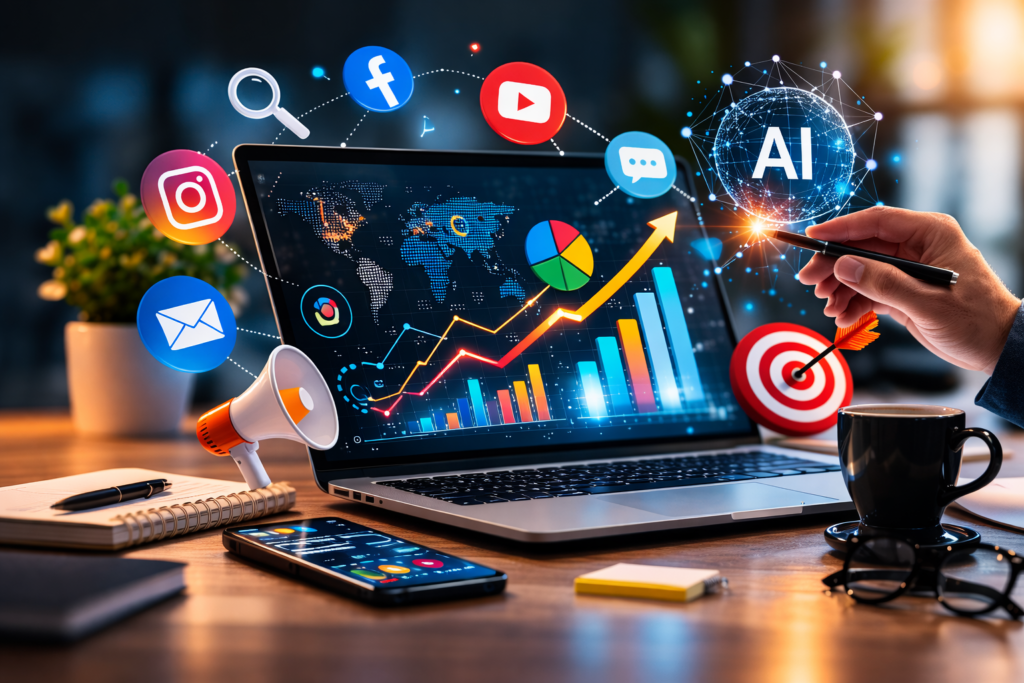
Digital marketing is the promotion of products and services through online channels such as search engines, social media, websites, email, and mobile apps to reach and engage targeted audiences.
Every time you search for a product, watch a quick review, or see an ad that feels perfectly timed, you’re witnessing digital marketing in action.
Today, people discover brands, compare options, and make buying decisions online more than ever before. Because of this shift, businesses no longer rely solely on traditional advertising — they use digital platforms to connect with the right audience at the right moment.
From the search results you trust to the ads that appear while scrolling, digital marketing plays a major role in how modern brands get noticed and stay relevant in a crowded online world.
In this blog, we’ll explore what digital marketing really means, how it works in practice, the major types and channels businesses use, and how AI is reshaping its future.
What Is Digital Marketing?
Digital marketing is the practice of promoting products or services through online platforms such as search engines, social media, websites, email, and mobile apps to reach, engage, and convert targeted audiences. It uses data, technology, and digital channels to deliver personalized messages, measure performance in real time, and build ongoing relationships with customers.
Unlike traditional marketing, which broadcasts messages to a broad audience, digital marketing focuses on delivering relevant content to specific users based on their interests, behavior, and online activity.
This approach allows businesses to attract potential customers, guide them through decision-making, and build long-term relationships using measurable and data-driven strategies.
By combining content, advertising, technology, and analytics, digital marketing helps brands stay visible, competitive, and responsive to changing consumer behavior.
How Digital Marketing Works in Practice
Digital marketing works by guiding potential customers through a journey — from discovering a brand to becoming loyal buyers. This journey is often described as a funnel with four key stages:
Awareness
At this stage, people first discover a brand through search results, social media posts, online ads, videos, or blog content. The goal is visibility and attracting attention.
Consideration
Once aware, potential customers begin comparing options. They may read reviews, explore websites, watch product demos, or follow social media pages to learn more and evaluate trust.
Conversion
This is the decision stage where the user takes action — making a purchase, signing up, downloading an app, or filling out a form. Clear messaging, offers, and a smooth user experience help drive conversions.
Retention
After conversion, businesses focus on keeping customers engaged through email updates, personalized offers, loyalty programs, and valuable content. Retention builds trust and encourages repeat purchases.
By moving customers through these stages, digital marketing helps businesses not only attract new buyers but also build long-term relationships and brand loyalty.
Why Digital Marketing Is Essential for Businesses Today
Consumers now rely heavily on the internet to discover products, compare options, read reviews, and make purchasing decisions. Whether searching on Google, scrolling social media, or watching video reviews, most buying journeys begin online. Without a strong digital presence, businesses risk remaining invisible to potential customers.
Digital marketing allows businesses to meet customers where they already spend their time — on search engines, social platforms, websites, and mobile apps. This visibility helps brands stay competitive, build credibility, and reach audiences beyond geographic boundaries.
Another major advantage is measurability. Unlike traditional advertising, digital marketing provides real-time insights into performance, including clicks, engagement, conversions, and return on investment (ROI). Businesses can track what works, adjust strategies quickly, and optimize spending for better results.
By combining online visibility, targeted reach, and measurable performance, digital marketing enables businesses to attract customers more efficiently, make data-driven decisions, and achieve sustainable growth.
For example, imagine you’re feeling hungry during work hours and search for “best biryani near me” on Google. You notice sponsored listings at the top, check ratings and photos, and click on a restaurant offering a discount. Later, while scrolling on Instagram, you see a limited time offer from a food delivery app for the same restaurant. That timely reminder nudges you to place an order — showing how search visibility, reviews, targeted ads, and personalized offers work together to influence your decision.
What Are the Main Types of Digital Marketing?
Digital marketing isn’t a single strategy — it’s a mix of methods that help businesses attract, engage, and convert customers online. Each type plays a unique role, from helping people discover a brand to nurturing relationships and driving sales.
Understanding these types makes it easier to see how businesses create a complete digital presence and reach customers at different stages of their journey.
Search Engine Optimization (SEO)
Search Engine Optimization (SEO) is the practice of improving a website’s visibility in search engine results when people look for information, products, or services online. Rather than paying for placement, SEO strengthens a site’s relevance and credibility through high-quality content, keyword alignment, technical performance, and a seamless user experience.
Because it connects businesses with users who are actively searching, SEO drives high-intent traffic — people who already have a need and are looking for solutions. Over time, this builds trust, increases discoverability, and supports consistent, long-term growth.
Search Engine Marketing (SEM) and Pay-Per-Click (PPC)
Search Engine Marketing (SEM) refers to promoting a business through paid visibility on search engines. The most common form of SEM is Pay-Per-Click (PPC) advertising, where businesses bid on specific keywords so their ads appear when users search for related products or services.
These ads are typically displayed at the top or bottom of search results and are marked as “Sponsored” or “Ad.” Businesses only pay when someone clicks on the ad, making it a performance-driven model focused on attracting users who are actively searching with intent.
SEM is especially valuable for immediate visibility, competitive keywords, and time-sensitive promotions. While SEO builds long-term organic presence, PPC enables businesses to appear instantly in search results, test messaging, and drive targeted traffic with measurable outcomes.
Content Marketing
Content marketing is the practice of creating and distributing useful, relevant, and informative content to attract and engage a defined audience instead of directly promoting a product. This content may include blog articles, videos, guides, social posts, case studies, or tutorials that help users solve problems or make informed decisions.
Within digital marketing, content acts as the foundation that supports multiple channels. Search engines rank helpful content; social media platforms distribute it to wider audiences, and email campaigns use it to nurture relationships. Rather than pushing sales messages, content marketing builds trust and positions a brand as a reliable source of information.
It works by addressing customer questions and needs at different stages of their journey — helping them discover solutions, compare options, and gain confidence before making a decision. Over time, this consistent value-driven approach increases brand credibility, improves organic visibility, and encourages long-term customer loyalty.
Social Media Marketing
Social media marketing involves using platforms such as Instagram, Facebook, LinkedIn, and X to connect with audiences, build brand awareness, and drive engagement. Businesses share content, interact with users, and participate in conversations to stay visible and relevant where people spend a significant amount of their time.
It combines organic engagement and paid promotion. Organic activity includes posts, reels, stories, and community interactions that build trust and familiarity over time. Paid social advertising allows brands to reach highly specific audiences based on demographics, interests, behavior, and location, helping amplify reach and drive targeted traffic.
Across industries, social media supports different goals. Retail brands showcase products and promotions, restaurants share menu highlights and offers, educational institutions promote courses and success stories, and B2B companies use LinkedIn to build authority and generate leads.
Within digital marketing, social media helps nurture relationships, shape brand perception, and guide users toward websites, products, or offers — turning engagement into measurable business outcomes.
Email Marketing
Email marketing involves sending targeted messages to subscribers to nurture relationships, encouraging repeat engagement, and guide customers through the buying journey. Unlike social media, where visibility depends on algorithms, email provides direct access to an audience that has already shown interest in a brand.
It plays a crucial role in retention and nurturing. Businesses use email to welcome new users, share helpful content, recommend products, announce offers, and re-engage inactive customers. These communications are often personalized based on user behavior, preferences, or past purchases, making them more relevant and effective.
Automation further strengthens email marketing by allowing businesses to send timely messages — such as onboarding sequences, abandoned cart reminders, renewal notices, or loyalty rewards — without manual effort. This consistent, value-driven communication builds trust, strengthens customer relationships, and encourages repeat purchases over time.
Performance Marketing
Performance marketing refers to paid digital campaigns where advertisers pay based on measurable results rather than simply for ad placement. Instead of spending money for visibility alone, businesses invest in outcomes such as clicks, leads, app installs, or completed purchases.
This approach uses data tracking and analytics to monitor performance in real time. Campaigns can be optimized continuously by adjusting targeting, creatives, budgets, and bidding strategies to improve conversion rates and maximize return on investment (ROI).
Performance marketing spans multiple platforms, including search ads, social media advertising, display networks, affiliate partnerships, and programmatic advertising. Because every action is tracked and evaluated, businesses can scale campaigns that deliver results while minimizing wasted spend.
By focusing on measurable outcomes and continuous optimization, performance marketing enables brands to grow efficiently, make data-driven decisions, and ensure that marketing budgets contribute directly to business goals.
Marketing Automation and CRO
Marketing automation and Conversion Rate Optimization (CRO) focus on improving efficiency and maximizing results from existing traffic and campaigns.
Marketing automation uses software and workflows to deliver timely, personalized communication without manual effort. Businesses automate actions such as welcome emails, lead nurturing sequences, abandoned cart reminders, and re-engagement campaigns. This ensures consistent communication while saving time and enabling marketing efforts to scale.
Conversion Rate Optimization (CRO) focuses on improving the percentage of users who take a desired action — such as making a purchase, signing up, or filling out a form. It involves analyzing user behavior and optimizing landing pages, calls-to-action, page design, and user experience to remove friction and improve conversion rates.
Together, automation and CRO help businesses grow more efficiently. Automation ensures the right message reaches the right user at the right time, while CRO ensures that more visitors convert once they arrive. This combination improves performance without increasing advertising spend.
How Businesses Use Different Types of Digital Marketing
| Digital Marketing Type | How Companies Use It | Real-Life Example |
|---|---|---|
| SEO | Improve website visibility in search results | A restaurant ranking on Google for “best biryani near me” |
| SEM / PPC | Run paid ads targeting search intent | Sponsored results appearing for “buy running shoes online” |
| Content Marketing | Educate and build trust through useful content | A skincare brand publishing guides for acne treatment |
| Social Media Marketing | Engage audiences and promote products | A café sharing reels and limited-time offers on Instagram |
| Email Marketing | Nurture leads and retain customers | An e-commerce store sending personalized product recommendations |
| Affiliate Marketing | Reward partners for driving sales | A blogger earning commission through product referral links |
| Influencer Marketing | Promote products via trusted creators | A fitness influencer reviewing a protein supplement |
| Performance Marketing | Optimize paid campaigns for measurable results | Running ads optimized for app installs or purchases |
| Marketing Automation | Send timely, automated user communication | Abandoned cart reminder emails |
| CRO | Improve conversion rates on websites | Testing a checkout page to reduce drop-offs |
What Are Digital Marketing Channels?
If digital marketing types describe the strategies businesses use, channels represent the platforms where those strategies reach people. These channels act as digital touchpoints where users discover brands, consume content, and take action.
From search engines and social media to email inboxes and mobile apps, each channel connects businesses with audiences at different moments in their online journey. Using the right mix of channels helps brands stay visible and deliver a consistent experience across platforms.
Search Engines
Search engines such as Google and Bing serve as primary gateways for discovering information, products, and services online. When users enter a query, they are typically looking for answers, solutions, or nearby options, making search engines one of the most intent-driven digital channels.
Businesses use this channel to appear in search results through website listings, local business profiles, and paid placements. This visibility allows brands to connect with users at the exact moment they are actively seeking something relevant.
Because search engines support discovery, comparison, and decision-making, they play a crucial role in influencing customer choices and directing traffic to websites, stores, or service providers.
Social Media Platforms
Social media platforms such as Instagram, LinkedIn, Facebook, and X function as everyday digital spaces where people consume content, interact with communities, and discover brands organically. Unlike search engines, where users look for something specific, social platforms enable discovery through feeds, shares, recommendations, and conversations.
These platforms allow businesses to stay present in users’ daily routines by sharing updates, visual content, announcements, and thought leadership. They also provide opportunities for real-time interaction through comments, messages, and community engagement, helping brands build familiarity and trust over time.
Different platforms serve different purposes. Instagram emphasizes visual storytelling and product discovery, LinkedIn supports professional networking and B2B visibility, Facebook enables community engagement and local outreach, while X facilitates real-time updates and public conversations.
As a channel, social media helps brands remain visible, encourage interaction, and influence perceptions through consistent presence in users’ digital environments.
Websites and Landing Pages
Websites and landing pages are owned digital assets that businesses control completely, making them a central hub for information, engagement, and conversions. Unlike social platforms or marketplaces, where visibility depends on algorithms, a website serves as a brand’s official online presence.
Users often arrive at websites through search results, social media links, advertisements, or email campaigns. Once there, they can explore products, learn about services, read content, compare options, and take action.
Landing pages are designed with a specific goal in mind, such as encouraging sign-ups, downloads, inquiries, or purchases. They remove distractions and guide visitors toward a single action, improving conversion rates.
As a channel, websites and landing pages turn interest into measurable outcomes by providing a controlled environment where businesses can inform, persuade, and convert visitors.
Email and Messaging Platforms
Email and messaging platforms provide direct, personal channels through which businesses can communicate with customers in a more private and immediate way. Unlike public platforms, these channels deliver messages straight to a user’s inbox or chat interface, making communication more targeted and personal.
Email remains a reliable channel for sharing updates, confirmations, newsletters, and important information. Messaging platforms such as WhatsApp, SMS, and in-app chat enable real-time communication, allowing businesses to send order updates, appointment reminders, support responses, and time-sensitive notifications.
Because users opt in to receive these communications, messages delivered through inboxes and messaging apps often receive higher attention and engagement. As a channel, they help businesses maintain ongoing communication, provide support, and deliver timely information that enhances customer experience.
Video and Audio Platforms
Video and audio platforms such as YouTube, OTT streaming services, and podcasts have become major channels for content consumption and brand discovery. People use these platforms to learn new skills, watch reviews, follow creators, stay informed, or enjoy entertainment, making them powerful environments for capturing attention.
Unlike text-based channels, video and audio formats allow businesses to communicate through visuals, storytelling, demonstrations, and voice, helping audiences understand products and ideas more easily. Tutorials, product reviews, interviews, and branded content often influence perceptions and shape purchasing decisions.
These platforms also support targeted advertising and content recommendations, allowing brands to reach viewers and listeners based on interests, viewing behavior, and preferences. As a channel, video and audio platforms help build awareness, deepen understanding, and create lasting brand recall.
Marketplaces and E-commerce Platforms
Marketplaces and e-commerce platforms such as Amazon and Flipkart serve as high-intent digital channels where users actively search, compare, and purchase products. Unlike general browsing environments, visitors on these platforms often arrive with a clear buying purpose.
These platforms allow users to evaluate options through product listings, ratings, reviews, pricing comparisons, and delivery details, helping them make informed decisions quickly. Built-in trust signals — including verified reviews, return policies, and seller ratings — further influence purchase confidence.
For businesses, visibility within marketplace search results, product recommendations, and promotional placements helps products reach ready-to-buy customers. As a channel, e-commerce platforms shorten the path from discovery to purchase by combining search, comparison, and checkout in one environment.
Mobile and App-Based Channels
Mobile and app-based channels connect businesses with users through smartphone apps and mobile device interactions. As people spend a significant portion of their digital time on mobile devices, apps create persistent environments where users shop, learn, communicate, and manage daily activities.
Within apps, businesses can engage users through personalized dashboards, in-app messages, and contextual prompts that guide actions such as completing a purchase, renewing a subscription, or exploring new features. Push notifications extend this engagement beyond the app by delivering timely alerts, reminders, and offers directly to a user’s lock screen.
Because mobile devices are always within reach, these channels enable real-time communication and highly personalized experiences based on user behavior, location, and preferences. As a result, mobile and app-based channels help businesses maintain ongoing engagement, encourage repeat usage, and strengthen customer loyalty.
Understanding how these channels work together becomes even more powerful when combined with intelligent automation and data insights — which is where AI is transforming digital marketing today.
How Is AI Reshaping Digital Marketing Today?
Artificial Intelligence (AI) is transforming digital marketing from a manual, broad-reach practice into a data-driven, highly personalized experience. Instead of relying on assumptions about customer behavior, businesses can now analyze vast amounts of data to understand preferences, predict needs, and deliver relevant content at the right moment.
AI powers many of the digital experiences people interact with daily — from personalized product recommendations and curated social media feeds to targeted ads and intelligent chat support. By automating analysis and optimizing decisions in real time, AI helps marketers improve efficiency, enhance customer experiences, and achieve better performance outcomes.
Rather than replacing human creativity and strategy, AI strengthens them. It enables marketers to focus on insights, storytelling, and customer relationships while automation handles data processing, targeting, and optimization at scale.
AI in Content Creation and SEO
AI is reshaping how marketers plan, create, and optimize content by turning data into actionable insights. Instead of relying only on manual research, AI tools can analyze search patterns, identify trending topics, and group related keywords into clusters that reflect real user intent. This helps marketers create content that aligns more closely with what audiences are actively searching for.
In content creation, AI assists with generating outlines, drafting copy, suggesting headlines, and optimizing readability. It can also recommend internal linking opportunities, metadata improvements, and content structure adjustments that enhance search visibility. These capabilities speed up production while ensuring content remains relevant and well-optimized.
AI also enables personalization at scale. Websites can dynamically adjust content, product suggestions, or recommendations based on user behavior, location, or preferences, creating a more tailored experience for each visitor.
While AI improves efficiency and insight, human expertise remains essential for strategy, originality, and brand voice. Together, AI-driven analysis and human creativity enable content that is both discoverable and meaningful.
AI in Advertising and Performance Optimization
AI is transforming digital advertising by enabling campaigns to optimize performance in real time rather than relying on manual adjustments. Instead of setting fixed bids and targeting broad audiences, AI analyzes vast amounts of behavioral and performance data to improve efficiency and results.
Smart bidding systems automatically adjust bids based on factors such as user intent, device, location, time of day, and likelihood of conversion. This ensures advertising budgets are spent where they are most likely to generate meaningful outcomes.
AI also enhances audience targeting by identifying patterns in browsing behavior, interests, and engagement signals. Rather than relying solely on predefined demographics, campaigns can reach users who show a higher probability of taking action.
Predictive modeling further strengthens performance by forecasting which users are most likely to convert and which placements will deliver the best results. These insights allow marketers to refine campaigns continuously, reduce wasted spend, and improve return on investment.
By combining automation with data-driven decision-making, AI enables advertising that is more precise, efficient, and responsive to real-time user behavior.
AI in Customer Personalization
AI enables businesses to move beyond one-size-fits-all messaging by delivering experiences tailored to individual users. By analyzing browsing behavior, past purchases, search history, and engagement patterns, AI systems identify preferences and anticipate what a customer is most likely to need or explore next.
Dynamic recommendations are a common example of this personalization. E-commerce platforms suggest products based on browsing history, streaming services recommend content aligned with viewing habits, and websites highlight relevant articles or offers tailored to each visitor.
Behavioral targeting further enhances personalization by adjusting ads, email content, and on-site messaging in response to user actions. For instance, a user who views a product multiple times may see related offers or reminders, while returning visitors may receive content aligned with their previous interests.
By delivering relevant experiences at the right moment, AI-driven personalization increases engagement, improves customer satisfaction, and makes interactions feel more intuitive and helpful rather than intrusive.
AI in Analytics and Decision-Making
AI is transforming marketing analytics by shifting the focus from reporting past performance to predicting future outcomes. Instead of manually analyzing dashboards and spreadsheets, AI systems process large volumes of data to uncover patterns, trends, and anomalies that may not be immediately visible.
Predictive insights help marketers anticipate customer behavior, identify emerging demand, and determine which campaigns are likely to perform best. This allows businesses to allocate budgets more effectively and prioritize strategies that deliver stronger results.
AI also supports churn forecasting by identifying signals that indicate when customers may disengage or stop using a service. By detecting patterns such as reduced activity, declining engagement, or changes in purchasing behavior, businesses can intervene with retention offers, personalized communication, or support before customers leave.
By transforming data into actionable intelligence, AI enables faster, more informed decision-making. Marketers can respond proactively, optimize strategies continuously, and align marketing efforts more closely with customer needs and business goals.
How AI Is Enhancing Digital Marketing
| AI Application | What It Does | Business Impact | Example |
|---|---|---|---|
| Content Creation & SEO | Identifies topics, clusters keywords, optimizes content | Improves search visibility & relevance | AI suggesting content topics based on search trends |
| Advertising Optimization | Automates bidding and targeting | Reduces ad waste & improves ROI | Ads shown to users most likely to convert |
| Customer Personalization | Tailors content and recommendations | Increases engagement & satisfaction | E-commerce sites recommending products based on browsing |
| Predictive Analytics | Forecasts trends and customer behavior | Enables proactive decision-making | Predicting demand for seasonal products |
| Churn Forecasting | Identifies users likely to disengage | Improves retention strategies | Triggering offers when user activity drops |
| Chatbots & Automation | Provides instant support and responses | Enhances customer experience | AI chatbot answering queries 24/7 |
As AI continues to evolve, marketers who understand how to combine data insights with human creativity will be best positioned to deliver meaningful and effective customer experiences.
Advanced Diploma in Digital Marketing + AI Essentials Course
The Advanced Diploma in Digital Marketing + AI Essentials is a 6-month program designed to build future-ready marketing professionals. Learners gain hands-on experience in digital strategy, performance marketing, and AI-powered tools to plan, optimize, and analyze campaigns that deliver measurable business results.

How Can Digital Marketing Aspirants Prepare for the Future?
As digital marketing continues to evolve with automation, data intelligence, and AI-driven personalization, the skills required to succeed are expanding beyond basic platform knowledge. Today’s marketers are expected to combine strategic thinking, analytical ability, and technological awareness to stay competitive in a rapidly changing landscape.
For aspiring professionals, this shift presents an opportunity rather than a challenge. By building strong fundamentals, understanding data-driven decision-making, and learning to work alongside AI-powered tools, individuals can position themselves for long-term growth in an increasingly digital economy.
Preparing for the future of digital marketing is not about mastering every new tool — it is about developing adaptable skills, staying curious, and understanding how technology enhances human creativity and customer connection.
Master the Core Fundamentals First
Before exploring advanced tools or automation, aspiring digital marketers must build a strong understanding of the core principles that drive online growth. These fundamentals form the foundation upon which all successful campaigns and strategies are built.
Search Engine Optimization (SEO) teaches how people search for information and how content becomes discoverable. Paid advertising introduces concepts such as audience targeting, bidding strategies, and performance tracking. Marketing funnels explain how potential customers move from awareness to consideration, conversion, and retention.
Understanding these core areas helps marketers think strategically rather than relying on guesswork. Even as AI and automation tools evolve, the ability to understand user intent, craft meaningful messaging, and guide customers through a journey remains essential.
By mastering the fundamentals first, aspirants develop the confidence and clarity needed to adapt to new tools, platforms, and trends throughout their careers.
Develop Data and Analytics Skills
Digital marketing success depends on understanding what is working, what is not, and why. Developing data and analytics skills enables marketers to evaluate performance objectively and make informed decisions rather than relying on assumptions.
Aspirants should become familiar with key metrics such as traffic sources, engagement rates, conversion rates, cost per acquisition, and return on investment. These indicators reveal how users interact with campaigns and where improvements can be made.
Understanding attribution is equally important. Customers often interact with multiple touchpoints before taking action, and attribution models help identify which channels and interactions contribute most to conversions.
Dashboards and analytics platforms present this data in a structured format, allowing marketers to monitor trends, compare performance, and identify opportunities quickly. By learning to interpret these insights, aspirants can optimize campaigns, allocate budgets more effectively, and demonstrate measurable impact.
Learn AI Tools Without Losing Strategic Thinking
AI-powered tools are becoming an integral part of digital marketing, helping automate research, optimize campaigns, generate content ideas, and analyze performance data. Learning how to use these tools effectively can significantly improve productivity and efficiency.
However, relying on AI without critical thinking can lead to generic messaging, poor brand differentiation, and decisions based solely on automation. AI works best when guided by human insight, creativity, and strategic intent.
Aspirants should focus on understanding when to use AI for speed and data analysis, and when human judgment is necessary for storytelling, positioning, and customer connection. The ability to interpret AI-generated insights and apply them thoughtfully will be a key competitive advantage.
By using AI as a support system rather than a substitute for thinking, marketers can combine technological efficiency with strategic clarity and authentic communication.
Build Real Campaign Experience
Understanding concepts is important, but real learning happens when you apply them in practical situations. Hands-on experience allows aspiring marketers to see how strategies perform, how audiences respond, and how small changes can impact results.
Running a small ad campaign, optimizing a blog for search visibility, managing a social media page, or creating an email sequence helps develop problem-solving skills that theory alone cannot provide. Experimentation teaches how to test ideas, interpret performance data, and refine approaches based on outcomes.
Practical projects also build a portfolio that demonstrates capability to employers or clients. Showing measurable improvements, engagement growth, or successful campaign outcomes provides stronger proof of skill than certifications alone.
By prioritizing real-world practice, aspirants gain confidence, adaptability, and a deeper understanding of how digital marketing works in dynamic environments.
Understand Consumer Psychology and Positioning
Despite advances in automation and AI, marketing decisions are still driven by human emotions, perceptions, and motivations. Understanding why people trust certain brands, respond to specific messages, or choose one product over another helps marketers create communication that resonates.
Consumer psychology explores factors such as trust, social proof, convenience, pricing perception, and emotional triggers that influence decision-making. When marketers understand these drivers, they can craft messaging that aligns with real customer needs rather than relying solely on features or promotions.
Positioning focuses on how a brand is perceived in relation to competitors. In crowded markets, success often depends on clearly communicating what makes a product different, valuable, or more relevant to a specific audience. Effective positioning ensures that a brand occupies a distinct and memorable space in the customer’s mind.
While tools and data provide insights, the ability to understand human behavior and shape meaningful brand perception remains a uniquely human strength. Combining psychological insight with strategic positioning enables marketers to build stronger connections and lasting brand preference.
What Is the Future of Digital Marketing?
Digital marketing continues to evolve alongside advances in technology, changing consumer expectations, and growing data intelligence. As people move seamlessly between devices and platforms, businesses must adapt to deliver more relevant, personalized, and privacy-conscious experiences.
The future of digital marketing will be defined by deeper integration of artificial intelligence, smarter use of data, and seamless customer journeys across multiple touchpoints. Rather than focusing on individual channels, brands will prioritize unified experiences that feel consistent, intuitive, and responsive to user needs.
At the same time, increasing awareness of data privacy and ethical marketing practices will influence how businesses collect and use customer information. Transparency, trust, and value-driven communication will become essential for maintaining long-term customer relationships.
As technology advances, the most successful marketers will be those who combine data intelligence with human creativity — delivering experiences that are both efficient and genuinely meaningful.
Data-Driven and Privacy-Centric Marketing
Data has long powered digital marketing by helping businesses understand customer behavior and deliver relevant experiences. Today, however, growing concerns about privacy and data security are reshaping how this data is collected and used. Consumers are more aware of how their information is tracked, and regulations and platform policies are evolving to protect user privacy.
The shift toward a cookieless future — where third-party tracking cookies are phased out — means businesses can no longer rely heavily on passive tracking across websites. Instead, marketers are prioritizing first-party data collected directly from customers through website interactions, purchases, subscriptions, and consent-based engagement.
This transition encourages more transparent and value-driven relationships. When users understand how their data is used and receive meaningful benefits such as personalized experiences, exclusive offers, or helpful content, they are more likely to share information willingly.
As privacy expectations grow, successful marketing will depend on trust, transparency, and responsible data practices. Businesses that balance personalization with respect for user privacy will build stronger relationships and long-term loyalty.
AI-Augmented Decision Making
The future of digital marketing will rely on collaboration between human insight and machine intelligence. AI can process vast amounts of data, detect patterns, and generate predictions far faster than humans, enabling marketers to make more informed decisions in less time.
Rather than replacing human judgment, AI augments it. Marketers can use AI-generated insights to identify trends, optimize campaigns, and forecast outcomes, while applying strategic thinking, creativity, and contextual understanding to guide final decisions.
This collaboration improves both speed and accuracy. Routine analysis and optimization can be automated, allowing marketers to focus on storytelling, brand positioning, and customer relationships — areas where human perspective remains essential.
As AI tools become more sophisticated, the competitive advantage will come from knowing how to interpret insights, ask the right questions, and align technology-driven recommendations with business goals and customer needs.
Omnichannel Integration
Omnichannel integration refers to creating a seamless and consistent customer experience across all digital and physical touchpoints. Instead of treating channels such as websites, mobile apps, social media, email, and in-store interactions as separate environments, businesses connect them to ensure customers can move between them effortlessly.
Modern consumers often interact with a brand through multiple touchpoints — discovering a product on social media, researching it on a website, comparing prices on a marketplace app, and completing the purchase on mobile. An omnichannel approach ensures that each interaction feels connected, with consistent messaging, saved preferences, and uninterrupted experiences across devices and platforms.
This level of integration improves convenience, builds trust, and reduces friction in the customer journey. As expectations for seamless interactions continue to grow, businesses that unify their customer experience across channels will be better positioned to deliver satisfaction, loyalty, and long-term value.
Conclusion
Digital marketing is no longer optional — it is a core driver of business growth, customer engagement, and brand visibility in an increasingly digital world. As technology evolves and consumer behavior shifts online, the ability to understand digital channels, interpret data, and deliver personalized experiences has become an essential professional skill.
From search visibility and social engagement to AI-powered personalization and predictive insights, digital marketing continues to shape how businesses connect with customers and compete in modern markets. Professionals who combine strategic thinking, technological awareness, and human understanding will be best positioned to succeed in this evolving landscape.
For those looking to build future-ready skills, structured learning and practical exposure can accelerate growth. Win in Life Academy’s Advanced Diploma in Digital Marketing + AI Essentials course equips learners with industry-relevant knowledge, hands-on experience, and AI-powered marketing insights needed to thrive in today’s digital economy.
“`html