


Cybersecurity analyst skills form the foundation for entry-level security roles such as SOC Analyst, Network Security Analyst, Network Security Engineer, and VAPT Analyst. Although these roles may sound different, freshers are usually evaluated on the same core fundamentals.
At the entry level, companies do not expect beginners to master advanced tools or specialized domains. Instead, they look for candidates who understand networking basics, system behavior, security alerts, log analysis, and the incident response process, and who can apply these concepts effectively in real-world situations.
Many cybersecurity analyst skills required lists overwhelm beginners by mixing entry-level expectations with advanced responsibilities meant for experienced professionals. This guide focuses specifically on the cybersecurity analyst skills for freshers tested in entry-level interviews in 2026.
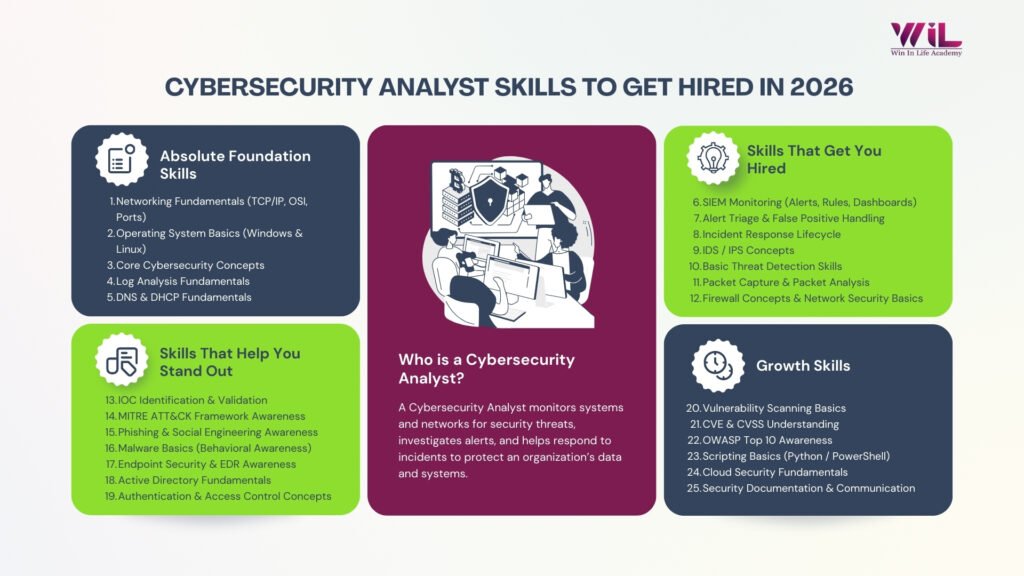
To keep the learning path clear, the skills needed for a cybersecurity analyst are organized into four buckets: absolute foundation skills, skills that help you get hired, skills that help you stand out, and growth skills to build after joining a security team.
Featured Snippet Content
These core skills apply across roles like SOC Analyst, Network Security Analyst, and VAPT Analyst, while advanced areas such as cloud security, threat hunting, and automation are typically learned after getting hired.
What Is a Cybersecurity Analyst?
A cybersecurity analyst is a security professional responsible for monitoring systems and networks for potential threats, investigating security alerts, and responding to incidents that could put an organization at risk.
At the entry level, a cybersecurity analyst’s work focuses on detection, analysis, and response rather than designing security systems or performing advanced attacks. Analysts review alerts from security tools, analyze logs from servers and endpoints, identify suspicious activity, and follow established incident response procedures.
Cybersecurity analysts typically work within a Security Operations Center (SOC) and collaborate closely with network teams, IT administrators, and senior security professionals. Over time, this role provides hands-on exposure to real attacks, tools, and workflows.
Key Cybersecurity Analyst Skills to Get Hired in 2026
Absolute Foundation Skills
These skills form the base of every entry-level cybersecurity role. They are not optional. If a candidate struggles with these fundamentals, interviews typically end early.
1. Networking Fundamentals (TCP/IP, OSI, Ports)
Networking fundamentals explain how data moves between devices over a network. This includes understanding IP addresses, ports, protocols, and how connections are established and closed.
At the entry level, this means knowing the TCP/IP model, the OSI layers, commonly used ports and protocols, the TCP three-way handshake, and the basic difference between TCP and UDP.
How it shows up in SOC work
In real SOC environments, many security alerts are tied to network activity such as failed login attempts, port scans, suspicious outbound connections, malware communication, and data exfiltration.
Why interviewers test this
Interviewers test networking fundamentals early because they reveal how well a candidate can reason through security events. A strong grasp of networking is a clear indicator of entry-level readiness.
2. Operating System Basics (Windows & Linux)
Operating system basics focus on understanding how Windows and Linux systems manage users, processes, files, and system activity. Since most security alerts originate from endpoints and servers, analysts must understand OS behavior.
At the entry level, this includes authentication, permissions, log locations, and basic command-line usage. Windows Event Viewer and Linux system logs are commonly used.
How this skill is used in SOC operations
SOC analysts investigate alerts related to failed logins, suspicious processes, unauthorized access attempts, and privilege misuse using OS logs and system behavior.
Why interviewers test this
Without OS knowledge, candidates cannot accurately interpret endpoint alerts or understand what happened during an incident.
Cybersecurity Fundamentals
Master practical, real-world cybersecurity and ethical hacking skills. This course teaches you how to analyze vulnerabilities, simulate attacks, secure systems, and interpret complex security data. It prepares you for technical roles across SOC operations, penetration testing, and modern security engineering.

3. Core Cybersecurity Concepts
Core cybersecurity concepts provide the foundational understanding behind how security risks are identified, evaluated, and managed. These concepts guide how analysts interpret incidents and assess their impact on systems and data.
This includes understanding the CIA Triad (Confidentiality, Integrity, Availability), the difference between threats, vulnerabilities, and risks, and basic ideas around encryption, authentication, and authorization. Analysts must also be familiar with common attack types such as phishing, malware, ransomware, brute-force attacks, and denial-of-service attempts.
How analysts use this skill in daily work
Analysts rely on these concepts when assessing alerts and incidents. Understanding whether an incident affects confidentiality, integrity, or availability helps determine severity and response priority.
Why interviewers test this
Interviewers ask conceptual questions to evaluate whether candidates understand security beyond tools. Strong fundamentals show that a beginner can explain the impact of incidents clearly.
4. Log Analysis Fundamentals
Log analysis is the process of reviewing system and security logs to understand what activity has occurred on a system or network. Logs act as evidence and are the primary source analysts use to validate alerts.
At the entry level, this means understanding timestamps, usernames, IP addresses, event types, and identifying behavior that deviates from normal patterns.
How this skill is applied in security teams
SOC analysts use logs daily to confirm alerts, investigate incidents, and build timelines by correlating events.
Why interviewers test this
Log analysis is tested because SOC work depends heavily on interpreting real security data rather than assumptions.
5. DNS and DHCP Fundamentals
DNS and DHCP are core network services that enable communication across networks. DNS resolves domain names, while DHCP assigns IP addresses to devices.
Analysts must understand DNS resolution, record types, and how attackers abuse DNS for phishing and malware communication.
Where this skill fits in SOC workflows
DNS-related alerts are common during phishing investigations and malware analysis. Analysts review DNS logs to identify suspicious domains.
Why interviewers test this
DNS knowledge helps analysts recognize malicious external communication quickly.
Skills That Get You Hired
6. SIEM Monitoring (Alerts, Rules, Dashboards)
SIEM monitoring involves working with centralized platforms that collect logs and generate alerts. Entry-level analysts focus on alert investigation rather than rule creation.
How it shows up in SOC work
Most L1 analysts spend their day reviewing alerts, validating activity, and documenting investigations inside a SIEM.
Why interviewers test this
SIEM knowledge reflects readiness for day-one SOC responsibilities.
7. Alert Triage & False Positive Handling
Alert triage involves deciding whether alerts represent real threats or false positives.
Why interviewers test this
Interviewers assess logical thinking and investigation approach more than tool depth.
8. Incident Response Lifecycle
9. IDS / IPS Concepts
10. Basic Threat Detection Skills
11. Packet Capture & Packet Analysis
Packet analysis involves inspecting network packets to understand traffic behavior at a detailed level. Tools such as Wireshark allow analysts to examine packet headers and payloads.
At the entry level, this skill focuses on understanding packet structure, identifying protocols, and recognizing abnormal traffic patterns rather than deep protocol analysis.
How analysts use this skill in daily work
Packet captures are used to validate suspicious network alerts, investigate unusual connections, and confirm malicious communication.
Why interviewers test this
Interviewers test packet analysis to assess whether candidates understand network traffic beyond high-level alerts and dashboards.
12. Firewall Concepts & Network Security Basics
Firewalls control network traffic based on predefined rules and act as a barrier between trusted and untrusted networks.
Entry-level analysts are not expected to configure firewalls but must understand what firewall logs and alerts indicate.
How it shows up in SOC work
SOC analysts review firewall alerts related to blocked traffic, policy violations, and suspicious connections.
Why interviewers test this
Firewall concepts are tested because they form the foundation of network security controls and traffic filtering.
Skills That Help You Stand Out
13. IOC (Indicators of Compromise) Identification
Indicators of Compromise are observable artifacts that suggest malicious activity. Common IOCs include IP addresses, domains, URLs, file hashes, and email indicators.
At the entry level, this skill focuses on recognizing suspicious indicators and validating them using trusted threat intelligence sources.
How this skill is applied in security teams
SOC analysts extract IOCs from alerts and logs and validate them to determine whether activity is malicious or widespread.
Why interviewers test this
IOC knowledge shows practical awareness of how alerts are validated in real SOC environments.
14. MITRE ATT&CK Framework Awareness
MITRE ATT&CK is a framework that categorizes attacker behavior into tactics and techniques, helping analysts understand how attacks unfold.
At the beginner level, this involves understanding common tactics such as initial access, persistence, lateral movement, and exfiltration.
How it shows up in SOC work
Many SIEM and EDR tools map alerts to ATT&CK techniques, providing valuable context during investigations.
Why interviewers test this
ATT&CK awareness demonstrates an understanding of behavior-based detection rather than reliance on signatures alone.
15. Phishing & Social Engineering Awareness
Phishing and social engineering attacks manipulate users into revealing credentials or executing malicious actions.
Entry-level analysts must recognize phishing indicators such as suspicious senders, fake links, urgency tactics, and credential harvesting pages.
Where this skill fits in SOC workflows
SOC teams frequently investigate reported phishing emails and email security alerts.
Why interviewers test this
Phishing awareness reflects real-world attack frequency and practical security awareness.
16. Malware Basics (Behavioral Awareness)
Malware basics focus on understanding how malicious software behaves after execution, including process creation, persistence, and network communication.
Entry-level analysts are not expected to reverse engineer malware but must recognize suspicious behavioral patterns.
How it shows up in SOC work
Malware alerts often involve abnormal processes, outbound connections, or file activity.
Why interviewers test this
Malware awareness helps assess whether candidates can interpret endpoint alerts logically.
Certified Ethical Hacker – CEH v13 AI
Gain job-ready ethical hacking skills through a fully hands-on, AI-powered CEH training path. Learn how modern attacks actually work, practice them in real labs, and build the technical depth needed for penetration testing and cybersecurity roles.
17. Endpoint Security & EDR Awareness
Endpoint Detection and Response (EDR) tools monitor endpoints for suspicious activity and provide detailed visibility into processes, files, and user actions.
At the entry level, analysts need a conceptual understanding of what EDR tools do rather than how to configure or tune them.
How this skill supports security investigations
EDR alerts are reviewed alongside SIEM alerts. Analysts examine process trees, file activity, and endpoint behavior to understand incidents.
Why interviewers test this
EDR awareness signals readiness to work with modern security tools used in most enterprise environments.
18. Active Directory Fundamentals
Active Directory manages users, authentication, and access control in enterprise environments. Many attacks target identity systems to gain access or escalate privileges.
Entry-level analysts must understand users, groups, authentication behavior, and basic AD-related alerts.
How it shows up in SOC work
SOC analysts investigate failed logins, account lockouts, privilege changes, and suspicious authentication activity.
Why interviewers test this
AD knowledge demonstrates readiness for real enterprise environments where identity-based attacks are common.
19. Authentication & Access Control Concepts
Authentication and access control define how users prove identity and what resources they can access.
At the entry level, this includes passwords, MFA, SSO, and basic authorization logic.
How analysts use this skill in daily work
SOC analysts investigate authentication anomalies such as repeated failures, MFA fatigue attempts, and suspicious access patterns.
Why interviewers test this
Identity-based attacks are among the most common attack vectors today.
Growth Skills
These skills are typically learned after joining a security team. Entry-level candidates are not expected to master them during interviews, but awareness is helpful.
20. Vulnerability Scanning Basics
Vulnerability scanning identifies weaknesses in systems, applications, and configurations that attackers could exploit.
At the entry level, this means understanding scan results, severity categories, and why remediation matters.
Why this is a growth skill
Vulnerability management requires prioritization, context, and coordination across teams, which develops with experience.
21. CVE and CVSS Understanding
22. OWASP Top 10 Awareness
If you want structured, hands-on guidance to build job-ready cybersecurity analyst skills, Win in Life Academy offers industry-aligned training programs designed for beginners.
23. Scripting Basics for Security (Python / PowerShell)
Scripting helps automate repetitive security tasks such as log parsing, enrichment, and reporting.
At the entry level, scripting is about understanding how automation improves efficiency, not building complex tools.
Why this is a growth skill
Automation becomes valuable after analysts understand workflows and operational pain points.
24. Cloud Security Fundamentals
Cloud security focuses on protecting workloads hosted on platforms such as AWS, Azure, and GCP. It includes identity management, access control, logging, and configuration security.
At the entry level, analysts only need conceptual awareness of how cloud environments work and how cloud activity is logged.
How it shows up in real security teams
Cloud-related alerts increasingly appear in SOC workflows. Analysts review cloud authentication logs, access events, and configuration alerts.
Why this is a growth skill
Cloud platforms differ significantly from traditional environments, so hands-on cloud security skills are usually developed after onboarding.
25. Security Documentation & Communication
Security documentation involves clearly recording investigations, alerts, and incident findings. Communication ensures that security information is understood by both technical and non-technical teams.
At the entry level, this includes writing clear incident notes, handover summaries, and basic investigation reports.
How it shows up in real security teams
Every investigation requires documentation. Analysts prepare case notes, escalation summaries, and post-incident reports.
Why this is a growth skill
Clear communication improves with experience and exposure to real incidents and stakeholders.
Conclusion
Breaking into cybersecurity as a beginner does not require mastering every tool or security domain at once. What matters most is building the right cybersecurity analyst skills in the right order.
As this guide shows, entry-level roles such as SOC Analyst and Network Security Analyst are built on the same foundations: understanding networks and systems, analyzing logs and alerts, following incident response processes, and thinking clearly during investigations.
By focusing first on absolute foundation skills, then strengthening core SOC capabilities, and gradually adding differentiator and growth skills, beginners can prepare for interviews without unnecessary confusion. This structured approach mirrors how real security teams operate and how freshers are evaluated during hiring.
For learners seeking guided, hands-on exposure, Win in Life Academy offers industry-aligned cybersecurity training programs designed to build practical SOC-ready skills.
Whether you are starting your cybersecurity journey or preparing for 2026 interviews, focusing on fundamentals with a clear roadmap remains the most reliable path to long-term success.
Frequently Asked Questions (FAQs)
1. What are the 7 layers of cybersecurity?
The seven layers of cybersecurity are Physical, Network, Perimeter, Endpoint, Application, Data, and User layers. Each layer adds protection so that if one fails, others still reduce risk.
2. What are 5 careers in cybersecurity?
Five common cybersecurity careers include SOC Analyst, Network Security Analyst, VAPT Analyst, Incident Response Analyst, and Cloud Security Analyst. Most beginners start in SOC roles and specialize later.
3. What is required to become a cybersecurity analyst?
To become a cybersecurity analyst, you need networking fundamentals, Windows and Linux basics, log analysis skills, SIEM awareness, incident response knowledge, and strong problem-solving abilities.
4. What are the 5 P’s of cybersecurity?
The five P’s of cybersecurity are People, Process, Policy, Prevention, and Protection. They emphasize that security depends on behavior and procedures, not just tools.
5. Do you need coding for cybersecurity?
No, coding is not required for entry-level cybersecurity roles. Most beginner jobs focus on alert monitoring and investigations. Basic scripting becomes useful later as you grow.