


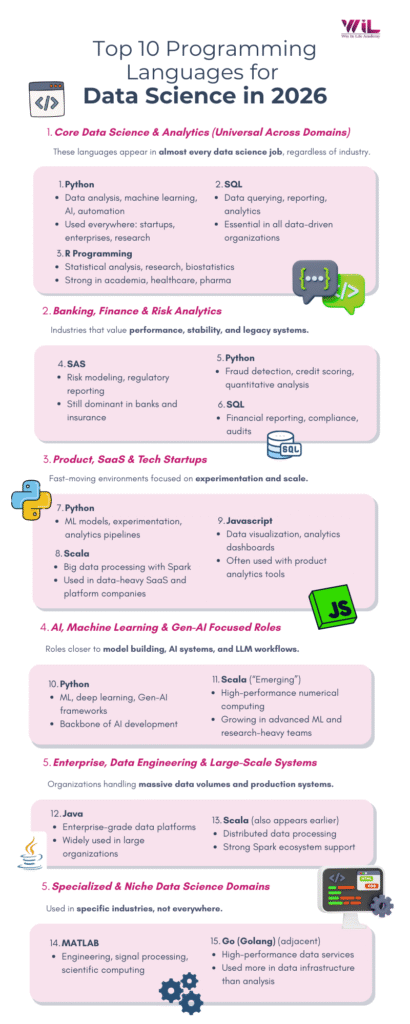
There is no single set of programming languages that fits every data science job. Yet most beginners are told to learn long lists of tools without any clarity on which language matters for which role. This is how people end up tool-hopping instead of building job-ready skills. This confusion is common when learners are not guided on programming languages for data science careers based on real job roles.
In practice, data science careers split into different paths: analysis, machine learning, data engineering, research, product analytics, and infrastructure. Each path uses programming languages differently, especially when comparing programming languages for analytics careers versus engineering or research roles. A data analyst does not need the same stack as a machine learning engineer. A clinical data analyst does not work with the same tools as a big data engineer.
This blog breaks down programming languages for different data science careers, mapping common roles to the languages they actually use in real-world work. The goal is simple: help you choose what to learn based on the role you are targeting, not on hype or generic “top tools” lists. This role-based approach helps clarify programming languages for data science careers without relying on generic recommendations.
Data Analyst
A Data Analyst focuses on understanding what has already happened in the business and explaining it clearly. The role is about turning raw data into insights that help teams make informed decisions. Unlike data scientists or engineers, data analysts are not expected to build complex models or large systems. Their value lies in accuracy, clarity, and consistency.
Most data analyst work starts with messy, incomplete, or scattered data. The job is to bring order to that data, identify meaningful patterns, and communicate findings in a way that non-technical stakeholders can understand. Because of this, the programming languages used by data analysts prioritize data access, cleaning, and exploration, not algorithmic complexity.
This practical focus defines the core expectations around data analyst programming languages in real-world roles.
Core Data Analyst Programming Languages
SQL: Foundation of the data analyst role
Almost all business data is stored in databases. Sales transactions, customer records, operational metrics, and performance logs are queried using SQL. A data analyst is expected to independently extract data, combine tables, and calculate metrics without relying on engineers.
Strong SQL skills allow analysts to answer questions quickly and accurately. Weak SQL creates dependency and slows down decision-making, which is why SQL proficiency is often the first skill evaluated during analyst interviews.
Python: Used to extend analysis beyond the database
Once data is extracted, Python helps with cleaning, exploratory analysis, automation, and visualization. Analysts use Python to handle datasets that are too complex for spreadsheets, automate repetitive reporting tasks, and perform deeper analysis when needed.
Python is not used here for advanced machine learning. Its role is to make analysis faster, cleaner, and more flexible.
Optional and Context-Dependent Languages
R: Appears in statistics-heavy analyst roles
In domains such as healthcare analytics, clinical research, or academic environments, R is sometimes used for statistical analysis and reporting. However, for most commercial data analyst roles, Python and SQL are sufficient.
What the Work Actually Looks Like
A typical data analyst spends time on:
- Writing SQL queries to extract and aggregate data
- Cleaning and preparing datasets for analysis
- Performing exploratory data analysis to identify trends
- Creating charts, summaries, and reports
- Answering questions such as “what changed?”, “why did it change?”, and “what does this mean for the business?”
The work is less about building systems and more about delivering clear, reliable insights.
Career Progression
Data analyst roles often serve as an entry point into the data field. With experience, analysts may grow into senior analyst roles or move toward data science, analytics management, or specialized domain roles. The same core skills, especially SQL and analytical thinking, continue to matter as responsibilities increase.
What to Learn First (Reality Check)
If you are aiming for a Data Analyst role:
- Focus on SQL first, including joins, aggregations, and window functions
- Learn Python for analysis and automation, not for machine learning
- Avoid spreading time across too many tools early
Business Analyst / Product Analyst
A Business Analyst or Product Analyst works closely to decision-making. The role is not about building complex models or experimenting with algorithms. It is about understanding what the business or product is doing, why certain trends are emerging, and what actions should be taken next.
Most of the work revolves around answering practical questions. Why did conversions drop last week? Which customer segment is growing fastest? Where are users dropping off in the product journey? These questions are answered by working directly with real business data, not by training machine learning models.
Because of this, the programming languages used in this role are focused on data access, analysis, and interpretation, not heavy engineering. This practical focus shapes the choice of programming languages for business analyst roles in real-world environments.
Core Programming Languages for Business Analyst
SQL: Non-negotiable skill
Almost all business and product data lives in databases. Product events, customer transactions, revenue data, marketing performance, and operational metrics are stored in structured tables. Business and Product Analysts are expected to query this data independently, without relying on engineers.
SQL allows analysts to pull exactly the data they need, combine multiple data sources, and calculate key metrics such as conversion rates, retention, churn, and cohort performance. If SQL is weak, analysis becomes slow, dependent, and unreliable. In practice, SQL skill often matters more than any other technical ability in this role.
Python: Supporting but important role
Once data is extracted using SQL, Python is used to clean it further, explore patterns, automate repetitive analysis, and create custom visualizations. Python helps analysts go beyond dashboards and static reports, allowing them to investigate trends, test assumptions, and explain complex behavior in a clear way.
Python is not used here for advanced machine learning. Its value lies in flexibility, speed, and analytical depth.
Optional and Context-Dependent Languages
JavaScript: Relevant in product-heavy environments
In companies where analytics is closely tied to web or app behavior, JavaScript is often used for event tracking and instrumentation. Business and Product Analysts are not expected to build applications but understanding how events are captured helps them evaluate data quality and interpret user behavior correctly.
This is especially useful in SaaS companies, consumer apps, and digital products where analytics accuracy directly affects business decisions.
What the Work Actually Looks Like
Day-to-day work in this role typically includes:
- Writing SQL queries to analyze business and product metrics
- Investigating changes in key KPIs such as revenue, engagement, or retention
- Supporting experiments and A/B tests with data analysis
- Building insights that guide product, marketing, and growth decisions
- Communicating findings clearly to non-technical stakeholders
The emphasis is on clarity and reasoning. Fancy tools add little value if insights are not understandable or actionable.
Career Progression
Business Analyst or Product Analyst roles often evolve into positions with broader influence. Common paths include moving into senior analytics roles, analytics management, or even product management. As responsibilities grow, the same core skills continue to matter, especially strong SQL, analytical thinking, and the ability to translate data into decisions.
What to Learn First (Reality Check)
If this is the role you are targeting, the learning order should be simple:
- Build strong SQL skills focused on real analytical queries
- Learn Python for data analysis and automation, not modeling
- Treat JavaScript as optional and context-specific
Spending time on advanced machine learning or niche languages at this stage usually adds little value. This role rewards depth in fundamentals, not breadth in tools.
Data Science and MLOps Professional Certificate
Build real-world data science and MLOps skills used across analytics, AI, and engineering teams. Learn to work with structured data, build and evaluate machine learning models, and deploy data solutions into production using industry-aligned workflows and best practices.

Data Scientist
A Data Scientist sits between analysis and modeling. The role is not just about building machine learning models, and it is not limited to reporting either. A Data Scientist’s core responsibility is to use data to answer complex questions and build predictive or explanatory models when needed.
In real organizations, most data scientists spend more time understanding data, testing assumptions, and validating results than training sophisticated models. The value of the role comes from choosing the right level of complexity, not from using advanced algorithms for their own sake.
Because of this, the programming languages used in data science focus on flexibility, experimentation, and analytical depth, rather than system-level performance. These expectations directly influence the selection of programming languages for data scientist roles across industries.
Core Programming Languages for Data Scientist
Python: Primary language for data scientists
Python supports the entire modeling workflow, from data preparation and exploration to feature engineering, model training, and evaluation. Its libraries make it possible to move quickly from an idea to a working solution without heavy engineering overhead.
Data scientists use Python to explore datasets, test hypotheses, and iterate on models. The goal is not to write perfect software, but to learn from data efficiently and accurately.
SQL: Remains essential at advanced levels
Despite the focus on modeling, most real-world datasets still live in databases. Data scientists are expected to extract and shape their own data using SQL before modeling begins. Relying on others for data access slows down experimentation and limits independence.
Optional and Context-Dependent Languages
R: Valuable in research-heavy and statistical environments
In organizations where statistical rigor, reproducibility, or regulatory requirements are important, R is often used alongside Python. It is common in healthcare analytics, clinical research, and academic settings where statistical reporting matters more than production deployment.
What the Work Actually Looks Like
A Data Scientist’s day-to-day work often includes:
- Exploring and cleaning large datasets
- Designing features and testing assumptions
- Building and evaluating predictive or explanatory models
- Interpreting model results and explaining them to stakeholders
- Iterating based on feedback and new data
Contrary to popular belief, most of this work happens before and after model training.
Career Progression
Data Scientist roles typically evolve in two directions. Some move deeper into modeling and become machine learning engineers. Others move toward decision-making and leadership roles, such as senior data scientist or analytics lead. In both cases, strong fundamentals in Python, SQL, and analytical reasoning remain critical.
What to Learn First (Reality Check)
If you are targeting a Data Scientist role:
- Master Python for data analysis and modeling
- Become comfortable with SQL for independent data access
- Learn statistics well before chasing advanced algorithms
Skipping fundamentals in favor of complex models usually leads to shallow understanding and fragile solutions. At this stage, choosing the right tools becomes less about trends and more about mastering programming languages for data science careers that support modeling and decision-making.
Machine Learning Engineer / AI Engineer
A Machine Learning Engineer exists to make models work in the real world. This role is not about experimenting with algorithms or exploring data endlessly. It is about taking a trained model and ensuring it runs reliably, efficiently, and at scale inside a production system.
Many beginners confuse this role with Data Scientist. The difference is simple:
Data Scientists focus on what the model should be.
Machine Learning Engineers focus on how the model survives in production.
Because of this shift, the programming languages used here change significantly. This distinction highlights the importance of core machine learning engineer skills in production-focused environments.
Core Programming Languages to Build Machine Learning Engineer Skills
Python: Essential, but for a different reason
Machine Learning Engineers use Python to build, train, and test models, just like data scientists. However, the emphasis is less on experimentation and more on reproducibility, performance, and integration with production pipelines.
Python frameworks make it easier to standardize training workflows, version models, and integrate with deployment systems. At this level, writing clean, maintainable Python code matters more than quick notebooks.
Java, C++, or Go: A systems language becomes necessary
As soon as models move into production, they need to interact with backend services, APIs, and infrastructure. This is where languages like Java, C++, or sometimes Go come into play. These languages are used to wrap models, build services around them, and ensure performance under load.
Not every ML Engineer uses these languages daily, but in mature teams, Python alone is rarely sufficient.
Optional and Context-Dependent Languages
SQL: Still relevant, but not central
ML Engineers use SQL to access training data or validate model outputs, but they are not spending their time writing analytical queries. Data access is usually part of a larger pipeline managed by data engineers.
What the Work Actually Looks Like
In practice, a Machine Learning Engineer works on:
- Turning trained models into deployable services
- Building pipelines for training, validation, and inference
- Monitoring model performance and data drift
- Optimizing latency, reliability, and scalability
- Collaborating closely with data scientists and data engineers
This role spends far more time on engineering problems than on modeling theory.
Career Progression
Machine Learning Engineers often grow into senior engineering roles, platform ownership, or technical leadership positions. Some move deeper into systems and become platform engineers. Others stay close to modeling but specialize in large-scale or real-time ML systems.
In all cases, the role rewards engineering discipline more than algorithm novelty.
What to Learn First (Reality Check)
If you are targeting a Machine Learning Engineer or AI Engineer role:
- Build strong Python fundamentals beyond notebooks
- Understand software engineering basics (APIs, versioning, testing)
- Learn how models are deployed and monitored, not just trained
- Add a systems language only when production demands it
Where AI Engineering Extends Beyond Traditional ML
In many teams, the AI Engineer role extends beyond classical machine learning into integrating large, pre-trained models into real systems. This includes working with model APIs, managing inference costs, handling latency constraints, and monitoring model behavior in production. While the core programming skills remain similar to machine learning engineering, AI engineers must also think about reliability, scalability, and responsible use of models in real-world applications.
Jumping straight into “AI engineering” without data science or engineering fundamentals usually leads to shallow skills and fragile systems.
Data Engineer
A Data Engineer is responsible for making data available, reliable, and usable. While analysts and data scientists work on insights and models, data engineers build the systems that move, store, and prepare data in the first place. Without this role, there is nothing clean or trustworthy to analyze.
This role is often misunderstood as an advanced version of data science. It is not. Data engineering is a separate engineering track with different priorities, workflows, and language requirements. These responsibilities clearly define the long-term data engineering career path within data-driven organizations.
Core Programming Languages for Data Engineering Career Path
SQL: Central to data engineering work
Data engineers use SQL to design data models, build transformations, and validate data inside warehouses and databases. Unlike analysts, they are not just querying data. They are shaping it so that others can use it reliably.
Strong SQL skills are critical here. Poor SQL design leads to slow pipelines, inconsistent metrics, and fragile systems.
Python: Used for orchestration and transformation
Python plays a different role for data engineers than it does for analysts or data scientists. It is used to build data pipelines, handle transformations, automate workflows, and integrate systems. The focus is on reliability and maintainability, not exploration.
Python is often used alongside workflow tools and scheduling systems to ensure data moves correctly and on time.
Systems programming language: Becomes important as scale increases
In more complex environments, data engineers also work with languages such as Java or Scala, especially when building high-throughput pipelines or working with distributed data processing systems. These languages offer better performance and tighter integration with large-scale data platforms.
Not every data engineer needs these languages on day one, but they become relevant as systems grow.
What the Work Actually Looks Like
In practice, a data engineer spends time on:
- Building and maintaining data pipelines
- Designing data models and schemas
- Ensuring data quality, reliability, and availability
- Integrating data from multiple sources
- Supporting analysts and data scientists with clean datasets
The work is closer to backend engineering than to data analysis.
Career Progression
Data engineers often grow into senior engineering or platform roles. Some specialize in infrastructure and scalability, while others move into architectural or leadership positions. The role rewards system thinking, discipline, and reliability over experimentation.
What to Learn First (Reality Check)
If you are targeting a Data Engineer role:
- Master SQL beyond querying, including data modeling and transformations
- Learn Python for building and maintaining pipelines, not analysis
- Understand how data flows across systems before chasing scale tools
Trying to become a data engineer without system fundamentals leads to brittle pipelines and production issues. These requirements reflect how infrastructure-focused roles demand a different set of data science skills 2026 compared to analytics or modeling roles.
Conclusion
In 2026, data science careers are shaped by role clarity rather than tool overload. Each career path uses programming languages differently, and success depends on learning what actually applies to the job you want. Chasing long tool lists creates confusion, slows skill development, and weakens fundamentals. Strong careers are built by focusing on depth, real-world usage, and practical problem solving instead of trends. Understanding these differences is essential for long-term data science career progression and for selecting the right programming languages for data science careers at each stage.
At Win in Life Academy, our programs are built around this exact reality, with role-based learning, strong foundations, and practical skills aligned to real industry expectations. The Data Science and MLOps Professional Certificate is designed to help you stop guessing, focus on what actually matters for your target role, and build job ready expertise through a clear, structured learning path.