
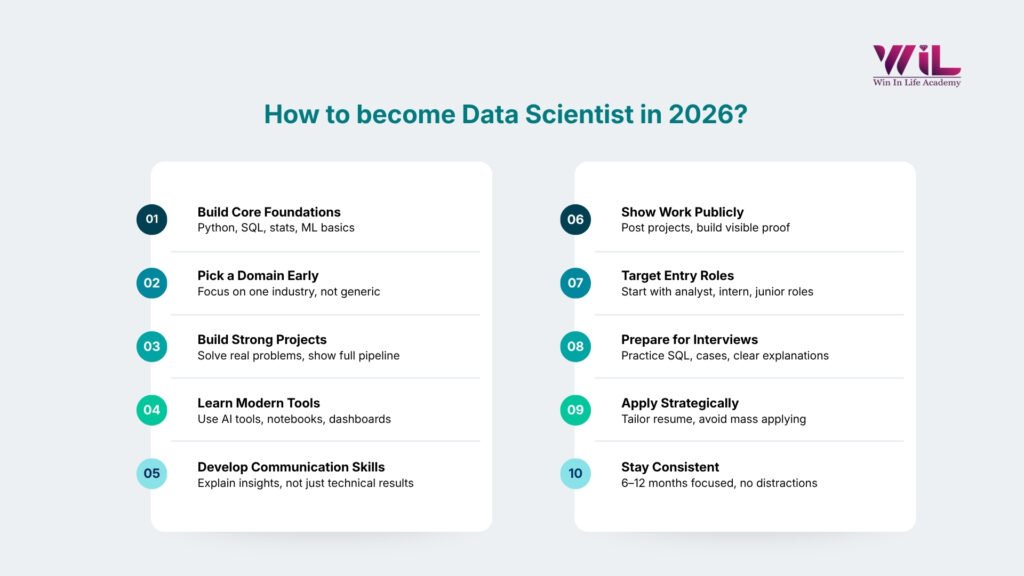
If you’re wondering how to become a data scientist in 2026, the path is more structured than ever. With the right combination of skills, projects, and practical experience, beginners can build a strong foundation and become job-ready in a relatively short time.
Data science has quickly become one of the most sought-after careers in the technology industry, but demand alone doesn’t get you hired — the right skills and proof of work do. According to the U.S. Bureau of Labor Statistics, employment of data scientists is projected to grow 34% between 2024 and 2034, much faster than the average for most occupations. This rapid growth reflects how strongly organizations now depend on data to guide strategy and innovation.
For beginners, the path can feel confused due to the number of tools and learning options available. This blog provides a clear roadmap to becoming a data scientist in 2026, covering essential skills, portfolio building, and practical steps to secure internships or entry-level roles.
5. Learn in Public and Build Your LinkedIn
Most beginners assume networking means sending connection requests or asking for referrals. It works differently. Networking is a result of visibility. People notice you when your work is visible, not when you ask for attention.
This is where learning in public is important. Instead of waiting until you feel ready, you start sharing your progress as you learn.
Your LinkedIn profile should support this. It is not just a place to list skills. It should clearly show what you are building and learning.
Consider a beginner who started posting one data project every week on LinkedIn. The posts were not perfect, but they clearly explained the problem, approach, and outcome.
Within a few months, their profile started to gain attention. Recruiters and professionals could see their work directly without needing a resume first.
This approach shifts the focus from trying to network to building credibility through consistent visibility.
6. What Companies Actually Want in 2026
The expectations for data scientists have changed significantly. What worked a few years ago is no longer enough. Companies are no longer just hiring for technical skills. They are looking for professionals who can work faster, think in context, and deliver business impact.
One of the biggest shifts is the rise of AI tools in everyday workflows. Today, tools like Copilot and advanced data analysis platforms are part of how teams operate. As a result, the expectation is not whether you can use them, but how effectively you can use them to speed up your work. Candidates who rely only on manual processes often fall behind in terms of efficiency and output.
At the same time, familiarity with large language models is becoming increasingly relevant. This does not mean building models from scratch, but understanding how to work with them. Knowing how to structure prompts, when to use an LLM instead of a traditional model, and how to integrate APIs into a workflow is now appearing in job requirements across companies.
Another key shift is in how results are communicated. Building a model is no longer the differentiator. What matters more is how well you can interpret the results and translate them into clear business actions. Companies expect data scientists to explain what the model means, what it does not capture, and what decisions should follow.
There is also a growing emphasis on domain knowledge. Generalist profiles are becoming less competitive as AI tools make basic tasks easier. What stands out now is the ability to combine domain understanding with applied AI skills. This combination is harder to replace and more valuable in real-world roles.
- The role is shifting from tool-based execution to decision-driven impact
- AI tools are increasing the baseline, not replacing the role
- Candidates who combine domain knowledge, AI usage, and clear thinking stand out
7. Build Your Resume and Cover Letter
At this stage, your resume is not a summary of everything you’ve done. It is a filter. Most recruiters spend only a few seconds scanning it, and in many cases, your application is screened by software before a human even sees it.
Your projects should lead. Not your degree, not a long list of tools. A recruiter should immediately understand what you’ve built and what problems you can solve.
A common mistake is trying to include everything. Irrelevant experience, generic objective statements, and long skill lists make your resume harder to scan and less effective. Clarity always wins over quantity.
Another important factor is how hiring systems work. Many companies use automated filters, which means your resume needs to reflect the language used in the job description. If a role emphasizes SQL, data analysis, or machine learning, those should appear naturally within your project descriptions, not just as keywords.
The cover letter should be even simpler. It is not a repeat of your resume. It should answer one question clearly: why this role and why you. One strong proof point is enough to make it effective.
Finally, tailoring matters. You don’t need to rewrite your resume for every application, but the top section and the opening lines should clearly align with the specific role you are applying for.
“Worked on a machine learning project using Python”
“Built a churn prediction model to identify high-risk customers, demonstrating how businesses can take early action to improve retention”
Data Science & MLOps Professional Certificate
Build end-to-end skills in data science, machine learning, MLOps, and generative AI through hands-on projects. Learn tools like Python, SQL, TensorFlow, and cloud platforms, and prepare for roles such as Data Scientist, ML Engineer, and AI Specialist.

8. Get Real Experience Early (Internships, Analyst Roles, Kaggle)
At some point, learning alone stops being enough. What actually moves you forward is working with real data in real scenarios.
You don’t need to wait for a “Data Scientist” title to start. Roles like data analyst or internships often give you better exposure to how data is actually used in business.
You learn how to write queries, work with stakeholders, and understand decisions behind the numbers, which are skills every data scientist needs.
Kaggle and hackathons can support this stage, especially when you don’t yet have professional experience. They help you test your skills, compare your approach with others, and add early credibility.
But they are not a replacement for real-world work. Use them to strengthen your profile, not substitute actual experience.
9. Interview Preparation
By the time you reach interviews, companies are not checking how much you’ve studied. They are checking how you think and how you explain.
Most interviews test a mix of SQL, basic statistics, and real problem scenarios. The exact focus depends on the job description.
Roles listed on LinkedIn or Naukri usually hint at what matters. If SQL and dashboards are mentioned, expect practical questions. If machine learning is highlighted, expect concepts and case discussions.
The mistake most candidates make is silent preparation. They read, practice, and understand, but struggle to explain.
Start practicing your answers out loud. Explain your projects, your approach, and your decisions as if you are talking to a non-technical person.
You can also use tools like Google’s Interview Warmup or ChatGPT to simulate questions, but the goal is not perfect answers. It is clarity and structured thinking.
Finally, don’t ignore behavioral questions. Interviewers want to know how you work, not just what you know.
- Clear thinking and structured problem-solving
- Ability to explain technical concepts in simple terms
- Practical understanding of tools and use cases
- Confidence and clarity in communication
10. Job Search Strategy
Getting hired in data science is not just about applying more. It’s about how you position yourself and where you focus.
Don’t limit yourself to one title. Roles like data analyst, business analyst (data-focused), junior ML engineer, or data science intern are all valid entry points. Waiting only for a “Data Scientist” role often slows you down.
Location and domain also matter more than most people expect. If one domain is slow in your city, others may be hiring actively. Staying flexible here can speed up your chances.
Referrals play a bigger role than most applicants realize. Many roles are filled before they are widely visible.
The practical approach is simple. Reach out to people already working in the role, mention what you’ve built, and keep the message clear and relevant. Generic messages rarely work.
If your goal is to get hired quickly, focus on entering any relevant data role and building experience. If your goal is a specific role or domain, be prepared for a longer and more targeted search.
- Apply across roles, not just titles
- Stay flexible with domain and location
- Use referrals strategically, not randomly
- Be clear on your priority: speed or specificity
Frequently Asked Questions (FAQs)
Conclusion
Becoming a data scientist is not a quick sprint. It is a 6 to 12 month process of building skills, projects, and real understanding step by step.
What matters is not learning everything at once, but focusing on the right sequence. Strong fundamentals, real-world projects, clear communication, and consistent visibility are what actually move you forward.
If you follow this roadmap with consistency, you don’t just prepare for interviews. You prepare for the role itself.
For those who prefer a more structured path, programs like the
Data Science & MLOps Professional Certificate by Win in Life Academy
are designed to guide you through this journey with hands-on projects, mentorship, and industry-relevant skills.
For those who prefer a more structured path, programs like the Data Science & MLOps Professional Certificate by Win in Life Academy are designed to guide you through this journey with hands-on projects, mentorship, and industry-relevant skills.
Frequently Asked Questions (FAQs)
1. Is data science still a good career in 2026?
Yes. Demand remains strong as companies continue to rely on data for decision-making, automation, and AI-driven products.
2. Do I need a degree to become a data scientist?
No. Many professionals enter the field through skills, projects, and portfolios rather than formal degrees.
3. How long does it take to become job-ready in data science?
For most beginners, it takes around 6 to 12 months of consistent learning and project building.
4. Can non-technical students learn data science?
Yes. With the right learning path and practice, even non-technical backgrounds can transition into data roles.
5. Which programming language is best for data science?
Python is the most widely used due to its simplicity and strong ecosystem of data libraries.
6. Is SQL necessary for data science jobs?
Yes. SQL is essential for working with databases and is commonly tested in interviews.
7. What matters more: certifications or projects?
Projects. Recruiters prioritize practical work that demonstrates problem-solving ability.
8. Can I get a data science job without experience?
Yes, by building a strong portfolio, gaining visibility, and starting with entry-level roles or internships.
9. Are AI tools replacing data scientists?
No. AI tools are changing workflows, but they increase expectations rather than replace the role.
10. What is the best way to stand out as a beginner?
Build real-world projects, share your work publicly, and clearly explain your thinking and results.

How to Become a Data Scientist in 2026: Complete Roadmap for Beginners
If you're wondering how to become a data scientist in 2026, the path is more structured than ever. With the...

Top AI Projects for Beginners in 2026
AI Projects Section Why AI Projects Matter AI projects help beginners apply theoretical knowledge to real-world problems. By working with...

Top Python Libraries for Machine Learning Beginners (2026 Guide)
Python is the "interface", but its libraries are the "engine." While Python is easy to read, it is too slow...