


Many people still believe that a career in IT means learning complex coding languages. In reality, that is no longer true. By 2026, several high paying IT roles focus more on understanding technology, working with AI tools, analyzing information, improving digital experiences, and supporting business decisions rather than writing code. These roles are designed for people who can think logically, communicate clearly, and work confidently with modern digital platforms.
According to the World Economic Forum, nearly 44% of job skills will change by 2027, and analytical thinking, technology awareness, and problem-solving are becoming more valuable than programming for many high paying IT roles. This shift is creating new opportunities for beginners who want to enter the tech industry without a coding background.
Industry forecasts show that the global low-code development platform market could surge from around $37.39 billion in 2025 to $264.40 billion by 2032, growing at a CAGR of 32.2 %, as businesses increasingly adopt tools that empower non-technical professionals to build applications without extensive programming. Additionally, in 2025, about 70 % of new enterprise applications were to be built using low-code or no-code technology, highlighting how accessible tech careers are becoming some of the most accessible high paying IT roles for absolute beginners.
Because of this shift, roles such as data analysts, product coordinators, UX/UI designers, AI operations specialists, and digital business analysts are growing quickly across industries. These careers offer strong growth, good salaries, and clear entry paths even for absolute beginners.
In this blog, we explore the Top 25 Non-Coding & AI-Enabled IT Roles for Absolute Beginners in 2026, helping fresh graduates, career switchers, and non-technical professionals understand where they fit in the future of IT without learning to code.
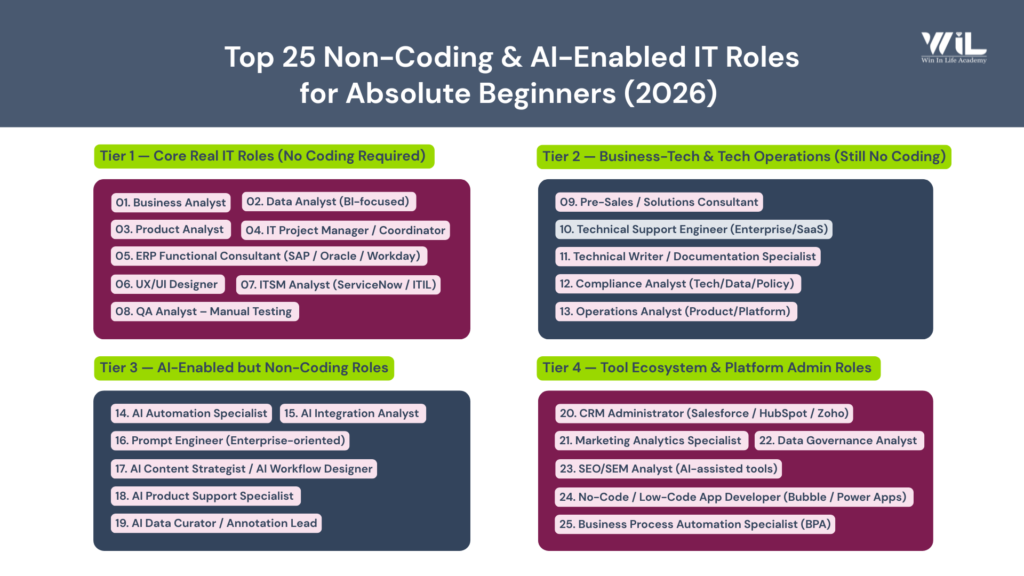
Top Non-Coding IT Roles for Absolute Beginners in 2026
The best non-coding IT roles for beginners in 2026 include Business Analyst, BI-focused Data Analyst, UX/UI Designer, IT Project Coordinator, ERP Functional Consultant, ITSM Analyst, QA Analyst (Manual Testing), Technical Writer, Compliance Analyst, AI Automation Specialist, and Data Governance Analyst. These roles focus on analytics, operations, design, compliance, and AI-assisted workflows rather than programming, making them some of the most accessible high paying IT roles for beginners without a coding background.
Core Real IT Roles (No Coding Required)
These positions represent some of the most stable and future-proof high paying IT roles, offering IT jobs with good salary packages without requiring programming knowledge.
1. Business Analyst
A Business Analyst helps organizations identify business problems, understand operational needs, and improve processes using data and structured analysis. This is a non-coding role that focuses on requirements gathering, workflow design, reporting, and coordination between business stakeholders and technology teams to ensure solutions meet real-world needs.
This role is ideal for beginners who enjoy logical thinking, documentation, and problem-solving rather than programming. Business Analysts spend a large part of their time understanding how businesses function, organizing information, asking the right questions, and converting complex requirements into clear, actionable insights that teams can work with.
In modern organizations, Business Analysts play a critical role in ensuring that digital tools, AI platforms, ERP systems, and automation solutions are aligned with business goals. Instead of building technology, they help choose the right systems, define how they should be used, and measure whether they are delivering value, making the role highly relevant in today’s AI-enabled workplaces. Meanwhile, global market research shows that the business analytics market is currently valued at approximately USD 91 billion in 2025 and is expected to reach USD 138 billion by 2030, reflecting sustained growth in data-driven business roles.
Demand for Business Analyst Role:
Employment for business analysis roles is projected to grow steadily, driven by the increasing demand for data-driven decision-making, operational efficiency, and process optimization across industries such as IT, healthcare, finance, and consulting.
Business Analyst — Responsibilities & Tools
| Core Responsibilities (What You Do) | Tools / Platforms You Work With |
|---|---|
| Gather and document business requirements from stakeholders | Jira, Confluence |
| Analyze existing business workflows and identify gaps or inefficiencies | Microsoft Visio, Lucidchart |
| Design process flows, use cases, and functional specifications | BPMN tools, Miro |
| Create reports and dashboards to support business decisions | Power BI, Tableau, Excel |
| Coordinate between business teams and technical teams to ensure clarity and alignment | Microsoft Teams, Google Workspace |
2.Data Analyst (BI-Focused)
A BI-focused Data Analyst helps organizations understand performance, trends, and patterns by analyzing data and presenting insights through dashboards and reports. This is a non-coding or low-coding role centered on business intelligence tools and data visualization rather than heavy scripting. According to industry workforce data, over 60% of analytics roles in enterprises today focus on reporting, dashboards, and descriptive analytics, not advanced data science. BI-focused Data Analysts and Product Analysts are increasingly viewed as most paid IT jobs outside traditional software development due to their direct impact on business growth and decision-making.
This role is ideal for beginners who enjoy working with numbers, identifying trends, and explaining insights clearly. Research from the World Economic Forum shows that data analysis and analytical thinking are among the top 3 fastest-growing skills globally, making BI-focused analyst roles one of the most accessible entry points into data careers.
In modern organizations, BI Data Analysts play a key role in supporting AI-driven and data-driven decision-making. Their work ensures that insights from dashboards and reports directly influence business actions. Academic research published on ResearchGate shows that the adoption of business intelligence and analytics has a positive impact on decision-making effectiveness and managerial work performance, confirming the strategic importance of BI roles in improving how organizations plan, operate, and compete.
Demand for Data Analyst Role:
Demand for BI and data analytics roles continue to rise as organizations rely more on dashboards, reporting, and data-driven decision-making. This growth is not limited to Western markets. In India, one of the fastest-growing analytics hubs globally, job postings requiring data analytics skills increased by approximately 52% over the past five years, highlighting strong and sustained demand for BI-focused data professionals across industries.
Data Analyst (BI-Focused) — Responsibilities & Tools
| Core Responsibilities (What You Do) | Tools / Platforms You Work With |
|---|---|
| Build and maintain dashboards to track business KPIs and performance metrics | Power BI, Tableau |
| Analyze data to identify trends, patterns, and insights for business teams | Excel, Google Sheets |
| Prepare and clean datasets for reporting and dashboard use | Excel Power Query, Google Sheets |
| Create scheduled reports and presentations for stakeholders | Power BI, Tableau, Microsoft Excel |
| Translate data insights into clear business recommendations | PowerPoint, Google Slides |
3.Product Analyst
A Product Analyst drives product success by analyzing user data, market trends, and performance metrics to inform strategy and optimization. This is a data-centric role blending analytics with product management, often requiring SQL and visualization skills.
This role suits those passionate about products, user behavior, and iterative improvements. Product Analysts bridge data and product teams, enabling faster feature launches and higher retention.
In data-driven companies, Product Analysts support AI-enhanced products by validating experiments and forecasting impacts.
Demand Insight:
Demand for Product Analysts surges with product-led growth strategies, especially in tech and e-commerce. This trend spans startups to enterprises, fueled by needs for A/B testing and churn reduction.
Product Analyst — Responsibilities & Tools
| Core Responsibilities (What You Do) | Tools / Platforms You Work With |
|---|---|
| Analyze user data to identify trends, churn risks, and growth opportunities | Amplitude, Mixpanel, Google Analytics |
| Conduct A/B tests and experiments to optimize features and UX | Optimizely, Google Optimize, SQL |
| Track product KPIs like retention, engagement, and conversion rates | Tableau, Looker, Power BI |
| Perform market and competitive analysis for roadmap input | Excel, Google Sheets, Ahrefs |
| Create reports and dashboards translating insights into recommendations | PowerPoint, Figma, Jira |
4.IT Project Coordinator
An IT Project Coordinator oversees the planning, execution, and delivery of IT projects, ensuring they meet timelines, budgets, and quality standards. This role involves coordinating teams, managing risks, and aligning projects with business objectives, often using agile or waterfall methodologies.
This position appeals to organized professionals who thrive in fast-paced environments and excel at communication. Coordinators support PMs by handling logistics, while Managers drive strategic decisions, making it a scalable career path.
In modern enterprises, IT Project Managers enable cloud migrations and cybersecurity initiatives by mitigating delays and optimizing resources. A Gartner study reveals that effective project management reduces IT project failure rates by 28%. Their efforts ensure seamless integration of technologies, boosting operational efficiency, and ROI.
Demand Insight:
Demand for IT Project Managers and Coordinators surges amid digital acceleration, with hybrid roles in high demand. The PMI projects 2.3 million annual project management roles needed globally, with India leading at 15-20% sector growth in IT by 2025.
IT Project Manager / Coordinator — Responsibilities & Tools
| Core Responsibilities (What You Do) | Tools / Platforms You Work With |
|---|---|
| Plan project timelines, resources, and budgets while managing scope changes | Microsoft Project, Asana |
| Coordinate cross-functional IT teams and stakeholders for seamless execution | Jira, Trello, Slack |
| Identify risks, track progress, and resolve issues to meet deadlines | Risk Register, Monday.com |
| Conduct status meetings, reports, and post-project reviews | MS Teams, PowerPoint |
| Ensure compliance with IT standards and facilitate change management | Confluence, ServiceNow |
5.UX/UI Designer
A UX/UI Designer creates intuitive, user-centered digital interfaces by researching user needs, crafting wireframes, prototypes, and visual designs for apps and websites. This role blends creativity with user psychology, focusing on usability, accessibility, and brand alignment rather than coding.
This career fits creative problem-solvers who love empathy, mapping, and iterative design. Designers collaborate across teams, turning research into pixel-perfect interfaces that boost engagement and conversions.
In tech-forward organizations, UX/UI Designers enable seamless omnichannel experiences, from web to AR/VR. Studies indicate optimized UX reduces bounce rates by 35% and lifts conversion by 200% on average. Their work directly impacts customer satisfaction scores and product adoption in competitive markets.
Demand Insight:
Demand for UX/UI Designers explodes with digital product proliferation, especially in e-commerce and fintech. In India, postings grew 62% from 2022-2025 per Naukri insights, outpacing general design roles amid app economy booms.
UX/UI Designer — Responsibilities & Tools
| Core Responsibilities (What You Do) | Tools / Platforms You Work With |
|---|---|
| Conduct user research via interviews, surveys, and usability testing | Figma, Miro, UserTesting |
| Create wireframes, prototypes, and high-fidelity mockups | Adobe XD, Sketch, InVision |
| Design UI elements like buttons, navigation, and responsive layouts | Photoshop, Illustrator, Zeplin |
| Iterate designs based on feedback and A/B testing results | Framer, Principle, Hotjar |
| Collaborate with developers and product managers to ensure design handoff and accessibility | Slack, Jira, Accessibility tools |
6. ERP Functional Consultant (SAP / Oracle / Workday)
ERP Functional Consultants configure enterprise systems like SAP, Oracle, or Workday to optimize finance, HR, and supply chain processes. They map business requirements to software capabilities through analysis and customization. This role emphasizes domain expertise over coding, with BLS projecting 11% growth for systems analysts (68,900 U.S. jobs yearly) through 2033.
You lead fit-gap workshops, configure modules (SAP FI/CO, Workday HCM), and develop blueprints shortening implementations by 20% with cloud accelerators.
Beyond configuration, you customize reports/dashboards, integrate APIs (35% efficiency gains), and provide hyper care. ERP teams achieve 2x ROI acceleration and 18% cost savings.
Demand accelerates with cloud ERP upgrades, as 79% of companies migrate by 2027 creating 420,000+ consultant roles for S/4HANA/Workday transitions
ERP Functional Consultant — Role Essentials Overview
| Core Responsibilities (What You Do) | Tools / Platforms You Work With |
|---|---|
| Fit-gap analysis and system configuration (20% faster rollout) | SAP S/4HANA, Oracle Fusion |
| Data migration and UAT execution (96% accuracy) | Workday, LSMW / LTMC |
| System integrations and end-user training (35% productivity gains) | SAP Fiori, OData APIs |
| Post-go-live hypercare and ROI optimization (2× acceleration) | Solution Manager, Jira |
7. ITSM Analyst (ServiceNow / ITIL)
An ITSM Analyst specializes in managing and optimizing IT service delivery through platforms like ServiceNow, following industry best practices such as ITIL (Information Technology Infrastructure Library). This role focuses on aligning IT operations with business processes to boost uptime, reduce disruptions, and deliver measurable service improvements. IT Service Management (ITSM) enables the planning, delivery, operation, and control of IT services to meet business goals and end-user needs.
You coordinate incident, problem, change, and service request management through ServiceNow ITSM modules, enabling faster ticket resolution and improved SLA adherence. Modern ITSM automation improves operational efficiency, reducing manual work and helping teams deliver more value with fewer escalations. A recent Forrester-commissioned study found that modernizing ITSM with ServiceNow drives a 20 % increase in IT productivity and a 25 % reduction in high-priority incidents, contributing to strong return on investment for organizations.
Beyond daily support operations, you design ITIL-aligned workflows, document standard operating procedures, and conduct user enablement training, all of which contribute to smoother service delivery and reduced downtime. You also maintain the CMDB, monitor KPIs such as MTTR and SLA compliance, and support integrations with monitoring, collaboration, and development platforms.
ITSM Analyst (ServiceNow / ITIL) — Role Essentials Overview
| Core Responsibilities (What You Do) | Tools / Platforms You Work With |
|---|---|
| Incident, problem & request handling (30–40% faster resolution) | ServiceNow ITSM |
| Change & release management (20–25% SLA improvement) | ServiceNow Change Management |
| Workflow automation & approvals (45% task reduction) | Flow Designer |
| CMDB maintenance & service mapping (33% downtime reduction) | ServiceNow CMDB |
| KPI tracking & performance reporting (18% FCR improvement) | ServiceNow Dashboards & Reports |
| User training & ITIL process enforcement | ITIL 4 Framework |
| Tool integrations & monitoring alignment (35% efficiency gains) | REST APIs, Jira, Monitoring Tools |
| Hypercare & continuous service improvement (2× service stability) | ServiceNow Knowledge Base |
8. QA Analyst – Manual Testing
A QA Analyst (Manual Testing) ensures software quality by validating functionality, usability, and business requirements before release. This role relies on human-driven testing, executing test cases, identifying defects, and verifying workflows, making it essential for exploratory testing, UAT, and business-critical applications. According to the U.S. Bureau of Labor Statistics, employment for software quality assurance analysts and testers is projected to grow by 17% from 2023 to 2033, adding around 165,000 new jobs, reflecting strong and sustained demand.
You perform functional, regression, smoke, and UAT testing, ensuring alignment with documented requirements and user expectations. The business value of early manual QA is well established. Research by the U.S. National Institute of Standards and Technology (NIST) estimates that inadequate software testing costs the economy approximately USD 59.5 billion annually, with a significant portion of these losses caused by defects detected late in the development lifecycle or after release. This clearly highlights how early defect detection through manual QA reduces remediation costs and prevents expensive post-release failures.
Collaboration is central to the role. Working with developers and business teams, manual QA helps reduce production risks. The World Quality Report 2023–24 reports that organizations with structured QA processes experience up to 40% fewer production defects and 23% faster release cycles.
With software failures costing the global economy over USD 1.7 trillion annually, effective manual testing remains a foundational quality control, especially in regulated and enterprise environments.
QA Analyst – Manual Testing Role Essentials Overview
| Core Responsibilities (What You Do) | Tools / Platforms You Work With |
|---|---|
| Analyze requirements and prepare detailed test scenarios | Requirement documents, User Stories |
| Execute functional and regression test cases | Test Case Management Tools |
| Perform smoke testing and user acceptance testing (UAT) | Manual Test Suites |
| Log, track, and validate software defects | Jira, Bugzilla |
| Verify fixes and support release readiness | Build notes, Release notes |
| Collaborate with development and business teams | Agile / Scrum Tools |
Business-Tech & Tech Operations
- Pre-Sales / Solutions Consultant
A Pre-Sales / Solutions Consultant (also called Solutions Consultant or Sales Engineer) bridges technical product expertise with business needs to support sales teams and drive revenue. You engage prospects early, conduct discovery, architect tailored solutions, lead product demonstrations, and qualify opportunities ensuring that complex technology offerings align with customer requirements before deals close. This role combines technical depth with strong communication, problem-solving, and client-facing skills.
In your daily work, you assess requirements, design solution architectures, lead technical discovery sessions, respond to RFP/RFI requests, and tailor demonstrations that showcase how the product solves real customer challenges. By aligning technical possibilities with business value, you help shorten sales cycles, increase conversion rates, and improve customer satisfaction.
Pre-Sales / Solutions Consultant – Role Essentials Overview
| Core Responsibilities | Tools / Techniques You Work With |
|---|---|
| Conduct discovery and requirements analysis to map customer pain points to solution capabilities | CRM systems (Salesforce, HubSpot) |
| Deliver tailored product demos and proof-of-concepts (POCs) that illustrate value and technical fit | Demo and presentation platforms |
| Design solution architecture and craft technical proposals aligned with business goals | Proposal & documentation tools (PandaDoc, Google Docs) |
| Support sales teams in qualifying leads, answering technical queries, and responding to RFPs/RFIs | Collaboration & communication tools (Slack, Microsoft Teams) |
| Influence deal outcomes by translating product features into business impact and ROI | Competitive analysis & market research tools |
2.Technical Support Engineer (Enterprise / SaaS)
A Technical Support Engineer (Enterprise / SaaS) ensures reliable operation of software platforms by diagnosing, troubleshooting, and resolving technical issues that impact customers and internal teams. This role is critical in SaaS environments where uptime, responsiveness, and customer experience directly affect revenue and retention. According to the U.S. Bureau of Labor Statistics, employment for computer support specialists is projected to grow 5% from 2023 to 2033, with approximately 62,700 job openings each year, reflecting sustained demand for skilled technical support professionals across enterprise technology and SaaS organizations.
The demand for strong SaaS support is driven by measurable business outcomes. Gartner research consistently shows that service quality and issue resolution strongly influence customer loyalty and customer churn, making technical support a strategic function rather than a purely operational one. This impact is reflected in enterprise customer experience research: Salesforce reports that 89% of customers are more likely to make another purchase after a positive customer service experience, highlighting how effective issue resolution and support quality directly contribute to retention and long-term revenue in SaaS environments.
Technical Support Engineers track and optimize key service metrics such as first response time, first contact resolution (FCR), SLA compliance, and customer satisfaction (CSAT) to maintain service quality. Industry benchmarks show that top-performing SaaS support teams achieve 70–75% first-contact resolution, which is strongly associated with higher customer satisfaction and lower ticket backlogs. Additionally, enterprise service research indicates that effective SLA management and KPI monitoring enable 20–30% faster issue resolution, reinforcing the importance of data-driven support operations in enterprise SaaS environments.
Technical Support Engineer – Role Essentials Overview
| Core Responsibilities | Tools / Techniques You Work With |
|---|---|
| Resolve technical issues for enterprise and SaaS customers, minimizing downtime and enhancing product reliability | Zendesk, Freshdesk, ServiceNow |
| Monitor performance and support SLAs, ensuring fast response and adherence to service level commitments | Splunk, Datadog, New Relic |
| Perform root-cause analysis and escalate complex issues to engineering or product teams | Jira, Confluence, Slack |
| Document resolutions and maintain knowledge bases to improve support quality and self-service options | Document360, Confluence |
| Measure support KPIs (first response time, first contact resolution, CSAT) to identify improvement areas | Support metrics and analytics tools |
3. Technical Writer / Documentation Specialist
A Technical Writer / Documentation Specialist creates clear, structured documentation that helps users and internal teams understand complex products, systems, and processes. The role focuses on translating technical information into user guides, knowledge bases, SOPs, API documentation, and release notes supporting product adoption, operational efficiency, and compliance in enterprise and SaaS environments.
According to the U.S. Bureau of Labor Statistics, employment for technical writers is projected to grow 4% from 2023 to 2033, with around 4,800 job openings annually, driven by ongoing demand for documentation across software, cloud, and digital products.
The value of strong documentation is supported by empirical research. An industrial case study on technical software documentation shows that well-designed documentation is frequently consulted during development and maintenance tasks and significantly improves task usefulness and efficiency, indicating reduced dependency on ad-hoc support and improved productivity when documentation quality is high.
Beyond individual productivity, documentation plays a broader organizational role. Research published in Nature (Humanities and Social Sciences Communications) demonstrates that effective knowledge creation, capture, and application have a positive and measurable impact on operational and quality performance, reinforcing documentation as a strategic asset rather than a support artifact.
Technical Writers work closely with engineering, product, QA, and support teams to ensure documentation remains accurate across releases and reflects real system behavior. By enabling consistent knowledge sharing and reducing ambiguity, the role contributes to smoother onboarding, faster issue resolution, and improved operational outcomes.
Technical Writer / Documentation Specialist — Role Essentials Overview
| Core Responsibilities (What You Do) | Tools / Platforms You Work With |
|---|---|
| Create user guides, manuals, and FAQs | Markdown, Microsoft Word, Google Docs |
| Write and maintain knowledge base content | Confluence, Document360 |
| Develop API and technical documentation | Swagger / OpenAPI, Postman |
| Document standard operating procedures (SOPs) and release notes | Version control systems (Git) |
| Collaborate with engineering and product teams | Jira, Agile tools |
| Ensure documentation accuracy, consistency, and compliance | Style guides, review workflows |
4. Compliance Analyst (Tech / Data / Policy)
A Compliance Analyst ensures that technology systems, data practices, and internal policies comply with regulatory and legal requirements. In tech- and data-driven environments, the role focuses on data privacy, security controls, regulatory adherence, and audit readiness, helping organizations reduce risk and maintain trust while scaling digital operations.
According to the U.S. Bureau of Labor Statistics, employment for compliance officers is projected to grow by 6% from 2023 to 2033, with approximately 37,800 job openings annually, reflecting steady demand across technology, healthcare, finance, and data-centric industries.
The financial impact of non-compliance is significant. IBM’s Cost of a Data Breach Report estimates the global average cost of a data breach at USD 4.45 million, with higher costs for organizations lacking strong governance and compliance controls.
Regulatory enforcement continues to intensify. Official data from the European Data Protection Board shows that cumulative GDPR fines have exceeded €4 billion, underscoring the real monetary consequences of data protection violations and the importance of proactive compliance monitoring.
Compliance Analyst — Role Essentials Overview
| Core Responsibilities (What You Do) | Tools / Frameworks You Work With |
|---|---|
| Monitor compliance with data, technology, and policy regulations | GDPR, ISO 27001, SOC 2 |
| Conduct risk assessments and perform control reviews | Risk assessment frameworks |
| Track regulatory changes and policy updates | Regulatory monitoring tools |
| Support audits and compliance reporting | GRC platforms |
| Identify compliance gaps and define remediation actions | Internal controls and compliance dashboards |
| Collaborate with legal, IT, and security teams | Cross-functional governance tools |
5. Operations Analyst (Product / Platform)
An Operations Analyst (Product / Platform) improves how digital products and platforms operate at scale by analyzing performance data, optimizing processes, and supporting data-driven decisions. Working closely with product, engineering, and business teams, the role focuses on efficiency, reliability, cost control, and platform performance.
According to the U.S. Bureau of Labor Statistics, employment for operations research analysts is projected to grow 23% from 2023 to 2033, with about 10,300 job openings annually, reflecting strong demand for analytical roles supporting digital and product operations.
Research shows that organizations implementing advanced analytics and data-driven optimization methods have achieved real, quantifiable operational improvements. For example, an empirical study on business process optimization integrating AI and advanced analytics found that solutions reduced operating costs by 35 %, improved resource utilization by 28 %, and shortened process cycle times by 42 % across multiple enterprise scenarios.
In daily work, you gather and analyze operational data from product usage, platform metrics, and support systems to identify bottlenecks and inefficiencies. You help define and track metrics like throughput, cycle time, error rates, and service reliability, providing actionable recommendations that improve product quality and operational performance.
Operations Analyst — Role Essentials Overview
| Core Responsibilities (What You Do) | Tools / Platforms You Work With |
|---|---|
| Monitor product and platform performance KPIs | SQL, BI dashboards |
| Analyze operational data to identify bottlenecks | Excel, Python |
| Optimize workflows and operational processes | Process mapping tools |
| Support incident, capacity, and cost analysis | Monitoring and analytics tools |
| Partner with product and engineering teams | Jira, Confluence |
| Track improvements and operational outcomes | Reporting and KPI frameworks |
AI-Enabled but Non-Coding Roles
AI Automation Specialist
An AI Automation Specialist designs and implements AI-driven automation to streamline workflows, reduce manual effort, and improve operational efficiency. The role focuses on applying AI, machine learning, and intelligent automation to repetitive and decision-based processes, enabling organizations to scale operations while improving speed, accuracy, and consistency. AI-enabled, non-coding positions are emerging as upcoming IT roles with high demand, especially as enterprises adopt automation, analytics, and intelligent workflows at scale.
AI and data analytics play a measurable role in modern operations: 78 % of organizations now report using AI in at least one business function, showing broad enterprise uptake of analytics and automation tools. Stanford HAI Research indicates that structured AI initiatives can yield up to 30 % gains in productivity and 20 % improvements in operational efficiency, demonstrating concrete value from data-driven optimization.
The productivity impact of AI automation is significant. McKinsey Global Institute estimates that existing AI and automation technologies can automate 60–70% of tasks across many occupations, delivering substantial efficiency gains when applied at scale.
In your role you track metrics (e.g., uptime, throughput, cycle times), analyze bottlenecks, recommend process improvements, and help implement performance enhancements that drive better product/platform reliability and customer experience.
AI Automation Specialist — Role Essentials Overview
| Core Responsibilities (What You Do) | Tools / Platforms You Work With |
|---|---|
| Identify processes suitable for automation | Process mapping frameworks |
| Design AI-driven automation workflows | RPA and workflow automation platforms |
| Integrate AI/ML models into operational workflows | Python, machine learning frameworks |
| Monitor automation accuracy and performance | Analytics and monitoring tools |
| Optimize workflows for scalability and efficiency | Orchestration and scheduling tools |
| Ensure secure and responsible use of AI | AI governance and compliance frameworks |
Prompt Engineer (Enterprise-oriented)
A Prompt Engineer designs, tests, and refines prompts that guide large language models (LLMs) to produce accurate, reliable, and business-aligned outputs. In enterprise environments, the role focuses on improving AI consistency, reducing ambiguity, and ensuring that generative AI systems support real workflows across product, analytics, support, and automation.
Enterprise demand for this role is growing rapidly. Grand View Research estimates the global prompt engineering market at USD 222.1 million in 2023, projected to reach USD 2.06 billion by 2030, growing at a 32.8 % CAGR, reflecting strong investment in AI optimization skills.
Broader AI adoption further reinforces the need for enterprise-focused prompt roles. McKinsey’s “State of AI” survey reports that 78 % of organizations now use AI in at least one business function, highlights why enterprises are formalizing roles focused on AI output quality, governance, and reliability.
Prompt Engineers work closely with AI/ML, product, and operations teams to evaluate prompt performance, build reusable prompt frameworks, and continuously improve AI behavior in production systems.
Prompt Engineer — Role Overview Essential
| Core Responsibilities | Tools / Platforms |
|---|---|
| Design and refine enterprise-grade prompts | LLM platforms (OpenAI, Anthropic, Google) |
| Test prompt accuracy, relevance, and consistency | Evaluation and experimentation frameworks |
| Build and maintain reusable prompt libraries | Git, documentation tools |
| Integrate prompts into production workflows | APIs, Python |
| Monitor and continuously improve AI output quality | Analytics and monitoring dashboards |
AI Content Strategist / AI Workflow Designer
An AI Content Strategist / AI Workflow Designer designs structured content systems and AI-driven workflows that ensure consistent, high-quality outputs from generative AI tools. The role focuses on prompt frameworks, content logic, workflow orchestration, and governance, enabling enterprises to scale content creation, decision support, and internal knowledge of workflows reliably and efficiently.
Enterprise AI adoption is no longer limited to experimentation or pilot projects. The Stanford AI Index Report shows that over 55% of organizations worldwide have adopted AI in at least one business function, up from under 40% just a few years earlier clearly signaling rapid enterprise-scale adoption. This growth reflects how AI is now embedded across core areas such as operations, customer engagement, and internal knowledge workflows, increasing demand for professionals who can design, manage, and scale AI-driven systems rather than use AI tools in isolation.
AI Content Strategists work closely with product, marketing, operations, and AI teams to design reusable prompt systems, content pipelines, and feedback loops ensuring AI outputs align with brand, policy, and business goals at scale.
AI Content Strategist / AI Workflow Designer — Role Essential Overview
| Core Responsibilities | Tools / Platforms |
|---|---|
| Design structured AI content and prompt frameworks | LLM platforms, prompt libraries |
| Build end-to-end AI content workflows | Workflow orchestration tools |
| Optimize AI outputs for consistency and accuracy | Evaluation and QA frameworks |
| Align AI-generated content with brand and policy standards | Governance and review systems |
| Monitor workflow performance and iterate for continuous improvement | Analytics and feedback dashboards |
AI Data Curator / Annotation Lead (Enterprise-oriented)
An AI Data Curator / Annotation Lead is responsible for ensuring that the data used to train and evaluate AI systems is accurate, consistent, unbiased, and business-aligned. In enterprise environments, this role focuses on defining annotation standards, managing labeling workflows, and enforcing quality controls so that machine learning and generative AI models behave reliably in real production use.
As AI adoption scales, data quality has become a primary constraint. The Stanford AI Index Report shows that over 55% of organizations worldwide now use AI in at least one business function, up from under 40% just a few years ago, significantly increased the need for well-curated and governed training data.
The need for formal data curation roles is reinforced by intergovernmental research. According to the OECD, more than half of organizations adopting AI report increased operational costs and risk exposure when data quality and governance are weak, particularly in regulated and high-impact use cases. The OECD further notes that inadequate data governance directly contributes to inefficiencies, compliance challenges, and reduced trust in AI systems driving enterprises to formalize roles focused on data annotation accuracy, bias control, and dataset governance rather than relying on ad-hoc labeling practices.
AI Data Curators work closely with data scientists, ML engineers, domain experts, and compliance teams to review labeled data, manage human and AI-assisted annotation pipelines, and continuously improve datasets based on model performance and business feedback.
AI Data Curator / Annotation Lead — Role Essential Overview
| Core Responsibilities | Tools / Platforms |
|---|---|
| Define annotation guidelines and labeling standards | Labelbox, Scale AI |
| Lead data annotation workflows and reviewers | Amazon SageMaker Ground Truth |
| Audit labeled data for accuracy and bias | QA & sampling frameworks |
| Measure annotation consistency across teams | Inter-annotator agreement metrics |
| Maintain curated datasets for model training | SQL, cloud storage (AWS / GCP / Azure) |
| Align datasets with ML model requirements | Python, Jupyter |
AI Integration Analyst (Enterprise-oriented)
An AI Integration Analyst focuses on embedding AI systems into real business workflows, applications, and decision processes. Rather than building models, this role ensures that AI outputs are usable, reliable, and connected to existing systems such as CRM, ERP, analytics platforms, and customer-facing tools.
Enterprise demand for AI integration roles is rising as organizations scale AI into daily operations.
This shift is already visible in practice. OECD research indicates that a significant share of organizations adopting AI have moved beyond pilot projects and are deploying AI across core operational functions, which has increased demand for roles that can translate AI systems into consistent, real-world business outcomes rather than experimental use cases.
AI Integration Analysts work with AI/ML teams, product, IT, and operations to deploy AI solutions, monitor performance in production, and continuously refine integrations to ensure business impact.
AI Integration Analyst — Role Essential Overview
| Core Responsibilities | Tools / Platforms |
|---|---|
| Integrate AI into business workflows | APIs, REST services |
| Deploy and monitor AI systems | Cloud platforms (AWS / Azure / GCP) |
| Align AI outputs with business processes | Process mapping tools |
| Ensure reliability and governance | Logging, monitoring dashboards |
| Optimize AI-driven workflows | Python, SQL |
AI Product Support Specialist (Enterprise-oriented)
An AI Product Support Specialist is responsible for supporting AI-powered features after deployment, ensuring reliability, accuracy, and user trust in live environments. Unlike traditional support roles, this position focuses on AI behavior analysis, output validation, and issue resolution for customer-facing and internal AI products.
Enterprise demand for this role is rising as AI systems move into production. The Stanford AI Index Report shows that over 55% of organizations globally now deploy AI in at least one business function, significantly increasing the number of AI-powered products exposed to real users and real failure scenarios.
However, not all AI initiatives deliver expected business value, only about 6 % of organizations report seeing a return on investment within a year, and many struggle to scale beyond early adoption. This gap between deployment and measurable impact creates demand for specialists who can monitor AI outputs, troubleshoot performance issues, and ensure stable behavior in customer-facing and mission-critical applications.
An AI Product Support Specialist works at the intersection of product, engineering, and business teams to track performance metrics, resolve system errors, manage version upgrades, and support users. Their efforts help reduce downtime, improve user trust in AI, and increase overall operational efficiency for all measurable outcomes that businesses rely on as AI becomes embedded into core workflows.
AI Product Support Specialist — Role Overview (Essential)
| Core Responsibilities (What You Do) | Tools / Platforms You Work With |
|---|---|
| Diagnose AI-related product issues | Product logs, monitoring dashboards |
| Validate AI outputs and edge cases | Test datasets, evaluation tools |
| Support AI features in live environments | CRM / ticketing systems |
| Communicate AI limitations to users | Documentation & knowledge bases |
| Escalate issues to AI & product teams | Issue tracking tools (Jira) |
| Track recurring AI failures and trends | Analytics dashboards |
Tool Ecosystem & Platform Admin Roles
CRM Administrator (Salesforce / HubSpot / Zoho)
A CRM Administrator manages, configures, and optimizes CRM platforms to ensure sales, marketing, and customer support teams operate on accurate, reliable, and well-structured customer data. The role focuses on user management, workflow automation, data quality, reporting, and system governance, turning CRM platforms into dependable operational systems rather than static databases.
Enterprise demand for CRM administrators is driven by the scale and economic impact of CRM adoption. The global CRM software market was valued at USD 73.40 billion in 2024 and is projected to reach USD 163.16 billion by 2030, growing at a 14.6% CAGR, reflecting strong and sustained investment in CRM systems across industries. This growth highlights how platforms like Salesforce, HubSpot, and Zoho have become central to revenue operations, customer management, and business decision-making.
CRM impact on business performance is measurable. Salesforce’s Annual Report highlights that organizations using CRM systems improve sales productivity by more than 30% and increase forecast accuracy by over 40%, reinforcing why companies invest in dedicated administrators to maintain data integrity, automation, and system reliability at scale.
CRM Administrators work closely with sales, marketing, customer success, and IT teams to configure pipelines, automate workflows, manage integrations, and ensure that CRM data supports real-time decision-making across the organization.
CRM Administrator — Role Essential Overview
| Core Responsibilities | Tools / Platforms |
|---|---|
| Configure CRM workflows & pipelines | Salesforce, HubSpot, Zoho CRM |
| Manage users, roles, and permissions | Admin consoles |
| Maintain CRM data quality & integrity | Validation rules, deduplication |
| Build reports & dashboards | CRM analytics & reporting tools |
| Support integrations with business systems | APIs, native integrations |
| Automate business processes | Workflow automation tools |
Marketing Analytics Specialist (Enterprise-oriented)
A Marketing Analytics Specialist uses data to measure, analyze, and optimize marketing performance across digital channels such as paid ads, SEO, social media, email, and CRM-driven campaigns. The role focuses on attribution analysis, campaign ROI measurement, customer behavior analysis, and performance reporting, helping marketing teams make data-backed decisions instead of relying on intuition.
The business impact of marketing analytics is measurable. Google’s Economic Impact Report shows that companies using advanced analytics and measurement frameworks achieve significantly higher marketing efficiency and ROI, as data-driven optimization improves targeting, budget allocation, and conversion performance across channels.
Marketing Analytics Specialists work closely with marketing, growth, product, and sales teams to track performance metrics, build dashboards, evaluate experiments, and translate campaign data into actionable insights that directly influence revenue and customer acquisition.
Marketing Analytics Specialist — Role Essential Overview
| Core Responsibilities | Tools / Platforms |
|---|---|
| Analyze campaign and channel performance | Google Analytics, GA4 |
| Measure marketing ROI and attribution | Attribution models, BI tools |
| Track customer behavior and funnels | SQL, CRM analytics |
| Build dashboards and performance reports | Tableau, Power BI |
| Support A/B testing and experiments | Experimentation tools |
| Share insights with marketing teams | Data visualization tools |
SEO/SEM Analyst (AI-Assisted Tools)
As search optimization evolves with AI, the demand for SEO/SEM Analysts skilled in AI-assisted tools is growing rapidly. The global Search Engine Optimization (SEO) services market is expected to expand from about USD 100 billion in 2025 to over USD 368 billion by 2033, growing at a 17.7 % CAGR, driven by digital transformation and the increasing role of AI in search strategies.
AI’s influence on SEO is already measurable, 56 % of marketers are actively using generative AI for SEO tasks, and 45 % plan to adopt AI-based optimization extensively within the next few years, reshaping the roles and skills required for search performance.
An SEO/SEM Analyst (AI-assisted tools) blends traditional optimization skills with AI capabilities using machine learning platforms to improve keyword discovery, automate performance reports, refine targeting in paid search campaigns, and enhance content based on AI insights. This role not only tracks rankings and ad performance but also leverages predictive patterns to drive higher ROI and adapt to AI-driven changes in search behavior.
SEO / SEM Analyst — Role Snapshot (Essential)
| Core Responsibilities | Tools / Platforms | |||||||||||||||||||||||||||||||||||||||||
|---|---|---|---|---|---|---|---|---|---|---|---|---|---|---|---|---|---|---|---|---|---|---|---|---|---|---|---|---|---|---|---|---|---|---|---|---|---|---|---|---|---|---|
| Keyword & search intent analysis | Google Search Console | |||||||||||||||||||||||||||||||||||||||||
| Paid search campaign optimization | Google Ads | |||||||||||||||||||||||||||||||||||||||||
| Use AI-assisted bidding & targeting | Smart Bidding, automation | |||||||||||||||||||||||||||||||||||||||||
| Track traffic & conversion performance | Google Analytics (GA4) | |||||||||||||||||||||||||||||||||||||||||
| Monitor SEO health & rankings |
| Core Responsibilities | Tools / Platforms |
|---|---|
| Build internal & external apps | Bubble, Power Apps |
| Automate business workflows | Power Automate |
| Design data-driven interfaces | Visual UI builders |
| Integrate apps with databases & APIs | Connectors, APIs |
| Maintain and iterate live applications | Platform dashboards |
| Ensure basic security & access control | Role-based permissions |
Business Process Automation Specialist (BPA)
The demand for Business Process Automation (BPA) Specialists is rising as enterprises focus on improving operational efficiency and scaling automation beyond isolated tasks. The global BPA market was valued at about USD 14.87 billion in 2024 and is projected to grow to USD 28.95 billion by 2029, driven by increased adoption of workflow automation, AI-enabled tools, and intelligent process orchestration.
Organizations implementing automation see measurable benefits at scale. According to McKinsey Global Institute, automation technologies can reduce operational costs by 20–30% while significantly improving processing speed and reducing manual errors across core business functions. These outcomes are why enterprises are formalizing BPA roles to ensure automation initiatives are not only launched, but governed, optimized, and scaled reliably across finance, HR, supply chain, and customer service.
A Business Process Automation Specialist works at the intersection of operations, technology, and analytics, designing automated workflows, integrating RPA/AI tools, monitoring performance, and continuously refining processes for maximum efficiency. As automation becomes a strategic priority for organizations globally, this role is central to turning automation investments into measurable business impact.
Business Process Automation — Role essential Overview
| Core Responsibilities (What You Do) | Tools / Platforms You Work With |
|---|---|
| Identify repetitive and manual processes | Process mapping tools |
| Design automated business workflows | Power Automate, UiPath |
| Implement rule-based automation | RPA platforms |
| Integrate automation with business systems | APIs, connectors |
| Monitor automation performance & failures | Logs, monitoring dashboards |
| Optimize workflows for cost & efficiency | Analytics & reporting tools |
Data Governance Analyst
Most students think data governance is just about setting up policies but in reality, it’s the foundation that makes enterprise data trustworthy, compliant, and actionable. The scale of investment proves this shift.
The reason behind this surge is measurable. According to recent industry adoption data, over 70 % of organizations now report having a formal data governance program in place, up from around 60 % just a year earlier a trend driven by needs like improving analytic quality, enhancing data integrity, and supporting AI readiness. Without robust governance, analytics and AI initiatives struggle because inconsistent, poor-quality, or untrusted data undermines outcomes, slows decision cycles, and increases operational risk.
This is where the Data Governance Analyst becomes critical. The role focuses on defining data standards, monitoring data quality, managing metadata, enforcing access controls, and ensuring regulatory alignment. By establishing ownership and accountability across datasets, Data Governance Analysts help organizations scale analytics and AI initiatives with confidence, consistency, and long-term reliability.
Data Governance Analyst — Role Essential Overview
| Core Responsibilities (What You Do) | Tools / Platforms You Work With |
|---|---|
| Define enterprise data standards | Data catalogs |
| Monitor data quality metrics | Data quality tools |
| Manage metadata & definitions | Metadata management platforms |
| Enforce data access & usage policies | IAM & access controls |
| Support audits & regulatory compliance | Governance & compliance tools |
| Coordinate with data & analytics teams | Governance dashboards |
Conclusion
The high-paying IT roles highlighted in this blog clearly show how the technology industry is evolving beyond traditional coding-centric careers. Today, many of the most valuable IT roles focus on data interpretation, AI-enabled workflows, digital platforms, process optimization, user experience, and business decision-making. These roles are especially well-suited for beginners, fresh graduates, and career switchers who want to enter IT with strong long-term growth and salary potential.
However, entering these roles requires more than theoretical knowledge. It demands practical exposure to industry tools, real workflows, and role specific skills that align with how organizations actually work. This is where structured, career-aligned training becomes important.
At Win in Life Academy, we offer related and specialized career programs designed around many of the roles discussed above, covering areas such as analytics, AI, cybersecurity, business technology, and digital platforms. These programs are built to help learners move from understanding concepts to applying them confidently in real-world IT environments.

What Is the Information Security Lifecycle? A Beginner-Friendly Guide to the 5 Security Stages
Information Security Lifecycle The Information Security Lifecycle is a continuous process organizations use to protect information by identifying risks, implementing...

What Is Digital Marketing? Types, Channels, and How AI Is Changing It
Digital marketing is the promotion of products and services through online channels such as search engines, social media, websites, email,...

8 Types of Digital Marketing: A Complete Beginner’s Guide to Digital Marketing Channels
Every day, we spend hours on our phones scrolling, searching, watching, and shopping. Along the way, brands quietly compete for...