


| Cybersecurity Certification Guidance for Beginners |
|---|
| A cybersecurity certification for beginners should be chosen based on the role you want to enter, not popularity. Start with strong fundamentals, then select certifications like Security+, CC, CEH, or Network+ that align with SOC, ethical hacking, or network security paths. This approach makes learning more structured and job-focused. |
Entering cybersecurity for the first time can feel exciting and confusing at the same time. Most beginners start with strong motivation, but quickly feel overwhelmed by certification names, tool lists, and conflicting advice. Instead of gaining clarity, they are left unsure about where to begin.
In this confusion, a few popular certification names appear repeatedly, making it easy to assume they are the only entry points into cybersecurity. Choosing a certification based on popularity rather than career direction is where many beginners unknowingly go wrong. Preparation begins, but without a clear understanding of what kind of cybersecurity work the certification actually leads to. With that, learning soon feels disconnected and overwhelming.
A more effective way to approach cybersecurity is to think about the role first and the certification next. When beginners understand the type of work they want to move into—such as security operations, ethical hacking, governance, or cloud security—the certification choice becomes clearer and more meaningful. This guide is for beginners, freshers, and career switchers who want to enter cybersecurity the right way—without guessing, rushing, or following hype.
This blog is written to clear the most common doubts beginners have when entering cybersecurity, including:
- Where should I start?
- Which certification is right for me as a beginner?
- Do I need to start with ethical hacking or tools?
- How many certifications do I need for my first role?
- How should I plan my learning so it leads to a real job?
By the end of this blog, you will have a clear and practical understanding of how to approach cybersecurity the right way, choose certifications with purpose, and start your journey with confidence.
Common Mistakes Beginners Make While Choosing Certifications
Most beginners don’t fail because cybersecurity is too hard — they struggle because they start the wrong way. Some of the most common mistakes include:
- Choosing certifications based on popularity instead of the role they want to move into
- Starting with CEH without clear fundamentals, especially in networking and security basics
- Ignoring the learning curve, assuming certifications can be cleared quickly
- Skipping foundational concepts and jumping straight into tools and techniques
- Expecting fast entry into cybersecurity without structured preparation
Recognizing these mistakes early helps beginners avoid confusion, save time, and start their cybersecurity journey with clarity instead of frustration.
Understanding Cybersecurity Certifications as a Beginner
When beginners first explore cybersecurity, they usually come across only a few familiar certification names. This often creates the impression that cybersecurity has limited entry points. In reality, the certification ecosystem is broad, role-specific, and purpose-driven, designed to support very different types of work.
Cybersecurity certifications exist across areas such as:
- security monitoring and operations
- ethical hacking and defense
- governance, risk, and compliance
- networking and infrastructure security
- cloud and platform security
Each area represents a distinct role inside organizations, with different responsibilities and skill requirements.
What many beginners don’t realize is that most certifications are not meant for entry-level learners. Many cybersecurity certifications are created for experienced professionals or very specific roles. As a beginner, you only need to focus on a small group of foundational certifications that help you build core understanding and prepare for entry-level opportunities.
Different organizations offer certifications for different purposes such as ethical hacking, security operations, governance, networking, and cloud security. You don’t need to decide your final path immediately — this awareness simply helps you start with better clarity.
Cybersecurity Certifications for Beginners
When beginners search for a cybersecurity certification for beginners, the natural tendency is to pick a familiar name and start preparing. A more practical approach is to first see how different certifications connect to different career paths inside organizations. When you view certifications through the lens of roles rather than popularity, the choice becomes clearer and far more meaningful.
Below, each certification is explained in a smooth, beginner-friendly way so you can understand what you will study, how the learning feels at the start, who this path suits, what roles it leads to, how it can be combined with other certifications, and how long it typically takes to become job-ready — whether you are a student, fresher, or a working professional planning a career switch.
1. CEH — Certified Ethical Hacker (from EC-Council)
What this certification is about
Understanding real-world cyber attacks and the methods security professionals use to test systems and uncover weaknesses before attackers do.
What you learn while preparing
- Communication between systems and networks
- Working principles of phishing, malware, and scanning attacks
- Practical use of penetration testing tools
- Identifying and documenting security vulnerabilities professionally
How the learning feels at the beginning
Can feel challenging if networking basics are unclear. With a strong foundation, the learning becomes practical, tool-based, and engaging.
Career Progression:
Often combined with Network+ or Security+ to build strong fundamentals.
Typical preparation time
With consistent practice and lab work, beginners and career switchers can become job-ready in about 5–7 months.
Global recognition
CEH is widely recognized and supports opportunities for security testing roles outside India after gaining practical experience.
| Certification | Focus Area | What You Learn | Suitable For | Roles You Can Target | Prep Time |
|---|---|---|---|---|---|
| CEH | Ethical hacking & penetration testing | Attacks, tools, vulnerability testing, reporting | Students, IT support, testers, network admins | Ethical Hacker, Penetration Tester, VAPT Analyst | 5–7 months |
2. CND — Certified Network Defender (from EC-Council)
What this certification is about
Understanding how organizational networks are protected and how defensive security is implemented before learning offensive techniques.
What you learn while preparing
- Role of firewalls in controlling network traffic
- Intrusion detection and monitoring of suspicious activity
- Daily network monitoring and defense practices
- Practical defensive strategies used to prevent security breaches
How the learning feels at the beginning
Very beginner-friendly, especially for those who feel unsure about networking or security basics. The focus is on understanding protection mechanisms rather than tools or hacking.
Career Progression:
Naturally combines with CEH or Security+ to move into advanced security roles.
Typical preparation time
With structured learning and simple labs, beginners and career switchers can be job-ready in about 3–4 months.
| Certification | Focus Area | What You Learn | Suitable For | Roles You Can Target | Prep Time |
|---|---|---|---|---|---|
| CND | Network defense & monitoring | Firewalls, IDS, monitoring, defensive strategies | Students, IT support, network & system admins | Network Security Associate, Security Support | 3–4 months |
3. Security+ — CompTIA (from CompTIA)
What this certification is about
Understanding how security functions inside organizations, including threat detection, protection mechanisms, and incident handling.
What you learn while preparing
- Types of cyber attacks and threats
- Risk management and security architecture
- Daily security operations and incident response practices
- Practical understanding of how organizations maintain security
How the learning feels at the beginning
Smooth and logical, especially if basic networking knowledge is already clear.
Career Progression:
Often combined with CEH or SSCP to move into advanced security roles.
Typical preparation time
With focused study and practice, beginners and career switchers can be job-ready in about 4–6 months.
Global recognition
Security+ is widely recognized in both Indian and international job markets.
| Certification | Focus Area | What You Learn | Suitable For | Roles You Can Target | Prep Time |
|---|---|---|---|---|---|
| Security+ | Security operations & threat handling | Attacks, risk, architecture, incident response | Students, helpdesk, NOC, system admins | SOC Analyst, Security Analyst, IT Security Support | 4–6 months |
4. CC — Certified in Cybersecurity (from ISC2)
What this certification is about
Introducing core security principles, basic risk concepts, and how security operations function inside organizations in a simple, beginner-friendly way.
What you learn while preparing
- Basic security concepts and terminology
- Understanding risks in everyday IT environments
- Fundamental protection measures used in organizations
- Introductory view of security operations
How the learning feels at the beginning
Light and easy to start, making it comfortable for freshers and career switchers.
Career Progression:
Often combined with Security+ later for deeper operational knowledge.
Typical preparation time
With focused study, learners can be ready for entry-level roles in about 3–4 months.
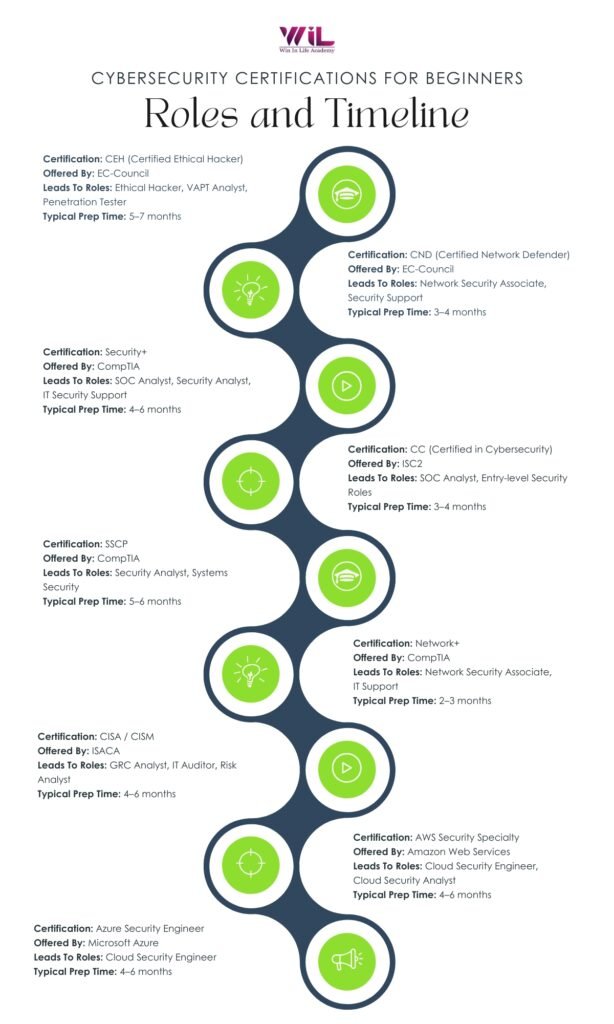
| Certification | Focus Area | What You Learn | Suitable For | Roles You Can Target | Prep Time |
|---|---|---|---|---|---|
| CC | Security basics & operations | Core principles, risks, protection measures | Students, non-IT grads, support professionals | SOC Analyst, Entry-Level Security Roles | 3–4 months |
5. SSCP — Systems Security Certified Practitioner (from ISC2)
What this certification is about
Understanding how systems are protected inside organizations, how access is controlled, and how operational security is maintained.
What you learn while preparing
- Managing user access and permissions
- Securing systems and servers in real environments
- Monitoring practices across networks
- Daily operational security practices
How the learning feels at the beginning
Structured and practical, especially for those who already have IT or networking exposure.
Career Progression:
Often combined with CEH or Security+ to expand into broader cybersecurity roles.
Typical preparation time
With steady preparation, learners can transition into these roles in about 5–6 months.
| Certification | Focus Area | What You Learn | Suitable For | Roles You Can Target | Prep Time |
|---|---|---|---|---|---|
| SSCP | Systems & operational security | Access control, monitoring, system protection | IT pros, system & network admins | Security Analyst, Systems Security | 5–6 months |
6. Network+ — CompTIA (from CompTIA)
What this certification is about
Building a clear understanding of how networks function — the foundation almost every cybersecurity role depends on.
What you learn while preparing
- Network structure and communication between systems
- Role of routers, switches, and firewalls
- Data flow across networks
- Practical understanding of OSI model, TCP/IP, routing, and switching
How the learning feels at the beginning
Very beginner-friendly and easy to grasp, especially for those who feel unsure about networking concepts.
Career Progression:
Creates a strong base before moving into CEH, Security+, or SSCP.
Typical preparation time
This foundation can usually be built in about 2–3 months, making future cybersecurity learning much easier.
| Certification | Focus Area | What You Learn | Suitable For | Roles You Can Target | Prep Time |
|---|---|---|---|---|---|
| Network+ | Networking fundamentals | Network structure, routing, switching, data flow | Students, freshers, support professionals | Network Security Associate, IT Support | 2–3 months |
7. CISA and CISM — ISACA (from ISACA)
What these certifications are about
Focusing on how organizations handle risk, enforce security policies, maintain compliance, and perform audits to keep systems secure in a structured way.
What you learn while preparing
- Risk assessment and policy development
- Compliance requirements and audit practices
- Governance frameworks followed by organizations
- Aligning security practices with global standards
How the learning feels at the beginning
More conceptual and process-driven than technical, suitable for those comfortable with structured thinking.
Career Progression:
Often combined with Security+ to add technical understanding alongside governance knowledge.
Typical preparation time
With focused study, learners can be ready for these roles in about 4–6 months.
| Certification | Focus Area | What You Learn | Suitable For | Roles You Can Target | Prep Time |
|---|---|---|---|---|---|
| CISA / CISM | Governance, risk & compliance | Policies, audits, risk, frameworks | Audit, compliance, management, IT pros | GRC Analyst, Risk Analyst, IT Auditor | 4–6 months |
8. AWS Security Specialty and Azure Security Engineer
(from Amazon Web Services and Microsoft Azure)
What these certifications are about
Securing cloud environments, managing identities, and protecting cloud networks and services used by organizations.
What you learn while preparing
- Identity and access management in cloud platforms
- Cloud networking and security controls
- Shared responsibility between cloud provider and organization
- Protecting cloud services and infrastructure
How the learning feels at the beginning
Easier to grasp if you already understand networking and basic security concepts.
Career Progression:
Combines very well with Security+ or Network+ to build a strong overall foundation.
Typical preparation time
With steady preparation alongside work, learners can be ready in about 4–6 months.
| Certification | Focus Area | What You Learn | Suitable For | Roles You Can Target | Prep Time |
|---|---|---|---|---|---|
| AWS Security / Azure Security | Cloud platform security | IAM, cloud controls, infrastructure protection | Cloud admins, system admins, IT engineers | Cloud Security Engineer, Cloud Security Analyst | 4–6 months |
Choosing Certifications Based on Your Career Direction
After seeing how each certification connects to a specific type of work, a common doubt beginners have is whether they should stop with one certification or plan what to do next. This is a very natural question.
In cybersecurity, certifications make more sense when they are chosen according to the role you want to move into, rather than being picked randomly or based on popularity. Most beginners do not need many certifications to enter their first role. In many cases, one or two well-chosen certifications are enough to become job-ready.
The focus should not be on collecting certificates, but on selecting certifications that support your career direction step by step. You also don’t need to finalize your long-term path on day one — this approach simply helps you begin in the right direction with clarity.
SOC and Security Operations Path
- For entry-level Security Operations (SOC) roles starting with CC or Security+ helps you understand how cyber threats are detected, how alerts are monitored, and how incidents are handled inside organizations.
- Once this base is clear, adding SSCP helps deepen your understanding of access control, system protection, and daily security practices. Later, some professionals choose to add CEH to understand the attacker’s side, but this is not necessary in the beginning.
- This combination allows a smooth progression from SOC Analyst roles to more advanced Security Analyst positions over time.
Ethical Hacking and VAPT Path
- Those interested in ethical hacking often find it easier to strengthen their foundation first. Certifications like Network+ or CND build clarity around how networks function and how defenses are designed.
- With this base, moving to CEH becomes much smoother because the core ideas are already clear. You can then focus on attack techniques, vulnerability identification, and reporting without confusion.
- This sequence prepares learners confidently for Ethical Hacker, Penetration Tester, and VAPT Analyst roles.
IT Background to Security Path
- Working professionals from helpdesk, system administration, networking, or NOC roles usually benefit from starting with Security+ or CC to gain a structured understanding of cybersecurity.
- From there, choosing SSCP supports a move into defensive and operational roles, while choosing CEH supports a move into testing and offensive roles.
- This path builds directly on existing IT experience and makes the transition into cybersecurity practical without starting from scratch.
Governance, Risk, and Compliance (GRC) Path
- Professionals from audit, compliance, documentation, or management backgrounds often begin with Security+ to understand how security works in real environments.
- Adding CISA or CISM after that aligns them with governance, risk, and compliance roles, where the focus is on policies, audits, and regulatory frameworks rather than technical testing.
- This path focuses more on policies, risk, and decision-making than hands-on technical testing.
Key Takeaway for Beginners
You don’t need to follow every path or collect multiple certifications. A clearer approach is:
The better approach is to first decide the kind of cybersecurity role you want to move into, then build the knowledge required for that role, and finally choose one or two certifications that directly support that direction.
This way, learning feels structured, preparation becomes easier, and your career progress feels natural rather than overwhelming.
What To Do After Exploring the Certifications
- Ignore the certifications that clearly don’t match your background (for example, governance certifications if you want ethical hacking, or ethical hacking if you prefer policy roles)
- Check whether your networking basics are strong. If not, start there before touching any security certification.
- Look at two certifications that match the kind of role you liked while reading this blog — not more than two.
- Compare their syllabus briefly and see which one feels more understandable with your current knowledge.
- Choose the one that feels closer to your level, not the one that sounds impressive.
- Start learning the topics first before thinking about the exam date.
- While learning, spend time in labs so the concepts become practical.
- Only after finishing this, think about the next certification based on how comfortable you feel with the subject.
This way, you move from confusion to clarity without trying to figure out everything at once.
Online Certifications
Build practical cybersecurity skills to protect systems, networks, and data in real-world environments. Learn how cyber attacks occur, how organizations defend against them, and how security professionals secure digital infrastructure, aligned with globally recognized certifications.

Conclusion
Cybersecurity does not become easier because you choose a popular certification. It becomes easier when you understand where you want to go and follow a learning path that supports that direction.
When fundamentals are clear, career direction is defined, and certifications are chosen with purpose, the journey into cybersecurity stops feeling confusing and starts feeling achievable. This is what turns beginners into job-ready professionals with confidence rather than doubt.
At Win In Life Academy, the Cyber Security Course with Online Certifications is designed exactly around this approach. Instead of pushing tools or rushing into exams, the course focuses on building strong foundations, guiding learners toward the right certification path, and preparing them for real entry-level cybersecurity roles.
If you are starting your cybersecurity journey, the right place to begin is not with a certification name, but with a structured learning path that helps you choose the right one.
FAQs
1. Do I need a technical background to start a cybersecurity certification as a beginner?
No. Many entry-level certifications are designed for learners with basic computer knowledge and do not require prior cybersecurity experience.
2. How long does it usually take to prepare for a beginner cybersecurity certification?
For most beginners, focused preparation with practice can take anywhere between 3 to 6 months depending on the certification and daily study time.
3. Can I prepare for cybersecurity certifications while working full-time?
Yes. Many learners prepare during evenings or weekends because most beginner certifications rely on concept clarity and lab practice rather than classroom time.
4. Is it necessary to know programming for beginner cybersecurity certifications?
No. Programming is not mandatory at the beginning. Understanding networking and security basics is more important.
5. Which certification is easier for absolute beginners to start with?
Certifications that focus on fundamentals, such as CC, Security+, or Network+, are often easier starting points for beginners.
6. Will a beginner cybersecurity certification help me get a job abroad?
These certifications are globally recognized, and with some practical experience, they can support applications for international roles.
7. Do I need to complete multiple certifications to get my first cybersecurity job?
No. One well-chosen certification aligned with your career goal is usually enough to apply for entry-level roles.
8. Are labs and practical practice necessary while preparing for certifications?
Yes. Practical exposure helps you understand concepts better and improves confidence during interviews.
9. Can non-IT professionals switch to cybersecurity through certifications?
Yes. Many professionals from support, operations, audit, and networking backgrounds transition into cybersecurity through structured preparation.
10. What matters more — certification or knowledge?
Certification validates your knowledge, but understanding the concepts and being able to apply them is what helps you succeed in interviews and jobs.