


In today’s data-driven world, the role of a Business Analyst (BA) can be confusing, especially with its overlap with roles like Data Analysts. While both work with data to influence business decisions, the key difference lies in their focus. Business Analysts go beyond data collection to align business needs with technological solutions. They act as a bridge between stakeholders and technical teams, ensuring strategies are viable and aligned with organizational goals.
These business analyst skills are crucial to effectively translating business challenges into actionable solutions. While there is overlap with Data Analysts, BAs excel in understanding business processes, developing strategies, and driving change within an organization.
The Indian business-analytics market itself is projected to grow sharply: one estimate values the Indian analytics market at USD 77.00 billion in 2022 and expects it to reach USD 136.47 billion by 2030 — a CAGR of ~9.6%. That suggests more jobs and demand for analysts. Acquiring these key skills needed for business analysts will not only help BAs thrive but also enhance their career prospects in an increasingly competitive job market.
Now, let’s explore the essential business analytics skills that define a successful Business Analyst and set them apart in today’s evolving industry.
Core Business Analyst Competencies
1. Requirements Gathering & Documentation
A key responsibility of a Business Analyst (BA) is to gather and document requirements, ensuring both technical and business stakeholders have a clear understanding of project goals. This foundational work guides the development team, aligning the final product with business objectives.
Requirements are gathered through techniques like interviews, surveys, workshops, and user feedback, and are then documented into formats such as user stories, use cases, and functional specifications.
User Stories, Use Cases, and Functional Specifications:
- User Stories: Short descriptions of features from the end user’s perspective, focusing on the value the feature will provide.
- Use Cases: Detailed descriptions of user-system interactions, outlining the steps to achieve specific goals.
- Functional Specifications: In-depth technical descriptions of the system’s behavior, serving as a blueprint for development.
Types of Requirements Documents & When to Use Them
| Document Type | Purpose | When to Use |
|---|---|---|
| User Stories | Brief feature descriptions. | Use in agile projects for high-level requirements. |
| Use Cases | Detailed user-system interactions. | Use waterfall projects for specific details. |
| Functional Specifications | Detailed system functionality. | Use for large projects with precise technical needs. |
| Business Requirements Document (BRD) | Business goals and objectives. | Use a project to start to define goals and align stakeholders. |
| System Requirements Specification (SRS) | Technical system details. | Use detailed specs needed for development. |
2. Stakeholder Management & Communication
Effective stakeholder management and communication set great BAs apart. Unlike good BAs, who focus on gathering requirements, great BAs ensure alignment across all stakeholders, addressing concerns early and keeping everyone informed throughout the project. Managing conflicting priorities and facilitating collaboration are crucial aspects of this skill.
Managing Conflicting Priorities
Great business analysts are adept at managing conflicting priorities by negotiating and aligning stakeholder needs. They balance differing viewpoints, ensuring the project stays focused on its goals while keeping stakeholders satisfied.
Facilitation Techniques
BAs use facilitation techniques like workshops, brainstorming sessions, and focus groups to foster collaboration. Techniques such as SWOT analysis, mind mapping, and Moscow prioritization help guide discussions, make decisions, and keep projects on track.
Mastering stakeholder management and communication enables BAs to ensure smooth project progress and strong stakeholder engagement.
3. Process Modeling & Analysis
A Business Analyst (BA) analyzes business processes by assessing the current state (existing processes) and defining the future state (ideal process). They identify gaps between these states and create a strategic plan to bridge them, ensuring efficiency and alignment with business goals.
BPMN Basics, Flowcharting, Swimlane Diagrams
To effectively document and communicate process changes, BAs use various modeling techniques:
- BPMN (Business Process Model and Notation): A standardized approach for visualizing business processes, showing workflows and decision points clearly.
- Flowcharting: A simple, visual tool for mapping out sequential process steps and decision points.
- Swimlane Diagrams: A type of flowchart that organizes process steps into lanes to indicate responsibility across different stakeholders or departments.
Process Modeling Notations Compared
| Notation | Purpose | When to Use |
|---|---|---|
| BPMN | Standardized process modeling for business workflows. | Use for detailed, complex processes and formal documentation. |
| UML | Unified Modeling Language, used for software systems. | Use for IT-related processes and system design. |
| Flowcharts | Simple visual representation of a process. | Use for basic process mapping or when simplicity is needed. |
4. Data Analysis & Interpretation
Business Analysts (BAs) use data to inform decisions, improve processes, and guide strategy, while Data Analysts focus on technical tasks like data cleaning and analysis. Despite the differences, BAs must understand data analysis to make data-driven decisions.
BAs often use SQL to query databases and data profiling to assess data quality, identify patterns, and detect anomalies, ensuring that the data used for decisions is accurate and reliable.
SQL Basics, Data Profiling
- SQL Basics: BAs use SQL to retrieve data and extract insights for analysis.
- Data Profiling: BAs evaluate data quality, identify inconsistencies, and ensure the data is reliable for decision-making.
Data Skills: Business Analyst vs Data Analyst
| Skill/Task | Business Analyst (BA) | Data Analyst |
|---|---|---|
| Data Collection | Gathers data for business processes. | Collects raw data from various sources. |
| Data Querying | Use basic SQL for business data. | Runs advanced SQL queries on large datasets. |
| Data Profiling | Ensures data quality for decisions. | Cleans and prepares data. |
| Data Analysis | Identifies trends for business decisions. | Use statistics and ML for data analysis. |
| Reporting | Communicates insights to stakeholders. | Creates reports and dashboards for analysis. |
Technical & Methodological Skills
5. Agile & Scrum Methodologies
The Waterfall methodology, with its rigid, linear approach, is being replaced by Agile and Scrum in many industries. Waterfall struggles to accommodate changes once a project is underway, leading to inefficiency. In contrast, Agile offers flexibility, continuous feedback, and iterative development, enabling quicker adaptations and faster delivery of smaller, incremental updates.
Business Analyst role in Sprints, Backlog Refinement, and User Story Creation
In Agile projects, Business Analysts (BAs) ensure business needs are prioritized and met:
- Sprints: BAs collaborate with product owners and developers to define and refine user stories during sprint planning, aligning them with business goals.
- Backlog Refinement: BAs help organize and prioritize the product backlog, ensuring user stories are well-defined and valuable.
- User Story Creation: BAs write user stories to describe how users will interact with the system, ensuring each story delivers customer value.
BA Responsibilities in Agile vs Waterfall
| Responsibility | Agile | Waterfall |
|---|---|---|
| Requirements Gathering | Iterative with frequent feedback. | Gathered upfront and rarely revisited. |
| Collaboration | Continuous collaboration with teams. | Limited to initial planning stages. |
| Documentation | User stories and backlog items. | Detailed specifications. |
| Project Changes | Adjustments based on sprint feedback. | Changes are difficult and costly. |
| Delivery | Incremental deliveries in each sprint. | One large final delivery at the end. |
6. Tools Proficiency
Proficiency with Business Analyst tools like JIRA, Confluence, Lucidchart, Visio, and MS Project is essential for Business Analysts (BAs) to manage projects, document requirements, and communicate effectively with stakeholders. These tools help streamline workflows, track progress, and visualize processes, ensuring smoother project execution.
Why Tool Knowledge Matters (But Shouldn’t Be Overemphasized)
While knowing the right tools is important, tools should complement the BA’s core skills—understanding business needs, problem-solving, and communication. Relying too much on tools can distract from strategic decision-making. It’s crucial for BAs to adapt to the tools that best fit the project’s needs.
| Tool | Purpose |
|---|---|
| JIRA | Track tasks, user stories, and project progress. |
| Confluence | Document collaboration and knowledge sharing. |
| Lucidchart | Create flowcharts and process diagrams. |
| Visio | Design professional diagrams and flowcharts. |
| MS Project | Plan, schedule, and manage project timelines. |
Business & Soft Skills
7. Business & Domain Knowledge
Having strong business domain knowledge enables BAs to align projects with industry goals and challenges. Familiarity with key business metrics such as P&L, ROI, and business cases helps BAs make informed decisions that drive business value.
BAs need to understand P&L (Profit & Loss), ROI (Return on Investment), and business case creation to evaluate project viability and ensure alignment with business objectives.
In a healthcare project, a BA with industry knowledge designed a system that improved operational efficiency, reduced costs by 20%, and ensured regulatory compliance. This expertise ensures solutions are relevant and impactful.
8. Problem-Solving & Critical Thinking
Root Cause Analysis Techniques (5 Whys, Fishbone)
Problem-solving and critical thinking are essential for Business Analyst to address complex issues. Techniques like 5 Whys and Fishbone diagrams help BAs identify the root causes of problems, enabling them to propose effective solutions.
Analytical Frameworks
BAs use various analytical frameworks to break down problems, assess their impact, and design solutions that align with business goals.
Problem-Solving Frameworks BAs Use
| Framework | Purpose |
|---|---|
| 5 Whys | Identify root causes by asking “why” repeatedly. |
| Fishbone | Visualize potential causes of problems to identify solutions. |
| SWOT Analysis | Evaluate strengths, weaknesses, opportunities, and threats. |
| Pareto Analysis | Prioritize problems based on their impact (80/20 rule). |
Conclusion
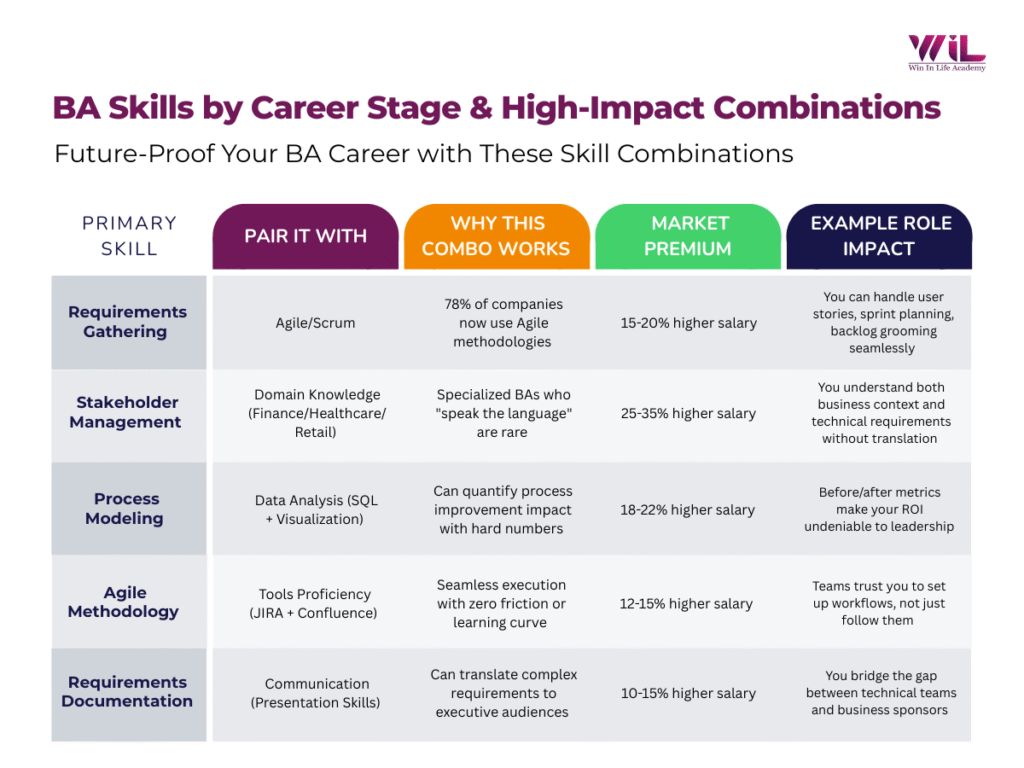
The role of a Business Analyst (BA) is evolving, but these 8 core business analyst skills remain essential across industries. Starting with requirements, gathering and stakeholder management offers the highest leverage for career entry. Use the career stage table to plan your skill development and focus on skill combinations that multiply your market value, rather than isolated competencies.
Want to build all 8 skills with real-world projects and industry mentorship? Win In Life Academy’s Business Analytics program will take you from beginner to job-ready BA in months, not years, giving you the expertise to excel in today’s competitive job market.