If you are learning data science right now, one worry is reasonable: tools that write and run their own analysis code are getting good enough to handle parts of the job you are still studying for. That is the real question behind “AI agents for data science.” Not whether agents can analyze data, but what is left for you to do once they can.
Here is the short version. Agents are taking over the execution of data science, not the judgment. The skills getting more valuable are the ones that let you direct an agent, check its output, and catch it when it is confidently wrong.
This guide covers how AI agents for data science are changing the workflow, where they still fail, and the specific skills worth learning so you end up supervising the agent instead of competing with it.
What are AI agents in data science?
AI agents for data science are software systems that take a goal written in plain language, break it into steps, and carry them out using tools like Python, SQL, and APIs, with limited human input. In data science, an agent can inspect a dataset, write and run cleaning code, test models, and report results, while you set the objective and check the work.
Say you tell an agent: clean this customer dataset and get it ready for analysis. A capable agent inspects the columns, flags missing values and duplicates, picks the right tools (Pandas, for example), writes and runs the cleaning code, checks whether the result matches what you asked for, and hands back the cleaned file with a summary of what it changed.
You set the goal and the validation rules. The agent handles the keystrokes. That division of labour is the whole story, and the rest of this article is about which side of it you want to be on.
How are AI agents changing the data science workflow?
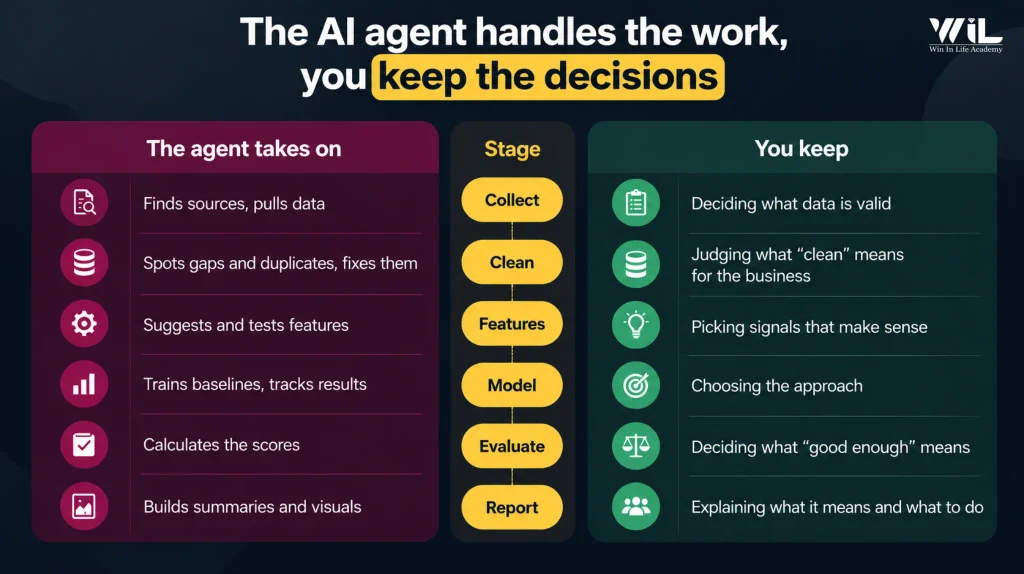
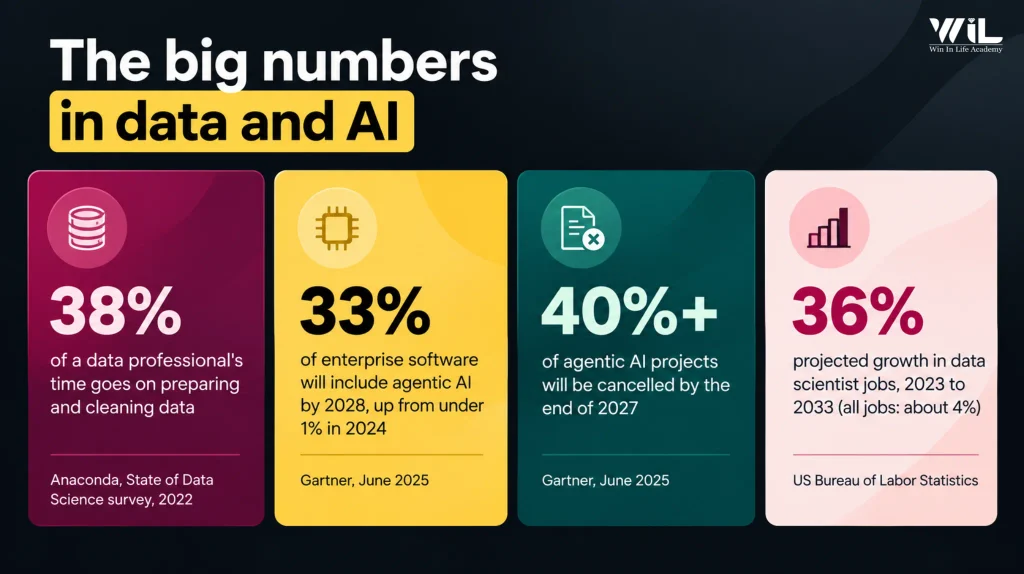
AI agents for data science compress the repetitive, code-heavy stages of the workflow, so your time shifts toward judgment calls. That matters because repetitive work is most of the job. In Anaconda’s State of Data Science survey, respondents spent around 38% of their time preparing and cleaning data, more than model training, selection, and deployment combined.
Adoption is also moving fast. Gartner projects that 33% of enterprise software applications will include agentic AI by 2028, up from less than 1% in 2024.
| Workflow stage | What the agent can take on | What stays with you |
|---|---|---|
| Data collection | Finding approved sources, running queries and API calls, assembling the dataset | Deciding which data is valid, relevant, and allowed |
| Data cleaning and exploration | Spotting missing values and duplicates, writing and running cleaning code, summarizing distributions | Judging whether “clean” means what the business needs it to mean |
| Feature engineering | Suggesting and generating features, testing variations | Knowing which signals make sense for the problem |
| Model building and testing | Training baseline models, running approved configurations, tracking results | Choosing the right modelling approach and constraints |
| Model evaluation | Computing precision, recall, F1, ROC-AUC, comparing across segments | Deciding what “good enough” means and where failure is costly |
| Reporting and automation | Turning results into summaries and visuals, running recurring tasks | Interpreting what the results mean and what to do next |
The real gain is not speed alone. It is that the parts needing a human (framing the problem, checking the answer, making the call) get more of your attention once the mechanical steps are handled.
Which skills should you learn to work with AI agents?
To learn AI agents for data science, go in layers, not frameworks-first. Start with the engineering foundation, then how LLMs use tools, then retrieval and orchestration, then production reliability, and prove it with projects. Jumping straight to LangChain tutorials without the layers underneath is the fastest way to build agents you cannot debug.
1. Core programming and developer foundations
Strong Python and data handling come first, because an agent application is still a software application.
- Advanced Python: functions, classes, error handling, modular code, async, and concurrency
- SQL and databases: querying and managing data
- APIs: connecting applications and triggering actions
- FastAPI and Pydantic: building APIs and validating structured data
- Git: version control and organised development
2. LLM mechanics and tool integration
Next, understand how a language model produces structured output and calls external tools. This is where “AI” stops being a black box.
- LLM fundamentals: tokens, context, structured outputs, limitations, and hallucinations
- Tool calling: connecting a model to Python, SQL, APIs, and other tools
- Function execution: letting an agent actually perform actions
- API integration: connecting LLMs to applications and data sources
The basic agent loop looks like this: prompt, structured output, tool call, result, next action.
3. Retrieval and agent orchestration
Once tool use is clear, learn how an agent reaches outside its own memory and coordinates several steps.
- RAG: retrieving information from documents, databases, and other sources
- Agent orchestration: managing actions, tools, decisions, and outputs
- Agent frameworks: LangChain, LangGraph, CrewAI, and AutoGen
- Multi-agent workflows: splitting complex tasks across specialised agents
The goal is to answer four questions reliably: which tool to use, what happens next, how a failure is handled, and when the workflow should stop.
4. Production, standards, and reliability
A working prototype is the easy part. Real agents have to hold up when data shifts, an API goes down, or the model returns something unexpected.
- Data and databases: SQL, SQLAlchemy, Alembic, and vector databases where needed
- Testing and logging: checking agent behaviour and diagnosing failures
- Monitoring and evaluation: tracking reliability, task completion, cost, latency, and odd behaviour
- MCP: how the Model Context Protocol connects agents to tools and data
The target is agents that are not just capable, but testable, traceable, and maintainable.
5. Projects: from single agent to multi-agent
Projects should show a clear step up from one useful agent to several working together.
Project 1, single agent: build a data analysis agent that takes a natural-language request and uses Python and Pandas to analyze a dataset. Flow: user request, AI agent, Python/Pandas, analysis, validation, result.
Project 2, multi-agent system: split a full data science workflow across specialized agents. Flow: user request, data agent, analyst agent, ML agent, evaluation agent, report agent, final output.
Build the single agent end to end before you touch multi-agent orchestration. The second project is only worth attempting once you have watched the first one break and fixed it.
Where do AI agents for data science still fall short?
Agents automate execution, not understanding. They fail in predictable ways, and those failures are the reason human judgment is getting more valuable, not less.
The hype is running ahead of the reliability. Gartner expects more than 40% of agentic AI projects to be canceled by the end of 2027, citing unclear value, rising costs, and weak risk controls. The technology is real. It is nowhere near hands-off.
The common failure modes are worth memorizing, because spotting them is the job:
- Weak understanding of business context
- Misreading statistical results
- Choosing an inappropriate model
- Working from poor-quality or incomplete data
- Generating incorrect code
- Reaching confident but wrong conclusions
- Hitting tool failures and unreliable integrations
This is also why the career is growing rather than shrinking. The US Bureau of Labor Statistics projects data scientist employment to grow 36% from 2023 to 2033, much faster than the roughly 4% average across all occupations. Demand is not collapsing. The work is moving from running every step yourself to supervising the steps and owning the decisions.
Conclusion
The shift AI agents for data science bring is not from skilled to obsolete. It is from running every analytical step to directing and verifying them. A person who can set the right objective, notice when an agent’s confident answer is wrong, and decide what to do about it stays valuable. The practical next step: build one data analysis agent end to end, then push it until it breaks and work out why.
If you want to learn AI agents for data science through this layered path in one structured programme, Win In Life Academy‘s Data Science and MLOps Professional Certificate covers Python, SQL, machine learning, MLOps, RAG pipelines, LLM APIs, and multi-agent systems through hands-on projects, with mentorship and portfolio support.
Frequently Asked Questions
1. Can AI agents replace data scientists?
No. Agents automate repetitive tasks but do not supply business context or validate their own results. The role is shifting toward supervising agents.
2. What AI agent skills should a data scientist learn first?
Python, SQL, APIs, and Git. Then LLM mechanics and tool calling, then RAG and orchestration, then testing, monitoring, and MCP.
3. What are the main types of agents in AI?
For data science, single-task agents, tool-using agents, and multi-agent systems. Classic theory also lists reactive, model-based, goal-based, utility-based, and learning agents.
4. What is the difference between generative AI and agentic AI?
Generative AI produces content such as code or summaries. Agentic AI uses it to take actions toward a goal: choosing tools, running them, and checking progress.
5. What is the difference between an AI agent and a chatbot?
A chatbot answers a question. An agent takes actions toward a goal, calling tools like Python or SQL and checking its own results across several steps.
6. Can beginners learn AI agents without a data science background?
Yes, but start with Python and SQL, not agent frameworks. Agents are built on those foundations, and skipping them leaves you unable to debug what the agent does.
7. How long does it take to learn to build AI agents?
It depends on your starting point. With solid Python, SQL, and API skills, a working single agent takes focused weeks. Without them, the foundations take most of the time.
8. Do I need to learn LangChain first?
No. Learn tool calling and the agent loop first, build a simple agent, then adopt a framework once you see the problem it solves.
9. Are AI agents for data science reliable enough for production?
Not without oversight. They work on narrow, well-defined tasks with validation in place. Treat their output as a draft to check.
10. What is MCP and why does it matter?
The Model Context Protocol is a standard way to connect agents to external tools and data, replacing brittle one-off integrations.