
Zero trust security is a way of protecting company systems where nobody is trusted automatically, not even people already inside the office network. Every request to open a file or use an app gets checked again.
Old office security worked like a building with one locked gate. Show your pass once, walk in, and nobody checks you again. Zero trust puts a check on every door instead.
This guide explains what zero trust is, the model behind it, where zero trust architecture and ZTNA fit in, and the four skills worth learning in 2026.
The short answer: Zero trust security means never trusting a user or device just because it is inside the company network. Every request is checked again, and each person reaches one thing at a time. It is a way of planning security, not a product you buy. Four checks do most of the work: identity, devices, access and monitoring.
What is zero trust security?
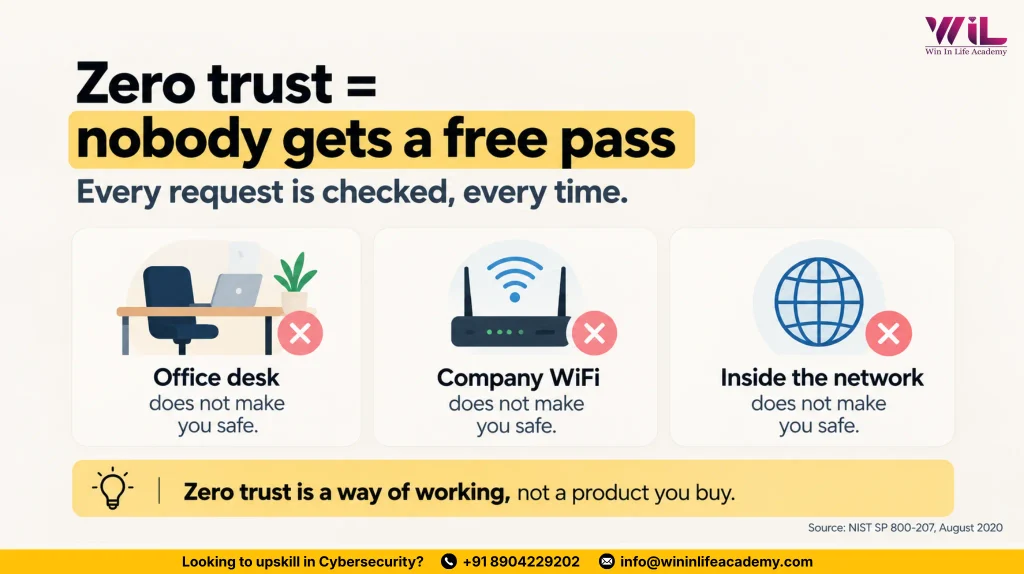
Zero trust security is a way of protecting systems where nobody is trusted automatically because of where they are. Sitting at an office desk does not make you safe. Neither does being on the company wifi.
The US National Institute of Standards and Technology (NIST) wrote the defining guide, SP 800-207, in August 2020. It says no “implicit trust” is given to a user or device “based solely on their physical or network location” (NIST).
The idea exists because the building changed. NIST points to remote workers, personal devices and cloud services outside the company network. With staff at home and apps online, there is no single gate left to guard.
What is the zero trust model and what principles does it follow?
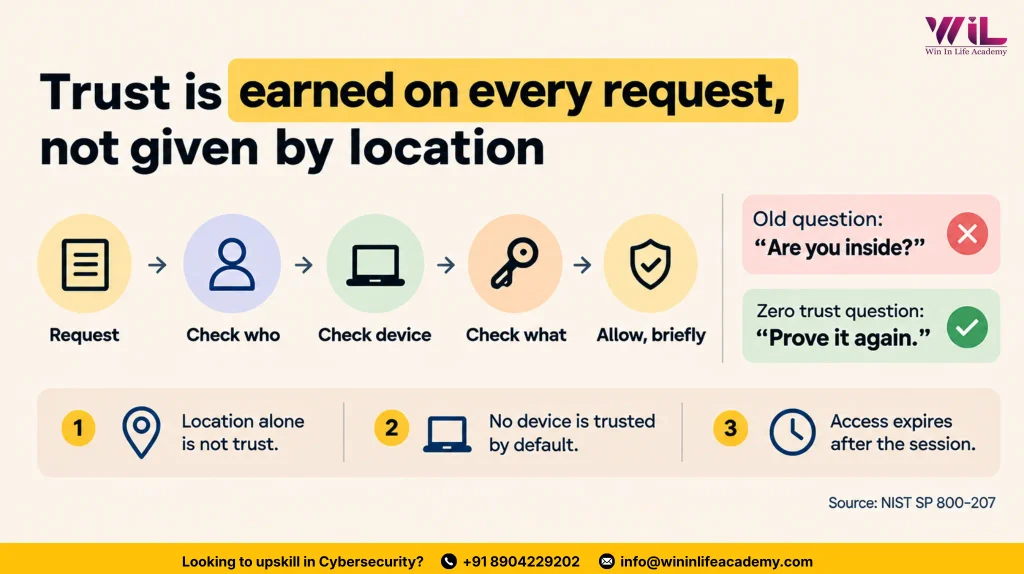
The zero trust model rests on one idea: trust comes from checking, never from location. The old question was “Are you inside?” The zero trust question is “Can you prove it again, for this request?”
NIST sets out seven rules behind this. Three matter most to a beginner, and they are the zero trust principles most guides repeat:
- “Network location alone does not imply trust”
- “No asset is inherently trusted”, so every laptop and phone gets checked
- Access is granted “on a per-session basis”, so permission is given once and then expires
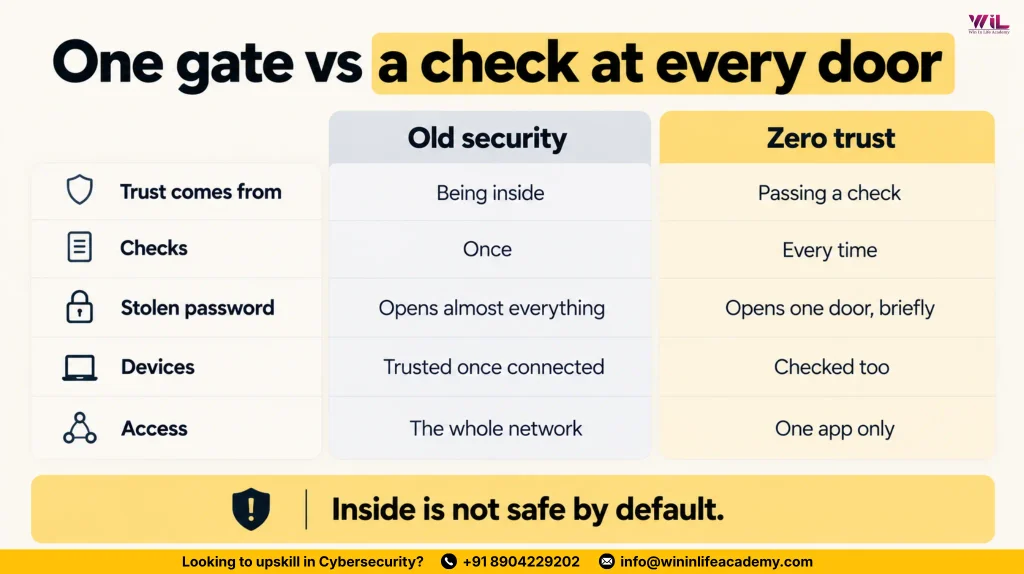
The table shows how the zero trust security model differs from the old gate.
| Old security | Zero trust security | |
|---|---|---|
| Trust comes from | Being inside the network | Passing a check |
| Checks happen | Once, at the gate | On every request |
| A stolen password | Can open almost everything | Opens one door, briefly |
| Devices | Trusted once connected | Checked too |
| Access given | The whole network | One app or resource |
What is zero trust architecture, and where does ZTNA fit in?
Zero trust architecture (ZTA) is the plan a company draws up to follow zero trust principles. Zero trust is the idea. The architecture is the blueprint, which NIST describes as using those principles to plan a company’s systems and workflows.
A zero trust network architecture decides which users, devices and apps may talk to each other, and what proof each must show. People also call this a zero trust security framework, which is fair if you remember it is a plan, not a product.
What is ZTNA (zero trust network access)?
Zero trust network access (ZTNA) is the part that controls who can reach which app. NIST SP 800-215 (November 2022) says it follows from zero trust architecture. Apps stay hidden until you are logged in and approved, and access is rechecked during your session (NIST).
Cloudflare describes the difference from a VPN this way. A VPN gives a logged-in user access to the whole network. ZTNA connects them only to the app they asked for (Cloudflare). That makes ZTNA the zero trust network security answer to remote work, because a stolen login reaches one app, not everything. Our guide to network security strategies covers the wider picture.
Is zero trust the same as a VPN?
No. A VPN opens a tunnel into the network. Zero trust is the wider approach, and ZTNA is how it gives remote access to one app at a time.
Is Cloudflare Zero Trust the same thing?
No. Cloudflare Zero Trust is a product that helps a company apply zero trust. It is not zero trust itself. Cloudflare describes its platform, Cloudflare One, as combining networking and Zero Trust in one place. Its Access tool checks users before they reach an app, and Tunnel connects an app without exposing a public IP address (Cloudflare).
Tools like this are zero trust security solutions. They help you apply the model, but buying one does not make a company zero trust. The same goes for zero trust cloud security tools, which apply these checks to data kept online. If cloud is your interest, read our guide to cloud security skills next.
What are the 4 core zero trust security skills?
The four skills are identity checks, device checks, limited access and monitoring. Each one answers a different question about a request.
1. Identity: proving who someone is, every time
This is the foundation: making sure the person asking is really that person, on every request. Passwords alone are not enough, so you learn to set up a second check, like a code on a phone or a fingerprint. You also learn to spot an account with far more access than its owner needs.
Start here if you are choosing one skill, because every other check depends on knowing who is asking. Stolen or leaked logins started 22 percent of breaches in Verizon’s 2025 report, the top route that year. Its 2026 edition says software flaws have taken the lead at 31 percent (Verizon 2025, Verizon 2026). See our guide to cybersecurity analyst skills for where identity work fits.
2. Devices: checking the laptop before it connects
This means checking the machine, not just the person using it. Before a laptop connects, you check three things. Are its updates installed? Is its security software running? Is its disk locked? A correct password on an infected laptop is still a problem. Checking machines this way overlaps with any vulnerability assessment.
3. Access: opening one door, not the whole building
This means giving someone the smallest access that lets them do their job. Instead of letting a person roam the network, you connect them to one app. Finance staff reach finance tools, not engineering files. This is the skill that limits damage when something goes wrong, and it builds on the attack vectors you already know.
4. Monitoring: recording who touched what
This means keeping a record of every request and watching it for things that look wrong. Zero trust generates a lot of records. The skill is reading them, spotting the login from a strange place at a strange hour, and acting on it. This is daily work for a SOC analyst.
| Skill | The question it answers |
|---|---|
| Identity | Is this really who they say they are? |
| Devices | Is this machine safe to let in? |
| Access | Should they reach this exact thing? |
| Monitoring | What happened, and does it look normal? |
How do you implement zero trust security, and how do you start learning it?
Companies do zero trust implementation in stages, not in a day. CISA, the US cyber security agency, scores progress as traditional, initial, advanced and optimal (CISA).
The best learning material is free. NIST SP 1800-35, published on 10 June 2025, shows how 24 partners built 19 working example implementations (NIST). A simple four-week plan:
- Week 1: read the seven rules in NIST SP 800-207
- Week 2: add a second login check to your own accounts and note how it works
- Week 3: build two accounts on a free cloud trial with different access, then prove the limits hold
- Week 4: turn on logging, make requests, then read the records and explain them
Write each week up in a short note. That note is what you show an employer.
A certificate is optional in zero trust cybersecurity. The Cloud Security Alliance offers the vendor-neutral Certificate of Competence in Zero Trust (CCZT). It asks for no formal work experience, though CSA says basic cloud security knowledge helps (CSA). Our guide to cyber security certifications compares the wider options.
Can a fresher get a zero trust job in India?
Rarely as a job title. Zero trust usually sits inside roles like security analyst, identity engineer or network security engineer. Learn the four checks, then apply for those roles. Start with our list of cyber security jobs for freshers and the cyber security roadmap.
Conclusion:
Zero trust replaces one old assumption, that being inside the network makes you safe.
So ignore the product adverts and learn the four checks. Who is asking, what machine are they on, what exactly should they reach, and what happened afterwards.
Start this week with identity, because every other check depends on it. It is free to practice. Add a second login step to your own accounts, write down how it works, and you have begun.
Frequently asked questions
1. What is zero trust security in simple words?
It means checking every request instead of trusting someone because they sit inside the company network. NIST, the US standards body, says no trust is given to a user or device based only on where it is.
2. What are the main zero trust security principles?
Location alone does not earn trust. Every user and device is checked, never assumed safe. Access lasts for one session and covers one resource. NIST SP 800-207 lists seven rules in total, and these three are the easiest starting point.
3. What is zero trust architecture?
It is a company’s plan for following zero trust principles. Zero trust is the idea, and the architecture is the blueprint for which users, devices and apps may connect, and what proof each needs. NIST SP 800-207 is the main guide.
4. What is ZTNA?
ZTNA stands for zero trust network access. It connects a user to one approved app instead of the whole network, keeps other apps hidden until the user is verified, and rechecks during the session. NIST SP 800-215 describes it.
5. Is Cloudflare Zero Trust the same as zero trust?
No. Cloudflare Zero Trust is a vendor product that helps a company apply zero trust. Zero trust itself is an approach set out by NIST, and no single product delivers it. Tools help, but they do not make a company zero trust alone.
6. How do companies implement zero trust?
In stages, not all at once. CISA scores progress as traditional, initial, advanced and optimal. NIST SP 1800-35 shows how 24 partners built 19 working example implementations, giving teams a free, practical starting point.
7. Which zero trust skill should a beginner learn first?
Identity. Every other check depends on knowing who is asking, and you can practice it free by adding a second login step to your own accounts today. Then move on to devices, access and monitoring.
8. Is there a zero trust certification?
Yes. The Cloud Security Alliance offers the vendor-neutral Certificate of Competence in Zero Trust (CCZT), which needs no formal work experience. Basic cloud security knowledge helps. Treat it as a bonus, not a requirement.