AI automation skills are what let you hand a task to software and walk away. The tool is the smallest part of that. Anyone can connect two apps in an afternoon. What takes months, and what employers pay for, is knowing which task deserves automating and what happens when the AI gets it wrong.
There is one choice to make before you start. Four different jobs share the word automation, and picking the wrong one costs six months.
What is AI automation? The 4 types explained
AI automation means using software to run a task from start to finish, with an AI model making at least one decision inside it. Four different things go by that name. Pick one before you spend money.
| What people mean | What you do | Where it leads |
|---|---|---|
| Workflow automation | Connect apps and add AI decisions inside a business process | This blog. Tools: n8n, Zapier, Make, Power Automate |
| AI productivity tools | Use ChatGPT or Copilot to work faster yourself | Useful, but it is a habit, not a job skill |
| Test automation | Automate software testing, with AI writing and repairing tests | A QA engineering career. Tools like Playwright |
| Machine learning for automation | Train a model to make the judgement inside a process | Closer to data science. Needs Python |
The second is worth a note. Microsoft’s 2026 Work Trend Index surveyed 20,000 knowledge workers across ten countries, India included. It found 66 percent of AI users spend more time on high-value work, but only 13 percent were rewarded for redesigning how work gets done.
Using AI faster is a habit. Being paid to build automations is a skill. This blog covers the second.
Why are AI automation skills in demand?
Because demand moved from building AI to deploying it, and deployment is where the shortage sits.
LinkedIn’s Skills on the Rise 2026 ranks India’s five fastest growing skills as prompt engineering, workflow automation, LLMOps, AutoML and API integration. Workflow automation is second. Nirajita Banerjee, LinkedIn’s India Senior Managing Editor, explained why: “The candidates getting noticed today aren’t just specialists, they’re skill stackers. The same report found 74 percent of Indian recruiters struggle to find qualified talent.
What are AI automation skills? AI automation skills are what you need to build a process that runs without a person watching it. They cover choosing the task, moving data between apps, writing prompts that return a fixed format, using one automation tool well, understanding AI agents, and designing for the times the AI is wrong.
Hiring backs it up. Naukri JobSpeak for August 2026 recorded AI and ML hiring up 31 percent year on year, and fresher hiring up 15 percent. Bengaluru, Chennai and Pune each grew 31 percent, Hyderabad 48 percent.
What are the top 6 AI automation skills?
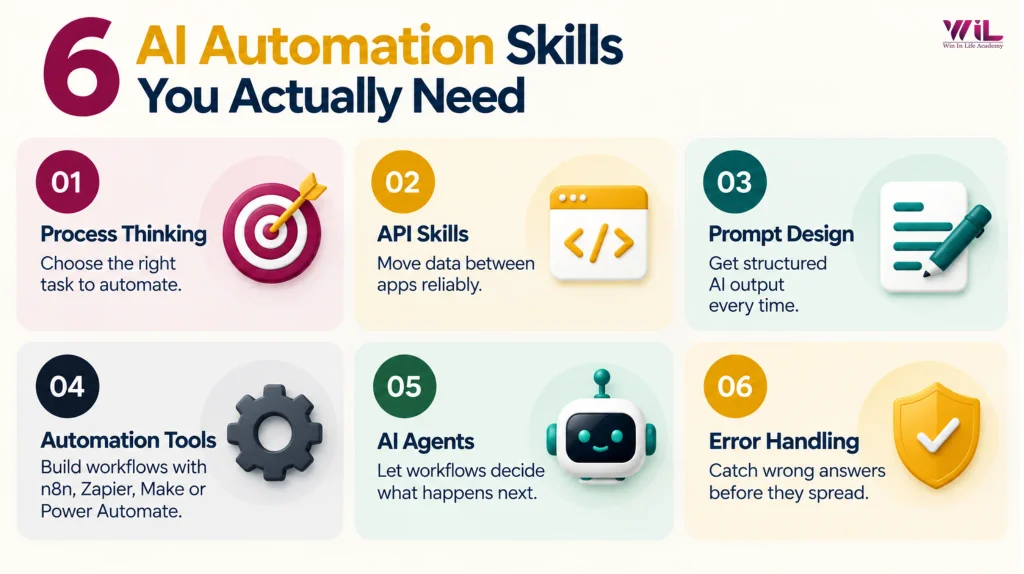
These are the six, in the order your work moves through them. Tools are fourth on purpose.
1. Process thinking: choosing what to automate
What it is: deciding which task is worth automating before you build anything.
Most automations fail because the task was badly chosen, not badly built. Ask four questions. Is it repetitive? Is it rule-based? Does it happen often? Does someone hate doing it?
McKinsey’s 2026 State of AI survey found nearly three quarters of high performers had redesigned how work flows. Only a quarter of everyone else had. Automating a broken process makes it broken faster.
2. API skills: moving data between apps
What it is: getting structured data out of one system and into another.
This is the wall most beginners hit. Learn what an API is, how to read JSON, and what a webhook does. Learn how API keys and logins work. Then learn what to do when an expected field comes back empty.
LinkedIn ranks API integration fifth in India. Zapier alone connects over 9,000 apps, so how connectors behave matters more than memorizing any one.
3. Prompt design: getting a fixed format back
What it is: writing instructions that return the same clean format every time, with nobody reading the output.
Chatting with ChatGPT is not this. Inside an automation the next step has to read what the AI returned. If the format changes, the workflow breaks silently.
So ask for a fixed structure. Give one or two examples. Then decide what happens when the answer comes back wrong. Generative AI is the engine here, and prompt engineering sits first on LinkedIn’s India list.
4. AI automation tools: learning one properly
What it is: picking a single platform and getting genuinely good at it.
| Tool | Best for | Coding needed |
|---|---|---|
| Zapier | Fastest start, widest app library | None |
| Make | Visual builder, mid-complexity work | Little |
| n8n | Self-hostable, most AI job ads | Some |
| Power Automate | Microsoft shops, Indian IT services | Some |
n8n appears most often in Indian AI automation ads. It raised 180 million dollars in October 2025 at a 2.5 billion dollar valuation. It also publishes free courses in its own documentation, the cheapest honest place to start.
Learn one deeply. The thinking transfers. The buttons do not.
Can I learn AI automation without coding?
Yes, to a point. Zapier and Make need no code, and plenty of paid work uses only those. But job ads that pay more ask for Python alongside n8n, because real workflows eventually need a step no tool provides.
5. AI agents: letting the workflow decide
What it is: a step that decides which action to take, instead of following a fixed path.
A normal workflow follows branches you drew. An agent gets tools and a goal, and picks for itself. Powerful, and harder to predict, which is why the next skill exists.
Learn one standard too. Model Context Protocol is becoming the common plug between AI models and tools, now under the Linux Foundation with close to half a billion downloads a month. Our guide to agentic AI covers where this heads.
6. Error handling: catching wrong answers
What it is: building the workflow so a wrong answer gets caught instead of quietly spreading.
This separates someone who built a demo from someone a company will pay. Researchers at the University of Illinois, Stanford and others studied where AI agents fail. The problem is spread: “A single root-cause failure can propagate through subsequent steps, compounding errors and leading to task failure.” One early mistake ruins everything after it.
So build the safety in. Add an error path for every step that can fail. Put a human approval on anything you cannot undo. Log every run. Keep twenty awkward inputs and re-run them after each change. Treat fetched text as untrusted: our prompt injection guide explains why.
What do AI automation jobs in India require?
We checked Indeed India on 25 September 2026. What matters is what the postings require.
Techolution listed an AI Automation Intern, open to entry level. Enpersol listed an Automation Engineer at one to five years, remote, at Rs 25,000 to Rs 50,000 a month that day. Appexert wanted an AI Agent Specialist in n8n and Zapier at three to five years. Zensar, Avalara and WebLineIndia had workflow roles live.
Compare that with MLOps jobs, where almost every Indian posting starts at three years. Several of these ask for skills and a portfolio, not a seniority band. One is an internship.
The honest catch: much of this work is remote, agency-side or contract, not a campus placement ladder.
Titles to search: AI Automation Engineer, Workflow Automation Engineer, Agentic AI Developer, AI Agent Specialist, RPA Developer. These skills also raise the ceiling in marketing, sales, HR and finance operations. See our guides to non-coding IT roles and AI jobs for freshers.
How to learn AI automation step by step
Start free, and check any certification is still live before paying.
Check certifications first. Microsoft retired exam PL-500, its Power Automate RPA Developer certification, on 30 June 2026. Its own study guide confirms the date, and the retirement listing shows no replacement. Courses are still sold against it. Verify a certification on the vendor’s site before paying, and see our list of AI certifications worth pursuing.
Then follow this order.
- Learn one tool from its free documentation. n8n and Microsoft both publish theirs.
- Learn APIs and JSON. Not full programming. Enough to read a response and fix a broken field.
- Learn prompt design for fixed-format answers, not conversation.
- Build one agent, then break it deliberately.
- Automate three real things for real people, with error paths.
- Write down what each saved, in hours or mistakes avoided. That sentence gets you hired.
What a paid course must include: real APIs, real error handling, and a project you can show. If it is forty hours of interface tours, or it promises a salary figure, skip it.
For the machine learning branch you need Python skills and data handling. Different path, different course. Our AI career roadmap for beginners and top AI skills to learn in 2026 show where each fits.
Certificate in AI and ML Essentials
Build the Python, data and generative AI foundations AI automation sits on, with capstone projects and 1:1 placement mentorship at Win in Life Academy.
Conclusion: pick the automation before the course
The tools are a weekend. The judgement is the job. Decide which of the four automations you are learning before you spend a rupee. The wrong choice costs six months, not money.
Then do one thing this week. Take a task you repeat every Monday, automate it, add an error path, and write down what it saved. That sentence beats any certificate in an interview.
Frequently asked questions
1. What are AI automation skills in simple terms?
AI automation skills are the abilities needed to make tasks run without constant human supervision. They include choosing suitable tasks, connecting applications, designing structured prompts, moving data, and catching incorrect AI outputs before they spread.
2. Are AI automation testing tools the same as AI automation tools?
No. Testing tools such as Playwright check whether software works correctly, while workflow tools such as n8n and Zapier automate business processes. AI tools for automation serve workflow purposes and belong to a different career path.
3. Do I need Python for AI automation?
You do not need Python to start. No-code platforms can handle many workflows, but technical roles often require Python for custom steps. Adding Python to your AI automation learning can help you handle more complex workflows.
4. Is the Microsoft PL-500 certification still available?
No. Microsoft retired the PL-500 Power Automate RPA Developer exam on 30 June 2026. Before paying for AI automation training, verify that the certification remains active on the vendor’s official website.
5. What projects prove AI automation skills without work experience?
Build three small automations that solve real problems, include error handling, and demonstrate measurable results. These projects showcase practical AI automation skills and can show employers the hours, errors, or manual effort your workflows saved.
6. What is generative AI automation?
Generative AI automation combines generative AI with automated workflows to perform tasks such as summarizing information, generating responses, classifying content, or supporting decisions. Appropriate checks should remain in place when AI-generated outputs could contain errors.
7. How can I learn AI automation as a beginner?
Start with workflow automation, then learn one platform, APIs, JSON, prompt design, and error handling. Learn AI automation by building practical projects around real tasks. Later, progress toward AI agents, Python, and advanced integrations.
8. Is AI automation a good career for freshers in India?
AI automation can offer opportunities for freshers in India. Indeed India listings included internships and roles open to candidates with one year of experience. Beginners can start with AI automation learning and develop practical skills.
9. Which tool should a beginner learn, Zapier or n8n?
Zapier is suitable if you want a quick, no-code start. n8n is useful for more technical workflows and appears in Indian automation job listings. An AI automation course for beginners should focus on mastering one platform.
10. What is the difference between RPA and AI automation?
RPA, or robotic process automation, follows predefined rules to perform tasks. AI automation adds AI-based decisions, such as classifying an email or generating information. Understanding this distinction is an important part of AI automation training.