Say your company has 500 HR policy PDFs. You want a chatbot that answers “how many casual leaves do I get?” from them.
You cannot retrain an AI model every time HR changes a rule. So you do something simpler. You search the PDFs, pick the paragraphs that look useful, and hand them to the model with the question. It reads them and writes the answer.
That setup is called RAG, short for Retrieval Augmented Generation. It does two things: search finds the right pieces of text, and the model turns them into a normal sentence.
Almost every wrong answer comes from the search step, not the model. These seven RAG skills fix it, in the order you will use them.
Why does search matter more than the AI model?
Because the model can only work with what you hand it. RAG came from a 2020 research paper by Patrick Lewis, Douwe Kiela and ten other researchers at Meta AI.
Anthropic measured this in September 2024. Out of every 100 questions, a basic setup missed the right text about 6 times. Then they changed only the search step. Same AI model, same questions.
| What they changed | How often search missed |
|---|---|
| Nothing, basic setup | 5.7 out of 100 |
| Added a line of context to each piece before saving | 3.7 out of 100 |
| Also added keyword search next to meaning search | 2.9 out of 100 |
| Also added a second model to re-sort results | 1.9 out of 100 |
Three changes to search removed two thirds of the mistakes. The model did none of that work.
What are RAG skills?
RAG skills are the skills needed to find the right information in your documents and hand it to an AI model. They cover cutting documents into pieces, turning text into numbers for search, mixing keyword search with meaning search, rewriting vague questions, re-sorting results, adding citations, and testing the answers.
Douwe Kiela, who led that Meta AI team, put it this way in a June 2025 interview: “The language model is only a small part of a much bigger system. If the system doesn’t work, you can have an amazing language model and it’s not going to get the right answer.”
Which RAG skills should you learn first?
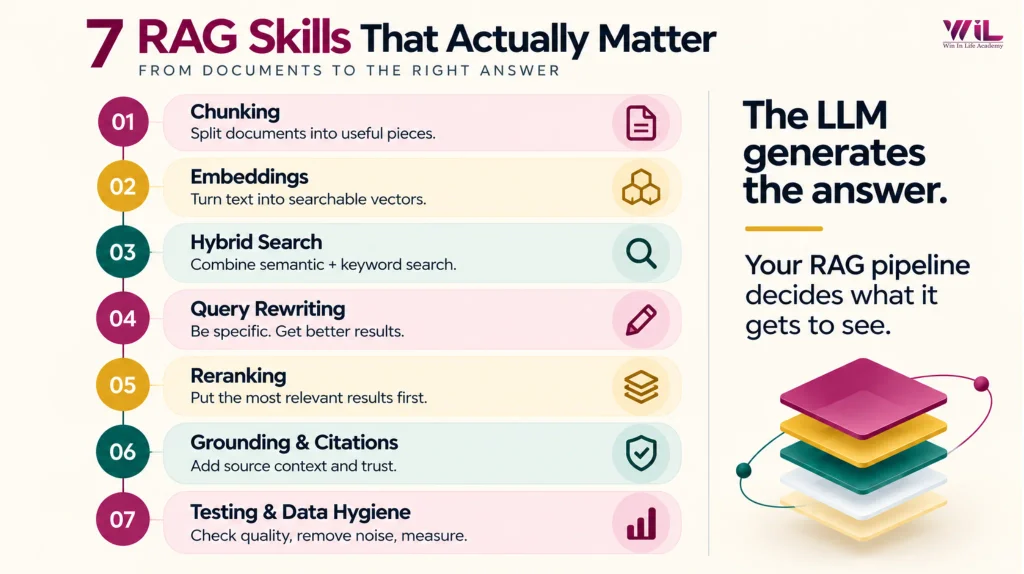
Seven skills, in the order your data moves through them.
1. Chunking: cutting documents into pieces
What it is: splitting each document into small passages before you save them for search.
A PDF is not clean text. It has tables, headers, footers, scans and two-column layouts, so pulling readable text out comes first. Then you cut it up. Too small and a piece loses meaning. Too big and the useful line gets buried.
Chroma, which builds search tools for AI, tested nine ways of cutting text. The method you pick can change results by up to 9 percent. A common default of 800 tokens per piece did worse than 200-token pieces.
2. Embeddings and vector databases: searching by meaning
What it is: turning each piece into a list of numbers so the computer can compare meanings.
Pieces with similar meaning get similar numbers. That list is called an embedding. A vector database stores millions of them and finds the closest fast. Pinecone, Qdrant, FAISS, ChromaDB and Milvus do this, and pgvector adds it to a PostgreSQL database you may already run.
The skill is not installing one. Some embedding models handle legal or medical text better, and filtering by plain details first, like department or year, often helps more than switching models.
3. Hybrid search: mixing keywords with meaning
What it is: running old-style keyword search alongside meaning search and combining both result lists.
Meaning search handles “what is the leave policy” well and exact codes badly. Ask about invoice INV-2291 and it may return a paragraph on invoicing rules instead.
Keyword search catches exactly what meaning search misses. In the table above, adding it took misses from 3.7 to 2.9 out of 100, and it costs almost nothing.
4. Query rewriting: fixing the question before you search
What it is: cleaning up what the user typed before you use it to search.
Real questions are messy. Someone types “leave rules” or “can I take 3 days off next month”. Neither matches the wording inside your policy PDF.
So rewrite first. Expand short questions, split two-part questions into two searches, and use earlier messages to work out what “it” means. This is the cheapest fix for a system that works in testing and fails with real users.
5. Reranking: re-sorting results before the model sees them
What it is: using a second, slower model to put the useful pieces at the top.
Your search brings back 50 pieces, most of them useless. A reranker reads the question against each one, reorders them, and you send only the top three to the model.
In Anthropic’s test this change alone took misses from 2.9 to 1.9 out of 100. It is the biggest improvement for the least effort.
Do I need RAG for every project? No. Anthropic says if all your documents come to under about 500 pages, you can paste everything into the prompt and skip search. Knowing when not to build a RAG system is a RAG skill too.
6. Grounding and citations: making answers checkable
What it is: arranging what you send the model, and making it name the piece it used.
Chroma tested 18 AI models from Anthropic, OpenAI, Google and Alibaba. The more text you send, the less reliable answers become. It is not enough for the right information to be in there. How you present it matters more.
So remove repeats, put the most useful piece first, and label where each came from. Tell the model to answer only from what you sent, and to name its source. A wrong answer with a source is easy to catch. One without is not.
7. Testing and data hygiene: proving it works, keeping it current
What it is: scoring your system against fixed questions, and keeping old documents out of search.
This separates someone who built a demo from someone a company will pay.
Researchers at Deakin University listed seven ways RAG systems fail, in a 2024 IEEE and ACM conference paper. The answer was never in your files. It ranked too low. It got dropped while pieces were combined. The model had it but missed it. Wrong format. Wrong level of detail. Half an answer. Five of the seven have nothing to do with how smart the model is.
So write 50 real questions with correct answers and run them after every change. Free tools like Ragas score whether search found the right pieces and whether the answer stuck to them.
Then handle old files. Put a version and expiry date on every document, and take outdated ones out of search. A confident answer from last year’s policy is worse than none.
What RAG skills do Indian companies ask for?
We checked Indeed India on 26 September 2026. A search for Retrieval Augmented Generation returns close to 2,000 openings. What matters is where RAG shows up.
Infosys has a Bengaluru opening titled “Python Developer – Agentic AI / LLM / RAG Engineer”, open at one to six years. A remote Agent Engineer role asks for RAG work and is open to freshers. CGI, NTT, Birlasoft and Jade Global have similar openings live.
Compare this with MLOps roles, where almost every Indian posting starts at three years. RAG shows up inside AI engineer and Python developer titles, not as a separate senior title. For a fresher that is good news. You can be hired for a normal Python or AI role and be given this work early. Our guides on AI engineer skills, AI jobs for freshers in India and AI engineer salary in India cover these roles.
How to learn RAG step by step
Most tutorials build everything in one sitting. That is why people finish them and still cannot tell which part is broken. Try this order.
- Get Python and APIs right first. Every job posting assumes it. The DeepLearning.AI course on RAG, taught by Zain Hasan of Together.ai, lists intermediate Python as a requirement. See what Python skills get you if you need a base.
- Build the simplest version that works. One folder, one chunk size, one embedding model, no re-sorting.
- Break it on purpose. Ask questions it gets wrong. Note which failure type each was.
- Fix one thing at a time. Keyword search, query rewriting, re-sorting, chunking. Check your score after each.
- Build your test set early. Fifty questions with correct answers, scored automatically.
- Put one small project online. A search tool over your college notes, say. One working project with a test report beats five tutorials.
If generative AI is new to you, read that first. The AI career roadmap for beginners shows where these RAG skills fit.
Conclusion
The AI model is the one part you cannot really control. Everything that decides whether an answer is right happens before the model sees anything, which is why you change the model last, not first.
So if you take one thing from this guide, write your 50 test questions before you build anything clever.
Start this week. Pick one folder of documents you care about, build the simplest chatbot for it, and note every wrong answer. That list is your study plan. If the basics still feel shaky, our AI and ML guide for beginners is a good place to start.
Frequently asked questions
1.Do I need a machine learning background to learn RAG?
No. Retrieval Augmented Generation is mostly backend and search work: you find the right documents and pass them to an existing AI model. Python, APIs and an understanding of search ranking take you further than deep learning theory.
2. How long does it take to learn RAG?
You can build a working RAG chatbot over your own documents in a few days. Learning to work out why it returns wrong answers takes a few months of building and testing. Employers pay for the second skill.
3. Is RAG finished now that AI models can read very long documents?
No. Douwe Kiela, who led the Meta AI team that created RAG, says treating RAG and long documents as opposites “isn’t a real thing”. A 2025 Chroma study of 18 AI models found answers grow less reliable as you send more text.
4. What is the difference between RAG and fine-tuning?
RAG, or Retrieval Augmented Generation, searches your documents when a question is asked and passes what it finds to the AI model. Fine-tuning trains the model further so it writes differently. Use RAG for facts that change, fine-tuning for tone.
5. Which vector database should a beginner learn?
Any one. A vector database stores text as lists of numbers so you can search by meaning instead of exact words. Indian job ads list Pinecone, Qdrant, FAISS, pgvector, ChromaDB and Milvus interchangeably, so learn one and the rest feel familiar.
6. What is chunking in RAG?
Chunking is cutting documents into smaller passages before you save them for search, so a question matches one useful paragraph instead of a whole file. Chroma tested nine methods and found the one you pick can change results by up to 9 percent.
7. How do I show RAG skills without work experience?
Put one small RAG project online with its test report: the questions you tested, how often it found the right document before and after each change, and the failures you could not fix. That beats a certificate.
8. Are RAG skills worth learning in 2026 as a fresher in India?
Yes. On Indeed India in September 2026, Infosys was hiring in Bengaluru for a “Python Developer – Agentic AI / LLM / RAG Engineer”, open at one to six years. RAG appears inside AI engineer and Python developer roles, not as a separate senior title.