Choosing your first cyber security certification is confusing, and the internet makes it worse. One list tells you Security+. The next says CEH. A third says start with CISSP, which needs five years of paid work experience you do not have yet. Even employers add to the noise: ISC2 research found 38% of hiring managers ask for CISA in early-career job ads and about a third ask for CISSP, though both need five or more years.
Underneath that confusion sit three real problems. Fees for Cyber security certifications run from ₹19,000 to more than ₹1.5 lakh and are billed in dollars, so you cannot plan a budget properly. Five of the exams below changed their syllabus during 2026, which means many guides you will find describe the wrong version. And nobody tells you plainly which cyber security certifications an Indian employer will actually respect.
This blog handles all three. Thirteen certifications, sorted beginner to advanced, each with the fee in INR, the experience you need and what it really proves.
Top Cyber Security Certifications in 2026 (Quick Comparison)
| Certification | Level | Experience gate | Approximate fee | |
|---|---|---|---|---|
| 1 | ISC2 CC | Beginner | None | ₹19,000 |
| 2 | CompTIA Security+ | Beginner | None | Check CompTIA store |
| 3 | CEH v13 | Beginner to mid | Training, or 2 years | ₹91,000 to ₹1.15 lakh |
| 4 | CompTIA CySA+ | Intermediate | None | Check CompTIA store |
| 5 | GIAC GCIH | Intermediate | None | ₹96,000 |
| 6 | OffSec OSCP+ | Intermediate | None | ₹1.68 lakh with course |
| 7 | ISC2 CCSP | Intermediate to advanced | 5 years | ₹57,500 |
| 8 | ISC2 CISSP | Advanced | 5 years | ₹72,000 |
| 9 | ISACA CISM | Advanced | Application | ₹55,000 members, ₹73,000 others |
| 10 | ISACA CISA | Advanced | Application, waivers | ₹55,000 members, ₹73,000 others |
| 11 | AWS Security Specialty | Advanced | None | ₹29,000 |
| 12 | IAPP AIGP | Advanced | None | ₹62,000 members, ₹77,000 others |
| 13 | ISACA AAISM | Advanced | CISM or CISSP | ₹44,000 members, ₹57,500 others |
Fees come from the official certification bodies in September 2026, converted at roughly ₹96 to the dollar (XE mid-market rate, 23 September 2026). These exams bill in dollars, so your card amount moves with the rate. ISACA adds an application fee of about ₹4,800. Confirm pricing before you pay.
Best Cyber Security Certifications Explained
Read these with one filter in mind. A certificate is like a driving license: it proves you learned the rules, not that you can handle Bengaluru traffic at 6pm. Some exams below hand you a car and watch you drive. Others only ask which sign means what. Both have value, but they are not the same purchase.
Beginner Cyber Security Certifications
Start here if you have a degree, maybe an L1 support job, and no security experience. Neither of the first two asks for work experience.
1. ISC2 Certified in Cybersecurity (CC)
CC is the cheapest honest way in, and it just improved. The new syllabus started on 1 September 2026, the first real update since 2022. Cloud security joined the networking domain, governance became a full domain worth 17.3%, and basic AI security now runs throughout.
- Covers: Security principles, governance, identity and access, networking and cloud, security operations.
- Fee: About ₹19,000, or ₹29,000 with two attempts. No experience needed.
- Best for: Junior Security Analyst, SOC Analyst, security support. A SOC is a security operations centre, the team that watches alerts and decides which are real.
2. CompTIA Security+
Security+ teaches security alongside the IT around it, which suits you if you came from networking or system administration. One timing warning most guides miss: CompTIA says Security+ V8 arrives on or around 17 November 2026, and the current English exam runs until 11 June 2027. Sit the current version now if you are ready. Otherwise study for V8.
- Exam: SY0-701, up to 90 questions in 90 minutes, pass mark 750 of 900.
- Fee: Check the CompTIA store for current voucher pricing in India.
- Best for: SOC Analyst, Security Analyst, network security associate roles.
3. Certified Ethical Hacker (CEH)
CEH teaches you to think like an attacker, and Indian recruiters know the name. Two surprises wait, though. You cannot simply book it: you either finish authorized training, or apply through the self-study route with a fee of about ₹9,600 and two years of IT security experience. And it is expensive for a first certificate.
- Exam: 125 multiple-choice questions over four hours, plus an optional six-hour practical with 20 live challenges for CEH Master.
- Fee: About ₹91,000 remote-proctored, or ₹1.15 lakh at a Pearson VUE centre.
- Best for: Junior Penetration Tester, Vulnerability Analyst. Learn the core ethical hacking tools alongside it, and check ethical hacker pay in India.
Intermediate Cyber Security Certifications
These assume you already work in IT or a SOC and want to move from watching alerts to handling them.
4. CompTIA CySA+
CySA+ was rebuilt this year, so ignore any guide written before mid-2026. Version 4 added AI use inside the SOC, AI governance, Zero Trust Network Access, SASE, software bill of materials and smarter vulnerability prioritization. The old V3 English exam retires on 22 December 2026.
- Exam: CS0-004, 85 questions, 165 minutes, pass mark 750.
- Fee: Check the CompTIA store for current voucher pricing in India.
- Best for: SOC Analyst, Threat Hunter, Incident Responder. Pay by level is in this SOC analyst salary guide.
5. GIAC Certified Incident Handler (GCIH)
GCIH is respected because part of it is hands-on. Its CyberLive tasks drop you into a live lab with real tools and ask you to work, rather than pick an option. At this price, it is usually the one you ask your employer to fund rather than buy yourself.
- Exam: 106 questions over four hours, 69% to pass, including CyberLive tasks.
- Fee: About ₹96,000 for a single certification attempt.
- Best for: Incident Responder, SOC Analyst.
6. OffSec OSCP+
OSCP+ is not a question paper. It is a lab. You get 23 hours 45 minutes to break into machines, then 24 hours to write the report. There is no option A, B, C or D. You either get in or you do not, which is exactly why hiring managers trust it.
- Exam: 70 points of 100 needed. Three standalone machines worth 20 each, plus three connected machines worth 40 testing Active Directory, the system most companies use to manage employee logins.
- Fee: About ₹1.68 lakh for the course and certification bundle, with 90 days of lab access and one attempt.
- Best for: Penetration Tester, Red Team Specialist.
7. ISC2 Certified Cloud Security Professional (CCSP)
CCSP is cloud security that is not tied to one provider, which matters if your company runs on more than one. Its syllabus was refreshed on 1 August 2026. The five-year experience requirement makes it a target rather than a next step.
- Exam: 100 to 150 adaptive questions in three hours, across six domains.
- Fee: About ₹57,500. Five years of experience required to certify.
- Best for: Cloud Security Engineer, Cloud Security Analyst.
Advanced Cyber Security Certifications
Everything below assumes years behind you. Treat this as a map for later.
8. Certified Information Systems Security Professional (CISSP)
CISSP is the broad one, covering eight domains from risk management to software development security. It suits people who will own security across a whole company rather than one tool, which is also why job ads misuse it for freshers.
- Fee: About ₹72,000. Five years of paid experience across at least two domains.
- Best for: Security Architect, Security Manager, Security Consultant.
9. Certified Information Security Manager (CISM)
CISM is the management version of CISSP, with a third of its exam on running a security programme rather than building one. Check the date before you buy books: the syllabus changes on 3 November 2026.
- Exam: 150 questions across governance, risk, security programme and incident management.
- Fee: About ₹55,000 for ISACA members, ₹73,000 for others, plus ₹4,800 application fee.
- Best for: Information Security Manager, GRC Lead.
10. Certified Information Systems Auditor (CISA)
CISA is the audit and compliance route into security, covering the auditing process, IT governance, operations, resilience and protection of information assets. You get five years after passing to apply, which leaves room to build the experience.
- Fee: About ₹55,000 for members, ₹73,000 for others, plus ₹4,800 application fee.
- Best for: IT Auditor, IT Risk Analyst, Compliance Specialist.
11. AWS Certified Security Specialty
If your work already runs on AWS, this is the quickest and cheapest advanced win on the list. It is also the most practical, because everything it tests is something you will touch on Monday morning.
- Exam: SCS-C03, 65 questions in 170 minutes, valid three years.
- Fee: About ₹29,000.
- Best for: Cloud Security Engineer, DevSecOps Engineer.
12. IAPP Artificial Intelligence Governance Professional (AIGP)
AI governance became a real job fast. In the DSCI and SANS study, 83% of Indian organisations called AI and GenAI security skills critical and 78% reported high demand for AI security engineers. AIGP is the credential for the policy side of that work.
- Exam: 100 questions over 2.75 hours, on a two-year certification term.
- Fee: About ₹62,000 for IAPP members, ₹77,000 for others.
- Best for: AI Governance Specialist, Privacy and Risk roles.
13. ISACA Advanced in AI Security Management (AAISM)
AAISM is the security-management answer to AIGP, covering AI governance, AI risk and the controls around AI systems. You cannot take it cold: an active CISM or CISSP is required first.
- Fee: About ₹44,000 for ISACA members, ₹57,500 for others, plus ₹4,800 application fee.
- Best for: AI Security Manager, Enterprise AI Security Lead.
How to Choose the Right Cyber Security Certification
Start with the job you want, list the skills that job screens for, then pick the exam that tests those skills. Doing it the other way round leaves you holding expensive certificates for work you never wanted.
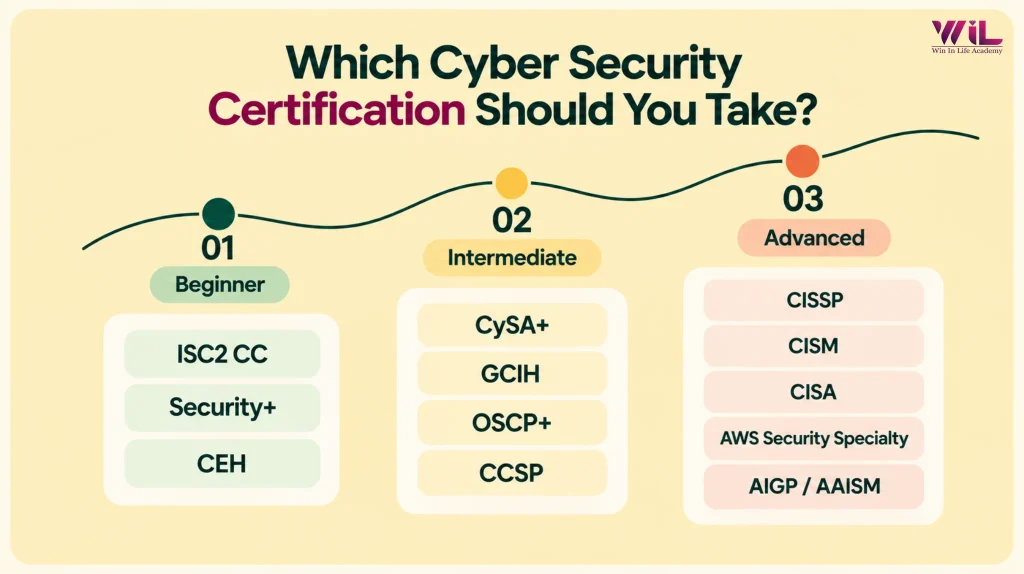
- No experience, low budget ➔ ISC2 CC, then Security+ when you can afford it.
- In IT support or networking ➔ Security+ first, then CySA+ V4.
- Aiming at a SOC ➔ Security+, CySA+ V4, then GCIH when your company funds it.
- Ethical hacking ➔ CEH for the method and the job ads, OSCP+ for the proof.
- Cloud ➔ build cloud experience first, then AWS Security Specialty or CCSP.
- Management or audit ➔ CISSP, CISM or CISA.
One thing no exam fixes. In the DSCI and SANS Indian Cyber Security Skilling Landscape 2025-2026 study, 63% of Indian enterprises said candidates had limited hands-on practical skills, and 84% said one security role takes one to six months to fill. Companies are desperate and still cannot fill the chair. The certificate gets you the interview. Lab work gets you the offer.
So book the exam date before you feel ready. A plan to study “someday” is how people spend two years not getting certified. To see who is hiring, look at companies hiring cyber security freshers in India and the realistic salary bands.
Conclusion
Go back to those lists telling a beginner to start with CISSP. You now know why they are wrong. The certificate that helps you is the one you can sit for this year, aimed at a job that exists, that leaves you able to do something you could not do last month.
Pick one from the table. Book the date. Then spend your study hours in a lab, because hands-on skill is exactly what Indian employers said candidates were missing. Win in Life Academy’s cyber security training with CEH certification runs that syllabus alongside live labs and career support if you would rather not improvise it.
Frequently Asked Questions
1. Which cyber security certifications are best for beginners?
ISC2 CC and CompTIA Security+. Neither needs work experience, and ISC2 hiring research names both among the credentials managers look for in junior hires.
2. Can a fresher get a cyber security job with only a certificate?
Rarely. 63% of Indian enterprises in the DSCI and SANS study said candidates lacked hands-on skills. The certificate gets you the interview, lab work gets you the offer.
3. How long does it take to prepare for an entry-level certification?
Most beginners take two to four months for CC or Security+ alongside a job, with a few hours on weekdays and real lab practice at weekends.
4. Do certification courses for cyber security expire?
Most need renewal. AWS Security Specialty is valid three years, AIGP runs a two-year term, and ISC2 and ISACA credentials need yearly maintenance fees and continuing education.
5. Is CEH enough for penetration testing jobs?
It teaches the method and gets you past Indian job filters. OSCP+ proves you can break into a live environment, because there is no multiple choice in it.
6. Which network and security certification helps in cloud careers?
AWS Certified Security Specialty if your work runs on AWS, CCSP for coverage across providers. CCSP needs five years, so it comes second.
7. What changed in cyber security certifications in 2026?
The ISC2 CC syllabus changed on 1 September 2026, CySA+ V4 replaced V3 in June 2026, Security+ V8 is expected around 17 November 2026, and the CISM syllabus updates on 3 November 2026.
8. Does Win in Life Academy offer cyber security certification classes?
Yes, an Advanced Diploma in Cyber Security with CEH certification, combining live instruction, capstone labs and placement mentorship.