The SOC analyst role is the single most common first job in Indian cybersecurity, which is exactly why the pay question gets asked so often. Entry pay is modest and honest about it: an L1 fresher package sits well below what LinkedIn hype suggests. The real story of the SOC analyst salary in India is not the starting number, it is how fast the L1 to L2 to L3 climb moves once you build the right skills.
This blog maps pay to the actual tiers you will be hired into, using level-matched sources rather than blended portal averages. If you are still deciding whether the role fits you at all, start with this plain breakdown of the SOC analyst roles and responsibilities before you chase the number.
SOC analyst salary in India at a glance
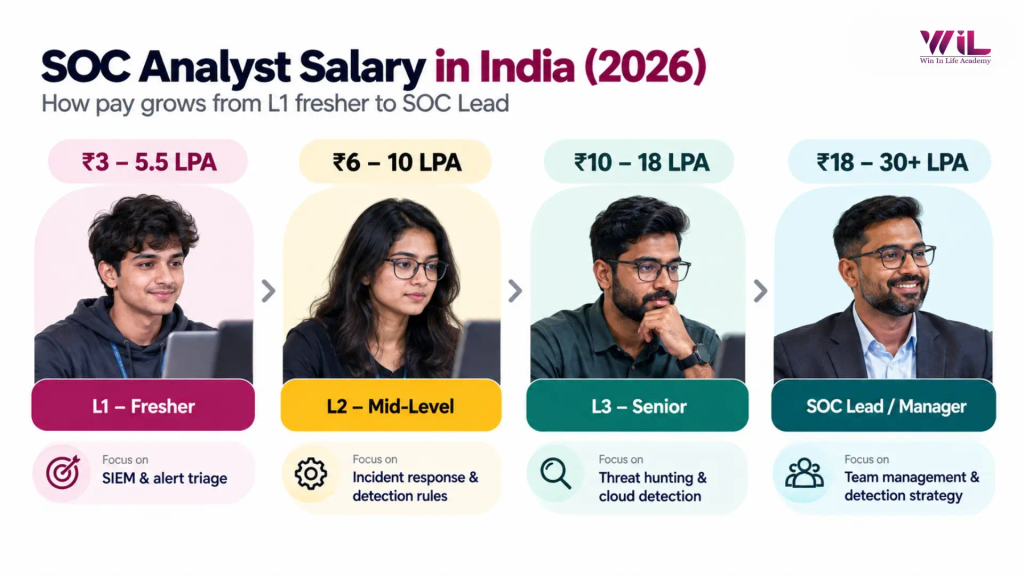
Pay in a Security Operations Center is structured in tiers, and your package tracks the tier you are hired into far more than your degree or college. The table below shows where reported ranges cluster in 2026. Treat the higher tiers as directional, since verified samples thin out fast above L2.
| L1 / Fresher (0 to 2 yrs) | ₹3 to 5.5 LPA | Comfort with a live SIEM console, clean alert triage, willingness to run night shifts |
| L2 / Mid (2 to 4 yrs) | ₹6 to 10 LPA | Real incident response, correlation-rule writing, threat-intel context, less hand-holding |
| L3 / Senior (4 to 7 yrs) | ₹10 to 18 LPA | Threat hunting, malware and forensic depth, cloud detection, mentoring L1s |
| SOC Lead / Manager (7+ yrs) | ₹18 to 30+ LPA | Owning SLAs, running the shift roster, client reporting, detection engineering strategy |
L1 and L2 ranges are anchored to level-matched Glassdoor and Indeed India data. L3 and Lead figures are directional and flagged in the open items at the end, because clean level-tagged samples above mid-level are thin on public portals.
L1 SOC analyst salary: the fresher entry tier
An L1 SOC analyst in India typically earns between ₹3 and ₹5.5 LPA, and this is the number most freshers actually get offered. Glassdoor reports an L1 SOC analyst base averaging around ₹5 LPA with a ₹4 to ₹6 LPA spread across roughly 50 reported salaries, while candidates in their first one to three years often land in the ₹3 to ₹4 LPA band. Fresher packages at large managed security service providers can start lower, sometimes near ₹2.5 to ₹3 LPA, especially when the offer bundles a training bond.
L1 is the monitoring and triage seat. You watch dashboards, read alerts from the SIEM, confirm whether something is a real threat or noise, and escalate the ones that matter. The L1 SOC analyst salary moves up mainly when you stop being someone who forwards every alert and start closing the obvious ones yourself. Employer types hiring at this tier include MSSPs and service firms like Wipro, TCS and Infosys, Big Four security practices at Deloitte and PwC, and product companies running an in-house SOC. None of those names carry a per-company figure here, since public salary data at role level is not company-verified.
L2 SOC analyst salary: the mid-tier where pay jumps
An L2 SOC analyst in India usually earns between ₹6 and ₹10 LPA, and this is the first real jump in the SOC analyst salary in India ladder. Indeed India lists a Security Analyst average near ₹8.7 LPA across 23 reported salaries, with a range running from about ₹4.9 to ₹15.4 LPA, which reflects the mid-to-senior blend that L2 sits inside. Most people reach L2 in two to four years, and the switch often comes with a job change rather than an internal promotion.
What earns the L2 band is doing the work an L1 escalates to you. That means running an incident to closure, writing and tuning correlation rules, adding threat-intelligence context to an alert, and needing far less supervision on a messy case. If you can already read a phishing chain end to end or trace lateral movement across logs, you are being paid as an L2 whatever your title says.
L3 SOC analyst salary: the senior specialist tier
An L3 SOC analyst in India typically commands ₹10 to ₹18 LPA, and at this tier your value shifts from responding to threats toward hunting them. Public portals thin out badly here, so treat this band as directional: the upper end is supported by senior security analyst postings on Indeed reaching ₹15.4 LPA and by scattered practitioner reports of six-year SOC packages near ₹14 LPA. The people who reach the top of this band are rarely generalists.
L3 is where specialization pays. Threat hunting, malware analysis, digital forensics, and detection engineering for cloud workloads on AWS, Azure and GCP are the skills that separate a ₹10 LPA senior from an ₹18 LPA one. Product companies with mature in-house security teams and specialist MSSPs pay the most at this level, because they need people who can build detections, not just consume them. If ethical hacking and offensive skills interest you more than defense, the pay curve there is worth comparing against the ethical hacker salary in India.
SOC Lead and Manager salary: running the operation
A SOC Lead or Manager in India generally earns ₹18 to ₹30 LPA and beyond, though this range is an estimate rather than a portal-verified figure, and the open items section flags it clearly. This is a people-and-process role more than a console role. You own the service-level agreements, build the shift roster, present to clients, and set the detection-engineering direction for the team.
The pay reflects accountability rather than raw technical skill. A SOC Manager is measured on whether incidents get caught and closed inside agreed timelines across a full 24×7 operation, not on how good they personally are at reading a packet capture. Movement into this tier usually needs seven or more years plus a track record of running incidents that went well.
What is the SOC analyst salary in India?
Across all tiers, the SOC analyst salary in India runs from roughly ₹3 LPA for an L1 fresher to ₹18 LPA for an experienced L3, with SOC Leads earning more. Most freshers start between ₹3 and ₹5.5 LPA, and the biggest single jump comes at the move from L1 to L2 once you can handle real incident response on your own.
What actually decides your SOC analyst salary
Two people with the same job title can be a few lakhs apart, and the gap comes down to a short list of factors. Here is what genuinely moves your number.
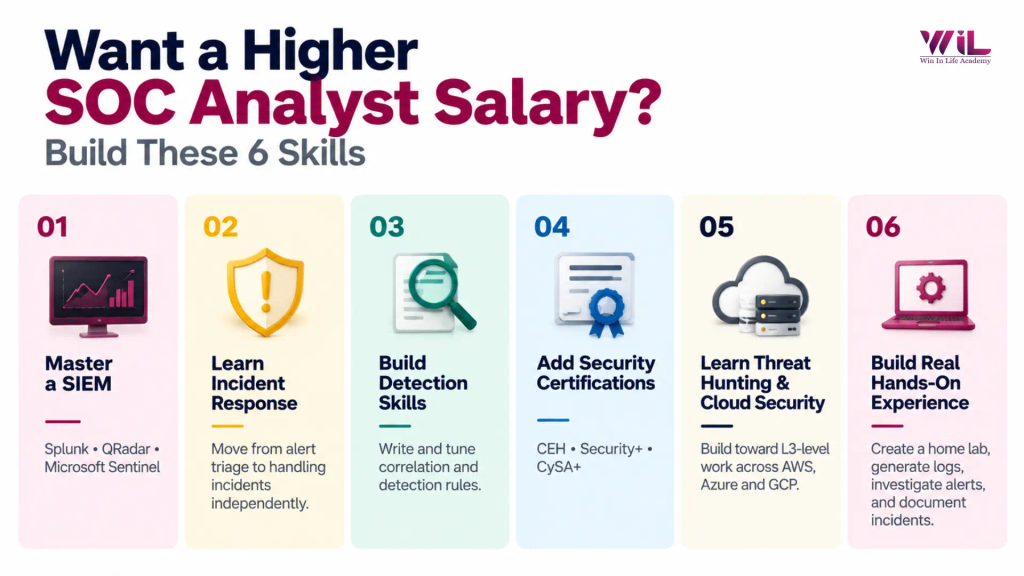
- Certifications: CEH, CompTIA Security+ and CySA+ are the credentials hiring managers actually look for at entry and mid level. They rarely add lakhs on their own, but they get your resume shortlisted, and CySA+ in particular signals L2-readiness.
- SIEM and tool depth: Hands-on skill in Splunk, IBM QRadar or Microsoft Sentinel is the clearest pay signal in the whole role. An analyst who can build queries and tune rules in a real SIEM is worth more than one who has only watched dashboards.
- Shift willingness: SOC work is 24×7, and rotational night shifts are part of the job at L1 and L2. Analysts who take night and weekend rotations without friction are easier to place and often negotiate a shift allowance on top of base.
- City: Bangalore, Hyderabad and Pune concentrate the SOC hiring and pay a little above smaller metros, mostly because that is where the MSSPs and product security teams sit.
- Company type: A pure-play MSSP running high-volume L1 monitoring pays less at entry than a product company with an in-house SOC or a Big Four advisory practice, though the MSSP often gives you faster exposure to volume and variety.
The demand behind the pay
The reason SOC roles keep hiring, even at modest entry pay, is a genuine talent shortage. The India cybersecurity market is projected to grow from USD 5.56 billion in 2025 to USD 15.06 billion by 2031 at an 18.07% CAGR, according to Mordor Intelligence, and monitoring is the layer most of that spend flows into first. Globally, ISC2 measured a cybersecurity workforce gap of 4,763,963 people in 2024, which is a large part of why a beginner with real SIEM skills gets interviews at all.
Is SOC analyst a good entry point into cybersecurity?
Yes, for most freshers it is the most realistic entry point. The bar to get in is lower than for pen-testing or security architecture, the role teaches you how attacks actually look in production, and the L1 to L2 to L3 path gives a clear, fast route to better pay if you keep building tool depth.
How to move up the SOC pay ladder faster
The fastest way to raise your SOC analyst salary in India is to stop looking like an L1 as quickly as you can. Get genuinely fluent in one SIEM rather than shallow across three, because depth in Splunk or Sentinel is what convinces an interviewer you can handle L2 work. Add one entry certification such as Security+ or CySA+ to clear resume filters, then build a small home lab where you generate logs, trigger alerts and write your own detection rules.
Learn to read an incident end to end, because that single skill is the wall between the L1 and L2 bands. Keep a plain record of incidents you handled and what you found, since that is what you will actually talk about in a switch interview. If you are mapping the wider set of entry roles first, the guide to cyber security jobs for freshers and the list of companies hiring cybersecurity freshers in India will tell you who is actually recruiting at L1.
Do SOC analysts have to work night shifts?
Mostly yes, at least early on. A Security Operations Center runs 24×7, so L1 and L2 analysts work in rotational shifts that include nights and weekends. It is one of the honest trade-offs of the role, and it usually eases as you move to L3 and lead positions, which lean more toward day-time analysis and planning.
The skills that get you hired at L1
Certifications open the door, but a hiring manager wants to see that you can sit at a console on day one. Focus your preparation on the small set of things a real L1 does every shift. A structured program helps here because it forces the hands-on SIEM practice that self-study often skips.
The Advanced Diploma in Cyber Security with CEH from Win in Life Academy is built around this entry tier, pairing the CEH credential with practical SOC tooling and placement mentorship. If you want the wider skills checklist first, the breakdown of essential cybersecurity analyst skills shows exactly what interviewers test, and beginners still weighing the field can sanity-check it against the best career options for freshers.
Conclusion
The realistic SOC analyst salary in India starts modestly and climbs quickly for people who build the right skills. Expect roughly ₹3 to ₹5.5 LPA as an L1 fresher, ₹6 to ₹10 LPA at L2 once you can run incidents on your own, and ₹10 to ₹18 LPA at L3 with genuine threat-hunting and cloud depth. The night-shift rotation is real and worth being honest with yourself about before you sign. If the trade-off works for you, the role is one of the clearest ways for a beginner to get inside cybersecurity and move up on skill rather than pedigree. When you are ready to train for the L1 seat with a placement-backed path, explore the Advanced Diploma in Cyber Security with CEH at Win in Life Academy.
Frequently asked questions
1. What is the SOC analyst salary in India for a fresher?
A fresher SOC analyst in India typically earns between ₹3 and ₹5.5 LPA. Level-matched Glassdoor data puts L1 base pay around ₹5 LPA with a ₹4 to ₹6 LPA spread, and first-year packages at large MSSPs can start closer to ₹2.5 to ₹3 LPA when a training bond is attached. This entry level cyber security salary reflects the typical starting responsibilities of monitoring, triage and escalation.
2. What is the L1 SOC analyst salary?
The L1 SOC analyst salary generally sits in the ₹3 to ₹5.5 LPA range. Glassdoor reports an average L1 base near ₹5 LPA across roughly 50 salaries, and candidates in their first one to three years often land ₹3 to ₹4 LPA. L1 is the monitoring and triage tier, so pay reflects entry-level responsibility and the ability to identify and escalate genuine security threats.
3. How much does an L2 SOC analyst earn in India?
An L2 SOC analyst usually earns ₹6 to ₹10 LPA, reached after about two to four years. Indeed India shows a security analyst average near ₹8.7 LPA across 23 reported salaries. The SOC analyst salary in India jump at this stage comes from handling real incident response independently, investigating suspicious activity and tuning detection rules.
3. What is the highest SOC analyst salary in India?
Senior L3 SOC analysts typically reach ₹10 to ₹18 LPA, and SOC Leads or Managers can earn ₹18 to ₹30 LPA and beyond. These upper bands are directional rather than portal-verified, since public salary samples thin out sharply above mid-level. The top of each band goes to specialists in threat hunting, forensics and cloud detection. This also explains why cyber security analyst salary figures can vary significantly at senior levels.
4. Do SOC analysts work night shifts?
Yes, most SOC analysts work rotational shifts including nights and weekends. A Security Operations Center runs 24×7, so L1 and L2 seats almost always involve shift rotation. This night shift cybersecurity job requirement is one of the honest trade-offs of the role, and it usually eases as you move into L3 and lead roles focused on daytime analysis and planning.
5. Which certifications raise a SOC analyst salary?
CEH, CompTIA Security+ and CySA+ are the certifications that matter most at entry and mid level. They rarely add lakhs by themselves, but they clear resume filters and get you shortlisted. CySA+ specifically signals readiness for L2 analyst work, and CEH is widely recognized for the L1 SOC seat. Practical SIEM experience also matters when employers assess SIEM analyst pay alongside certifications.
6. Which cities pay SOC analysts the most in India?
Bangalore, Hyderabad and Pune lead SOC hiring and pay slightly above smaller metros. That is where most managed security service providers and product-company security teams are based, so both the volume of roles and the pay concentrate there. City premiums are modest compared with the tier and skill gaps. Location can therefore influence the overall security operations center salary.
7. Is SOC analyst a good career in India?
Yes, it is one of the most practical entry points into cybersecurity. The role has a lower barrier than pen-testing or security architecture, teaches you how real attacks look in production, and offers a clear L1 to L2 to L3 path where pay rises on skill. For professionals comparing the SOC analyst salary in India with other cybersecurity roles, the main trade-off is the night-shift rotation early in your career.
8. How long does it take to move from L1 to L2?
Most analysts move from L1 to L2 in about two to four years, though skill matters more than time. The jump usually needs you to run incidents to closure on your own, write or tune SIEM correlation rules, and add threat-intelligence context. A job switch, rather than an internal promotion, is often what unlocks the higher band. At this stage, SOC L2 salary can increase substantially with stronger incident-response skills.
9. What is the difference between a SOC analyst and a security analyst salary?
The titles overlap heavily, and pay is broadly similar at matched experience. Security analyst is a wider label that can include GRC and vulnerability roles, while SOC analyst specifically means monitoring and incident response inside a Security Operations Center. On portals, security analyst averages read a little higher mainly because the sample blends in more senior roles. This makes SOC analyst salary in India figures easier to understand when comparing equivalent experience levels.