Most guides on how to become an MLOps engineer hand you a 28 week roadmap and promise you will be job ready at the end. Then you apply, and every posting asks for three to five years of experience you do not have.
That gap is not a personal failing. It is how the role is built. MLOps is a second job, not a first one, because the work assumes you already know how to ship software and move data before anyone trusts you with a production model.
This guide answers how to become an MLOps engineer the way the market actually works: which first job to take, what to build inside it, and how long the move really takes.
What does an MLOps engineer actually do?
An MLOps engineer owns everything that happens after the model is good.
Training is a small part of a working system. The NeurIPS paper Hidden Technical Debt in Machine Learning Systems, from Sculley and colleagues at Google, put it plainly: “Only a small fraction of real-world ML systems is composed of the ML code.” The surrounding infrastructure, the paper says, is vast and complex. That infrastructure is the job.
Google Cloud is blunter about why the role exists: “In practice, models often break when they are deployed in the real world.” Data shifts. Training features stop matching serving features. Accuracy falls quietly for weeks before anyone notices.
Başak Tuğçe Eskili, an ML engineer on the machine learning platform team at Booking.com, makes the case in one line: “If you want to implement anything related to ML there has to be an operation site.” Her own route is the normal one: data science intern, then data scientist at ABN Amro, then ML engineer at Ahold Delhaize, then the platform team at Booking.com. Four roles. No shortcut.
New to the lifecycle itself? Start with the steps in the machine learning life cycle.
How do you become an MLOps engineer?
You become an MLOps engineer by first getting hired as a data engineer, DevOps engineer or machine learning engineer, then taking on the deployment, pipeline and monitoring work inside that role. Most people reach the title in two to three years.
Why MLOps is not an entry-level job in India
Can a fresher become an MLOps engineer?
Not directly. MLOps roles in India ask for three to five years of prior engineering experience. Freshers enter through data engineering, DevOps or machine learning engineering, then move across after two to three years.
These are live postings in India as of September 2026.
| Employer | Role title | Stated experience requirement |
|---|---|---|
| EXL, Bengaluru | MLOps Engineer | 4+ years in ML engineering, data science, MLOps or data engineering |
| Persistent Systems, Bengaluru | MLOps Engineer | 5+ years |
| VOIS (Vodafone), Pune | MLOps Engineer | Minimum 3 years in MLOps, ML engineering or a related software role |
| Sonata Software, Bengaluru | MLOps DevOps Engineer | 3 to 5 years |
| Nisum, Hyderabad | MLOps Engineer | 7 to 11 years |
Every one is tagged mid-senior level. Not one is tagged entry level.
There is a second tell. EXL’s posting is titled MLOps Engineer, but the first line of its description reads: “We are looking for an experienced Machine Learning Engineer with strong MLOps expertise.” The title and the job are two different things.
Salary data says the same from another direction. On AmbitionBox in September 2026, MLOps Engineer had 182 reported salaries in India. Data Engineer had over 1.1 lakh. Roles with real fresher intake collect tens of thousands of reports because tens of thousands of juniors hold them. MLOps does not, because they do not.
MLOps Engineer also does not appear on LinkedIn’s Jobs on the Rise 2026 list for India, where AI Engineer ranks first in Hyderabad. The demand is real. It is filed under other titles.
Which first job should you take?
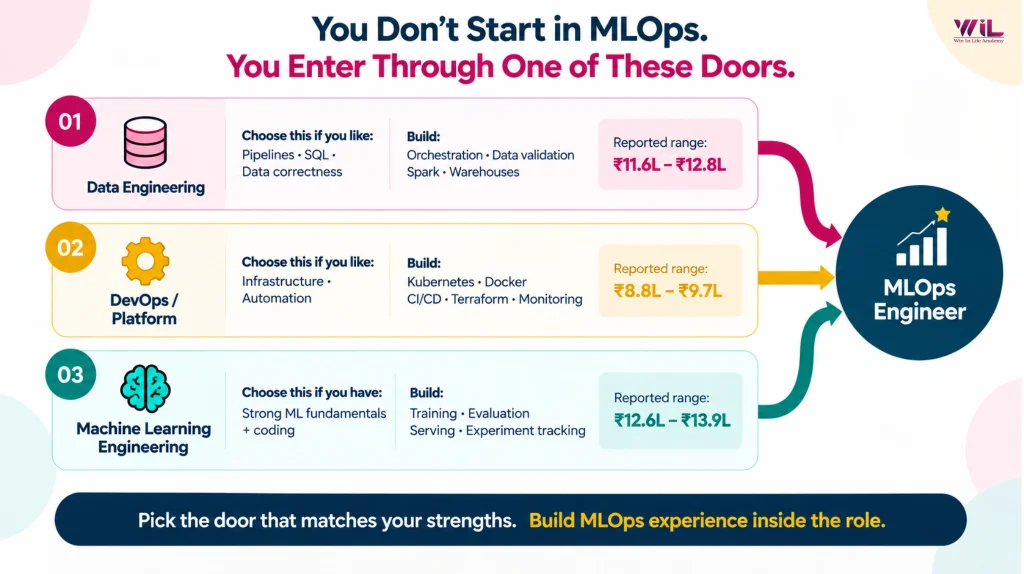
Three doors lead to MLOps. Pick the one that matches what you are already better at, not the one that sounds closest to the destination.
| First role | Pick it if | What it teaches you that MLOps needs | Reported range on AmbitionBox |
|---|---|---|---|
| Data engineer | You like pipelines, SQL and data correctness | Orchestration, data validation, Spark, warehouse design | ₹11.6L to ₹12.8L, 1 to 7 years |
| DevOps or platform engineer | You like infrastructure and automation | Kubernetes, Docker, CI/CD, Terraform, monitoring | ₹8.8L to ₹9.7L, 2 to 6 years |
| Machine learning engineer | You have strong ML fundamentals and can code | Model training, evaluation, serving, experiment tracking | ₹12.6L to ₹13.9L, 1 to 6 years |
Self-reported ranges on AmbitionBox, 18 and 19 September 2026, blended across all levels. Treat them as direction, not as a fresher offer, and confirm current figures before deciding.
Data engineering is the widest door in India by volume. DevOps is the fastest if infrastructure already appeals to you, and the least crowded with ML aspirants. ML engineering is the most direct and the hardest to enter cold. See our guide to machine learning engineer roles and pay and to AI jobs for freshers in India.
How to Become an MLOps Engineer: The Two Stage Roadmap
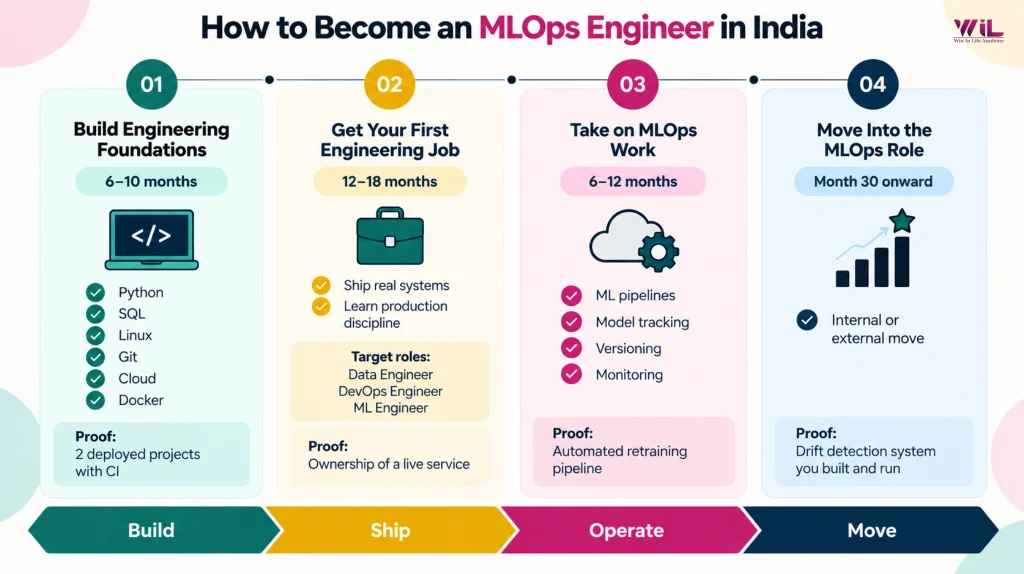
- Stage 1 is getting hired as an engineer. Build Python you can ship, SQL beyond SELECT, Linux, Git, and one cloud learned properly rather than three learned shallowly. Finish with Docker, the one skill that appears on both the DevOps and the ML side of every posting. Your proof is two or three deployed projects with real repositories. A pipeline that runs on a schedule and fails loudly beats a notebook with a higher accuracy score.
- Stage 2 is earning MLOps work inside that job. You do not leave to study it. You take the work nobody wants: the deployment that keeps breaking, the retraining still done by hand, the model with no monitoring. Then add tooling deliberately.
A March 2026 systematic review of MLOps tools from Vrije Universiteit Amsterdam found four dominate practice, MLflow, DVC, Kubeflow and Amazon SageMaker, and that “No single solution addresses the entire ML lifecycle.” Learn those four, expect to stitch them together, ignore the weekly launches.
| Stage | Focus | Typical time | Proof to build |
|---|---|---|---|
| 1. Foundations | Python, SQL, Linux, Git, one cloud, Docker | 6 to 10 months | Two deployed projects with CI |
| 2. First engineering job | Ship real systems, learn production discipline | 12 to 18 months in role | Ownership of a live service |
| 3. MLOps inside the role | Pipelines, tracking, versioning, monitoring | 6 to 12 months | An automated retraining pipeline |
| 4. Move to the title | Interview internally or externally | Month 30 onward | Drift detection you built and run |
MLOps engineer skills that appear in real Indian postings
What skills do I need for MLOps?
Python, SQL, Docker, Kubernetes, CI/CD, one major cloud, and at least one pipeline or tracking tool such as MLflow or Kubeflow. Running a model reliably matters more than machine learning theory.
If you are working out how to become an MLOps engineer from a job description rather than a syllabus, this is what the EXL, Persistent Systems and VOIS postings above actually list:
- Language and data: Python, SQL, Bash, Spark or PySpark
- Infrastructure: Docker, Kubernetes, Terraform, one of AWS, Azure or GCP
- Pipelines and tracking: MLflow, Airflow, Kubeflow, DVC
- Serving and monitoring: real time and batch endpoints, drift detection, explainability, AI governance
- Newly expected: LLM deployment, RAG frameworks, vector databases
That last line is new and worth acting on, since both EXL and VOIS now ask for generative AI operations alongside classical MLOps. Our overview of top AI skills to learn in 2026 maps where that is heading.
Notice what is absent: research level mathematics. If model building is what draws you, read data scientist vs AI engineer before committing.
Certifications, and when to take them
Both major vendor certifications assume you already work in the field, which tells you something about the role.
- The AWS Certified Machine Learning Engineer, Associate recommends at least one year of hands-on experience with SageMaker and related services. Its MLA-C02 version launched on 1 September 2026 and adds generative AI coverage.
- The Google Cloud Professional Machine Learning Engineer recommends three or more years of industry experience, including at least one year on Google Cloud.
Take them in Stage 2. A certification confirms experience, it does not substitute for it, which is the part most guides on how to become an MLOps engineer get backwards. Sat before you have shipped anything, it reads as course completion. See AI certifications worth pursuing in 2026 for the wider picture.
What MLOps pays in India
| 1 to 3 years | 20 of 182 reports | ₹8.5L to ₹11.9L |
| 3 to 6 years | 132 of 182 reports | ₹12.5L to ₹15L |
| 6 to 9 years | 25 of 182 reports | ₹16.1L to ₹23.1L |
| 9 to 12 years | 3 of 182 reports | ₹24.7L to ₹27.3L |
| All levels, typical range | 182 reports, 1 to 8 years | ₹13.3L to ₹15.5L |
Self-reported salaries on AmbitionBox, updated 17 September 2026. Portal figures blend companies and levels, so treat them as direction, not as an offer, and confirm current numbers before a negotiation.
Four mistakes that keep people stuck
Knowing how to become an MLOps engineer is not the hard part. These four habits are what stall people in practice.
- Collecting tools instead of shipping one system. A repository with MLflow, Kubeflow, Airflow and Terraform configured and nothing running proves less than one model serving live traffic with monitoring attached.
- Applying to MLOps titles as a fresher. The experience field filters you before a human reads the CV. Apply to the door role, get in, then move.
- Treating accuracy as the finished product. As Chip Huyen, author of Designing Machine Learning Systems, puts it: “No matter how great your ML models are, if they take just milliseconds too long to make predictions, users are going to click on something else.”
- Waiting for permission. Andrew Ng has described the stalled work bluntly: “I see lots of, let’s call them $1 million to $5 million projects, there are tens of thousands of them sitting around that no one is really able to execute successfully.” One of those is sitting near you. Claim it.
Conclusion
The useful question is not how to become an MLOps engineer. It is which first job puts you in the room where production models live, because that is where the skill gets built and the title eventually follows.
Pick your door this month. Pipelines and data correctness point to data engineering. Infrastructure and automation point to DevOps. Then, inside that job, volunteer for the deployment nobody wants to own.
To build that foundation in a structured order, with projects you can put in front of an interviewer, the Advanced Diploma in Data Science and MLOps at Win in Life Academy runs from model development through deployment and monitoring, with mentorship and placement support alongside.
Frequently Asked Questions
1. How long does it take to become an MLOps engineer?
Two and a half to three years from a standing start, including a first engineering job. With two years of software, data or DevOps experience already, twelve to eighteen months is achievable.
2. Is MLOps better than DevOps as a career?
Neither is better. DevOps has far more openings and a wider entry path in India. MLOps is narrower, pays a modest premium, and requires DevOps skills as a prerequisite, so treat it as a specialization you grow into.
3. Do MLOps engineers build machine learning models?
Rarely. They deploy, automate, monitor and retrain models built by data scientists, and need enough ML understanding to debug them.
4. Can I become an MLOps engineer without a computer science degree?
Yes. EXL, Persistent Systems and VOIS ask for a bachelor’s degree in computer science, engineering or a related discipline, which is broad. Production engineering experience carries more weight than the degree subject.
5. Which cloud should I learn first for MLOps?
One, learned properly. AWS has the largest share of Indian postings, Azure dominates Microsoft-heavy enterprises, GCP appears often in product companies. Concepts transfer.
6. How much do MLOps engineers earn in India?
Reported ranges on AmbitionBox clustered around ₹13.3 lakh to ₹15.5 lakh a year across one to eight years of experience in September 2026, with most reports from people at three to six years. Verify current figures before a negotiation.
7. What is the difference between MLOps and DataOps?
DataOps governs the reliability of data pipelines. MLOps governs the reliability of models consuming that data, including retraining and drift. Our DataOps explainer covers the comparison.
8. Which companies hire MLOps engineers in India?
September 2026 postings include EXL, Persistent Systems, Cognizant, Infosys, TCS, Accenture, UST, Standard Chartered India, VOIS, Fractal Analytics and Tredence, concentrated in Bengaluru, Hyderabad and Pune.
9. Do I need Kubernetes to get an MLOps job?
For most mid-level postings, yes. Start with Docker and container basics, then add Kubernetes once you are inside an engineering role.
10. What should I learn first if I am starting today?
Python, SQL and Linux, in that order, then Git and one cloud platform. Our AI career roadmap for beginners sets out the sequence.