
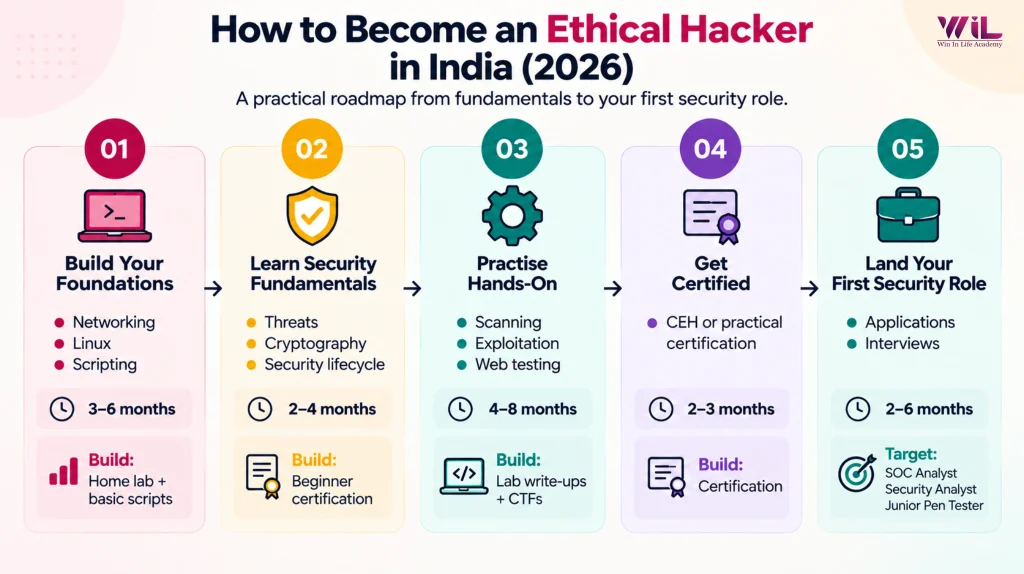
| Stage | Focus | Typical time | Proof to build |
|---|---|---|---|
| 1. Foundations | Networking, Linux, scripting | 3–6 months | Home lab, basic scripts |
| 2. Security basics | Threats, cryptography, security lifecycle | 2–4 months | Beginner certification |
| 3. Hands-on practice | Scanning, exploitation, web testing | 4–8 months | Lab write-ups, CTFs |
| 4. Certification | CEH or practical certification | 2–3 months | Certification |
| 5. First role | Applications and interviews | 2–6 months | Security/SOC role |
1. Build Networking, Linux and Scripting Fundamentals
Learn TCP/IP, DNS, HTTP, subnets, firewalls, and how systems communicate. Get comfortable with the Linux command line and learn enough Python or Bash to read, modify, and automate simple scripts.
These foundations matter when learning how to become an ethical hacker because the job is not just about knowing tools. You need to understand what the tool is actually doing.
2. Learn Security Fundamentals
Next, learn how systems are attacked and defended. Cover authentication, basic cryptography, common threats, vulnerabilities, and the information security lifecycle. A beginner certification such as ISC2 CC or CompTIA Security+ can help demonstrate this foundation.
3. Practise in Legal Hacking Labs
Hands-on practice is where the theory becomes useful. Use purpose-built environments such as TryHackMe, Hack The Box, or your own virtual machines. Never test a system without explicit permission. Keep your practice inside authorised environments and learn responsible testing alongside the technical skills. Start with scanning and enumeration using resources such as the Nmap cheatsheet, then explore the wider range of ethical hacking tools.
Build a short write-up for each useful lab: what you tested, what you found, how you proved it, and how the issue could be fixed.
4. Add a Relevant Certification
A certification can strengthen your resume, but it does not replace practical ability. CEH certification is a recognised option for learners targeting ethical hacking roles, while practical certifications can provide stronger evidence of hands-on skills for penetration testing paths.
If you are deciding how to become an ethical hacker, choose a certification based on your current level and target role rather than collecting certificates.
5. Target Your First Security Role
People asking how to become an ethical hacker often expect that to be their first job title. Few people actually start their careers with the title “ethical hacker.” Entry routes can include SOC analyst, security analyst, vulnerability analyst, or junior penetration tester. A SOC role can build experience with alerts, incidents, logs, and security operations. A junior penetration testing role gives you more direct exposure to authorised security testing. See SOC analyst roles and responsibilities and examples of companies hiring cybersecurity freshers in India to understand common entry routes.SOC analyst roles and responsibilitiescompanies hiring cybersecurity freshers in India
What Skills Do You Need to Become an Ethical Hacker?
Focus on four areas:
- Networking and systems: TCP/IP, DNS, Linux, Windows, servers, and firewalls.
- Security and testing: scanning, enumeration, vulnerability assessment, exploitation, and web application testing.
- Scripting: Python or Bash for automation and understanding existing scripts.
- Reporting: clear technical findings that explain the risk and remediation to a client or manager.
You do not need to become a software engineer to learn how to become an ethical hacker. But you should be able to understand and modify scripts and explain what your tools are doing. WILA’s guide to top cybersecurity analyst skills also covers several capabilities that overlap with an early security career.top cybersecurity analyst skills
Which Ethical Hacking Certifications Should You Consider?
| Level | Options | Purpose |
|---|---|---|
| Beginner | ISC2 CC, CompTIA Security+ | Demonstrate security fundamentals |
| Ethical hacking | CEH | Build recognised knowledge of ethical hacking concepts |
| Practical penetration testing | eJPT, OSCP | Demonstrate hands-on testing ability |
Check current exam fees, requirements, and certification policies before paying. The cybersecurity certification guide for beginners can help you compare options. Certification value also depends on the role you are targeting.
For beginners, certification matters more when it is paired with lab work and a portfolio.
Ethical Hacker Salary and Demand in India
Anyone researching how to become an ethical hacker should view cybersecurity hiring in the context of the wider market rather than a single salary figure. Mordor Intelligence projects India’s cybersecurity market to grow from about USD 5.56 billion in 2025 to USD 15.06 billion by 2031.Mordor Intelligence
Salary figures need more caution. Indeed penetration-testing averages can include experienced professionals and therefore should not be treated as a fresher benchmark. Starting pay can vary by role, city, employer, skills, and experience. For a broader breakdown, see WILA’s guide to ethical hacker salary in India.
Common Mistakes Beginners Should Avoid
- Learning tools before fundamentals: Know networking and Linux before trying to master advanced tools.
- Collecting certifications without practice: Pair every major certification with hands-on labs and write-ups.
- Testing systems without permission: Use authorised labs or systems you have explicit permission to test.
- Ignoring reporting: Finding a vulnerability is only part of the job; you must explain its impact and remediation clearly.
Learn Ethical Hacking with Structured Training at WILA
Self-study can work, but a structured programme can make the learning path easier to follow. Win in Life Academy’s Advanced Diploma in Cyber Security with CEH Certification covers networking, security fundamentals, hands-on tools, and CEH preparation, with practical projects and career support.
If you are comparing an ethical hacking course, look at the curriculum, lab work, certification preparation, mentorship, and career support rather than the course title alone.
Conclusion
Learning how to become an ethical hacker is less about mastering a collection of hacking tools and more about building a strong security foundation, practicing legally, proving your skills, and entering through a relevant security role.
If you are serious about how to become an ethical hacker, start with networking and Linux, move into security fundamentals, practise in controlled labs, choose a relevant certification, and build evidence of what you can do. The path takes consistent effort; the exact timeline depends on your starting point and how much hands-on practice you put in.
Frequently Asked Questions
1. How long does it take to become an ethical hacker?
For many beginners, learning how to become an ethical hacker to a job-ready level can take around 12–24 months of consistent learning and hands-on practice. Building an ethical hacker career requires strong fundamentals, practical experience, and continuous improvement. Your starting knowledge, study time, and target role can change the timeline.
2. Can I become an ethical hacker without a degree?
Yes. A degree can help with some roles, but practical skills, security knowledge, relevant certifications, and evidence of hands-on work can also support entry into cybersecurity. Developing strong cyber security skills and gaining practical exposure can help candidates demonstrate their abilities to employers.
3. Can a non-technical graduate become an ethical hacker?
Yes, but expect to spend more time on networking, Linux, operating systems, and basic scripting before moving into advanced security topics. With consistent learning and hands-on practice, non-technical graduates can gradually build the foundation needed for how to become an ethical hacker.
4. Do I need to know how to code?
You do not need advanced software-development skills for many entry-level security roles. You should, however, be comfortable reading and modifying Python or Bash scripts, as scripting knowledge supports vulnerability testing and security automation.
5. Is CEH certification worth it in India?
CEH can be useful for learners targeting ethical hacking roles, particularly when combined with hands-on labs and portfolio evidence. Compare it with practical certifications based on the role you want and the direction you plan to take your hacking career.
6. Is ethical hacking legal in India?
Ethical hacking is lawful when you have appropriate authorization to test the system. Accessing or testing systems without permission can create legal consequences, so practise only in authorised environments and follow responsible security practices.
7. How much can a fresher ethical hacker earn?
There is no single fresher salary. Pay varies by role, location, employer, skills, and experience. Be careful with online averages because they often combine entry-level and experienced professionals. Developing strong technical skills and a practical portfolio can influence early career opportunities