If you are considering a career in data and artificial intelligence, one question is likely to come up: Data Scientist vs AI Engineer, which career is better in 2026?
Both roles work with data, machine learning, and artificial intelligence, but their responsibilities are different. Data Scientists focus on analyzing data, finding patterns, building predictive models, and supporting business decisions. AI Engineers focus on building, integrating, deploying, and maintaining AI-powered applications.
What Is the Difference Between a Data Scientist and an AI Engineer?
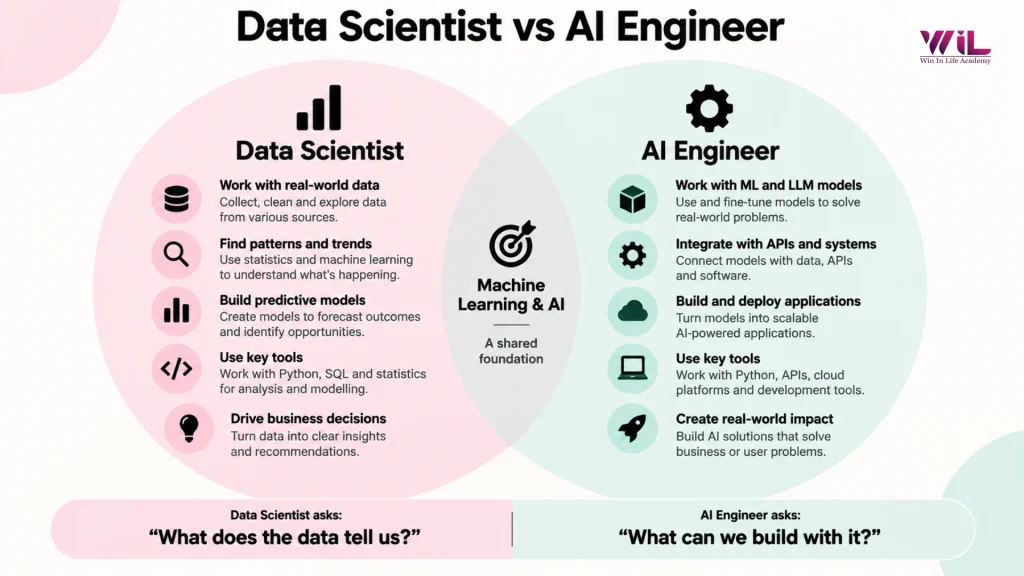
A Data Scientist uses data to answer business questions, identify patterns, build models, and generate insights that support decision-making.
Typical responsibilities of a Data Scientist include:
- Cleaning, exploring, and analyzing datasets
- Identifying trends and patterns
- Building and evaluating predictive and machine learning models
- Conducting experiments and analyzing results
- Turning analysis into actionable business recommendations
Data Scientists commonly work with Python, SQL, statistics, machine learning, data visualization, and analytical tools.
Whereas an AI Engineer builds AI-powered applications and makes sure they work reliably in real-world environments.
Typical responsibilities of an AI Engineer include:
- Building AI-powered applications
- Integrating AI models with data, APIs, and existing software
- Working with machine learning, deep learning, and Generative AI
- Deploying AI systems into production
- Testing, monitoring, and improving AI applications
AI Engineers generally require stronger software development, API, cloud, deployment, and system-integration skills. See our full AI Engineer skills required in 2026 breakdown for the specifics employers screen for.
Data Scientist vs AI Engineer: Key Differences
| Factor | Data Scientist | AI Engineer |
|---|---|---|
| Core focus | Data analysis and predictive modelling | Building and deploying AI applications |
| Data | Analyze and interpret data | Connect AI systems with data and software |
| Machine Learning | Build and evaluate models | Integrate and deploy models |
| Generative AI | Apply GenAI to analysis and workflows | Build LLM-powered applications |
| Programming | Python and SQL | Python, APIs and software development |
| Career direction | Analytics, modelling and decision-making | AI applications, automation and AI products |
The distinction is not always fixed. Job titles vary between companies, and responsibilities can overlap. A Data Scientist may perform machine learning engineering tasks, while an AI Engineer may work extensively with machine learning models.
For that reason, always evaluate the actual job description, required skills, and responsibilities instead of relying only on the job title.
Data Scientist vs AI Engineer: Career Path and Salary
A Data Science career can begin with roles such as Data Analyst, Junior Data Scientist, or Associate Data Scientist. With experience, professionals can progress to Data Scientist, Senior Data Scientist, Lead or Principal Data Scientist, Data Science Manager, or Head of Data Science.
AI Engineers may start as AI/ML Interns, Junior ML Engineers, or AI Developers before moving into AI Engineer or Applied AI Engineer positions. With experience, they can progress to Senior AI Engineer, Lead AI Engineer, Principal AI Engineer, AI Architect, or AI Engineering Manager.
Salary Comparison
Salary varies considerably according to experience, location, company, technical depth, and specialization. Therefore, salary ranges should be treated as indicative rather than guaranteed.
| Experience | Data Scientist | AI Engineer |
|---|---|---|
| 0–2 years | ₹6–10 LPA | ₹4–8 LPA |
| 2–6 years | ₹15–28 LPA | ₹12–22 LPA |
| 6+ years | ₹25–70+ LPA | ₹25–80+ LPA |
Note: the ranges above have been corrected from the original draft, which understated Data Scientist entry pay and significantly overstated AI Engineer pay at every level. These figures are sourced from Glassdoor India and Indeed India, and are cross-checked against our own Data Scientist salary in India 2026 and AI Engineer salary in India 2026 guides, which carry the full level-by-level breakdown.
Professionals with specialized skills in machine learning, LLMs, cloud, MLOps, system design, or AI deployment can move into higher-value technical roles.
Data Scientist vs AI Engineer: Career Scope and Job Opportunities
Both careers have opportunities across technology, BFSI, fintech, e-commerce, healthcare, manufacturing, consulting, and other industries.
Data Science Career Scope
Data Scientists work across areas such as:
- Predictive analytics
- Business and customer analytics
- Risk modelling
- Forecasting
- Experimentation
- Machine learning
- Product analytics
The Data Scientist career path continues to benefit from organizations’ need for data-driven decision-making. The U.S. Bureau of Labor Statistics projects Data Scientist employment to grow 33.5% from 2024 to 2034, much faster than the average for all occupations, with about 23,400 openings projected each year.
AI Engineering Career Scope
AI Engineers work more directly on building and deploying AI systems for products and business processes.
Common areas include:
- Generative AI applications
- LLM-powered products
- Intelligent automation
- AI APIs and integrations
- Machine learning applications
- AI deployment and monitoring
- AI agents and production AI systems
As companies move from experimenting with AI to deploying it inside products and workflows, professionals who can build and maintain production-ready AI systems are becoming increasingly valuable.
Will AI Replace Data Scientists and AI Engineers?
AI is changing both careers, but it is not simply eliminating them.
Data Scientists still need to understand data, statistics, experimentation, modelling, and business problems. AI Engineers need software engineering, system design, evaluation, deployment, and monitoring skills.
The bigger change is in how professionals work. Tasks such as coding, data preparation, analysis, documentation, and experimentation can increasingly be assisted by AI tools.
Professionals who can use these tools effectively while understanding the underlying technology and business problem are likely to remain valuable.
Data Scientist vs AI Engineer: Skills Comparison
Both roles share a foundation in programming, machine learning, data handling, and mathematics. Their specializations become different as they progress.
| Skill | Data Scientist | AI Engineer |
|---|---|---|
| Python | Data analysis and modelling | AI applications and systems |
| SQL | Query and analyze datasets | Access and manage application data |
| Statistics | Experiments, trends and hypotheses | Model evaluation and uncertainty |
| Probability | Risk and uncertainty analysis | Understanding model behaviour |
| Data analysis | Find patterns and generate insights | Prepare data for AI systems |
| Machine learning | Build predictive models | Build and integrate ML models |
| Deep learning | Specialized modelling | Neural-network-based AI systems |
| LLMs / GenAI | Analysis and automation | LLM applications and AI agents |
| APIs | Access data and AI services | Connect models with applications |
| Cloud | Run data workloads and models | Deploy and scale AI applications |
| Deployment | Deploy models for business use | Production AI deployment |
| MLOps | Manage model workflows | Manage production AI systems |
Data Scientists generally move deeper into statistics, experimentation, data analysis, and predictive modelling.
AI Engineers move deeper into software development, APIs, cloud platforms, deployment, system design, and production AI.
You do not need to learn every tool at once. Build the fundamentals first, then develop the skills required by your target role.
Which Career Should You Choose?
Choose Data Science if you:
- Enjoy working with data and statistics
- Like finding patterns and answering business questions
- Are comfortable with SQL and analytical work
- Want to work in analytics, experimentation, or predictive modelling
- Have a background in mathematics, statistics, economics, analytics, or a related field
A typical Data Science career path involves learning Python, SQL, statistics, data analysis, machine learning, and increasingly Generative AI and MLOps. Our full how to become a Data Scientist in 2026 guide maps this out step by step.
Choose AI Engineering if you:
- Enjoy programming and building applications
- Prefer creating working systems over analyzing datasets
- Are interested in Generative AI and LLM applications
- Want to work with APIs, cloud, deployment, and system design
- Have a background in software development, backend development, cloud, or programming
An AI Engineering career path typically involves Python, machine learning, deep learning, LLMs, APIs, cloud, deployment, MLOps, and AI application development. See how to become an AI Engineer after graduation for the full roadmap.
Which is Easier for Freshers?
Neither career is automatically easier. A strong statistics or analytics background can make Data Science more accessible. Strong programming and software development skills can make AI Engineering a more natural transition.
For freshers without a technical background, both paths require structured learning, technical foundations, and practical project experience.
Build Your Data and AI Career with Win In Life Academy
Choosing between Data Science and AI Engineering is only the first step. The harder part is developing skills that employers can actually use.
Win In Life Academy offers different learning paths depending on your career goal.
For learners who want to build production-ready Data Science skills, the Data Science & MLOps Professional Certificate focuses on Data Science, machine learning, deployment, and MLOps.
For learners looking toward broader AI and machine learning roles, the Advanced Diploma in Data Science & AI/ML provides a broader pathway across Data Science, Machine Learning, Deep Learning, NLP, and AI.
For learners who want to specialize in Generative AI, the GenAI Production Bootcamp focuses on LLMs, prompt engineering, RAG, AI agents, and modern GenAI applications.
The right program depends on where you are starting and the role you ultimately want to target.
Conclusion
There is no single winner in the Data Scientist vs AI Engineer comparison.
Data Science is a strong choice for people who enjoy data, statistics, analysis, experimentation, and predictive modelling. AI Engineering is better suited to people who enjoy programming, building AI applications, working with models and APIs, and deploying technical systems.
Whichever direction you choose, strong fundamentals and practical projects matter more than simply collecting certificates.
At Win In Life Academy, we help aspiring professionals build industry-ready skills in Data Science, Artificial Intelligence, Machine Learning, and MLOps through hands-on projects, practical tool training, and expert mentorship. Our career-focused programs are designed to help learners develop the technical expertise and confidence needed to pursue successful AI careers.
Frequently Asked Questions
1. Data Scientist vs AI Engineer: Which Career Is Better?
When comparing Data Scientist vs AI Engineer, there is no universally better career option. The right choice depends on your interests, skills, and long-term goals. Data Science suits people who enjoy statistics, analysis, experimentation, and business problems, while AI Engineering suits those who prefer programming, software systems, AI applications, and deployment.
2. Data Scientist vs AI Engineer: Which Career Pays More?
The Data Scientist salary in India and AI Engineer salary in India depend on factors such as experience, company, location, specialization, responsibilities, and technical skills. Professionals with expertise in machine learning, Generative AI, cloud technologies, and AI deployment can access higher-value career opportunities.
3. Which has more career opportunities?
The AI Engineer vs Data Scientist career path depends on your background, interests, and preferred work style. Data Science focuses more on analytics, experimentation, predictive modelling, and data-driven decision-making, while AI Engineering focuses on building AI applications, software systems, and deploying intelligent solutions.
4. Data Scientist vs AI Engineer: Which Career Is Easier for Freshers?
Neither career is automatically easier. Candidates with strong statistics and analytical skills may find Data Science more accessible, while those with programming and software development skills may find AI Engineering a more natural path. Following a structured career roadmap can help freshers build the right skills.
5. Can a non-CS graduate become a Data Scientist or AI Engineer?
Yes. Non-CS graduates can enter either field by developing programming, mathematics, statistics, data handling, machine learning, and software skills. Building a strong foundation in Python, SQL, and AI concepts can help professionals transition into these roles.
6. Can working professionals switch to these careers?
Yes. Analytics professionals can move toward Data Science, while software developers, backend developers, and programmers may find AI Engineering a natural transition. Learning areas such as MLOps, cloud platforms, and AI application development can support this career shift.
7. What is the difference between a Machine Learning Engineer and a Data Scientist?
A machine learning engineer focuses on building, deploying, and maintaining machine learning systems, while Data Scientists focus on analysis, experimentation, modelling, and business problems. Their roles may overlap, but their goals differ. See our Machine Learning Engineer salary in India 2026 guide for how this role’s pay compares.
8. Should I learn Data Science or AI first?
If you are unsure, start with Python, SQL, data handling, statistics, and machine learning fundamentals. Understanding Data Science vs AI Engineering can help you choose the right direction based on your interests and career goals.