
Quick Answer
A Data Analyst career typically starts as a Junior Data Analyst, progresses to Business Analyst, BI Analyst, or Product Analyst, then advances into Senior Analyst, Analytics Lead, Analytics Manager, Head of Analytics, and ultimately Chief Data Officer (CDO). Career growth depends on technical skills, business understanding, and leadership abilities.
You’ve probably heard that Data Analysts are still in demand, even as AI transforms the workplace. Yet when you open a job portal, you often find hundreds—sometimes thousands—of applicants competing for the same entry-level role. You spend months learning SQL, Excel, Power BI, and Python through online courses, but interviews don’t always translate into job offers. It’s easy to start wondering: Is Data Analytics still a good career in 2026?
The long-term outlook remains strong, but the expectations have changed. According to the Deloitte–NASSCOM report Advancing India’s AI Skills, India’s demand for AI and data talent is expected to exceed 1.25 million professionals by 2027, highlighting the growing need for skilled analytics professionals. The real challenge isn’t whether opportunities exist—it’s understanding how to build a career that grows beyond the first job. This guide explains the complete Data Analyst career path, from entry-level roles to leadership positions, along with the skills, responsibilities, and salary progression you can expect at every stage.
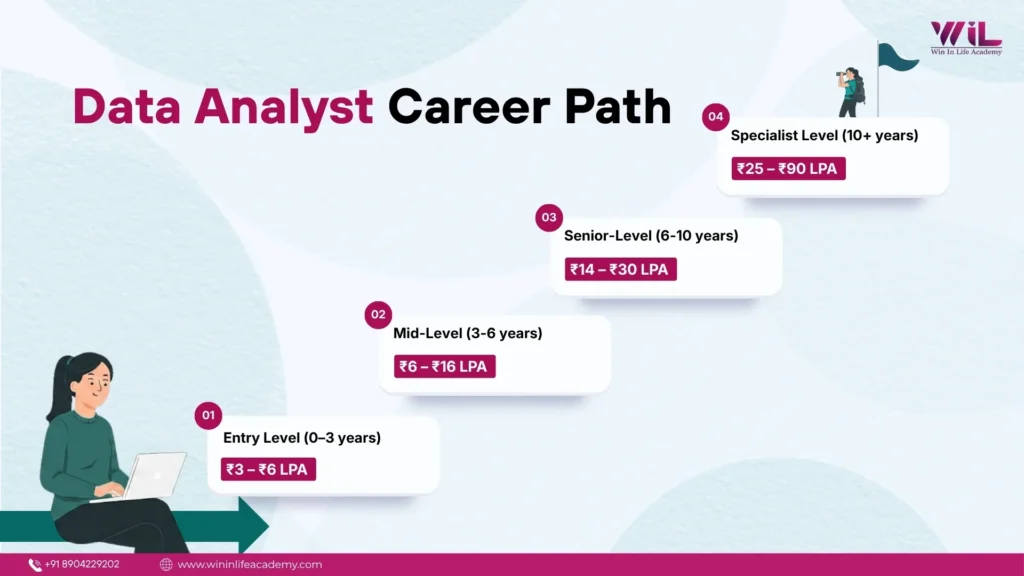
Table: Data Analyst Career Path Overview
| Experience Level | Roles | Skills | Tools | Salary Range (India) |
|---|---|---|---|---|
| Entry Level (0–3 years) | Junior Data Analyst / Data Analyst | Data cleaning, basic analysis, reporting, communication | SQL, Excel, Power BI / Tableau | ₹3 – ₹6 LPA |
| Mid-Level (3–6 years) | Business Analyst, Product Analyst, BI | Problem solving, data interpretation, stakeholder | SQL, Power BI, Tableau, Python (basic), Excel | ₹6 – ₹16 LPA |
| Analyst, Junior Data Scientist | communication, analytical thinking | |||
| Senior Level (6–10 years) | Senior Data Analyst, BI Lead, Analytics Lead, Data Science Lead | Leadership, decision-making, advanced analytics, mentoring, business strategy | SQL, Advanced BI tools, Python, Data modeling tools | ₹14 – ₹30 LPA |
| Specialist Level (10+ years) | Analytics Manager, Head of Analytics, Director of Data, Chief Data Officer (CDO) | Strategy, data governance, leadership, enterprise decision-making | Enterprise BI tools, Data platforms, Cloud analytics tools | ₹25 – ₹90 LPA |
*Salary ranges are directional and vary by city, company tier, and skill level. Verify current figures on Glassdoor India or Indeed India before relying on them.
How the Data Analyst Career Path Looks (Real Picture)
Think of this career less like a straight ladder and more like a growing curve. At the start, you’re mostly “doing what you’re told” — cleaning data, fixing reports, and building dashboards.
But slowly, something changes:
- You start asking “why this is needed”
- You stop just building reports and start giving insights
- Eventually, you influence decisions, not just support them
That’s the real shift in this career.
Entry Level Careers in Data Analytics (0–3 Years)
This is where most people begin their journey in data analytics, usually with a mix of curiosity and confusion about what the job actually looks like in real companies.
At this stage, you typically step into roles like Junior Data Analyst or Entry-Level Data Analyst. Your work is mostly structured and guided—working with datasets, cleaning data, fixing errors in reports, and building basic dashboards that support business teams.
In India, entry-level Data Analyst roles usually start around ₹3 LPA to ₹6 LPA, depending on your skills, company, and hands-on experience. Along with IT service companies, you’ll also find opportunities in startups like Zomato and Swiggy, e-commerce companies like Flipkart and Amazon, healthcare platforms like Apollo and Tata 1mg, and fintech companies like Paytm and PhonePe, across different data-driven domains. Some of the top mass hiring companies include TCS, Accenture, Deloitte, Fractal Analytics, Mu Sigma, Tiger Analytics, and EXL.
Still confused between Data Analyst and Data Scientist? Here’s a simple breakdown to help you decide.
To get into a first job as a Data Analyst, you need a strong foundation in SQL, Excel, and basic BI tools like Power BI or Tableau, along with statistics and communication skills. What matters more is how well you can apply them to simple real-world projects, not just tutorials.
During this period, you start learning how data actually works in companies—how messy it can be, how reports are used for decisions, and how different teams depend on analytics.
If you’re preparing for interviews, you can also explore common Data Analyst Interview Questions to understand what companies actually test at this stage.
Your First Data Analyst Job Checklist
- ✅ Build strong fundamentals in SQL, Excel, and one BI tool (Power BI/Tableau)
- ✅ Solve real-world datasets
- ✅ Create a portfolio with 2–3 projects showing insights and dashboards
- ✅ Practice SQL queries daily
- ✅ Learn to explain projects through a clear business story
- ✅ Prepare a simple, focused resume highlighting your skills and projects
- ✅ Practice common SQL interview questions and basic case-based questions
- ✅ Apply consistently for jobs while improving your skills in parallel
- ✅ Focus on demonstrating data thinking (insights) over tool usage
Mid-Level Careers in Data Analytics (3–6 Years)
Mid-level roles are typically reached after gaining hands-on experience in entry-level data analytics positions. The transition happens gradually as responsibilities increase beyond basic reporting and execution.
At this stage, professionals start handling more independent work, working with stakeholders, and contributing to business decisions through data. They move from task-based execution to more ownership-driven responsibilities.
Common ways professionals reach this stage include:
- Taking ownership of dashboards and reports used by business teams
- Handling end-to-end analysis for smaller projects
- Moving from guided work to independent problem-solving
- Getting exposure to business discussions and requirement gathering
- Gradually contributing insights that influence decisions
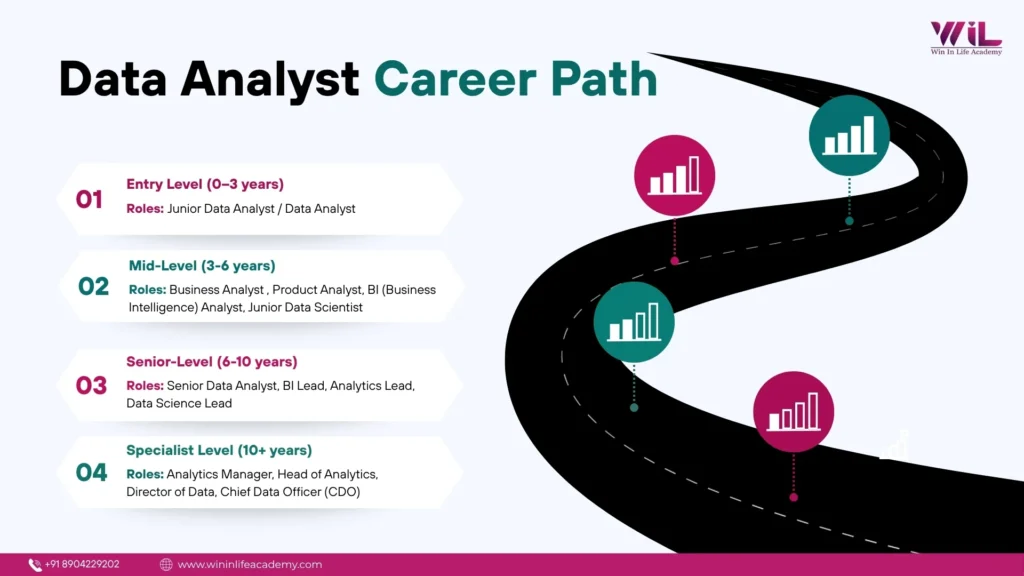
These experiences build the foundation needed to move into mid-level roles such as Business Analyst, Product Analyst, BI Analyst, or Junior Data Scientist.
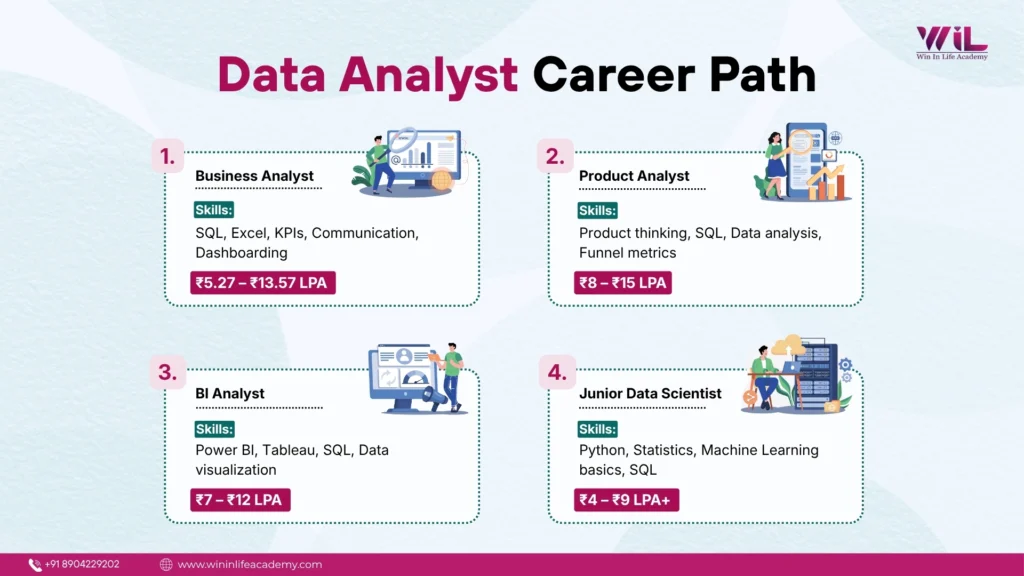
- Business Analyst – You focus on translating business problems into actionable insights, spotting trends, and helping stakeholders make decisions. Your work involves analyzing KPIs, processes, and operational metrics, creating dashboards, and presenting insights clearly. This role strengthens SQL, Excel, and dashboarding skills while developing business understanding and communication. Salaries generally range from ₹5.27 LPA to ₹13.57 LPA.
- Product Analyst – Here, you focus on products, user behavior, and growth metrics. You analyze funnels, engagement, and feature adoption to guide product decisions, often collaborating with product managers and engineering teams. You sharpen analytical thinking and product intuition while learning to connect insights to business outcomes. Salaries are typically around ₹8 LPA to ₹15 LPA.
- BI (Business Intelligence) Analyst – This role centers on turning complex datasets into dashboards, reports, and visualizations that teams can act on. You spend your days extracting, cleaning, and structuring data while using tools like Power BI, Tableau, and SQL. Mid-level BI Analysts earn between ₹7 LPA to ₹12 LPA.
- Junior Data Scientist – This is your first step into predictive analytics and machine learning. You work on building basic models, running statistical analysis, and supporting data-driven business decisions. You gain hands-on experience with Python/R, SQL, and machine learning libraries, preparing for a full data science role. Salaries typically fall in the ₹4 LPA to ₹9 LPA+ range.
At this stage, growth depends less on tools and more on your ability to make decisions, communicate effectively, and apply domain knowledge. This is the phase to take ownership of real business problems and turn data into actionable insights — laying the foundation for senior leadership, specialized analytics, or a transition into full-fledged data science.
Mid-Level Data Analyst Roles Comparison (3–6 Years)
| Role | Main Responsibility | Skills | Average Salary |
|---|---|---|---|
| Business Analyst | Translates business problems into data insights and supports decision-making | SQL, Excel, KPIs, Communication, Dashboarding | ₹5.27 – ₹13.57 LPA |
| Product Analyst | Analyzes user behavior, funnels, and product performance to improve growth | Product thinking, SQL, Data analysis, Funnel metrics | ₹8 – ₹15 LPA |
| BI Analyst | Builds dashboards, reports, and visualization systems for business teams | Power BI, Tableau, SQL, Data visualization | ₹7 – ₹12 LPA |
| Junior Data Scientist | Builds basic predictive models and supports data science projects | Python, Statistics, Machine Learning basics, SQL | ₹4 – ₹9 LPA+ |
*Salary ranges are directional and vary by city, company tier, and skill level. Verify current figures on Glassdoor India or Indeed India before relying on them.
💡 Career Tip
This is the stage where international opportunities start opening up — global consulting projects, product-based companies, or analytics teams serving international clients. These roles go to professionals who consistently perform well, take ownership of projects, and deliver impact. It’s not about years of experience, but about proving results.
Senior Level Careers in Data Analytics (6–10 Years)
Senior-level roles are typically reached after consistently handling mid-level responsibilities and gaining strong experience in independent analysis, stakeholder communication, and project ownership. The transition happens gradually as professionals move beyond execution and start focusing on larger business impact.
At this stage, professionals are no longer just working on analysis tasks—they begin leading projects, guiding teams, and influencing business decisions through data. The focus shifts from delivering reports to shaping how analytics is used across the organization.
Common ways professionals reach this stage include:
- Leading end-to-end analytics projects with minimal supervision
- Mentoring junior and mid-level analysts
- Working directly with business stakeholders on strategic problems
- Designing dashboards and KPIs used for decision-making
- Owning high-impact analysis that influences business direction
To succeed at this level, strong stakeholder management, team leadership, business strategy understanding, project management, and data governance awareness become essential alongside technical expertise.
These experiences prepare professionals for senior-level roles such as Senior Data Analyst, BI Lead, Analytics Lead, or Data Science Lead.
- Senior Data Analyst – You lead large-scale analytics projects, define KPIs, and provide insights that drive critical business decisions. You also mentor mid-level analysts and ensure data quality and accuracy. salaries in India typically range from ₹7 LPA to ₹18 LPA
- BI Lead – You design and manage dashboards, reports, and data pipelines that support executive decision-making. Your role emphasizes strategy, insights, and leadership rather than just reporting. Salaries generally range from ₹16 LPA to ₹23 LPA
- Analytics Lead – You manage analytics teams across functions, solve high-impact business problems, and translate insights into strategic recommendations. Mid-level salaries for analytics leadership roles typically fall between ₹15 LPA to ₹30 LPA
- Data Science Lead – You oversee predictive modeling, machine learning, and advanced analytics projects. You guide teams to ensure models deliver real business impact and mentor junior and mid-level data scientists. Salaries typically range from ₹22 LPA to ₹39 LPA+
At this stage, success depends less on tools and more on strategic thinking, communication, and leadership skills. You’re no longer just converting data into dashboards — you’re turning data into decisions that influence the business direction.
Ready to Start Your Data Analyst Career?
Talk to an advisor to understand the right learning path based on your background and how to move from learning tools to landing your first job.
Director Level Careers (10+ Years)
Director-level roles are typically reached after years of experience in senior analytics positions, where professionals have already led projects, managed teams, and contributed to business decision-making. The transition at this stage is less about technical growth and more about leadership, strategy, and organizational impact.
At this level, professionals move away from day-to-day analytics work and focus on building data-driven strategies, guiding large teams, and ensuring that analytics supports long-term business goals. Their role becomes more about direction, governance, and business alignment at an enterprise level, including shaping data strategy, AI adoption frameworks, and data privacy standards across the organization. They also play a key role in ensuring data governance and compliance, making sure data is secure, reliable, and aligned with regulations while enabling scalable analytics across business units.
Common ways professionals operate at this stage include:
- Defining the overall data and analytics strategy for the organization
- Leading multiple teams across analytics, BI, or data science functions
- Working closely with senior leadership and business executives
- Ensuring data governance, quality, and compliance across systems
- Driving company-wide decisions using data insights
These responsibilities prepare professionals for top leadership roles such as Analytics Manager, Head of Analytics, Director of Data, or Chief Data Officer (CDO).
- Analytics Manager: Becoming an Analytics Manager is more than analyzing data as you lead teams, manage projects, and drive business decisions while building leadership, communication, and strategic thinking skills, with salaries in India typically ranging from ₹13 LPA to ₹30 LPA+ depending on company, industry, and experience.
- Head of Analytics: As Head of Analytics, you set the vision for analytics across a business unit, guide multiple teams, prioritize initiatives, and turn insights into strategic decisions while typically earning ₹25 LPA to ₹64 LPA in India depending on company, industry, and scale.
- Director of Data: A Director of Data owns the organization’s data strategy and governance, oversees data operations, ensures quality and compliance, and aligns analytics with long-term business goals while typically earning ₹40 LPA to ₹88 LPA in India depending on company size, industry, and scope of responsibility.
- Chief Data Officer (CDO): As a CDO, you define the company-wide data vision, shape policies, lead enterprise data initiatives, and guide board-level decisions while driving analytics-led growth, and at this level executive compensation varies significantly by company, industry, and total compensation structure, Salaries generally range from ₹60 LPA to ₹66 LPA
At this stage, success is measured by impact, strategic influence, and leadership rather than technical skills alone. You’re guiding multiple teams, shaping the organization’s data culture, and making decisions that affect the company’s long-term growth.
Best Certifications for Data Analysts
Certifications help you build the right job-ready skills and show employers that you can work with real data tools. They don’t guarantee a job, but they make it easier to get shortlisted and start your career as a Data Analyst.
- Microsoft Power BI Certification – Helps you create interactive dashboards and reports to turn raw data into meaningful business insights.
- Google Data Analytics Professional Certificate – A beginner-friendly certification that builds a strong foundation in data cleaning, analysis, and real-world analytics tools.
- Tableau Desktop Certification – Focuses on building clear and interactive visual dashboards for better data understanding and storytelling.
- SQL Certification for Data Analysis – Strengthens your ability to work with databases, write queries, and extract useful insights from large datasets.
- Microsoft Excel Certification – Builds strong Excel skills for organizing, analyzing, and presenting data efficiently.
- Python for Data Analytics Certification – Helps you work with data using Python for analysis, automation, and handling larger datasets using libraries like Pandas.
Conclusion
A Data Analyst career is defined less by job titles and more by the ability to use data to solve real business problems across different stages of growth. As roles progress from entry-level analysis to senior positions, the focus shifts toward:
- Learn SQL & Excel for data analysis
- Build real-world data analytics projects
- Master Power BI for data visualization and reporting
- Develop business thinking for data analytics roles
- Continue upskilling in data analytics and BI tools
NASSCOM highlights that India’s demand for data and AI professionals continues to grow rapidly, with a projected need for over 1 million skilled professionals in the coming years, showing a clear gap between industry demand and available talent.
If you’re looking to build a structured path into this field, the focus should be on developing practical skills through real work. Programs like WILA’s Data Analyst training are designed around SQL, Excel, Power BI, and hands-on projects, helping learners build job-ready experience and move toward roles across analytics, BI, and product teams.
Thinking About a Career in Data Analytics?
Get guidance from an advisor to understand the roadmap, required skills, and how to move toward your first Data Analyst role.
Frequently Asked Questions
1. Is Data Analytics a good career in 2026?
Yes, Data Analytics is a high-demand career in 2026 with strong opportunities across IT, healthcare, finance, and product-based companies
2.Is learning tools like SQL, Excel, or Power BI enough to become a Data Analyst?
Tools help you land your first job, but real growth comes from thinking with data, understanding business context, and solving problems, not just running dashboards.
3. What is the difference between a Data Analyst and a Data Scientist?
Data Analysts focus on reporting, dashboards, and insights, while Data Scientists build predictive models, machine learning workflows, and advanced statistical analysis.
4. What roles can I expect at the entry level?
Freshers typically start as Junior Data Analysts or Entry-Level Data Analysts, handling data cleaning, basic reporting, and simple dashboards under guidance.
5. How does the career progress after entry-level?
With 3–6 years of experience, analysts can move into Business Analyst, Product Analyst, BI Analyst, or Junior Data Scientist roles, gaining independence and exposure to strategic business problems.
6. Can non-IT students become Data Analysts?
Yes, non-IT students can become Data Analysts by learning SQL, Excel, Power BI, and statistics along with hands-on projects.
7. How long does it take to become a Data Analyst?
It usually takes 3–6 months of focused learning with projects to become job-ready for a Data Analyst role.
8. Which certification is best for Data Analytics?
The best certifications are those that cover SQL, Power BI, Python, and real-world projects in Data Analytics, as employers value practical skills over theor.
9. How can I plan my growth from an entry-level Data Analyst to leadership roles?
Focus on building business acumen, mentorship skills, and strategic thinking alongside technical expertise. Early-career experiences like managing small projects, presenting insights, and collaborating across teams set the foundation for senior and director-level roles.
10. What is the average Data Analyst salary in Bangalore?
In Bangalore, entry-level Data Analyst salaries typically range from ₹3 LPA to ₹6 LPA, depending on skills, tools, and company.