
A cyberattack vector is the way an attacker enters a system, network, or application. Most cyberattacks start through common entry points such as phishing emails, weak or reused passwords, unpatched software, malware, or insecure applications. Understanding cyberattack vectors helps prevent attacks by closing these entry points before damage occurs.
Most cyberattacks don’t begin with advanced hacking tools or elite technical skills. They begin with everyday actions that feel harmless. A single click on a link, an email that looks routine, a file download, a reused password, or a software update that keeps getting postponed. Attackers are not looking for the hardest way in. They are looking for the easiest one.
These easy entry points are called cyber-attack vectors. An attack vector is the path an attacker uses to enter a system, application, or network. In most cases, the path already exists due to small security gaps, basic configuration mistakes, or simple lack of awareness. This is why understanding attack vectors cyber security is critical. It explains how attacks succeed even in organizations that use modern security tools and technologies.
Research consistently shows that human actions play a role in more than 80% of data breaches. This does not mean people are careless. It means attackers design their methods around normal behavior. When entry points are left open, threat actors exploit them quietly and efficiently.
This is why learning how attacks enter a system matters more at the beginning than learning security tools. If entry points are not secured, detection tools often react too late. For beginners, understanding attack vectors cyber security builds the awareness needed to recognize risk early and forms the foundation for everything else in cybersecurity.
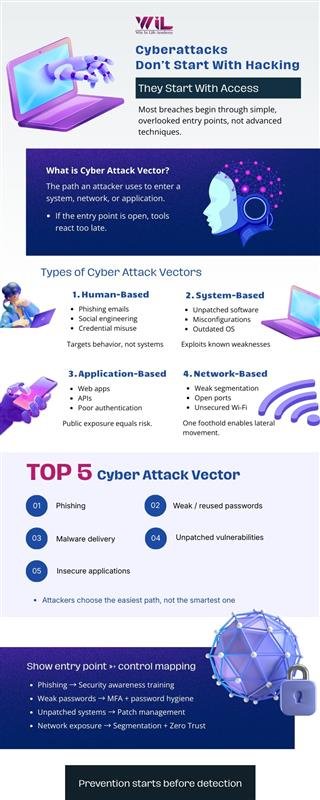
What is a Cyber Attack Vector?
A cyber attack vector is the route or entry point an attacker uses to gain unauthorized access to a system, network, or application. It explains how an attack starts, not what the attacker does after getting access. This distinction is critical when learning attack vectors cyber security at a foundational level.
An attack vector is different from an attack method. The attack vector is how access is gained, while the attack method is what happens after access, such as data theft or deployment of malware and ransomware. This clarity helps beginners understand Types of attack vectors without confusion.
Attack vectors remain effective mainly because of human behavior, system complexity, and weak security practices. Actions such as falling for social engineering techniques or mishandling credentials are common contributors. According to the Verizon Data Breach Investigations Report (DBIR) 2024, the human element was involved in about 68% of data breaches, showing how everyday mistakes help attackers gain initial access. At the same time, modern IT environments with cloud services, remote access, APIs, and multiple applications create more entry points that attackers can exploit.
Attack vectors remain effective when security tools are used without strong awareness and basic hygiene. Firewalls cannot compensate for poor access controls. Standards bodies emphasize that cyber threat prevention begins with blocking entry points, not only detecting incidents. ENISA and NIST both emphasize that awareness, patching, and access management are as critical as technical controls, reinforcing that cybersecurity begins with preventing entry.
Classification of Cyber Attack Vectors
Cyber attacks are categorized into 4 distinct buckets:
1. Human-based attack vectors
2. Technical or System-based attack vectors
3. Network-based attack vectors
4. Application-based attack vector
This grouping is based on where the weakness exists. Some attacks rely on human behavior, others exploit technical flaws, network exposure, or vulnerable applications. This classification helps beginners understand that attacks do not start randomly. They begin at specific entry points that are either misused, misconfigured, or left unprotected.
Human-based attack vectors exploit everyday actions like clicking emails or mishandling credentials. Technical and system-based vectors take advantage of unpatched software and misconfigurations. Network-based vectors target exposed ports, weak segmentation, or insecure connections, while application-based vectors abuse flaws in websites, web apps, or APIs. Across all categories, the pattern is the same. Attackers choose the entry point that requires the least effort and the least resistance.
Most Common Cyber Attack Vectors
1. Phishing Attacks (Email, SMS, Social Media)
Phishing is a cyberattack where attackers trick people into sharing sensitive information or taking unsafe actions by pretending to be a trusted source. These messages usually come through emails, SMS messages (smishing), or social media platforms, and they often look legitimate at first glance.
Attackers use simple techniques to deceive users. They may create messages that appear to come from banks, companies, colleagues, or service providers. These messages often create urgency such as account warnings, payment issues, or security alerts pushing users to click links, open attachments, or enter login details without thinking carefully.
Common phishing examples include fake password reset emails, delivery notifications with malicious links, SMS messages asking users to verify accounts, or social media messages offering jobs, prizes, or urgent requests. Once a user interacts with these messages, attackers can steal credentials, install malware, or gain access to systems.
Phishing remains the number one attack vector because it targets people rather than technology. Even well-secured systems can be compromised if a user is tricked into giving access. Since phishing relies on trust, urgency, and lack of awareness, it continues to be one of the easiest and most effective ways for attackers to gain initial access.
Kolkata New Year Phishing Scam
During the New Year season, cybercriminals targeted people in Kolkata using fake event offers and promotional deals. Attackers created phony advertisements, cloned websites, and misleading links that appeared to represent legitimate New Year events and booking platforms. These links were made to look authentic and time-sensitive.
Delivery Channels:The phishing links were circulated through sponsored social media ads, messaging apps, and manipulated search results, increasing their visibility and credibility.
Victims who clicked on these links were asked to enter personal details or make advance payments. As a result, multiple individuals were defrauded, leading to collective financial losses of around ₹40 lakh. The incident highlights how phishing attacks exploit trust, urgency, and seasonal events to trick users into unsafe actions.
How It Could Have Been Avoided:Users could have reduced the risk by booking events only through official websites, avoiding links from ads or messages, carefully checking website URLs, and being cautious of offers that created urgency or seemed unusually attractive.
2. Malware Attacks (Viruses, Trojans, Spyware)
Malware is short for malicious software. It refers to any software designed to harm systems, steal data, or give attackers unauthorized access. Common types of malwares include viruses, trojans, and spyware, each created to perform different harmful actions.
Malware usually enters systems through simple and often unnoticed actions. It may be installed when a user opens an infected email attachment, clicks on a malicious link, downloads software from an untrusted source, or visits a compromised website. In many cases, users are not aware that malware has entered their system.
Common delivery methods for malware include phishing emails, fake software updates, cracked or pirated software, infected USB devices, and malicious advertisements. Once delivered, malware can run silently in the background.
The impact of malware can be serious. It can slow down systems, steal sensitive information, monitor user activity, damage files, or create backdoors for further attacks. Because malware often exploits basic entry points, it remains one of the most common and damaging cyber attack vectors.
Malware-Based Cyberattack on Kolkata Real Estate Firm
A real estate and infrastructure company in Kolkata recently reported a significant malware-related cyberattack after discovering that multiple data servers and computer systems had been compromised. The breach was first noticed early in the morning when a ransom note appeared on the affected systems, indicating that malware had encrypted or locked key files, disrupting critical business operations.
Delivery Channels:The malware infiltrated the company’s systems despite having firewalls and antivirus software in place, suggesting that attackers exploited unprotected entry points such as outdated software, weak credentials, or misconfigured systems to bypass technical defenses.
Once inside, the attackers were able to access sensitive operational and business data, forcing the organization to halt essential functions such as project management, billing, and internal communication. The incident threatened financial stability and posed potential legal risks if client or employee data was exposed.
How It Could Have Been Avoided:This malware attack could have been reduced or prevented through frequent software updates, stronger access controls such as multi-factor authentication, regular security audits, network segmentation, and employee awareness training to detect suspicious activity early.
3. Ransomware Attacks
Ransomware is a type of malware that locks or encrypts files and systems and then demands payment to restore access. Once ransomware runs, users are unable to access their data until the attacker’s conditions are met.
Ransomware usually enters systems through phishing emails, malicious attachments or links, weak or stolen passwords, and unpatched software vulnerabilities. In many cases, attackers gain initial access quietly and deploy ransomware only after moving through the network.
Organizations often pay ransom because ransomware can halt operations completely. Critical data becomes unavailable, systems go offline, and business activities stop. The pressure to restore services quickly, especially in sectors like healthcare, finance, and logistics, pushes organizations toward payment, even though recovery is not guaranteed.
The real-world impact of ransomware includes data loss, financial damage, operational downtime, and reputational harm. Recovery can take weeks or months, and costs often go far beyond the ransom itself. This is why ransomware remains one of the most disruptive and costly cyber-attack vectors today.
Ransomware Attack on Ingram Micro (July 2025)
Ingram Micro Holding Corporation, a major global IT distributor, confirmed a ransomware attack that compromised certain internal systems by encrypting or locking access to critical resources. As a result, the company was forced to take multiple systems offline to contain the incident and prevent further spread.
Delivery Channels:The ransomware infiltrated despite existing security controls, likely exploiting vulnerabilities such as compromised VPN credentials, weak passwords, or unpatched software. This allowed attackers to gain quiet initial access before deploying the ransomware across the network.
Impacts:The attack caused a global operational shutdown, disrupting order processing, shipping, and digital platforms including Xvantage. These disruptions led to significant supply chain delays for partners and customers. Ingram Micro engaged cybersecurity experts and law enforcement, and issued apologies for the downtime that threatened revenue and business continuity across the IT distribution ecosystem.
How It Could Have Been Avoided:Regular patching of VPN and software vulnerabilities, strict enforcement of multi-factor authentication, network segmentation to restrict lateral movement, employee phishing awareness training, and routine backups with air-gapped storage could have reduced the risk of entry, limited the spread, and shortened recovery time.
4. Weak Passwords & Credential Theft
Weak passwords and stolen credentials are one of the easiest ways attackers gain access to systems. Many users reuse the same password across multiple accounts or choose passwords that are easy to guess. This makes it possible for attackers to break into account without needing advanced techniques.
One common method is brute force, where attackers try many password combinations until one works. Password reuse enables brute force attacks credential stuffing, where attackers use usernames and passwords leaked from one breach and automatically test them on other websites, assuming users have reused the same credentials.
Leaked credentials usually come from previous data breaches, phishing attacks, or malware infections. Once credentials are exposed, attackers can access email accounts, internal systems, cloud services, and applications as if they were legitimate users.
This is why multi-factor authentication (MFA) matters. MFA adds an extra verification step such as a code, app approval, or biometric check making stolen passwords alone useless. Even if credentials are compromised, MFA can stop attackers from gaining access, significantly reducing the risk of account-based attacks.
Weak Passwords & Credential Theft on MGM Resorts
MGM Resorts International identified a major cybersecurity incident in which attackers leveraged stolen credentials to breach internal systems. The attackers exploited weak or reused passwords from prior data leaks, enabling unauthorized access and allowing them to impersonate legitimate users across critical platforms.
Delivery Channels:Scattered Spider and ALPHV attackers conducted vishing and phishing attacks against helpdesk staff to obtain password resets. This was followed by credential stuffing, where leaked username–password combinations were tested via brute-force attacks on Okta authentication services and VPN portals where multi-factor authentication was not consistently enforced.
Impacts:The incident led to system shutdowns lasting more than 10 days across over 30 MGM properties. Slot machines, digital room keys, check-ins, and reservation systems were disabled, resulting in revenue losses exceeding $100 million. Customer personally identifiable information—including names, dates of birth, identification details, and some Social Security numbers—was exposed, triggering lawsuits and regulatory investigations.
How It Could Have Been Avoided:The risk could have been significantly reduced by enforcing multi-factor authentication on all accounts including helpdesk systems, using password managers to prevent password reuse, monitoring dark web sources for leaked credentials, conducting regular vishing and phishing awareness training, implementing zero-trust access verification, and rotating credentials immediately following any suspected compromise.
5. Unpatched Software Vulnerabilities
A software vulnerability is a weakness or flaw in a system, application, or operating software that attackers can exploit to gain access or cause damage. These vulnerabilities are often discovered by security researchers or attackers and are usually fixed through software updates or patches.
Outdated systems play a major role in security breaches. When software is not updated, known vulnerabilities remain open, giving attackers an easy way in. Older systems may also stop receiving security updates altogether, making them high-risk targets.
There are two main types of vulnerabilities. Delays in fixing zero day vulnerabilities allow attackers to exploit known gaps. A known vulnerability is already identified and often has a patch available but remains exploitable if the update is not applied.
Patching delays cause breaches because attackers actively scan systems that have not been updated. Even when fixes are available, slow patching leaves a window of opportunity for attackers to exploit these weaknesses, making unpatched software one of the most common and preventable attack vectors.
Unpatched Software Vulnerabilities on Kaseya
Kaseya VSA remote management software was exploited through CVE-2021-30116, a zero-day vulnerability chain involving authentication bypass and arbitrary code execution. The attack enabled the deployment of REvil ransomware across more than 1,500 customer organizations and approximately 60,000 endpoints worldwide.
Delivery Channels:Attackers actively scanned internet-exposed Kaseya VSA servers for the unpatched vulnerability. Although security patches were released on July 1, delayed application left many on-premises deployments exposed to automated exploitation targeting known weaknesses in outdated systems.
Impacts:The incident triggered global supply chain disruption, impacting retailers such as Sweden’s Coop, which was forced to close approximately 800 stores, along with schools and managed service providers. Ransom demands reached up to $70 million, while organizations faced weeks of downtime, extensive recovery costs, and long-term operational damage, highlighting the catastrophic ripple effects of unpatched software.
How It Could Have Been Avoided:The impact could have been significantly reduced through automated patch management with immediate deployment of critical updates, strict firewall rules blocking external access to VSA administrative interfaces, continuous vulnerability scanning, rigorous supply chain vendor security audits, network isolation of management tools, and regular offline backups to minimize exposure and speed recovery.
6. Insider Threats (Malicious & Accidental)
Trusted users may accidentally or intentionally expose data, creating insider threats. Because they are trusted users, their actions can directly affect systems and data.
Insider threats can be intentional or unintentional. Intentional insider threats occur when someone deliberately misuses access to personal gain or harm. Unintentional insider threats are more common and happen due to mistakes, lack of awareness, or poor security practices, such as clicking phishing links or mishandling sensitive data.
Common insider mistakes include sharing passwords, using unauthorized devices, downloading unsafe files, or sending sensitive information to the wrong recipient. These actions may seem harmless but can create serious security risks.
Insiders are hard to detect because their activities often appear normal. Since they already have access, traditional security tools may not immediately flag their actions as suspicious, making insider threats one of the most challenging attack vectors to manage.
Insider Threats (Malicious & Accidental) on Tesla (2021)
In 2021, Tesla software engineer Alex Khatilov maliciously exfiltrated thousands of proprietary automation scripts and internal files to his personal Dropbox account shortly after being hired. By abusing trusted new-employee access, he was able to steal critical business logic and sensitive intellectual property.
Delivery Channels:Khatilov used legitimate engineering credentials to access and download sensitive files beyond his role scope, disguising the activity as routine onboarding behavior. Since the data transfers occurred internally using authorized access, they bypassed perimeter defenses, and the download volumes appeared normal.
Impacts:The exposure of Tesla’s automation processes created risks of competitive sabotage and intellectual property theft. The incident led to a lawsuit for trade secret theft, potential multimillion-dollar damages, and accelerated the need for enhanced insider threat monitoring, highlighting the challenges of detecting abuse by trusted users.
How It Could Have Been Avoided:The threat could have been mitigated through data loss prevention (DLP) controls to block mass downloads to personal cloud storage, user and entity behavior analytics (UEBA) to flag role-inappropriate access, restricted access during probationary periods, endpoint monitoring during onboarding, mandatory NDA acknowledgment, and behavioral baseline profiling for new hires.
7. Web Application Attacks
Web application attacks target websites, web apps, and online services that are accessible through the internet. Since these applications are public-facing and handle user data, they are common targets for attackers looking for easy entry points.
SQL Injection occurs when attackers insert malicious input into application fields to manipulate databases. If input validation is weak, attackers can view, modify, or delete sensitive data stored in the backend database.
Cross-Site Scripting (XSS) allows attackers to inject malicious scripts into trusted websites. When users visit the affected page, the script runs in their browser, enabling attackers to steal session data, redirect users, or perform actions without permission.
Insecure APIs (application programme interface) are another major risk. APIs connect to applications and exchange data automatically. If APIs lack proper authentication, authorization, or input validation, attackers can access or extract sensitive information directly.
Public-facing applications are frequent targets because they are accessible to anyone and often interact with databases, user accounts, and APIs. Even a small flaw in a web application can provide attackers with a direct path into systems, making web application attacks a critical cyber-attack vector.
Web Application Attacks on Uber (September 2022)
In September 2022, Uber experienced an organization-wide breach after an attacker used stolen credentials to access an internal web tool that lacked proper input validation. This weakness enabled lateral movement through insecure APIs and database queries, ultimately leading to compromise of critical internal systems.
Delivery Channels:The attacker bypassed multi-factor authentication through social engineering of a contractor and then targeted the MWR intranet search tool, which was vulnerable to command injection or SQL injection–like abuse. Weak API authentication controls allowed further escalation into AWS, GSuite, Slack, and GitHub repositories.
Impacts:The breach resulted in near-total infrastructure compromise, exposing source code, internal vulnerability reports, and financial data. The attacker publicly taunted employees via Slack, forcing Uber to initiate a global systems lockdown, rotate credentials, and engage in a costly incident response effort, demonstrating how insecure internal web applications can cascade into full organizational takeover.
How It Could Have Been Avoided:The incident could have been mitigated by deploying a Web Application Firewall (WAF) to block injection attempts, enforcing parameterized queries and strict input sanitization, implementing an API gateway with OAuth or JWT-based authentication, applying zero-trust principles to internal tools, integrating automated code scanning into CI/CD pipelines, and conducting regular penetration testing across all web endpoints.
8. Network-Based Attacks
Network-based attacks target communication channels that connect systems and devices. Instead of attacking users or applications directly, attackers focus on how data moves across networks.
Attackers exploit poor segmentation and unencrypted traffic, including man in the middle attacks. This allows them to read, modify, or steal data without either side knowing.
Wi-Fi attacks exploit unsecured or poorly configured wireless networks. Attackers may set up fake Wi-Fi networks or connect to open networks to capture sensitive information from users.
Packet sniffing involves monitoring data packets as they travel across a network. If traffic is not encrypted, attackers can collect login details, emails, or other sensitive data.
Poor network segmentation makes these attacks more damaging. When networks are not properly segmented, attackers who gain access to one system can easily move to other systems. This is why weak network design remains a common and dangerous attack vector.
Network-Based Attacks on Colonial Pipeline (May 2021)
In May 2021, Colonial Pipeline’s network was compromised after attackers used stolen VPN credentials to gain access to internal systems. The DarkSide ransomware group leveraged this foothold to intercept network traffic, move laterally across poorly segmented IT and OT environments, and encrypt critical billing systems that supported pipeline operations.
Delivery Channels:Attackers exploited weak network segmentation between corporate IT networks and operational pipeline systems. Using compromised credentials, they conducted man-in-the-middle–style lateral movement and packet sniffing of unencrypted internal communications during reconnaissance, enabling deeper access across the environment.
Impacts:Pipeline operations were halted for approximately six days, disrupting nearly 45 percent of the U.S. East Coast fuel supply. The outage triggered fuel shortages, price spikes, and multiple state emergency declarations, ultimately resulting in a $4.4 million Bitcoin ransom payment and demonstrating the cascading impact of network-based attacks on critical infrastructure.
How It Could Have Been Avoided:The incident could have been mitigated through network micro-segmentation to isolate operational technology from corporate IT, strict enforcement of multi-factor authentication on VPN access, encryption of all internal network traffic, deployment of IDS/IPS solutions to detect lateral movement, air-gapped backups for OT systems, and adoption of zero-trust network access policies.
Clinical Research, Cybersecurity & Cloud Technology
Build practical cybersecurity skills to protect systems, networks, and data from real-world cyber threats. Learn how vulnerabilities are identified, attacks are analyzed, and security controls are implemented across modern IT and cloud environments.

How Organizations Reduce Attack Vector Risks
Organizations reduce risk by focusing on attack vectors cyber security prevention rather than reaction.
Security Awareness Training
Organizations invest in regular security awareness training that reduces human error to understand common threats such as phishing emails, fake links, social engineering, and unsafe downloads. Training teaches users how to verify emails, recognize warning signs, and report suspicious activity. Since human behavior is one of the most common attack vectors, improving awareness directly reduces the chances of successful attacks.
Patch Management
Patch management focuses on keeping operating systems, applications, and devices up to date with the latest security fixes. Many cyberattacks exploit known vulnerabilities for which patches already exist. By applying updates on time and removing unsupported software, organizations close these entry points before attackers can take advantage of them.
Access Control and Least Privilege
Access control ensures that users and systems have only the permissions they actually need to perform their tasks. The principle of least privilege limits access to sensitive systems and data, reducing the impact of an account is compromised. Strong authentication methods, role-based access, and periodic access reviews are commonly used to enforce this control.
Monitoring and Detection
Continuous monitoring helps organizations detect unusual or suspicious activity early. This includes tracking login attempts, access patterns, system changes, and data movement. Early detection allows security teams to respond quickly, isolate affected systems, and prevent attackers from spreading further inside the network.
Zero Trust Mindset
Zero Trust supports attack surface reduction. A Zero Trust mindset assumes that no user, device, or system should be trusted automatically, even if they are inside the network. Every access request is verified based on identity, device status, and context. This approach helps reduce risks from stolen credentials, insider threats, and lateral movement within systems.
Conclusion
Most cyberattacks do not begin with complex hacking. They start with open entry points. Understanding attack vectors cyber security shows that prevention always begins before detection. Understanding common cyber-attack vectors makes it clear that attackers succeed not because systems are advanced, but because basic gaps are left open.
This is why prevention always begins before detection. Security tools can help detect and respond to attacks, but they cannot fully protect systems if users are unaware, updates are ignored, or access controls are weak. Reducing attack vectors through awareness, good security hygiene, and basic controls is the most effective way to lower cyber risk.
For individuals and organizations alike, cybersecurity starts with knowledge and practical skills. Learning how attacks begin, how attackers think, and how entry points can be secured is the foundation of a strong security posture.
To learn more and build real-world cybersecurity skills, explore the Cybersecurity course offered by Win in Life Academy, designed to help learners understand threats, attack vectors, and practical defense strategies needed in today’s digital world.
Frequently Asked Questions (FAQs)
1. What are cyberattack vectors?
Cyberattack vectors are the entry points attackers use to gain unauthorized access to systems, networks, or applications.
2. What are the most common cyber attack vectors?
Common cyber attack vectors include phishing, weak or reused passwords, malware, ransomware, unpatched software, insecure applications, insider threats, and network weaknesses.
3. Why do most cyberattacks start with simple mistakes?
Most cyberattacks succeed due to human error, poor security hygiene, weak passwords, and delayed software updates rather than advanced hacking.
4. What is the difference between an attack vector and an attack method?
An attack vector explains how attackers enter a system, while an attack method describes what attackers do after gaining access, such as data theft or ransomware deployment.
5. How does phishing work as an attack vector?
Phishing works by tricking users into clicking malicious links, opening infected attachments, or sharing credentials through fake emails, messages, or websites.
6. Why are weak passwords dangerous in cybersecurity?
Weak or reused passwords allow attackers to use brute force or credential stuffing attacks to access multiple accounts without exploiting systems directly.
7. How does unpatched software become an attack vector?
Unpatched software contains known vulnerabilities that attackers can exploit to gain access to systems before security updates are applied.
8. What are insider threats in cybersecurity?
Insider threats occur when employees or trusted users intentionally or accidentally misuse their access, leading to data exposure or security incidents.
9. How do organizations reduce attack vector risks?
Organizations reduce attack vector risks through security awareness training, patch management, access control, monitoring, and Zero Trust security practices.