
Business Analyst roles are becoming increasingly attractive in India, but breaking into the field can be confusing. Which skills matter? Which tools should you learn? Do you need certification? And when should you start applying?
If you are wondering how to become a Business Analyst, you don’t need to master every analytics tool or collect multiple certificates. You need a clear, practical path from learning the fundamentals to building projects and becoming job-ready.
This blog breaks down that path, covering the skills, tools, certification, portfolio, job search, resume, interviews, salary, timeline, and career growth. Think of it as your complete business analyst roadmap for 2026.
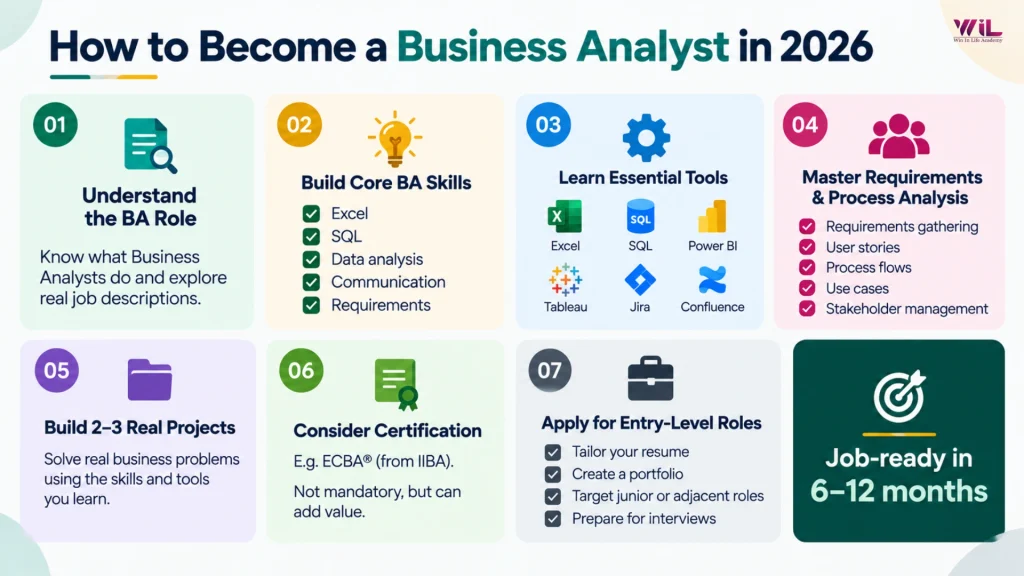
The Business Analyst Roadmap: From Beginner to Job-Ready in 2026
Step 1: Understand What a Business Analyst Does
Before learning how to become a Business Analyst or tools like Excel, SQL, or Power BI, understand what a Business Analyst actually does. A Business Analyst identifies business problems, gathers requirements, analyses information, and helps stakeholders make better decisions.
For example, if a company is losing customers, a Business Analyst may:
- Talk to stakeholders to understand the problem
- Gather and analyze relevant data
- Identify why customers are leaving
- Present findings and recommendations
The tools are important, but they are only a means to solve business problems.
No. A technical or engineering degree can help with some roles, but it isn’t mandatory. Employers also value analytical thinking, business understanding, communication, problem-solving, and practical skills.
Relevant projects can help demonstrate these abilities, even if your degree isn’t directly related to Business Analysis.
Step 2: Build the Core Business Analyst Skills
Once you understand how to become a Business Analyst, build the core skills needed to perform it effectively. Focus on these six areas:
- Business Analysis: Understand business problems, objectives, and gaps.
- Requirements Gathering: Learn to gather, document, and validate requirements.
- Data Analysis: Use Excel and SQL to analyze and interpret business data.
- Data Visualization: Learn tools like Power BI or Tableau to present insights clearly.
- Process Analysis: Understand workflows, identify inefficiencies, and suggest improvements.
- Communication & Stakeholder Management: Ask the right questions, clarify requirements, and communicate findings clearly.
You don’t need to master everything at once. Build these skills gradually and focus on how they help you solve real business problems.
For most beginners, start with Excel. It builds fundamental data-analysis skills such as filtering, formulas, data cleaning, pivot tables, and basic calculations.
Once you’re comfortable with structured data, move to SQL for retrieving and analyzing data from databases.
You don’t need advanced SQL initially. Start with SELECT, WHERE, GROUP BY, ORDER BY, JOIN, CASE statements, aggregate functions, and basic subqueries, then progress to more advanced queries.
- Power BI or Tableau: Data visualization and dashboards
- Jira: Task tracking and Agile collaboration
- Confluence: Documentation and knowledge sharing
- Process modelling tools: Mapping and improving workflows
Start with Excel and SQL, then add Power BI. Learn other tools based on the type of Business Analyst role you want.
Most importantly, don’t just learn how to use a tool. Understand what business problem it solves and what decision the output supports.
SQL isn’t required for every Business Analyst role, but it is highly valuable. It helps you retrieve and analyze data directly from databases instead of relying entirely on technical teams.
The requirement varies by role, so use current job descriptions to guide your learning priorities.
Step 4: Choose a Business Analyst Certification Strategically
Certification can strengthen your profile, but it should support your skills, not replace them.
A practical sequence is:
Skills → Projects → Certification → Applications
For beginners, the IIBA Entry Certificate in Business Analysis (ECBA) can help demonstrate foundational knowledge. However, certification alone won’t make you job-ready.
Choose one relevant certification, apply what you learn through projects, and focus on building practical skills.
Step 5: Build a Business Analyst Portfolio
As you learn how to become a Business Analyst, Your portfolio turns your learning into evidence. You don’t need ten projects, two or three strong, end-to-end projects are enough to start.
Each project should show:
Problem → Requirements → Analysis → Insight → Recommendation → Business impact
Good project ideas include:
- Customer Churn Analysis: Analyze why customers leave and recommend ways to reduce churn using Excel, SQL, and Power BI.
- Sales Performance Analysis: Compare sales across regions, products, or customer segments and recommend actions to improve performance.
Don’t just showcase dashboard screenshots. Explain the problem you solved, what you discovered, and what the business should do next.
A strong portfolio can also give you concrete examples to discuss during applications and interviews, especially if you don’t yet have direct Business Analyst experience.
Step 6: Start Applying for Business Analyst Jobs
Once you understand how to become a Business Analyst, have the fundamentals, essential tools, and at least one strong project, start exploring real job descriptions. Do not limit your search to “Business Analyst”; depending on your background, also consider Junior Business Analyst, Associate Business Analyst, Business Analyst Trainee, Product Analyst, MIS Analyst, Reporting Analyst, and Operations Analyst roles.
Use Job Descriptions to Guide Your Preparation
Study 20–30 relevant job descriptions and identify the skills and responsibilities that appear repeatedly. If employers consistently ask for Excel, SQL, Power BI, requirements work, stakeholder communication, and process analysis, prioritize those areas in your preparation.
This approach keeps your learning aligned with what employers actually want instead of trying to master every skill mentioned in generic Business Analyst courses.
Prepare for scenario-based questions rather than memorizing definitions. Be ready to explain how you would approach a business problem, gather requirements, analyze information, work with stakeholders, and make recommendations.
For every portfolio project, practice explaining:
Problem → Analysis → Finding → Recommendation
Step 7: Turn Your Skills Into a Job-Ready Resume
Your portfolio demonstrates what you can do; your resume needs to make that evidence relevant to the role. Avoid sending the same generic resume everywhere. Highlight the skills, projects, and transferable experience that match each job description.
For example:
Weak: “Created Power BI dashboards.”
Stronger: “Built a Power BI dashboard to analyze customer churn and identify high-risk customer segments.”
The stronger version shows the tool, analysis, and business problem rather than simply listing an activity. If you have experience in operations, sales, finance, customer service, or project coordination, connect that experience to relevant Business Analyst responsibilities.
How Long Does It Take to Become a Business Analyst?
There is no fixed timeline. Your starting experience and learning pace matter. For beginners studying consistently, six to twelve months is a realistic target for building a job-ready foundation.
| Period | Main Focus |
|---|---|
| Months 1–2 | Business Analysis fundamentals, Excel, communication |
| Months 3–4 | SQL, requirements, process analysis |
| Months 5–6 | Power BI and first portfolio project |
| Months 7–9 | Second project, certification, interview preparation |
| Months 10–12 | Applications, interviews, resume and portfolio refinement |
You don’t need to wait 12 months to apply. Start applying once you have the fundamentals and at least one strong project, while continuing to improve.
Business Analyst Salary in India
Business Analyst salaries vary by experience, location, industry, employer, and specialization. Average figures should not be treated as direct expectations for freshers.
| Experience / Level | Indicative Salary |
|---|---|
| Fresher / Entry Level | Varies by company and location |
| Business Analyst | Around ₹9.16 LPA average* |
| Senior Business Analyst | Around ₹13.46 LPA average* |
*Actual compensation can vary significantly. Figures updated to the current live averages on Indeed India as of September 2026
As a beginner, focus first on building skills and gaining relevant experience. Your earning potential can grow as your responsibilities and expertise increase.
Common Mistakes Beginners Make
| Common Mistake | What You Should Do Instead |
|---|---|
| Learning too many tools | Focus on core tools like Excel, SQL, and Power BI before adding more software to your toolkit. |
| Collecting certificates without practical work | Build projects alongside your learning so you can demonstrate how you apply your knowledge to real business problems. |
| Avoiding SQL | Learn the fundamentals of SQL. Not every Business Analyst role requires advanced SQL, but basic knowledge can open more data-focused opportunities. |
| Ignoring communication skills | Practice gathering requirements, asking clear questions, explaining findings, and communicating recommendations to stakeholders. |
| Using the same resume everywhere | Tailor your resume to the skills, responsibilities, and keywords relevant to each Business Analyst job you apply for. |
| Waiting until you feel completely ready | Once you understand the fundamentals and have at least one strong project, start applying while continuing to improve your skills. |
What Should Your Business Analyst Career Path Look Like?
Your first Business Analyst role does not define your entire career. A common progression is:
Junior / Associate Business Analyst → Business Analyst → Senior Business Analyst → Lead Business Analyst
With experience, you can also move into data analytics, business intelligence, process improvement, consulting, project management, or product management.
Your direction will depend on the problems you enjoy solving and the skills you develop. Focus on building a strong foundation first; your first role will help you decide where to specialize.
Start Your Business Analyst Journey with Win In Life Academy
If you prefer a structured path for how to become a Business Analyst, Win In Life Academy’s Professional Certificate in Analytics Leadership & Generative AI can help you build practical analytics skills for your career.
Win In Life Academy also offers resources covering Business Analyst tools, roadmaps, jobs, and interview preparation.
Frequently Asked Questions
1. Can I Become a Business Analyst Without a Technical Degree?
Yes. A technical degree isn’t mandatory for every Business Analyst role. If you’re learning how to become a Business Analyst, employers also value analytical thinking, business understanding, communication, problem-solving, and practical BA skills. Relevant projects can help demonstrate these skills.
2. Can I Become a Business Analyst With No Experience?
Yes. Freshers can learn how to become a Business Analyst by targeting junior, associate, trainee, and related analyst roles while building relevant skills and completing practical projects. Experience in areas such as operations, finance, sales, customer service, or project coordination can also provide transferable skills.
3. Is Business Analyst Certification Necessary?
No. Certification isn’t mandatory for every Business Analyst position. Practical skills, relevant projects, communication, requirements gathering, and knowledge of Business Analysis processes are also important. A certification can strengthen your profile when combined with these capabilities.
4. Which Business Analyst Certification Is Best for a Fresher?
The right Business Analyst certification depends on your career stage and goals. Beginners can consider an entry-level credential such as ECBA, while advanced certifications are generally more suitable after gaining relevant Business Analysis experience.
5. What Jobs Can I Apply for as a Business Analyst Fresher?
Depending on your skills and background, consider Junior Business Analyst, Associate Business Analyst, Business Analyst Trainee, Product Analyst, MIS Analyst, Reporting Analyst, and Operations Analyst roles. Searching related job titles can help you follow a business analyst roadmap toward more entry-level opportunities.
6. How Many Projects Do I Need for a Business Analyst Portfolio?
You don’t need a large portfolio. Two or three strong, end-to-end projects are more valuable than many small exercises. Each should demonstrate the business problem, requirements gathering, analysis, findings, recommendations, and tools used.
7. How Long Does It Take to Become a Business Analyst?
A committed beginner can build a job-ready foundation in around six to twelve months. The timeline depends on your existing experience, technical skills, learning consistency, and ability to demonstrate your skills through practical projects when learning how to become a Business Analyst.
8. What Is the Salary of a Business Analyst in India?
Business Analyst salaries vary by experience, location, employer, industry, and specialization. Entry-level salaries are typically lower than averages that include experienced professionals, so check current job postings for your target role and location. Stakeholder management, SQL, and Power BI can also be valuable skills for Business Analyst roles.
9. What Is the Difference Between a Business Analyst and a Data Analyst?
A Business Analyst focuses on business problems, requirements gathering, processes, stakeholder needs, and recommendations. A Data Analyst focuses more on analyzing data to identify trends and insights. The roles can overlap, particularly in data-driven organizations.