A VAPT projects is a vulnerability assessment and penetration test you run end to end, on a target you are allowed to attack, and then write up. Most freshers quietly drop the last two words. They run a scanner, screenshot the output, and call it a project. Recruiters have seen a thousand of those, and they do not count for much.
What gets you hired is proof you can do the part a scanner cannot: confirm a flaw by hand, explain why it exists, and tell the developer how to fix it. India’s hiring data is blunt about this. In the DSCI and SANS India Cyber Security Skilling Landscape Report 2025-2026, 63% of enterprises said candidates have limited hands-on practical skills, and 45% said they do not even have lab environments for people to build those skills in. That second number is your opening. The lab nobody is giving you, you can build on your own laptop.
This guide gives you four VAPT projects you can set up at home, plus the one thing that turns them into a portfolio: a report a client could act on. Pick one or two and take them all the way through. That beats four half-finished scans every time.
Why a scan is not a VAPT project
Anyone can install Nessus, Burp Suite, or Nmap and press start. That is tool operation, not security work. A VAPT project earns its place on your resume only when it shows the three things a scanner cannot do for you:
- Manual verification: a scanner flags a possible SQL injection, and you prove it is real or prove it is a false positive. Knowing which is which is most of the job.
- Root-cause analysis: not “the login form is vulnerable,” but why it is vulnerable and what a developer changes in the code to close it.
- A usable report: scope, method, evidence, severity, and the fix, written so a manager can act without phoning you to explain it.
Freshers who can show those three things are rare, which is exactly why the skills gap exists.
One rule before you start. Run every project below only against targets you own or have written permission to test. Pointing these tools at a live website, a company network, or someone else’s Wi-Fi is an offence under the Information Technology Act, 2000. Keep it in your lab, every time.
Four VAPT projects for beginners
Each project targets a different area recruiters hire for. No corporate access or paid infrastructure needed, just a laptop, free software, and a weekend each.
1. Web application penetration test
Start here, because web apps are the most tested surface in the industry and the first thing IT services firms screen for. Set up OWASP Juice Shop or DVWA locally with Docker, map the app as a normal user first, then test for the common risks in the 2025 OWASP Top 10, verifying each by hand in Burp Suite instead of trusting the scanner:
- SQL injection: feed test characters into search and login fields to see if you can alter the database query.
- Cross-site scripting (XSS): enter small scripts in input fields to check whether the browser runs them.
- Broken access control (IDOR): change a parameter like user_id=101 to 102 and see whose data loads.
- Security misconfiguration: read response headers and page source for debug logs or default credentials.
The deliverable is a report that follows this path from mapping to verified finding to fix. That is what proves you can run an assessment, not just a tool.
2. Internal network penetration test
This project interests banks, hospitals, and manufacturing IT teams, where the inside of the network is often softer than the public website. Build the lab in VirtualBox with Kali Linux as the attacker and Metasploitable 2 as the target, then work through it:
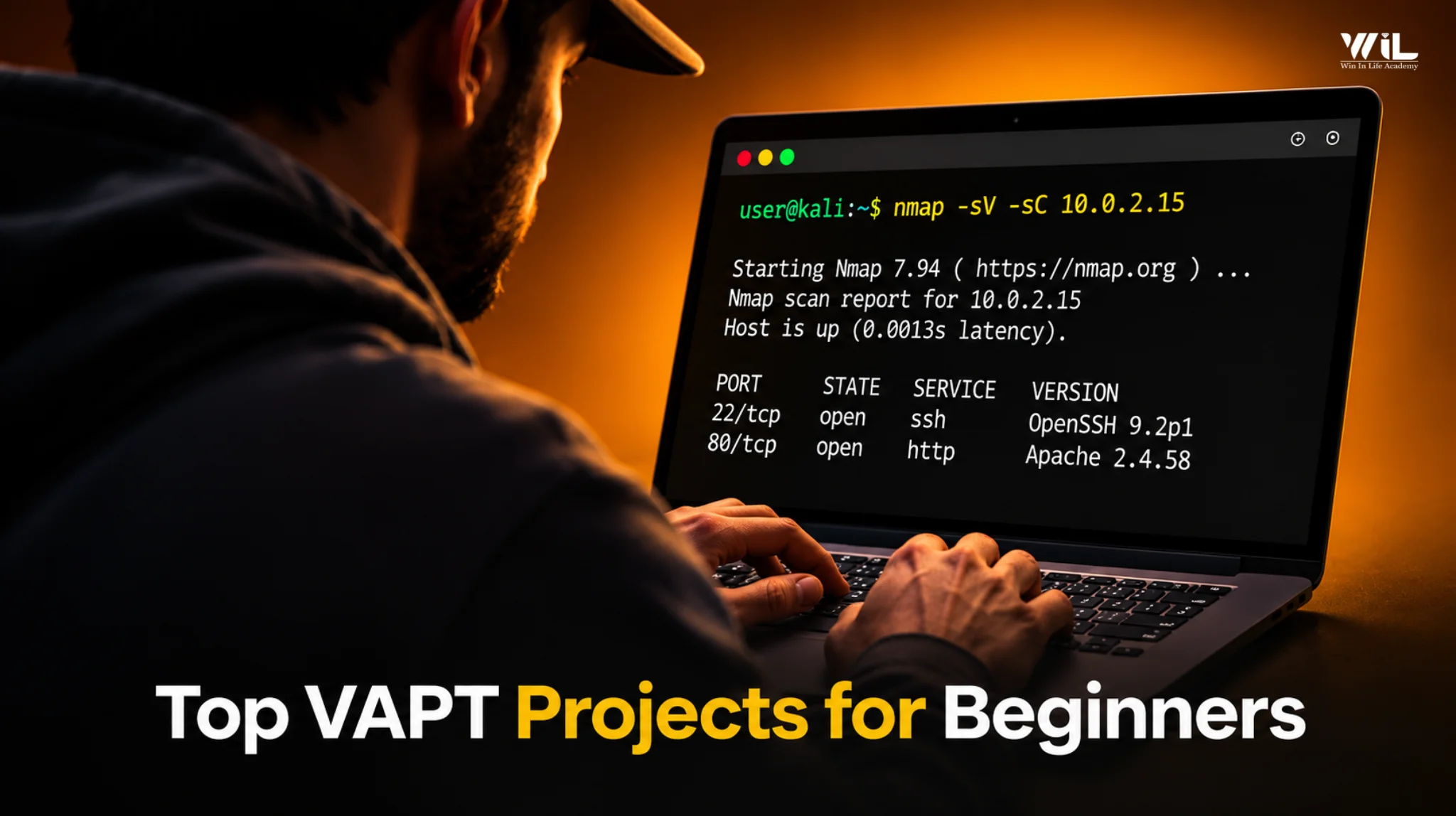
- Discover: scan the subnet with Nmap for live hosts and open ports, and work out what each service is actually for.
- Match: cross-reference service versions against known exploits with Searchsploit.
- Probe shares: check whether file shares allow anonymous access.
- Inspect traffic: capture packets with Wireshark to see what the network sends unencrypted.
The skill that sets you apart is attack-path thinking. Do not stop at “this host is vulnerable.” Show how an attacker moves from one machine to the next, then recommend fixes like network segmentation and patch management.
3. Wi-Fi network security test
Shared office Wi-Fi is a soft target, because staff, guests, and devices often sit on one network, so a weak router or an open guest network lets anyone in range reach internal resources. Fair warning: this is the only project that needs hardware, a spare router, a Kali VM, and a USB adapter that supports monitor mode. If you do not have the kit, do another project instead. With the lab ready:
- Review the router: check for default admin credentials, outdated encryption, old firmware, and WPS left on.
- Capture traffic: record 802.11 frames with Wireshark and observe the WPA/WPA2 handshake with Aircrack-ng.
- Test isolation: connect a device to the guest network and check whether it can reach the main network.
That last isolation check is often where the real finding is. Write up the gaps with fixes, and you have a wireless assessment most freshers never attempt.
4. CMS vulnerability assessment
Most small-business sites are not broken by an elite exploit. They are broken by one forgotten plugin. Set up a local WordPress or Joomla site with Docker or XAMPP, install some outdated plugins and themes, then assess it:
- Fingerprint: use Nmap, Nikto, and WPScan or JoomScan to list versions, themes, and plugins.
- Research: look up the matching CVE records for those versions.
- Verify: confirm in your lab whether each weakness is genuinely exploitable, not just reported.
- Dig deeper: intercept requests with Burp Suite to test for XSS, injection, and unsafe file uploads, and check admin logins and file permissions.
The point you prove is judgment: you can tell a real CMS vulnerability from scanner noise and know what a site owner should do about it.
Turn your VAPT projects into a portfolio recruiters can read
Do not run four shallow projects. Take one or two all the way through, from first scan to verified finding to applied fix and retest, and document them properly. Depth is the signal; breadth is noise.
Build a clean GitHub repository for each project:
- README.md: objective, test environment, scope, methodology, and tools used.
- Evidence/: sanitized screenshots of your testing and validated findings.
- Reports/: the final VAPT report as a PDF.
- Remediation/: the fixes you applied and the retest results.
Structure the report the way a professional would, because the report is the deliverable clients pay for:
- Executive summary: the main risks in plain language a non-technical manager can follow.
- Scope and methodology: what you tested, what you did not, and how.
- Findings: each vulnerability with severity, using CVSS scores where they apply.
- Evidence and impact: proof the flaw is real and what it would cost the business.
- Remediation and retest: the recommended fix and confirmation it worked.
A single project documented to this standard carries more weight than a resume line that says “familiar with Nmap and Burp Suite.” For the fundamentals underneath it, see our guides to ethical hacking skills and how to become an ethical hacker.
Conclusion
Getting into VAPT is not about owning every tool or finishing ten projects. It is about taking one assessment from first scan to final fix and being able to walk an interviewer through every decision you made and why. Build one web application test or one network test, verify everything by hand, write the report, and put it where a recruiter can find it. That one documented project will do more for your chances than another certificate.
If you want structured lab time and someone reviewing your work, Win in Life Academy runs the Advanced Diploma in Cyber Security & Ethical Hacking in Bangalore, covering ethical hacking, VAPT, and CEH preparation through supervised labs and mentorship.
Frequently Asked Questions About VAPT Projects
1. What are the best VAPT projects for beginners?
A web application test, an internal network test, a Wi-Fi security test, and a CMS vulnerability assessment. Between them they cover the main areas recruiters hire for and let you practice finding, verifying, and reporting flaws.
2. Do I need coding skills to do VAPT projects?
Not to start. Basic networking, Linux commands, and the common tools are enough for your first project. Some Python, JavaScript, and SQL will help you understand application behaviour and verify vulnerabilities faster, so pick it up as you go.
3. Can VAPT projects help me get freelance work?
They help you demonstrate skill to a potential client, but a portfolio does not guarantee work. Clients also judge communication, responsible testing, and whether your reports are clear enough to act on.