Open your feed on any given week and Power BI is either finished or unstoppable.
One post says Copilot writes DAX now, so dashboard jobs are done. The next says Future Power BI has never been bigger. A thumbnail asks if you should bother learning it in 2026. Someone in the comments says learn Fabric instead. You do not know what Fabric is.
The real problem with that noise: you have never sat inside a BI team, so you cannot tell a genuine shift from a scary thumbnail. Every opinion sounds equally confident.
So use a test that does not depend on opinion. This gets asked in real Power BI interviews:
“Sales says we did 40 lakh last month. Finance says 34 lakh. Both pulled it from Power BI. What went wrong?”
Nobody is checking whether you can build a chart. The laptop does that now. They are checking whether you know where a number comes from.
The answer: sales counts an order the day it is placed, finance counts it the day payment clears. Both are right. Nobody agreed what a sale is. That is not a chart problem. It is a data model problem, and it is the half of this job AI cannot touch.
What is the future of Power BI?
The future of Power BI is as the modelling brain inside a much bigger Microsoft platform. To understand why that matters, you need three things nobody explains to beginners.
First, what is Microsoft Fabric?
Power BI used to be one tool with one job. Someone else prepared the data, you connected, modelled it and built reports.
But companies needed more: somewhere to store raw data, pipelines to move it, a warehouse to query it, tools for data science. All separate products, all separate bills.
So Microsoft bundled them into one platform called Microsoft Fabric. Picture one big store instead of six separate shops, with a shared stockroom called OneLake that every counter pulls from.
Power BI was not removed. It became the counter handling modelling and reporting. That is why job ads now say “Power BI and Fabric” as if they are one thing. Increasingly, they are.
Second, what is a SKU, and why does P-SKU keep coming up?
A SKU is just a purchase plan. The word means stock keeping unit, retail language for “the exact thing you are buying”.
Power BI Premium sold in P plans: P1, P2, P3. A company rented a block of computing power so reports stayed fast for hundreds of users. Fabric replaced these with F plans, F2 through F64 and beyond, where the number is how much computing power you get. Microsoft stopped selling P plans to new customers on 1 July 2024, and most renewals ended on 1 January 2025 (Microsoft Licensing).
Why a beginner should care: the AI features are tied to F plans, not your personal license. Whether you use Copilot at work is a finance decision, not a skill you can study your way into.
Third, what changed for the person building reports
Your data model stopped being a private working file. Microsoft now treats it as where the company’s business language lives, the thing AI reads before answering anyone (Microsoft Learn). If your model says a sale happens at payment, every AI answer in that company says the same.
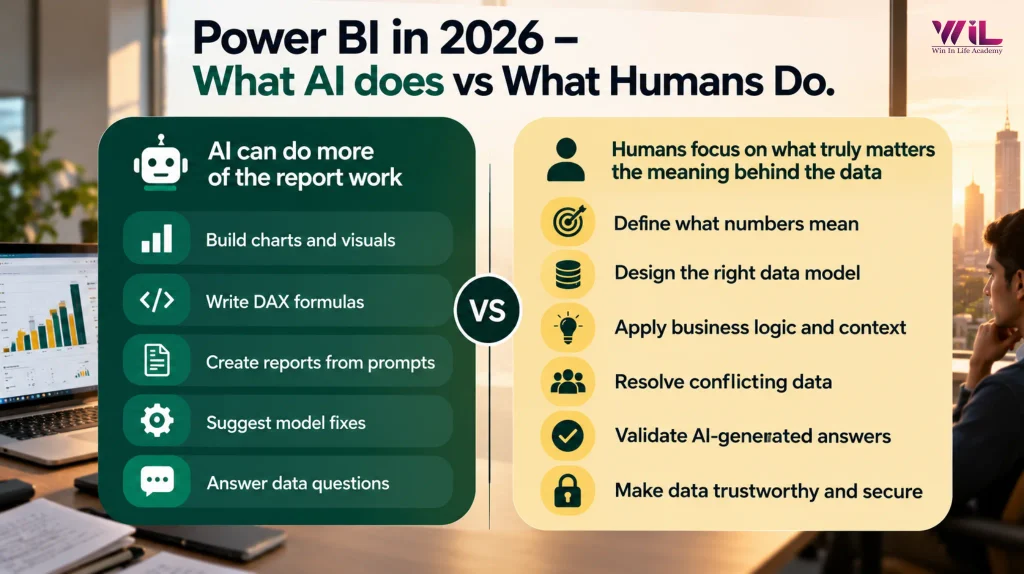
And as of June 2026, Copilot writes DAX, suggests fixes to your model, and builds a full report from a conversation (Power BI June 2026 update). Microsoft is not building a nicer canvas for you to drag charts onto. It is building something that reads your model and writes the report itself.
So how should a beginner pick this up?
Not by starting with Fabric. That is the mistake people make after reading one panicked post.
Fabric is a workplace platform, not a beginner tool. You cannot practice most of it without a company paying for capacity. Power BI Desktop is free and runs on your laptop.
Learn SQL, then modelling in Power BI Desktop, then DAX. Once you understand a data model, the Fabric vocabulary takes a weekend. Beginners who chase buzzwords instead end up able to name things they cannot build.
Do I need to learn Microsoft Fabric as a fresher?
Not first. Learn SQL, data modelling and Power BI Desktop, which are free to practice. Fabric concepts make sense quickly once the modelling is solid.
Will AI replace Power BI developers?
No. AI is taking over report building, not the analytics job. Microsoft’s own documentation says Copilot is meant to help people, not replace the people who create and manage reports. What disappears is dragging charts onto a page. What stays is deciding what the numbers mean.
That is from Microsoft Learn. Of course Microsoft would say that, so look at what the AI cannot do.
Fabric data agents answer questions about company data in plain English. They work, and they have hard limits (Microsoft Learn):
- They can only read data, never change it.
- They work in English only.
- They can use a maximum of five data sources.
- Answers are capped at 25 rows and 25 columns.
- They cannot read PDF, Word or text files.
Before any of it works, a human must name every table and column clearly, choose which tables the AI may use, write instructions telling it where to look, and give it 10 to 20 sample questions with correct answers.
Now go back to the 40 lakh problem. AI answers “what were our sales last month” in two seconds. It cannot tell you which definition of sales is right for your company. Microsoft admits this: “Without preparation, Copilot can misinterpret the data and return generic or inaccurate results” (Microsoft Learn).
A messy model plus AI does not give no answers. It gives fast, confident, wrong answers, sent to a hundred people before anyone checks. That is where the future of Power BI work sits.
| Getting easier for AI to do | Getting more valuable for you to do |
|---|---|
| Building charts and layouts | Deciding what a number means |
| Writing everyday DAX formulas | Designing how tables connect |
| Making a report when asked | Naming things so AI reads them right |
| Knowing where a button is | Controlling who sees which rows |
| Making more dashboards | Making the data trustworthy |
Stuck on formulas? Start with DAX functions in Power BI.
Do I still need DAX if Copilot writes it?
Yes. AI-written DAX is only as correct as the model beneath it. Wrong filters produce wrong numbers that look completely normal, so you must be able to check it.
Can you even use Power BI Copilot in India?
Often, no. This is the part of the future of Power BI nobody in your feed mentions.
Copilot needs a paid Fabric capacity of F2 or higher. A Power BI Pro license will not get it, and free and trial accounts are not supported (Microsoft Learn). Pro costs $14 per user per month and still does not include Copilot (Microsoft).
There is a location catch too. Copilot is not available in the India West region, and setups based in India send requests to servers in the US, which an admin must allow first (Microsoft Learn).
So in plenty of Indian teams the AI you fear is switched off, blocked by compliance, or not budgeted. The fresher who gets hired builds the model by hand.
Is Power BI worth learning in 2026?
Yes, if you learn the right half of it. Microsoft was named a Leader in the 2026 Gartner Magic Quadrant for Analytics and Business Intelligence Platforms in June 2026, the nineteenth year running, and reports over 35 million monthly users (Microsoft Fabric Community). The tool is not shrinking. And this is not Microsoft-only: Salesforce rebuilt Tableau around AI agents, Google is adding Gemini to Looker. Still choosing? Read Tableau vs Power BI.
Ignore any single salary average online, since those mix freshers with veterans. Check level-wise ranges in our data analyst salary in India guide.
What to do in your first 90 days
Change the order you learn in.
- SQL first. Joins, grouping, and what one row in a table represents.
- Then modelling. How tables connect, and why a bad connection gives wrong totals.
- Then DAX. Enough to read someone else’s formula and spot the mistake.
- Then naming and access. Clear names, and who can see which rows.
- Charts last. The AI already does this well.
Then build proof. Take two ideas from our Power BI projects list and write down why you modelled it that way. Most freshers post screenshots. Almost nobody explains their thinking, and that gap gets you shortlisted. For where this leads, see the data analyst career path and business intelligence vs business analytics.
Win in Life Academy teaches this order on purpose, because the future of Power BI belongs to people who can explain a number, not just display it.
Conclusion
Go back to that interview question. Two teams, two numbers, one tool.
The person who gets hired is not the one with the prettiest dashboard. It is the one who can explain why the numbers differ. That is the future of Power BI, and the noise on your feed is not about that at all.
Start with SQL this week. Build one small model where every number has one definition. That project teaches you more than ten dashboard tutorials.
Frequently Asked Questions
1.Will Power BI become obsolete?
No. The future of Power BI is as the reporting and modelling layer inside Microsoft Fabric, with over 35 million monthly users.
2. What is the future of Power BI for freshers in India?
Good, if you learn SQL and modelling, not only visuals. Report building is automating first, so drag-and-drop-only freshers face the toughest competition.
3. What is Microsoft Fabric in simple words?
Microsoft’s single platform for storing, moving, querying and reporting on data. Power BI is the modelling and reporting part.
4. What does SKU mean in Power BI?
The purchase plan. Old Premium plans were P1 to P3. Fabric plans run F2 upward, where the number shows how much computing power is bought.
5. Can I use Copilot in Power BI for free?
No. It needs a paid Fabric capacity of F2 or higher, and it is unavailable in the India West region.
6. What is a semantic model in simple words?
The agreed rulebook behind your reports. It stores how tables connect and what each number means, so everyone gets the same answer.
7. Is Tableau a safer choice than Power BI?
No. Salesforce rebuilt Tableau around AI agents and Google is adding Gemini to Looker. The tool matters less than the modelling skill.
8. Should I learn Power BI or SQL first?
SQL first. The future of Power BI work sits in the data model, and Power BI cannot fix a weak understanding of joins and grouping.