AI is no longer limited to technology companies. It is changing how businesses analyze information, build software, automate processes, create content and serve customers.
For graduates entering the job market and working professionals considering a career shift, the question is no longer whether AI will affect their careers. It is which top AI skills to learn in 2026 are actually worth prioritizing.
The answer is not about chasing every new AI tool. The most valuable skills involve knowing how to use AI to solve problems, connect systems, work with data and build reliable workflows.
This guide covers the top AI skills to learn in 2026, the tools associated with them and how you can start building them.
Why AI Skills Matter for Your Career in 2026
AI adoption has moved well beyond experimentation. According to the Stanford AI Index Report 2026, 88% of surveyed organizations used AI in 2025, while 70% used generative AI in at least one business function.
This shift is creating demand for professionals who can apply AI to real business problems. The top AI skills to learn in 2026 are becoming relevant across technology, marketing, operations, research and other business functions.
The goal, therefore, should not be to learn every AI tool available. It should be to build a combination of technical and practical skills that remains useful as individual tools change.
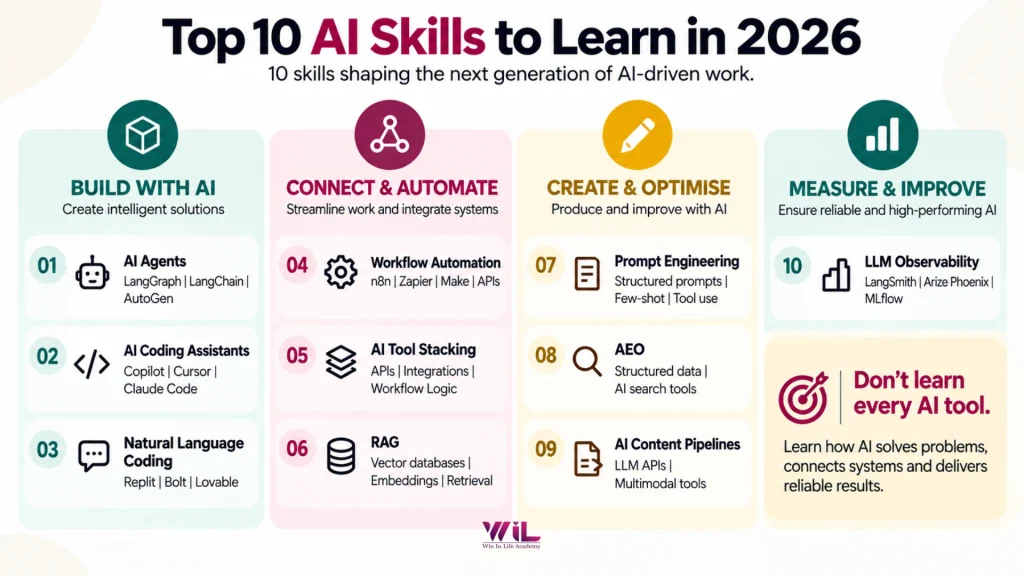
Top 10 AI Skills to Learn in 2026
| Prompt Engineering | ChatGPT, Gemini, Claude | Prompt Engineer, GenAI Specialist |
| AI Agents | LangGraph, LangChain, AutoGen | AI Agent Developer, AI Engineer |
| Workflow Automation | n8n, Zapier, Make, APIs | AI Automation Specialist |
| AI Coding Assistants | Copilot, Cursor, Claude Code | AI Developer, Software Developer |
| Natural Language Coding | Replit, Bolt, Lovable | AI Product Builder |
| RAG | Vector databases, embeddings | RAG Engineer, GenAI Engineer |
| AEO | Structured data, AI search tools | AEO Specialist, AI Search Specialist |
| AI Tool Stacking | APIs, automation platforms | AI Solutions Specialist |
| AI Content Pipelines | LLM APIs, multimodal tools | GenAI Content Specialist |
| LLM Observability | LangSmith, Arize Phoenix, MLflow | LLMOps Engineer, AI Evaluation Engineer |
1. Prompt Engineering
Prompt engineering involves structuring instructions, context and requirements so AI systems produce more accurate and consistent results.
In 2026, this goes beyond writing clever prompts. Learn prompt structure, few-shot prompting, structured outputs, tool use and prompt testing. These skills can support research, content, analysis, coding and business workflows.
For professionals who already use generative AI, prompt engineering is one of the most accessible artificial intelligence skills to learn because it can complement an existing career.
2. Building AI Agents
AI agents can work toward a goal, decide which steps to take, use tools and complete multi-step tasks with less human intervention.
Research on multi-agent orchestration highlights frameworks including LangGraph, CrewAI and AutoGen as part of the rapidly developing agent ecosystem.
To build this skill, learn tool calling, agent workflows, memory, orchestration and evaluation. These capabilities can support roles such as AI Agent Developer, AI Engineer and GenAI Developer.
3. Workflow Automation
Businesses still spend significant time on repetitive work such as moving data between applications, processing requests, generating reports and sending routine updates.
AI-powered workflow automation combines AI models with automation platforms and APIs to reduce this manual effort. Tools such as n8n, Zapier and Make allow professionals to connect applications and build automated workflows.
The valuable skill is understanding the logic behind those workflows: triggers, conditions, APIs, data processing, AI steps and human approval.
This can lead to roles such as AI Automation Specialist, Automation Engineer and AI Solutions Specialist.
4. AI Coding Assistants
AI coding assistants such as GitHub Copilot, Cursor, Claude Code and Gemini Code Assist can generate code, explain unfamiliar code, identify errors and support testing.
However, using an AI coding tool is not the same as knowing software development.
Research on AI-assisted coding shows mixed productivity results depending on the task and developer experience. McKinsey’s research on developer velocity indicates stronger gains on well-defined implementation tasks, while other research has found that AI assistance can sometimes slow experienced developers on familiar repositories.
The takeaway: learn to use AI for coding, debugging and testing, but maintain enough programming knowledge to review its output.
5. Natural Language Coding
Natural language or “vibe” coding allows users to describe what they want to build and use AI coding platforms to generate much of the implementation.
Tools such as Replit, Bolt and Lovable make rapid prototyping more accessible. But effective natural language coding still requires clear requirements, testing and code review.
If you cannot identify when AI-generated code is broken or insecure, the tool is doing more work than you are.
6. Retrieval-Augmented Generation (RAG)
Large language models do not automatically have access to an organization’s latest internal documents, product information or proprietary knowledge.
Retrieval-Augmented Generation (RAG) addresses this by retrieving relevant information from external sources before generating a response. This makes RAG useful for enterprise search, customer support and internal knowledge systems.
Research on enterprise RAG highlights the importance of multi-source ingestion, retrieval quality and data control. Other research also identifies security, data protection and preprocessing as key challenges.
To build RAG applications, learn embeddings, document processing, chunking, information retrieval and vector databases.
7. Answer Engine Optimization (AEO)
People are increasingly using AI-powered search tools to get direct answers instead of browsing traditional search results.
Answer Engine Optimization (AEO) focuses on making content structured, accurate and understandable enough for AI-powered systems to retrieve and interpret.
According to HubSpot’s research on AEO trends, areas such as answer-first content, entity consistency and AI visibility measurement are becoming increasingly relevant.
For content and marketing professionals, AEO adds another layer to traditional SEO and can support roles such as AEO Specialist, AI Search Specialist and SEO/AI Search Strategist.
8. AI Tool Stacking
No single AI tool is best at everything. One may be better for research, another for writing or coding, while automation platforms can connect these capabilities.
AI tool stacking involves combining these tools into a larger workflow. For example, one AI system could handle research, another analysis, and an automation platform could move the output into another application.
The important skill is not memorizing dozens of tools. It is understanding APIs, integrations and workflow logic.
9. AI Content Generation Pipelines
Generating one piece of AI content is easy. Building a repeatable process that produces consistent, useful content is harder—and more valuable.
AI content pipelines can combine research, drafting, editing, formatting, image or video generation and quality checks.
Research published through SciOpen on generative AI in digital marketing highlights AI’s growing role in automated content, personalization and multimodal campaigns.
For marketers and content professionals, combining generative AI with workflow automation can create opportunities in GenAI content strategy and AI automation.
10. LLM Observability & Analytics
Building an AI application is only the beginning. Once users interact with it, teams need to know whether its responses are accurate, where failures occur and how the system performs.
LLM observability covers logging, tracing, evaluation, monitoring and user feedback. Tools such as LangSmith, Arize Phoenix and MLflow help teams understand AI applications in production.
Research published by Frontiers in Computer Science highlights the importance of monitoring and explainability for identifying and diagnosing failures.
This makes observability increasingly relevant to roles such as LLMOps Engineer, AI Evaluation Engineer and AI Quality Engineer.
How to Build AI Skills for Your Career
Start with the Fundamentals
To build the top AI skills to learn in 2026, do not begin by trying to learn every new AI framework. Build foundations in programming, data handling, APIs, software development, basic machine learning and cloud computing.
These fundamentals make it easier to adapt as AI tools change.
Choose Skills That Match Your Career Goal
You do not need to master all the top AI skills to learn in 2026.
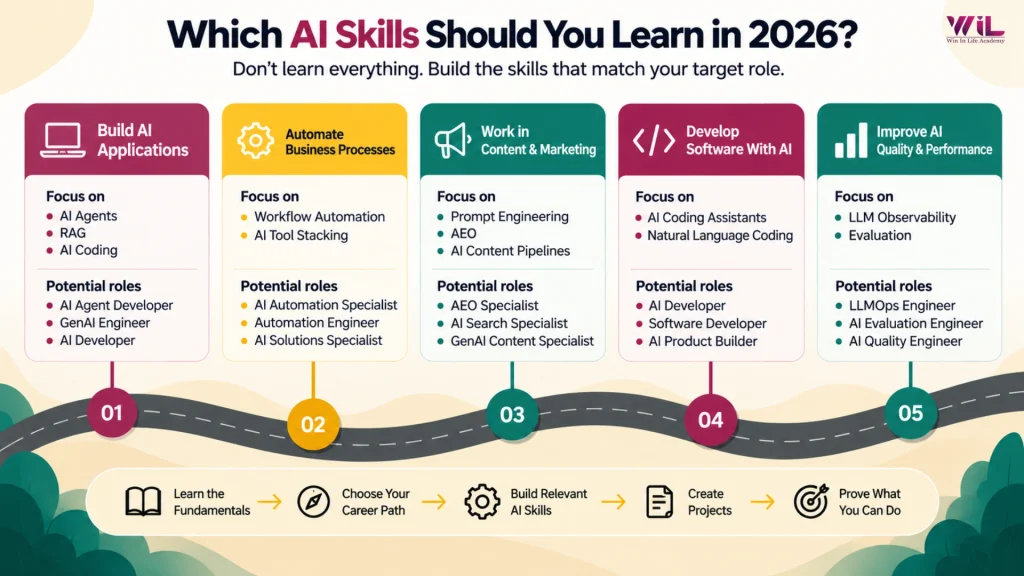
If you want to build AI applications, focus on agents, RAG and AI coding. If you are interested in business operations, explore workflow automation and AI tool stacking. Content and marketing professionals can consider prompt engineering, AEO and AI content pipelines.
Choose according to the role you want—not whichever AI tool is trending this month.
Consider Industry Certifications
A recognised certification can demonstrate structured knowledge, but it is not a substitute for practical experience.
Options to consider include AWS Certified AI Practitioner, NVIDIA-Certified Associate: Generative AI LLMs, Databricks Certified Generative AI Engineer Associate and Microsoft Certified: Azure AI Engineer Associate.
Before choosing an AI engineer certificate, compare the exam requirements, cost, validity and relevance to your target role.
Build Hands-On Projects
This is where learning becomes evidence.
Instead of simply listing Generative AI or Machine Learning on your CV, build projects that demonstrate what you can actually do.
You could build a RAG-based knowledge assistant, automate a business workflow, create an AI content pipeline or develop an agent that completes a multi-step task.
Document the problem, tools, approach and results. A strong portfolio can demonstrate practical ability far better than a long list of completed courses.
Conclusion
The top AI skills to learn in 2026 are not simply a list of the newest tools. The durable advantage comes from understanding how AI systems work, connect to data and software, automate workflows and get evaluated.
For Indian graduates and working professionals, the opportunity is real, but so is the competition. Learning a tool is not enough. You need to demonstrate that you can use AI to solve actual problems.
Start with strong fundamentals, choose skills that match your career goals and build projects that prove what you can do.
For learners considering structured training, Win in Life Academy‘s Advanced Diploma in Data Science and AI ML is one pathway to explore. When comparing AI courses for professionals or graduates, look beyond the course title and assess the curriculum, hands-on projects, tools covered, mentorship and career support.
Frequently Asked Questions
1. What are the top AI skills to learn in 2026?
The top AI skills to learn in 2026 include prompt engineering, AI agents, workflow automation, AI coding assistants, natural language coding, RAG, AEO, AI tool stacking, AI content pipelines, and LLM observability. The best choice depends on your career goals and the type of AI role you want to pursue.
2. What skills are required for AI jobs?
The skills required for AI jobs vary by role. Common foundations include programming, data handling, problem-solving, and software development. Specialized jobs in AI and machine learning may require skills in machine learning, generative AI, cloud computing, RAG, deployment, or AI evaluation.
3. Can I enter AI after completing an AI/ML course?
An AI/ML course can provide structure and foundational knowledge, but completing one does not guarantee an AI job. Projects, portfolios, technical assessments, and relevant experience demonstrate your ability to apply what you learned and build skills for artificial intelligence jobs.
4. Are AI certifications enough to get an AI job?
Usually, no. Certifications such as an AI engineer certificate can add credibility, but they work best alongside practical projects and demonstrable technical skills. Some learners also explore options like an IBM AI certificate to strengthen their AI knowledge.
5. Can working professionals move into AI without a computer science degree?
Yes, depending on the role and existing background. Professionals can combine domain expertise with AI skills and apply them to areas such as marketing, finance, operations, and other business functions. These skills can create new AI career opportunities across industries.
6. Is an AI/ML course useful for graduates?
It can be useful if it goes beyond theory. Graduates should look for hands-on projects, practical tools, mentorship, portfolio development, and skills aligned with actual artificial intelligence jobs and future career opportunities in artificial intelligence.
7. How can I choose an AI course?
Compare the syllabus, fundamentals covered, practical projects, tools, learning format, mentorship, and career support. The strongest program should help you understand the top AI skills to learn in 2026, develop practical abilities, and demonstrate what you can build or apply.