
Artificial Intelligence is transforming industries at an unprecedented pace, creating strong demand for professionals skilled in Machine Learning, Generative AI, AI Automation, and Data Analytics. As organizations continue investing in AI-driven solutions, certifications have become a valuable way for learners and professionals to validate their skills and stay competitive in the job market.
However, not all AI certifications offer the same value. Some focus on technical implementation, while others emphasize business strategy, cloud AI, or emerging technologies such as Large Language Models (LLMs) and AI Agents. To help you choose the right learning path, we’ve compiled a list of the top AI certifications worth pursuing in 2026 based on industry relevance, practical learning outcomes, and career potential.
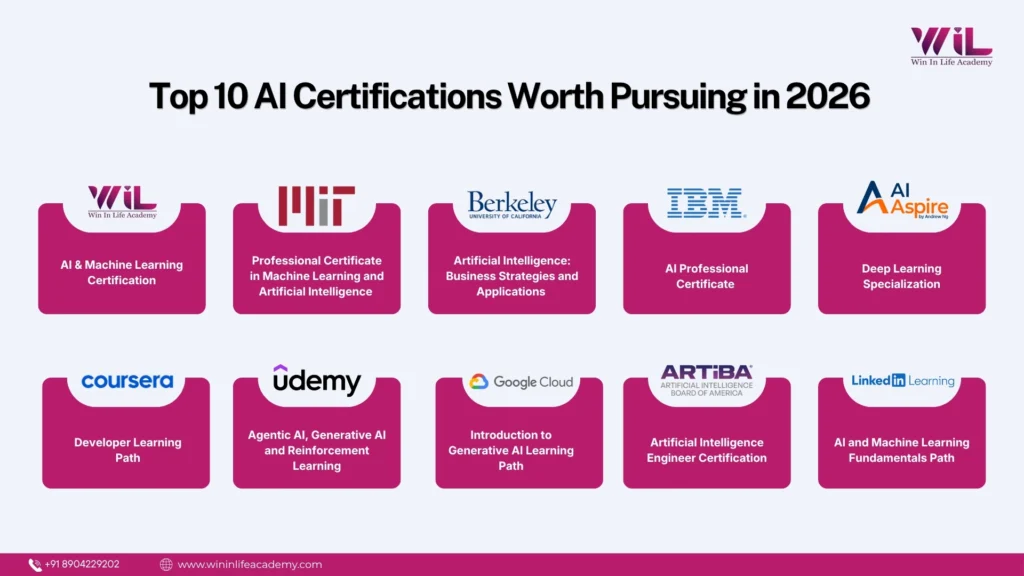
| Course Provider | Courses |
|---|---|
| WILA | WILA AI & Machine Learning Certification |
| MIT | Professional Certificate in Machine Learning and Artificial Intelligence |
| Berkeley | Artificial Intelligence: Business Strategies and Applications |
| IBM | AI Professional Certificate |
| Andrew Ng | Deep Learning Specialization |
| Tensorflow – Coursera | Developer Learning Path |
| Artificial Intelligence A-Z – Udemy | Agentic AI, Generative AI and Reinforcement Learning |
| Google Cloud | Introduction to Generative AI Learning Path |
| Artiba | Artificial Intelligence Engineer Certification |
| Linkedin Learning | AI and Machine Learning Fundamentals Path |
1. WILA AI & Machine Learning Certification Program
While many AI certifications focus primarily on theory, modern employers increasingly look for professionals who can apply AI to real-world business problems. WILA’s AI & Machine Learning Certification Program is designed with this industry-first approach in mind, combining foundational concepts with practical implementation.
The program covers machine learning, deep learning, generative AI, data analytics, Python programming, and business-focused AI applications. Learners gain hands-on exposure to industry tools while working on projects that help build a professional portfolio.
A major advantage of the program is its focus on employability. Instead of teaching isolated concepts, the curriculum helps learners understand how AI is used across industries such as healthcare, finance, retail, cybersecurity, and business intelligence.
Students also gain exposure to emerging technologies including Generative AI, Large Language Models (LLMs), prompt engineering, and AI-powered automation workflows, which are becoming essential skills in the modern workplace.
AI & ML Certification Program
Build practical projects and develop the skills employers are actively seeking in 2026 and beyond.
2. MIT Professional Certificate in Machine Learning and Artificial Intelligence
MIT’s AI certification is designed for professionals who want a rigorous understanding of machine learning and artificial intelligence without pursuing a full degree program.
The curriculum combines theoretical foundations with practical applications, helping learners understand how AI systems can solve real business and technical challenges. Topics often include predictive analytics, machine learning workflows, data-driven decision-making, and advanced AI methodologies.
One of the strongest aspects of this program is its emphasis on real-world application. Instead of focusing solely on academic concepts, it encourages participants to connect AI techniques with organizational objectives and business outcomes.
This makes it particularly appealing to experienced professionals, technical managers, and individuals responsible for leading AI initiatives within their organizations.
3. Berkeley Artificial Intelligence: Business Strategies and Applications
Not everyone needs to build machine learning models. Many professionals simply need to understand how AI can create value for their organizations.
This is where Berkeley’s AI-focused executive education program stands out.
Rather than diving deeply into coding and algorithm development, the program examines AI through a strategic business lens. Participants learn how organizations adopt AI technologies, how AI initiatives should be structured, and how leaders can effectively collaborate with technical teams.
The certification also explores important topics such as automation, data-driven decision-making, AI implementation challenges, and organizational transformation.
For executives, business leaders, consultants, and managers, this certification provides practical insights that are often more valuable than highly technical training.
4. IBM AI Professional Certificate
For individuals taking their first serious step into artificial intelligence, IBM’s AI Professional Certificate offers one of the most accessible learning pathways available today.
The program begins with foundational concepts before gradually introducing learners to generative AI, prompt engineering, application development, and AI-powered software solutions. Unlike many beginner programs, it focuses heavily on practical implementation rather than abstract theory.
Participants gain exposure to programming concepts, AI application development, and the growing ecosystem of generative AI technologies. This balanced approach makes the certification suitable for learners from both technical and non-technical backgrounds.
Because the curriculum emphasizes job-ready skills, it has become a popular choice among students, career changers, and professionals looking to enter the AI workforce.
5. Deep Learning Specialization by Andrew Ng
Few individuals have contributed as much to AI education as Andrew Ng. His Deep Learning Specialization has become one of the most recognized learning pathways for aspiring AI professionals worldwide.
The specialization focuses on neural networks, deep learning architectures, computer vision, and natural language processing. Learners gradually progress from foundational concepts to advanced techniques used in modern AI systems.
What distinguishes this program is its ability to explain complex topics in a practical and approachable manner. Rather than overwhelming learners with mathematics, it emphasizes intuition, application, and implementation.
For aspiring machine learning engineers, AI developers, and data scientists, this specialization remains one of the strongest foundations available.
6. TensorFlow Developer Learning Path – Coursera
TensorFlow continues to play an important role in the development of AI and machine learning applications. As organizations build increasingly sophisticated AI solutions, professionals who understand how to work with machine learning frameworks remain in high demand.
The TensorFlow learning path focuses on developing practical skills for building, training, and deploying machine learning models. Learners explore neural networks, computer vision applications, and model optimization techniques while gaining hands-on experience with one of the industry’s most widely adopted frameworks.
For developers who want to move beyond theory and start building AI applications, TensorFlow skills can significantly strengthen their technical portfolio.
7. Artificial Intelligence A-Z: Agentic AI, Generative AI, and Reinforcement Learning – Udemy
As AI continues to evolve, the focus is shifting from traditional machine learning models toward autonomous systems capable of reasoning, planning, and taking actions independently. This has led to the rise of Agentic AI, one of the most talked-about developments in the AI industry.
Artificial Intelligence A-Z is designed for learners who want exposure to emerging AI technologies rather than just foundational concepts. The program introduces reinforcement learning, generative AI, large language models, and AI agents while providing opportunities to build practical projects.
One of the biggest strengths of this certification is its emphasis on implementation. Learners don’t just study AI concepts, they build systems that solve problems, make decisions, and interact with environments.
For professionals interested in future-focused AI careers, this certification provides valuable exposure to technologies that are likely to shape the next generation of intelligent systems.
8. Google Cloud’s Introduction to Generative AI Learning Path
Generative AI has transformed the technology landscape, creating demand for professionals who understand how large language models and foundation models work.
Google’s Generative AI learning path provides an accessible introduction to these concepts. The program explores the fundamentals of generative AI, prompt engineering, responsible AI practices, and Google’s AI ecosystem.
What makes this learning path particularly useful is its simplicity. Rather than overwhelming learners with technical complexity, it focuses on helping them understand how generative AI technologies are being applied in real-world environments.
This certification is especially suitable for beginners, business professionals, project managers, and individuals who want to understand the growing impact of generative AI without pursuing advanced technical training.
As organizations increasingly integrate AI-powered assistants and automation tools into their workflows, a foundational understanding of generative AI is becoming a valuable skill across industries.
9. Artiba’s Artificial Intelligence Engineer (AIE) Certification
For professionals seeking formal recognition of their AI expertise, the Artificial Intelligence Engineer certification offers a more structured credentialing pathway.
Unlike many learning-focused certifications, this program is designed to validate existing knowledge and technical competencies. It covers machine learning, deep learning, neural networks, natural language processing, reinforcement learning, and cognitive computing.
The certification is particularly attractive to working professionals who already possess technical experience and want a credential that demonstrates their expertise to employers.
Another advantage is its flexibility. Multiple pathways allow candidates from different educational and professional backgrounds to qualify, making it accessible to both traditional graduates and experienced practitioners.
As competition for AI-related roles increases, certifications that validate real-world competencies may become increasingly important in hiring decisions.
Build the Foundation for an AI Career
Learn how to work with real-world datasets, build predictive models, and deploy AI solutions using industry-relevant tools.
10. LinkedIn Learning’s AI and Machine Learning Fundamentals Path
Not every professional needs to become an AI engineer. Many simply need enough AI knowledge to make informed decisions, collaborate effectively with technical teams, or understand how AI will impact their industry.
LinkedIn Learning’s AI and Machine Learning Fundamentals Path is designed specifically for this audience.
The program covers AI concepts, machine learning foundations, neural networks, explainable AI, AI accountability, cybersecurity applications, and business use cases. Rather than focusing on coding and model development, it emphasizes AI literacy and practical understanding.
This makes it an excellent option for managers, business analysts, project leaders, consultants, and professionals who want to stay relevant in an increasingly AI-driven workplace.
As AI adoption expands beyond technical departments, AI literacy is becoming a core professional competency, much like digital literacy became essential in previous decades.
Which AI Certification Should You Choose?
The best AI course depends on your current skill level, career goals, and the type of role you want to pursue in the future.
If you’re completely new to Artificial Intelligence and looking for a structured learning path, it’s important to choose a program that covers both foundational concepts and practical applications. While global certifications can help build theoretical knowledge, many learners struggle to bridge the gap between learning and real-world implementation.
For students, freshers, and working professionals looking to build job-ready AI skills, the AI & Machine Learning Course at Win In Life Academy (WILA) offers a practical learning approach that combines AI fundamentals, Python programming, data analysis, machine learning, deep learning, and Generative AI concepts. The program emphasizes hands-on projects, industry-relevant tools, and real-world applications to help learners build a strong portfolio alongside technical knowledge.
Those interested in specialized areas such as Generative AI, AI automation, AI agents, and machine learning development should look for programs that provide project-based learning rather than focusing solely on theory or certifications.
Ultimately, the right course is one that aligns with your career aspirations, provides practical exposure, and helps you develop skills that employers are actively seeking. The goal should not be to collect certificates, but to gain the knowledge and experience needed to apply AI effectively in real-world scenarios.
Common Mistakes to Avoid When Choosing an AI Certification
One of the most common mistakes is selecting a certification based solely on brand recognition. While reputable institutions add credibility, the program must also align with your learning goals.
Another mistake is focusing exclusively on theory. Certifications that include practical projects, hands-on labs, and implementation exercises generally provide greater career value.
Many learners also underestimate the importance of prerequisites. Advanced certifications can be challenging without a strong foundation in programming, mathematics, or machine learning fundamentals.
Finally, it’s important to remember that certifications are not guaranteed job offers. They are tools that help demonstrate knowledge, but long-term success depends on applying that knowledge effectively.
Conclusion
Artificial Intelligence continues to create new career opportunities across industries, making AI skills more valuable than ever before. Whether you’re a student, developer, manager, analyst, or business leader, investing in the right AI certification can help you stay competitive in an increasingly technology-driven world.
The most effective certification isn’t necessarily the most expensive or prestigious, it’s the one that aligns with your goals, builds practical skills, and prepares you for the type of work you want to do.
As AI technologies continue to evolve, professionals who combine certifications with hands-on experience, project work, and continuous learning will be best positioned to thrive in the years ahead.
Explore WILA’s AI & Machine Learning Program
Explore WILA’s AI & Machine Learning Program to build practical AI skills, work on industry-focused projects, and prepare for emerging AI career opportunities in 2026 and beyond.
Frequently Asked Questions (FAQs)
1. Which AI course is best for beginners in 2026?
The best AI course for beginners is one that combines AI fundamentals, Python programming, machine learning, Generative AI, and hands-on projects. Look for a structured program that helps you build practical skills rather than focusing only on theory. Programs such as WILA’s AI & Machine Learning Course are designed to help beginners develop job-ready AI skills through guided learning and real-world projects.
2. Can I learn AI from scratch without a technical background?
Yes. Many successful AI professionals started without a computer science degree or programming experience. By learning AI fundamentals, Python, data analysis, and machine learning step by step, beginners from diverse educational backgrounds can build a strong foundation in AI.
3. Do I need coding skills to learn Artificial Intelligence?
Basic coding knowledge is helpful, especially if you want to build AI applications or machine learning models. Python is the most commonly used programming language in AI and is beginner-friendly. However, you can start understanding AI concepts even before becoming proficient in coding.
4. How long does it take to learn AI from scratch?
Most learners can develop a solid AI foundation within 6 to 12 months of consistent learning and practice. The timeline depends on your learning pace, prior experience, and the amount of time you dedicate to building projects and applying your knowledge.
5. What should I learn first: AI, Machine Learning, or Generative AI?
Start with AI fundamentals to understand the broader field. Then move to Python and data analysis before learning Machine Learning concepts. Once you have a strong foundation, exploring Generative AI, Large Language Models, AI Agents, and Prompt Engineering becomes much easier.
6. Is mathematics necessary to learn AI?
You do not need advanced mathematics to begin learning AI. Basic concepts in statistics, probability, and logical reasoning are usually sufficient for beginners. As you progress into machine learning and deep learning, you can gradually learn more advanced mathematical concepts when required.
7. What projects should beginners build while learning AI?
Beginners can start with projects such as AI chatbots, recommendation systems, resume analyzers, sentiment analysis tools, and AI-powered assistants. Practical projects help reinforce concepts and create a portfolio that demonstrates your skills to employers.
8. Are AI certifications enough to get a job?
Certifications can strengthen your resume, but employers often place greater emphasis on practical skills, project experience, and problem-solving abilities. Building a portfolio of AI projects is often more valuable than collecting multiple certifications.
9. What are the most in-demand AI skills in 2026?
Some of the most sought-after AI skills include Python programming, machine learning, Generative AI, Prompt Engineering, AI automation, data analysis, AI agent development, and working with Large Language Models (LLMs). These skills are increasingly valuable across industries.
10. What career opportunities are available after learning AI?
AI skills can lead to roles such as AI Engineer, Machine Learning Engineer, Data Analyst, AI Developer, Generative AI Specialist, AI Automation Specialist, AI Consultant, and AI Product Professional. As AI adoption continues to grow, professionals with practical AI expertise are expected to remain in high demand across industries.
Schema