AI courses for beginners without coding are in high demand, as graduates and working professionals from non-technical backgrounds look for ways to build AI skills without first becoming programmers. The challenge is that most learners get stuck between heavily technical programs that assume prior coding knowledge and surface-level “AI without programming” courses that teach tool usage but build no real understanding of how AI works.
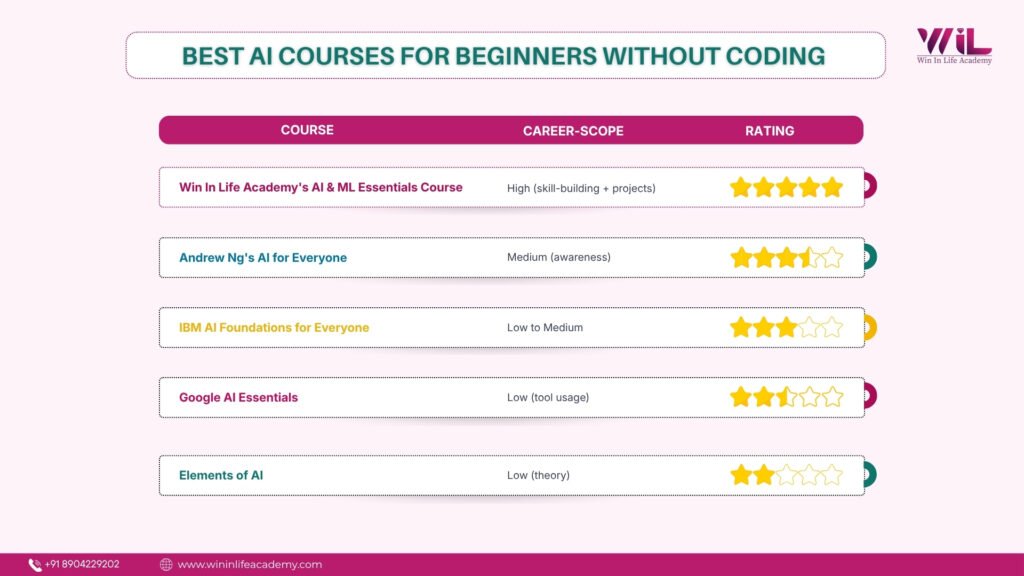
This guide compares the best AI classes for beginners, both free self-study platforms and structured instructor-led programs, on one practical question: which actually helps a non-technical learner build real skills rather than just understand concepts. That distinction also shapes which non technical AI careers become realistic later, so the right starting point depends on what you are actually trying to achieve. Here is the quick comparison first, with the full breakdown below.
Can You Learn AI Without Coding?
The honest answer is: it depends on what you want to do with AI.
Using AI tools like ChatGPT (from OpenAI) or Canva AI requires no coding. But understanding how machine learning works, why models behave the way they do, or how data is processed to produce outputs, that requires at least basic technical exposure. Completely avoiding coding does not make AI learning easier. It just limits how far you can actually go.
Basic Python for AI is not software engineering. Variables, functions, loops, basic data handling, that is the realistic starting point, and it is achievable for most non-technical learners when introduced gradually. The best beginner AI courses do exactly that. They do not eliminate coding. They make it approachable. If you want a fuller breakdown of where to begin, this guide on AI and ML for beginners covers the fundamentals in plain language.
Why Learning AI Now Actually Matters
This is not hype. According to the World Economic Forum’s Future of Jobs Report 2025, 85% of employers plan to prioritize upskilling their workforce and 77% plan to provide AI training in the coming years. The same report found that AI and big data are the fastest-growing skills in the global job market over the next five years.
How We Evaluated These AI Courses for Beginners
Not every beginner AI course is designed for learners from non-technical backgrounds. Some focus heavily on theory, while others only provide surface-level exposure to AI tools without building real foundational understanding. To make this comparison more practical for graduates and working professionals, we evaluated these AI classes for beginners based on factors that matter most to entry-level learners.
Our comparison considered beginner friendliness, coding difficulty, curriculum structure, hands-on learning, practical AI and machine learning exposure, mentorship or guidance, flexibility, and long-term learning value. Above all of these, we weighted one thing most heavily: whether a course actually moves a beginner from understanding AI to being able to work with it. That means structured progression, guided instruction, and real project work carry the most weight in our ranking, because those are the factors that separate passive learners from capable ones. A free course can score extremely well on accessibility and still rank lower here if it leaves learners with awareness but no practical ability. That is a deliberate choice, and it is why this list is organized around skill-building rather than popularity or price.
Quick Comparison: Best AI Courses for Beginners (2026)
| Course | Best For | Coding Exposure | Certification | Beginner Score | Career Focus | Price |
| Win in Life Academy – AI & ML Essentials | Structured beginner roadmap with gradual coding | Beginner Python (guided) | Yes | 5/5 | High (skill-building + projects) | Paid |
| Andrew Ng’s AI for Everyone | Respected non-technical overview | None | Yes (paid) | 3.5/5 | Medium (awareness) | Free to audit |
| IBM AI Foundations for Everyone | Free course with a certificate | None | Yes (paid) | 3/5 | Low to Medium | Free to audit |
| Google AI Essentials | AI awareness and tool usage | None | Yes | 2.5/5 | Low (tool usage) | Free |
| Elements of AI | Conceptual understanding of AI | None | Yes (free) | 2/5 | Low (theory) | Free |
AI & ML Essentials Foundation Course
A 3-month instructor-led program for non-technical beginners. Gradual Python, real projects, and the structure free courses cannot offer. Choose online, offline, or hybrid.
3 Months Instructor-led Real Projects Globally Recognized CertificateTop 5 AI Courses for Beginners Without Heavy Coding
1. Win in Life Academy – AI & ML Essentials Foundation Course
The Best Structured, Instructor-Led AI Course for Beginners Who Want to Build Real Skills
Most beginners make one of two mistakes. They either jump into advanced technical programs and burn out within the first month, or they choose a completely no-code course and finish it with no real ability to work with AI beyond clicking buttons in a tool. Win in Life Academy’s AI & ML Essentials Foundation Course is designed to avoid both traps.
It is not the cheapest option on this list, and it does not have the largest enrollment numbers. What it offers instead is the one thing free self-study courses structurally cannot: a guided, structured path with an instructor, real projects, and accountability.
| Feature | Details |
| Duration | 3 Months (Structured) |
| Coding Exposure | Beginner Python, gradual and guided |
| Learning Format | Online / Offline / Hybrid |
| Instruction | Instructor-led by industry practitioners |
| Projects | Yes, real datasets, mini projects + capstone |
| Price | Paid |
What the Course Covers
The curriculum moves through Python fundamentals, data handling with NumPy and Pandas, statistics, core machine learning concepts including regression, classification, and clustering, and data visualization using Matplotlib and Seaborn. As learners progress, the same foundations extend naturally into tools like Scikit-learn for building models and, in advanced programs, TensorFlow for deep learning and data science work.
The progression is deliberate. Month one covers Python and data handling, month two moves into statistics and machine learning logic, and month three covers unsupervised learning, visualization, EDA, and a capstone mini project with titles like house price prediction, disease detection, and customer churn prediction. For learners curious about the tools involved, these are some of the core Python libraries for machine learning the course introduces.
What Makes It Work for Beginners
The program is instructor-led, with the flexibility to choose between online, offline, or hybrid formats. Instructors are industry practitioners, which means the guidance is grounded in how AI and ML are actually applied rather than just theoretically explained. The structured format also removes the decision fatigue of self-directed learning, which is the single biggest reason most people who start free courses never finish them.
Honest Limitation
This is a foundation course. It does not include placement support and is not designed for learners who want advanced AI specialization, GenAI workflows, or deployment-level skills immediately. For those goals, Win in Life Academy offers the GenAI Production Bootcamp, a six-month IBM-collaborated program covering LLMs, MLOps, Docker, and cloud deployment, and the PG Diploma in Data Science and AI/ML, which includes deeper specialization and placement mentorship. The foundation course is the entry point before those pathways, not a substitute.
Best For: Freshers, graduates, and working professionals from non-technical backgrounds who want a structured, instructor-guided introduction to AI and machine learning without getting overwhelmed on day one.
AI & ML Essentials Foundation Course
A 3-month instructor-led program for non-technical beginners. Learn gradual Python, work on real projects, and gain the structured guidance free courses cannot offer. Choose online, offline, or hybrid learning modes.
3 Months | Instructor-led | Real Projects | Globally Recognized Certificate
2. Google AI Essentials
If You Want a Free Introduction to AI Concepts
Google AI Essentials is one of the most popular free AI courses available, designed to help beginners understand how AI works and how to use tools like Gemini for everyday workplace tasks. It is a genuine AI without programming course, requiring no code at all, and for someone with zero prior exposure it builds basic awareness quickly.
| Feature | Details |
| Duration | Self-paced |
| Coding Exposure | None |
| Learning Format | Online only |
| Instruction | Pre-recorded videos, no live guidance |
| Projects | None, tool-based exercises only |
| Price | Free |
The course covers AI fundamentals, prompt writing, and responsible AI usage. It is built entirely around tool usage and conceptual understanding, not around building any real technical foundation. There is no instructor to clarify doubts, no structured schedule to keep learners consistent, and no hands-on implementation of actual machine learning concepts. Most learners finish it with better AI vocabulary but no practical ability to apply AI beyond the tools they were already using.
For beginners who want to move beyond awareness into something they can actually build on, a structured program with guided instruction and real project work will take them further.
3. Elements of AI
If You Want to Understand How AI Thinks
Elements of AI, developed by the University of Helsinki, is one of the most respected free AI courses for non-technical learners. It explains AI concepts, machine learning logic, neural networks, and AI ethics in a simplified and genuinely thoughtful way. Over two million learners across 170 countries have completed it, which speaks to its accessibility.
| Feature | Details |
| Duration | Self-paced |
| Coding Exposure | None |
| Learning Format | Online only |
| Instruction | Text-based, no live guidance |
| Projects | None |
| Price | Free |
The course is almost entirely theoretical. There are no coding exercises, no datasets to work with, and no projects to complete. Learners gain strong conceptual clarity about AI but leave with no practical implementation experience. It also has no videos, the content is entirely text and reading-based, which can make it harder to stay consistent without external structure or deadlines. Understanding how AI thinks is a good start, but it is a long way from being able to work with it.
4. IBM AI Foundations for Everyone
If You Want a Free Course With a Recognizable Certificate
IBM AI Foundations for Everyone is a beginner-level specialization on Coursera that introduces AI concepts, machine learning basics, and business applications of AI without requiring any prior technical knowledge. The IBM name carries weight, and the certificate has reasonable recognition value for someone looking to add a credential to their LinkedIn profile early on.
| Feature | Details |
| Duration | Self-paced |
| Coding Exposure | None |
| Learning Format | Online only |
| Instruction | Pre-recorded videos, no live guidance |
| Projects | No-code exercises only |
| Price | Free to audit, certificate requires payment |
The content stays at an awareness level throughout. There is no gradual coding introduction, no real ML implementation, and no mentorship. Like most free AI courses, it works well as a confidence-builder for complete beginners but does not give learners the practical foundation needed to actually work with AI and machine learning in any meaningful capacity.
5. Andrew Ng’s AI for Everyone
If You Want the Most Respected Free AI Course for Non-Technical Professionals
AI for Everyone by Andrew Ng on Coursera is widely regarded as the gold standard of free non-technical AI education. It is designed specifically for business professionals and non-technical learners who want to understand AI’s capabilities, limitations, and business applications without getting into programming or data science.
| Feature | Details |
| Duration | Self-paced (around 6 hours total) |
| Coding Exposure | None |
| Learning Format | Online only |
| Instruction | Pre-recorded videos, no live guidance |
| Projects | None |
| Price | Free to audit |
The course is exceptionally well-explained and genuinely useful for understanding how to think about AI in a business context. However, it is roughly six hours of content in total, closer to a long workshop than a course. There is no coding, no projects, no datasets, and no structured progression beyond the videos. It is the right starting point for someone who wants to understand AI before committing to deeper learning, but it leaves a significant gap between awareness and actual capability.
Which AI Course Should You Choose?
The honest answer is that it depends on what you actually want to walk away with.
If your goal is purely to understand AI terminology, follow industry conversations, or explore whether AI is relevant to your career before committing to anything, the free courses on this list will serve that purpose. Google AI Essentials and Andrew Ng’s AI for Everyone are both solid starting points that cost nothing and take very little time.
But if you are a graduate or working professional who wants to build practical AI skills, work with real data, understand how machine learning actually functions, and come out of a program with projects you can show, free awareness courses will not get you there. They are built for consumption, not capability.
The gap between finishing a free AI course and being able to do something useful with AI is wider than most beginners expect. That gap is exactly what a structured, instructor-led program with hands-on projects is designed to close. Win in Life Academy‘s AI & ML Essentials Foundation Course is built for that transition, and for learners who want to go further, into Generative AI, MLOps, cloud deployment, or advanced data science with placement mentorship, the GenAI Production Bootcamp and the PG Diploma in Data Science and AI/ML offer the next level of depth and career-focused training.
AI & ML Essentials Foundation Course
A 3-month instructor-led program for non-technical beginners. Gradual Python, real projects, and the structure free courses cannot offer. Choose online, offline, or hybrid.
3 months | Instructor-led | Real projects | Globally Recognized Certificate
Frequently Asked Questions
1. Can I learn AI without any coding knowledge?
Yes, but only up to a point. You can use AI tools, understand how AI systems work at a conceptual level, and explore basic applications without writing a single line of code.
However, if you want to work with machine learning, build models, or move into any technical AI role, some coding exposure, particularly basic Python, becomes necessary. The most practical approach for beginners is gradual coding introduction, not zero coding forever.
2. What is the best AI course for beginners without a technical background?
The best course depends on what you want to achieve. For pure awareness, Google AI Essentials or Andrew Ng’s AI for Everyone are solid free options. For beginners who want structured, practical learning with guided coding introduction and real projects, a foundational program like Win in Life Academy’s AI & ML Essentials course offers a more complete starting point than self-paced free content.
3. Is Python necessary to learn AI?
For understanding AI at a surface level, no. For actually working with machine learning concepts, building models, and handling data, yes. Basic Python is not the same as advanced software engineering. Most beginners can develop a working understanding of Python fundamentals within the first few weeks of a structured program, often starting with the most common Python libraries for data science beginners.
4. How long does it take to learn AI as a beginner?
A foundational understanding of AI and machine learning concepts, including basic Python, data handling, and core ML algorithms, typically takes three to six months with consistent effort in a structured program. Completely self-paced learning through free courses often takes longer due to inconsistency and lack of guidance.
5. What are the career options in AI for non-technical graduates?
Non-technical graduates can explore roles such as AI Prompt Engineer, AI Business Analyst, AI Trainer, AI Product Manager, and AI-assisted Data Analyst. For roles that require deeper technical understanding, like Machine Learning Engineer, Data Scientist, or AI Application Developer, some foundational technical training becomes necessary regardless of educational background. If you are wondering how AI affects existing data roles, this breakdown of whether AI will replace data analysts is worth reading.
6. Are free AI courses enough to get a job?
For roles that are purely tool-based or awareness-level, free courses can help build a basic profile. For most AI and ML roles in India’s job market, employers expect candidates to demonstrate practical skills, like working with data, building models, and showing project-based experience, which most free courses do not provide.
7. What is the difference between AI and machine learning for beginners?
Artificial Intelligence is the broader field focused on building systems that can perform tasks requiring human-like intelligence. Machine learning is a subset of AI that trains algorithms to learn from data, and deep learning is a further subset that uses neural networks to handle more complex problems.
Data science overlaps with all three, focusing on extracting insights from data. Most beginner AI courses introduce these distinctions, but the depth of coverage varies significantly between awareness-level and technical programs.
8. Can a commerce or arts graduate learn AI and machine learning?
Yes. Prior technical education is not a prerequisite for starting AI learning. Most foundational AI and ML programs are designed to introduce programming and technical concepts from scratch. The willingness to engage with basic coding and data concepts matters far more than educational background at the beginner stage.
9. What should I look for when choosing an AI course as a beginner?
The most important factors are structured curriculum progression, instructor-led guidance, hands-on projects with real datasets, beginner-friendly coding introduction, and clear learning outcomes. Knowing the essential Python data science tools a course teaches is a useful signal too. Self-paced courses without instructor support and no project work tend to produce passive learners rather than capable ones.
10. How is learning AI different from learning to use AI tools?
Learning to use AI tools means becoming proficient with platforms like ChatGPT, Gemini, or Canva AI for specific tasks. Learning AI means understanding how these systems work, how data is used to train models, and how machine learning logic functions, skills that enable you to work with AI at a deeper level rather than just consuming it as a user.